📅 Last Updated On: 07 Sep 2026
⏱ 10 Min Read
Dwarkadhish Temple Dwarka: Darshan, Timings, History & Travel Guide
T
Top Indian Holidays
Ministry of Tourism Approved Tour Operator
Dwarkadhish Temple Dwarka: Complete Travel Guide
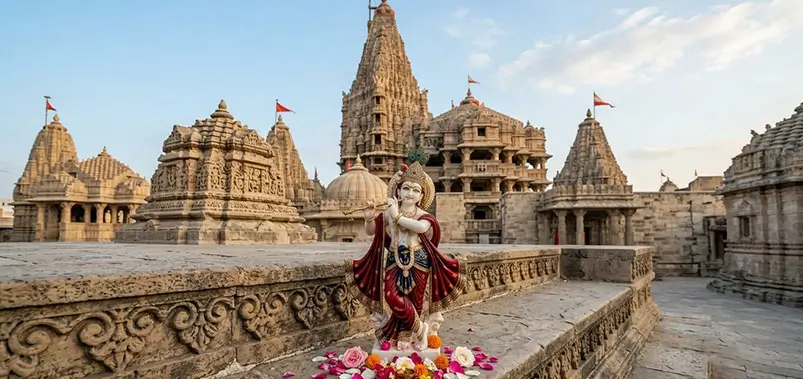
On the western edge of Gujarat, where the sacred city of Dwarka meets the Arabian Sea, Dwarkadhish Temple stands as one of India's most important Krishna pilgrimage centres. The temple is dedicated to Lord Krishna in his royal form as Dwarkadhish, meaning the Lord of Dwarka, and is also widely known as Jagat Mandir. For pilgrims, the shrine represents much more than a beautiful historic building. Dwarka belongs to the traditional Char Dham pilgrimage network and remains one of the principal sacred cities associated with Krishna's later life and kingship.
The Government of Gujarat's district administration describes the temple as the main shrine of Dwarka, situated beside Gomti Creek. It records the traditional belief that the temple was originally established by Vajranabh, the great-grandson of Lord Krishna, while the present architectural form reflects later construction and restoration over many centuries. The temple's carved tower rises approximately 43 metres, and its enormous ceremonial flag can be seen from considerable distance.
The physical setting gives Dwarkadhish Temple Gujarat a character unlike the Krishna temples of Mathura or Vrindavan. Here, pilgrims encounter temple towers, old lanes, Gomti Ghat, sea air and the open horizon of India's western coast within the same sacred landscape. The experience is strongest when visitors remain in Dwarka long enough to see the temple both early in the morning and after sunset rather than arriving for a single hurried darshan between long road transfers.
Current Gujarat Tourism information lists the temple's principal visiting periods as approximately 7:00 AM to 12:30 PM and 5:00 PM to 9:00 PM. This split schedule is extremely important for travellers because arriving in Dwarka during the afternoon does not mean immediate access will be available. Worship periods can also change on festival dates or according to temple management, so visitors making a dedicated pilgrimage should confirm the schedule shortly before arrival.
Dwarkadhish Temple History, Architecture and Krishna Tradition
The religious identity of Dwarkadhish Temple in Dwarka begins with the sacred tradition surrounding Lord Krishna's move from Mathura to the western coast. In Hindu tradition, Dwarka became Krishna's royal city, associated with his later life after the events of Mathura and the Braj region. The historical and archaeological discussion surrounding ancient Dwarka is complex, but the religious importance of the city has remained powerful for centuries.
The Devbhumi Dwarka district administration identifies the main shrine as Jagat Mandir, also referring to it through the traditional title Trilok Sundar. The same government source records the longstanding belief that Vajranabh, Krishna's great-grandson, established an early temple here. Travellers should read this correctly as sacred and traditional history rather than treating every date associated with the early temple as an archaeologically proven construction date.
The present temple is an impressive stone structure built in a multi-level form with a tall carved spire dominating the skyline. Gujarat Tourism records the temple tower at approximately 43 metres high, while the district administration notes that its ceremonial flag is made using 52 yards of cloth. The flag is one of the most visible symbols of the temple and is changed ceremonially according to the temple's established tradition.
Visitors approaching through the old city may first see the upper tower rising above surrounding buildings. When approaching from the Gomti side, however, the temple appears in a broader visual context, standing above the ghats near the river-sea confluence. This is one reason pilgrims should spend time around Gomti Ghat instead of entering the temple and leaving immediately.
The temple traditionally has two important gateways, often associated with entering and leaving the sacred precinct. Visitors may hear them referred to as Moksha Dwar and Swarg Dwar within local religious tradition. The movement through these entrances has symbolic significance for many pilgrims, while from a practical perspective the separate flow also helps manage the large number of worshippers visiting the shrine.
Inside, the principal sacred image represents Krishna as Dwarkadhish. The dark stone image is richly dressed according to daily ritual cycles, and the appearance of the deity can change with ceremonial clothing, jewellery and festival decoration. The temple's rhythm therefore depends not only on whether the door is open but on the sequence of daily worship.
Unlike a museum, the temple should not be approached primarily for architectural inspection. Ritual takes priority. Access may stop while the deity is being dressed or offerings are being made, and visitors need to accept that the religious schedule determines the pace.The strongest appreciation of the architecture comes after darshan, when visitors can view the exterior from the old lanes, Gomti Ghat and nearby sea-facing areas. The contrast between the carved stone tower and the open coastal landscape is one of the defining visual impressions of Dwarka.
Plan a Private Dwarka & Gujarat Temple Tour
Planning to visit Dwarkadhish Temple along with Bet Dwarka, Nageshwar Jyotirlinga and Somnath? Let our travel experts create a comfortable private itinerary designed around your travel dates and interests.
Current Dwarkadhish Temple Timings and the Best Darshan Periods
The current Dwarkadhish Temple timings published by Gujarat Tourism are 7:00 AM to 12:30 PM for the morning period and 5:00 PM to 9:00 PM for the evening period. Visitors should take this split opening schedule seriously because the temple is closed to normal public access for several hours during the afternoon.
The daily religious schedule itself contains several shorter worship periods within these broader opening hours. Temple doors may close temporarily between individual darshan sessions while offerings, dressing and ceremonial services are performed. This means a traveller arriving at 10:30 AM should not assume uninterrupted access until 12:30 PM.
For most first-time visitors, early morning darshan at Dwarkadhish Temple offers the strongest experience. Dwarka's streets are quieter, temperatures are more comfortable and the coastal light is softer. Pilgrims who are comfortable waking early can reach the temple precinct before the largest tour groups and bus traffic arrive.
Late morning becomes busier as regional pilgrims arrive. The streets around the temple are narrow, and congestion increases rapidly when several buses and private vehicles reach central Dwarka at similar times.
Evening darshan offers another atmosphere entirely. The temple becomes increasingly active around evening worship, and the surrounding lanes fill with devotees. Visitors can combine evening temple access with time around Gomti Ghat and the nearby seafront, making this one of the strongest periods for someone staying overnight in Dwarka.
Janmashtami is especially important here because Krishna is worshipped as the ruler of Dwarka. Gujarat Tourism identifies Janmashtami as one of the major times of celebration at Dwarkadhish Temple. The devotional atmosphere can be extraordinary, but visitors should expect enormous crowds, traffic controls and substantially longer waiting times.
Ordinary weekends and public holidays can also be much busier than weekdays. Travellers seeking comfortable access should therefore favour a normal weekday outside major festivals.
The temple's district administration provides an official contact number specifically for darshan enquiries, which is useful when a traveller needs to verify a schedule before making a long journey. This is particularly sensible on festival dates, because exact hours can differ from the standard Gujarat Tourism listing.
Entry Fee, Security, Mobile Phones and Visitor Procedures
There is generally no standard admission fee for ordinary Dwarkadhish Temple darshan. Visitors enter through the established pilgrimage queue rather than purchasing a sightseeing ticket.
This does not mean the temple functions without security controls. Major Indian pilgrimage centres use screening systems, and visitors should carry only essential belongings. Mobile phones, cameras, large bags and certain electronic items may be restricted within the principal sacred area. Rules can change, so travellers should follow current security instructions rather than relying on old online comments.
Keeping possessions to a minimum makes the visit much easier. A visitor staying near the temple can leave cameras, tablets and unnecessary valuables at the hotel and walk to the shrine carrying only required identification, a small wallet and essential medication.
Photography should never be attempted in restricted temple areas. Even where phones are carried through some sections, visitors should not assume that photography is permitted simply because a device has not been confiscated.
Footwear must be removed before entering appropriate sacred sections. Authorised footwear storage should be used, and expensive shoes are unnecessary for temple visits involving crowded public storage.
Visitors may encounter individuals offering special worship arrangements or promises of extremely fast access. Any paid service should be arranged only through recognised temple channels. The ordinary pilgrim does not need to purchase an expensive ceremony simply to see the deity.
The same rule applies to donations. Religious offerings can be made according to personal preference, but large cash payments should go only through recognised systems.
International visitors unfamiliar with Hindu temple etiquette should not feel intimidated. Modest clothing, quiet behaviour, respect for queues and compliance with photography restrictions cover most practical requirements.
Gomti Ghat and the Sacred Relationship Between the Temple and the Sea
One of the biggest mistakes visitors make at Dwarkadhish Temple Dwarka is seeing only the inner temple and ignoring the riverfront below it.
Gomti Ghat lies immediately within the wider temple landscape and marks the place where the sacred Gomti meets the Arabian Sea. The Devbhumi Dwarka district administration describes the ghat as one of the area's principal sacred places and specifically notes the religious importance of bathing at the river-sea meeting point.
The descent towards the ghat provides a completely different view of the temple. Stone steps, smaller shrines, pilgrims and water create a layered sacred environment that feels very different from the busy entrance lanes above.
Many pilgrims visit the river before temple darshan. Others walk down afterwards and spend time around the water. Visitors should allow at least 30 to 60 minutes around Gomti Ghat, more if photography, quiet observation or nearby smaller temples are of interest.
Bathing is a personal religious choice, but travellers should assess water and weather conditions rather than entering automatically. Stone steps near water can become slippery, and older visitors need to take particular care.
The sea breeze can also be surprisingly strong. Loose scarves, hats and lightweight items should be secured.
Sunrise and sunset both create excellent conditions around the ghat. Early morning is quieter, while evening brings more visitors and a stronger devotional atmosphere.
The nearby Dwarka Beach provides another simple coastal stop. The district tourism authority lists the beach among the principal attractions of the city and notes its location close to the main temple area. Travellers who have spent several days among densely crowded pilgrimage streets often appreciate having a short period beside the open sea.
Bet Dwarka: The Most Important Excursion from Dwarkadhish Temple
A pilgrimage to Dwarka is incomplete for many devotees without visiting Bet Dwarka, traditionally associated with Krishna's residence.
The island lies approximately 30 kilometres from Dwarka town according to the Devbhumi Dwarka district administration. Gujarat Tourism currently lists Bet Dwarka temple visiting hours at approximately 7:30 AM to 12:00 PM and 4:30 PM to 6:00 PM. As with Dwarkadhish Temple, this split schedule matters when arranging the day's transport.
Historically, visitors approached the island by public ferry from Okha. Gujarat Tourism still describes the traditional ferry connection as a short ride from the Okha side. Road connectivity to the island has improved considerably through modern infrastructure, but visitors should confirm the current preferred access route and local traffic management before departure.
Bet Dwarka should not be treated as a 20-minute photo stop. The journey from central Dwarka, local movement, temple queue and return can easily occupy several hours.
A strong day can combine Rukmini Devi Temple, Nageshwar Jyotirlinga, Bet Dwarka and selected coastal stops, but only when the route is arranged sensibly and departure is early. Adding too many minor attractions usually results in arriving at one of the temples during its afternoon closure.
The main Krishna temple on Bet Dwarka is the primary religious reason for visiting. The island also contains additional shrines and cultural sites, including the Dandi Hanuman tradition. The Devbhumi Dwarka district administration identifies Dandi Hanuman as approximately five kilometres east of the main Krishna temple on the island.
For travellers with only one full day in Dwarka, the main temple and Gomti Ghat should take priority over an overloaded island excursion. With two full days, Bet Dwarka fits comfortably.
Rukmini Devi Temple and Nageshwar Jyotirlinga
Rukmini Devi Temple is another essential sacred site close to Dwarka. Dedicated to Krishna's consort Rukmini, the temple stands outside the busiest core of the old city and is architecturally much smaller than Dwarkadhish Temple.
Gujarat Tourism currently lists Rukmini Devi Temple visiting hours from approximately 7:30 AM to 8:00 PM. This broader access window makes it easier to fit into a day when the main Dwarkadhish Temple is closed during the afternoon.
The temple's religious traditions include the well-known story explaining why Rukmini's shrine stands apart from the main city, connected with the sage Durvasa and a curse involving Krishna and Rukmini. As with many ancient pilgrimage narratives, travellers should present and interpret the account as sacred tradition rather than literal documented history.
Nageshwar Jyotirlinga Temple lies approximately 18 kilometres from Dwarka, according to Gujarat Tourism. It is associated with one of the twelve Jyotirlingas and is a major Shiva pilgrimage centre, making it a natural addition for travellers already visiting Krishna's sacred city.
The temple complex is known for its large seated Shiva statue and an underground-style sanctum arrangement. The district administration also identifies its position on the route between Dwarka and Bet Dwarka, which makes route sequencing particularly efficient.
Visitors can therefore leave Dwarka early, stop at Nageshwar, continue towards Bet Dwarka and return via other selected locations. This avoids travelling repeatedly over the same road.
The practical mistake is attempting to combine Nageshwar, Bet Dwarka, Rukmini Temple, Shivrajpur Beach, Gopi Talav and every minor stop in one short winter day. A private car makes movement easier, but it does not create additional daylight.
Shivrajpur Beach and a Different Side of the Dwarka Region
Pilgrimage dominates most visits to Dwarka, but travellers spending two or three nights may appreciate a coastal break at Shivrajpur Beach.
Gujarat Tourism places Shivrajpur approximately 12 kilometres from Dwarka and currently lists visitor hours around 8:00 AM to 7:00 PM, with an entrance fee of approximately INR 30 per adult.
The beach is particularly useful for families or international travellers travelling with relatives who may not want an itinerary made entirely of temples. Clean coastal scenery, open space and a slower pace can balance an intensive pilgrimage schedule.
The best period is usually late afternoon, particularly when the day's main temple visits have already been completed. Travellers should leave enough time to return to Dwarka for evening darshan if that remains part of the schedule.
Water activities and marine conditions depend on weather and current local operations. Visitors should follow lifeguard and beach-management instructions rather than assuming all activities are available every day.
How to Reach Dwarkadhish Temple by Air, Train and Road
Dwarka lies in Gujarat's Saurashtra region and requires more travel than Ahmedabad or Vadodara, but connectivity is straightforward when the route is organised correctly.
For air travellers, Jamnagar is one of the most useful regional gateways. Gujarat Tourism lists Jamnagar at approximately 145 kilometres from the Dwarka region, while Porbandar is approximately 95 kilometres from Bet Dwarka according to its destination information. Actual road distance to central Dwarka depends on the airport and selected route.
A private transfer from Jamnagar generally requires around three hours, depending on traffic and road conditions. A comfortable sedan can cost approximately INR 4,500 to INR 7,500+ one way, while an SUV or premium vehicle can cost INR 7,000 to INR 12,000+. These are realistic higher-side budgeting figures rather than government-fixed rates.
Dwarka Railway Station gives pilgrims direct rail access from several important cities. Train schedules vary, so travellers should select their overnight accommodation according to actual arrival time rather than assuming every service arrives during daytime.
Ahmedabad to Dwarka by road is a much longer journey and can require roughly eight to nine hours depending on traffic and stops. It is possible, but many travellers are better served by train or by flying closer before continuing by private vehicle.
For a broader Gujarat itinerary, road travel works well. A common sequence can connect Ahmedabad, Jamnagar, Dwarka, Porbandar and Somnath, giving travellers a logical west-coast route.
Dwarka to Somnath is a substantial drive rather than a short transfer. Keeping the whole day available allows stops and avoids arriving exhausted after dark.Top Indian Holidays can incorporate Dwarka into a larger private Gujarat pilgrimage where vehicle quality, realistic road time and well-positioned hotels make a much greater difference than simply choosing the shortest itinerary on paper.
Ready to Explore Dwarka & Gujarat’s Sacred Temples?
Turn your Dwarka pilgrimage into a memorable private journey covering Dwarkadhish Temple, Bet Dwarka, Nageshwar Jyotirlinga, Somnath and other important spiritual destinations across Gujarat. We handle your transportation, hotels and itinerary so you can focus on the experience.
Where to Stay in Dwarka and Realistic Hotel Costs
Dwarka has accommodation for almost every pilgrimage budget, from simple religious guesthouses to modern hotels and more comfortable upper-category properties.
The Devbhumi Dwarka administration confirms that hotel and guesthouse clusters are available around Teen Bati Chowk, Bhadrakali Chowk and the highway area. Staying close to the temple allows walking access, while highway hotels may provide easier vehicle movement and parking.
For a simple clean room, travellers can budget approximately INR 2,000 to INR 4,000 per night depending on season and quality.
Comfortable mid-range hotels often fall around INR 4,000 to INR 8,000+ per night.
Better modern hotels with stronger room standards and restaurant facilities may cost around INR 8,000 to INR 15,000+ per room per night during popular travel dates.
Premium rooms and suites can move higher, especially during Janmashtami, long weekends and peak winter pilgrimage dates.
Travellers focused primarily on early and evening darshan may prefer a property within reasonable walking or electric-rickshaw distance of Dwarkadhish Temple. This avoids repeatedly bringing a private car into congested old-city streets.
International travellers should verify whether the hotel provides lift access, reliable hot water, in-house dining and vehicle pickup assistance rather than choosing purely according to distance.
Two nights represent a good minimum for most visitors. Three nights are better if Bet Dwarka, Nageshwar, Shivrajpur Beach and a relaxed temple schedule are all important.
Best Time to Visit Dwarkadhish Temple
Gujarat Tourism recommends the cooler period between November and February for Dwarkadhish Temple and the surrounding Dwarka region. This is also the most comfortable period for walking through the old streets and spending time at Gomti Ghat.
Winter mornings can be cool and windy because of the coastal location. A light jacket is useful, particularly for early temple visits.
Summer becomes significantly hotter. Darshan itself remains possible, but afternoon outdoor sightseeing can become tiring. Visitors travelling during warmer months should structure the day around early morning and evening and use the temple's afternoon closure as a natural rest period.
The monsoon brings greater humidity and changing sea conditions. Coastal weather can become more dramatic, and travellers using boats or visiting beaches should follow local safety advice.
Janmashtami in Dwarka carries exceptional religious importance and attracts large numbers of devotees. Anyone visiting specifically for the celebration should book hotels and transport well in advance. Visitors interested primarily in relaxed temple access should choose another date.
Normal weekdays outside major holidays provide the easiest combination of religious atmosphere and manageable queues.
A Practical Two-Day Dwarka Temple Schedule
A comfortable first day should focus almost entirely on central Dwarka. Reach the temple early for darshan, spend time at Gomti Ghat and walk through the surrounding old sacred area. Return to the hotel around midday when the temple closes, have lunch and rest, then visit Rukmini Devi Temple later in the afternoon. Return to central Dwarka before evening worship and spend the final part of the day around the temple and sea.
The second day can begin early with a private vehicle towards Nageshwar Jyotirlinga, followed by Bet Dwarka according to current opening arrangements. Lunch can be kept simple before returning towards Dwarka. If time and energy remain, a late-afternoon visit to Shivrajpur Beach can be added before returning to the hotel.
This schedule provides significantly more value than attempting every attraction on the first day and leaving Dwarka early the next morning.
A third night allows additional rest, a second early temple darshan and more flexibility if weather or crowds disrupt Bet Dwarka access.
Practical Costs for a Comfortable Dwarka Visit
A couple staying two or three nights should budget according to the level of comfort expected.
A good private regional transfer can cost several thousand rupees each way, depending on starting city and vehicle.
A dedicated local car for the Nageshwar-Bet Dwarka circuit may cost around INR 4,000 to INR 8,000+ depending on vehicle, waiting time and route.
Good accommodation can cost around INR 5,000 to INR 15,000+ per night.
Meals are generally affordable compared with India's luxury tourism cities, although premium hotel dining is naturally more expensive.
Basic temple darshan does not require a large admission budget. Most expenses come from transport, accommodation and any special religious services personally requested by the traveller.
For a high-comfort private journey, keeping a total ground budget of INR 30,000 to INR 60,000+ for two travellers over a short Dwarka stay is realistic once hotel, private transport and meals are included. Premium hotels and long intercity transfers can raise the figure significantly.
The important point is not to purchase unnecessary expensive access. Money is better spent on a well-located hotel and reliable vehicle than on unofficial promises of special temple entry.
Related Guides



 info@topindianholidays.net
 +91-8955000999