📅 Last Updated On: 22 Oct 2026
⏱ 8 Min Read
Jim Corbett vs Ranthambore for Wildlife Photography: 5-Day Plan
N
Nand Singh Rathore
Travel & Tourism Expert specializing in India
Jim Corbett or Ranthambore for Tiger Photography: A 5-Day Travel Guide
The first tiger I watched a photographer miss in Ranthambore was not lost to bad luck. She was lying on a fallen wall below the fort, golden in the early sun, and the man beside me had a 600mm lens fitted, far too long for an animal fifteen metres away. He got a beautiful frame of an ear. Twenty minutes later, in the same zone, another guest with a modest 100–400mm zoom came away with the whole scene: tiger, ruined arch and the soft haze over the lake. That morning sums up why choosing between Jim Corbett and Ranthambore for wildlife photography is not simply a question of which park has more tigers.
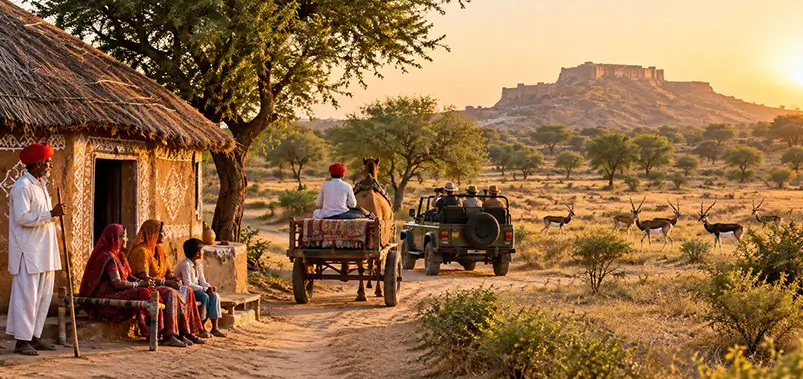
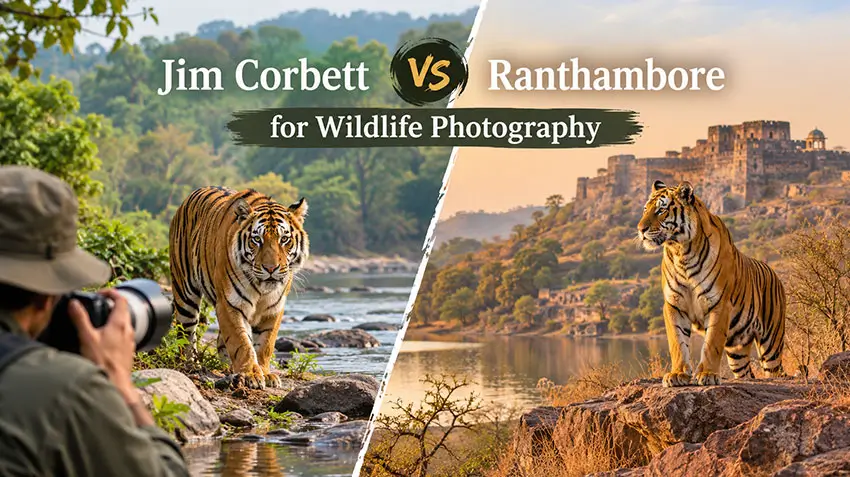
Both are among India's oldest and most famous tiger reserves, and both reward a patient photographer with a five-day stay. Yet they could hardly look more different. Ranthambore is dry, open and scattered with old stone, where tigers walk past lakes, banyan roots and crumbling pavilions. Corbett is tall sal forest, rolling grassland and the wide Ramganga river, with wild elephants, river birds and the Himalayan foothills in the background.
This guide sets the two side by side for the serious amateur or professional: tiger sighting odds, light and terrain, zones, seasons and closures, safari timings, booking rules, realistic higher-side costs in mid-range and luxury tiers, gear, ethics, a day-by-day itinerary for each park, and the lodges worth paying for.
Tiger Odds, Light and Terrain Through a Photographer's Lens
Start with the question everybody asks first. Corbett holds far more tigers. The most recent national estimate put the Corbett landscape at roughly 260 tigers, one of the highest densities anywhere in the world, while Ranthambore holds somewhere around 70 to 80 adults and cubs across its core and outer areas. On paper, then, Corbett should win. In practice, tiger sighting odds in Ranthambore are usually higher for a short trip, because the forest is open, the undergrowth thins out sharply after February, and the tigers here have grown up around vehicles for decades. A guest doing six to eight drives in Ranthambore between March and May has a very good chance of at least one clear tiger encounter, and often several. In Corbett the same number of drives might produce a tiger crossing a forest track or resting in tall grass, but the cover is thick and the animals are shyer.
The light tells a similar story. Ranthambore is a dry deciduous forest dominated by Anogeissus pendula trees, which lose their leaves in the hot months and turn the landscape silver, ochre and rust. Low winter sun rakes across this terrain beautifully in the first and last hour of each drive, and by April the bare branches let sunlight onto the forest floor, which helps exposure but can make midday light harsh and contrasty. The great draw for photographers is context. Ranthambore's fort ruins, the Jogi Mahal pavilion beside Padam Talao, the old hunting lodge at Rajbagh Talao, Malik Talao with its crocodiles and storks, and the arches and step-walls scattered through the reserve give pictures a sense of place you cannot find in any other Indian park. A tiger walking into a lake for sambar deer, framed by ruins, is the classic Ranthambore image, and it is still possible.
Corbett asks for a different eye. The sal forests of Corbett are tall, straight and dense, and light comes down through them in shafts, which is gorgeous on a misty winter morning and maddening on a bright afternoon when a tiger sits in deep shadow beside a sunlit track. The open grasslands are where Corbett opens up. Dhikala's great grassland, with the Ramganga reservoir glinting behind it and the hills rising beyond, is one of the finest wildlife panoramas in Asia. Here you photograph herds of Asian elephants, hog deer and spotted deer, and occasionally a tiger walking through grass taller than itself.Corbett is also the stronger park for variety. Over 600 bird species have been recorded across the reserve, including Pallas's fish eagle, the crested serpent eagle, the great hornbill in some forest blocks, kingfishers of several kinds and the wallcreeper in winter. The Ramganga holds gharial and mugger crocodiles, and the river bends at dawn give soft reflected light. If your portfolio needs elephants, birds and river scenes as much as big cats, Corbett gives you more subjects per drive, even when the tigers stay hidden.
Plan Your Perfect Wildlife Photography Safari
Discover India's incredible wildlife through a tailor-made safari experience in Jim Corbett or Ranthambore. We can help you plan your itinerary, choose suitable safari experiences, and make the most of your time in the wilderness.
Safari Zones That Matter for Your Camera
Zone allotment shapes a photography trip more than almost anything else, so it is worth knowing what each area offers before you book.
Ranthambore is divided into ten numbered safari zones. The first five, plus parts of zone six, form the older heart of the reserve around the fort, the three lakes and the Rajbagh area, and these are the zones most photographers want. Zones three and four carry Padam Talao, Rajbagh Talao and Malik Talao, the lakeside ruins and the banyan grove near Jogi Mahal, and they have produced many of the park's best-known tiger images. Zone two runs along the base of the fort and through good water points. Zone five has open valleys and tracks that tigers use to move between lake areas. Zones six to ten cover the outer, more recently opened country of Kundal, Kachida, Balas, Kushalipura and Bhadlav, with drier hills, scrub and gorges. These outer zones are not second-rate by any means; resident tigresses there have given superb sightings, and the open hillsides suit environmental portraits. You do not choose your exact zone at the gate, though. Ranthambore allots zones by computerised rotation, and you can only state a preference when you book through the official portal. The forest also has separate Ranthambore buffer zones outside the core, used in monsoon months and when core seats sell out.
Corbett is laid out differently, with named zones entered through separate gates around the town of Ramnagar. Dhikala is the jewel, deep inside the reserve on the Ramganga, reached through Dhangarhi gate. It holds the big grassland, the reservoir edge, elephant herds and the best overall tiger density, but day visitors can only enter by the shared canter bus, and private jeep drives inside Dhikala are reserved for guests staying at the Dhikala Forest Lodge. Bijrani, entered at Amdanda gate a few minutes from Ramnagar, is the most popular zone for jeep safaris, with mixed sal forest, open grassland patches and a good record for tigers. Jhirna, entered from the southern side near Dhela, is drier, more open and dotted with old village clearings, and it is one of the best zones in the reserve for sloth bear as well as tiger. Dhela, the newest zone on the southern edge, has fresh grassland and forest, fewer vehicles and growing tiger activity.
Two smaller zones suit photographers who want quieter roads. Durga Devi, in the north-east, runs along the Mandal and Ramganga rivers through hilly forest, and is known among birders for river species and its deep, clear river pools. Sitabani is technically outside the national park in a reserve forest, needs no permit lottery, and is good for birds and river scenery with an easy entry, though big cats are less reliable there. The Garjia, Sonanadi and Pakhro areas also take vehicles in season. For a five-day trip most serious photographers combine two or three nights inside Dhikala with Bijrani and Jhirna drives, because together they cover grassland, forest and drier terrain.
Seasons, Closures and Safari Timings
Both parks follow the monsoon, and getting the dates wrong is the quickest way to ruin a trip.
In Ranthambore the core zones close from the start of July to the end of September for the rains, reopening on or around the first of October. During the monsoon some buffer areas may stay open for limited drives depending on rainfall, but the core zones with the lakes and fort are shut. Rajasthan's tiger reserves have also introduced a weekly closure on Wednesday for some periods, so check the current rule when you book; it can quietly cost you two drives on a short stay. The season splits into three photographic moods. October and November bring green forest, full lakes and soft light, with tigers harder to find in thick cover. December to February is cold, often misty at dawn, with long golden light and very comfortable days, though jackets and gloves are needed in the open vehicle. March to June is hot and dry, temperatures climb past 40°C by May, the forest becomes bare, and tigers gather near water, which gives the strongest sighting odds of the year.
Approximate Ranthambore safari timings shift with the sun. In October the morning drive runs roughly from 6:30 am to 10:00 am and the afternoon from 2:30 pm to 6:00 pm. From November through January the morning starts later, around 7:00 am to 10:30 am, with afternoons from 2:00 pm to 5:30 pm. February and March return to the 6:30 am and 2:30 pm starts, April and May open at 6:00 am with afternoons from 3:00 pm to 6:30 pm, and in June the afternoon drive runs from about 3:30 pm to 7:00 pm. Each drive lasts around three and a half hours.
Corbett's calendar is more varied because each zone has its own season. Dhikala opens on 15 November and closes around 15 June, so it is out of reach for nearly five months each year. Bijrani opens on 15 October and closes around 30 June. Durga Devi follows a similar pattern to Dhikala, opening in mid-November. Jhirna and Dhela are the exceptions, open year-round in principle, although monsoon floods and washed-out tracks can still stop drives from July to September. So if you can only travel in October, Ranthambore's core is open from the first day of the month while in Corbett you will have Bijrani, Jhirna and Dhela but not Dhikala.
Corbett safari timings are close to Ranthambore's, with a morning slot of roughly 6:00 am to 9:30 am and an afternoon slot of about 1:30 pm to 5:30 pm, adjusted by a half hour either side with the season. Winter mornings in Corbett are colder than you expect; the foothill fog can sit on the grassland until 8:00 am, giving lovely atmospheric frames but very slow shutter speeds. For pure photographic value, the sweet spot in Corbett runs from late February to April, when the grass has been partly burned or cut, the light warms up and elephant herds gather by the river. In Ranthambore the strongest months for tigers are April and May, but many photographers prefer late February and March for the balance between warm light, bare forest and bearable heat.
Booking Rules and Higher-Side Safari Costs
Permits are the hidden backbone of any wildlife trip in India, and both parks sell out in peak months.
For Ranthambore, bookings are made through the Rajasthan forest department's online portal, and the window opens well in advance, so seats for December holidays and Easter weeks can go months ahead. Every passenger needs a valid photo ID, which for foreigners means the passport, and the same document must be carried on the drive. You choose between two vehicles. The gypsy, an open six-seater four-wheel drive, is far better for photography: it is lighter, quieter, can stop quickly and allows you to shift sides. The canter is a 20-seat open truck, cheaper but crowded, with less control over where it stops. The official permit fees, raised by about ten per cent from April, now stand at roughly ₹1,612 per seat in a gypsy for Indians and ₹3,025 for foreigners, and about ₹987 per canter seat for Indians and ₹2,400 for foreigners. These are entry fees only. Once vehicle hire, guide, booking charges and taxes are added, a realistic higher-side cost for a single gypsy seat comes to around ₹3,500 for Indians and ₹5,500 for foreigners. Booking an entire gypsy for your group, which serious photographers should do, comes to roughly ₹21,000 for Indians and ₹33,000 for foreigners per drive. A full-day exclusive safari in Ranthambore, with the vehicle inside from dawn to dusk, runs upwards of ₹1,00,000 for Indians and about ₹1,60,000 for foreigners, and must be requested well in advance.
Corbett permits are sold on the Uttarakhand forest department's online portal, again with photo ID for every guest. Bijrani, Jhirna, Dhela and Durga Devi are booked by gypsy, and you hire the whole vehicle for up to six adults. The higher side of a complete Corbett gypsy package, covering permit, vehicle, mandatory guide and fees, is about ₹5,500 per drive for Indians and around ₹10,500 for foreigners. A seat on the Dhikala canter, which runs a long morning or afternoon circuit, costs up to about ₹2,000 for Indians and ₹4,000 for foreigners. Cameras with very long lenses may attract a separate camera fee, so declare your equipment at the gate.
The Dhikala Forest Lodge deserves its own note. Rooms are simple government rest-house accommodation, booked online, with rates on the higher side reaching around ₹7,000 a night for Indians and roughly double for foreigners, plus a per-night vehicle entry fee and mandatory canteen meals. The rooms are plain and the food basic, but sleeping inside the reserve gives you the only legal way to take private jeep drives in Dhikala, and you hear elephants trumpeting by the boundary fence at night. Dhikala rooms open for booking roughly 45 days ahead and are often gone within minutes.
In terms of budget tiers, a mid-range photography trip means a good resort at around ₹12,000 to ₹18,000 a night for two, shared or semi-exclusive gypsy drives and a private car with driver. A luxury photography trip means a top lodge at ₹60,000 to ₹1,50,000 a night, exclusive gypsies on every drive, a lodge naturalist and possibly one full-day safari. Most guests sit somewhere between the two.
Camera Gear, Lenses and Field Ethics
The right kit for these parks is lighter than many people think. In an open gypsy you have little room, you cannot leave the vehicle and the jolts are constant, so a heavy fixed 600mm on a gimbal is rarely practical outside Dhikala's grassland.
For Ranthambore, the ideal main lens is a 100–400mm or 150–600mm zoom on a full-frame body, or a 100–400mm on a crop-sensor body for extra reach. Tigers here often walk close to the track, sometimes within ten metres, and you will want to pull back for the ruins, lakes and banyan roots that make the image. A second body with a 24–70mm or 24–105mm is extremely useful for wide environmental scenes, tigers crossing in front of the vehicle and sweeping landscapes of the fort at sunrise. A 70–200mm f/2.8 is a strong alternative if you shoot mainly in the soft early light.
Corbett calls for more reach. Tigers and elephants on the Dhikala grassland can be 80 to 200 metres away, and birds need focal length. A 500mm or 600mm prime, or a 200–600mm or 180–600mm zoom, is the better main lens here, and a 1.4x teleconverter earns its keep for raptors and kingfishers. In the sal forest, light drops sharply, so a body that handles ISO 6400 cleanly is worth more than an extra stop of reach. Again, carry a second body with a wider zoom for grassland panoramas and elephant herds against the hills.
Support matters. A beanbag draped over the side of the gypsy or the canter rail is the best stabiliser in both parks; bring it empty and fill it with rice or lentils locally. Monopods are awkward in a crowded vehicle and tripods are useless. Dust is relentless in Ranthambore from March onward and in Corbett's grassland tracks, so pack a rain cover or dust sleeve, a blower and lens cloths, and change lenses only when the vehicle is still and the wind is low. Carry more memory cards and batteries than seem sensible; you may shoot several thousand frames on a good morning, and there is little chance to charge between drives in Dhikala. In winter, a warm hat, gloves with fingertip openings and a down jacket make the morning drive far more pleasant.
Then the ethics, which are not optional. Drivers and guides face penalties for leaving the track, chasing animals or crowding a tiger, and you should never press them to bend the rules for a better angle. Do not call out, clap or bang the vehicle to make an animal look up, and never use flash. Do not bait, feed or play recorded calls for birds inside the reserve. Responsible wildlife photography also means accepting when a tiger walks away into cover. If several vehicles gather at a sighting, ask your driver to hold back and leave the animal an escape route; the best frames often come when a calm tiger chooses to walk past a quiet vehicle. Keep drones at home; they are banned in both reserves. Finally, be careful about sharing exact locations of nesting birds or denning animals online.
Five Days in Ranthambore, Day by Day
Day One begins in Jaipur, with a morning drive of about 160 km and three to three and a half hours south-east to Sawai Madhopur. Leave by 8:00 am and you reach your lodge for lunch, which gives you time to unpack, charge batteries, fill the beanbag and meet the lodge naturalist. Your first Ranthambore afternoon safari starts around 2:00 pm to 3:00 pm depending on the month. Treat it as a reconnaissance drive: learn how the gypsy moves, test your settings in the dappled light and get a feel for the guide's style. Whatever zone you are allotted, ask the guide about recent tiger movements and which water points are active.
Day Two is a full double-drive day. The morning drive begins in near darkness at the gate, and the first half hour gives the softest light of the day. If you have drawn zone three or four, ask to wait near Padam Talao or Rajbagh Talao, where tigers often come to drink and hunt sambar in the shallows, and where Jogi Mahal and the lakeside ruins give you that classic Ranthambore frame. Return to the lodge by mid-morning, back up cards and rest through the heat. In the afternoon, try a wider lens for scenes of the forest and fort as the light turns golden.
Day Three is the day to consider a full-day exclusive safari if your budget allows. Entering at dawn and staying inside through the heat lets you wait patiently at a water point while other vehicles come and go, which in April or May can bring a tiger to the lake in the hottest hours. If a full day is out of reach, make it two exclusive gypsy drives, and in between take a short trip to Ranthambore Fort itself, a UNESCO World Heritage Site, where the ramparts give wide views over the lakes and langurs and peacocks pose in good light.
Day Four is for the outer zones and for variety. If your earlier drives have been in zones one to five, an allotment in zones six to ten, around Kundal, Balas or Bhadlav, gives you rocky hillsides, open scrub and resident tigresses that are sometimes easier to photograph in clean backgrounds. Spend part of the morning on smaller subjects: crocodiles at Malik Talao, painted storks, Indian eagle owls on the cliffs, sloth bear in the rocky country and the striped hyena on rare occasions. In the evening, many photographers skip the drive and visit the Dastkar women's craft centre near the park road or simply edit at the lodge.Day Five is your last morning drive. By now you know the zone patterns and your guide knows exactly what you want, so this is often the most productive session. Shoot until the gate closes, return for a late breakfast and then drive back to Jaipur, or take an afternoon train to Delhi. A five-day stay gives you seven to nine drives in all, which is enough for realistic odds of strong tiger images in the dry season.
Create Your 5-Day Tiger Photography Adventure
Whether you prefer Corbett's diverse forest landscapes or Ranthambore's iconic tiger habitats, let us help you design a personalized wildlife journey with safari planning, comfortable stays, and seamless travel arrangements.
Five Days in Corbett, Day by Day
Day One starts with the drive from Delhi to Ramnagar, about 260 km and six to seven hours, or a short flight to Pantnagar followed by around 80 km by road. Leave Delhi by 6:00 am to avoid traffic and you reach a riverside lodge near Dhikuli or Garjia in time for a late lunch. If permits allow, take an afternoon drive in Sitabani or Bijrani to settle in. Otherwise walk along the Kosi river by the lodge with a long lens; river lapwings, wagtails, plumbeous water redstarts and the crested kingfisher are all common along this stretch.
Day Two is a double day in Bijrani. The morning drive through Amdanda gate passes sal forest that glows in shafts of early light, opening into grassland patches where tigers like to rest in the sun on cold winter mornings. Keep your camera settings ready for both the dark forest and the bright meadow, because you will cross from one to the other within seconds. In the afternoon, switch to Jhirna if possible, where open, drier terrain and old clearings give clean backgrounds and good chances of sloth bear as well as tiger.
Day Three is the move into Dhikala. Enter by the Dhangarhi gate in the morning and drive around 30 km through forest to the lodge on the edge of the great grassland. Overnight guests can take private jeep drives inside Dhikala, and these are the most rewarding hours of the whole trip. The morning mist lifts off the grassland, elephant herds move toward the reservoir, and tigers sometimes walk the open tracks such as Sambar Road and the routes toward Phulai and Thandi Sadak. The afternoon drive, in long warm light, is the time for elephants against the Ramganga with the hills behind. In the evening, the watchtower near the lodge gives wide views over the grassland, and the canteen serves simple hot meals.
Day Four is a second full day inside Dhikala. Shoot the morning drive with your longest lens for tigers, deer and the many raptors that hunt over the grassland, including Pallas's fish eagle and the grey-headed fish eagle along the reservoir. Use the middle of the day for birds around the lodge compound and for gharial and mugger crocodiles basking on the river below the lodge. On the afternoon drive, ask your guide to work the riverbanks near Dhikala and the Ramganga crossings, where tigers sometimes come to drink at dusk. Nights in Dhikala are quiet and dark, with no mobile signal in many parts, so sleep early.
Day Five is your final morning drive in Dhikala on the way out of the reserve. Leave the lodge at first light, photograph the grassland one last time, and exit through Dhangarhi gate by mid-morning. After breakfast back in Ramnagar, set off for Delhi, arriving in the evening. If you prefer a gentler finish, add a sixth night at a luxury resort on the Kosi river and use the morning for Durga Devi, where river birds and quieter forest roads make a fine closing session. Across five days you will have eight to ten drives in all, and a much broader set of subjects than in Ranthambore, even if the tiger count is lower.
Getting There, Luxury Lodges and Which Park Suits Whom
Getting there is straightforward from either city. Ranthambore lies about 160 km from Jaipur, around three to three and a half hours by road, and roughly 380 km from Delhi, around six to seven hours by expressway. Fast trains from Delhi to Sawai Madhopur take about five hours and make a good alternative. A private Innova Crysta from Jaipur to Ranthambore costs around ₹7,000 one way on the higher side, and from Delhi around ₹14,000. Corbett lies about 260 km from Delhi, around six to seven hours, while Jaipur to Ramnagar is more than 520 km and is best broken overnight. A private Innova Crysta from Delhi to Ramnagar comes to around ₹12,000 one way. Pantnagar airport, about 80 km from Ramnagar, has limited flights from Delhi.
The lodges are where these two parks most clearly show their luxury tiers. In Ranthambore, The Oberoi Vanyavilas has luxury tents with private gardens, a spa and strong naturalist support, with peak-season rates on the higher side of around ₹1,10,000 a night for two before taxes. Aman-i-Khas offers ten large tents in a quiet setting near the park, with rates of roughly ₹1,60,000 a night or more including meals and some activities; it typically closes during the hottest months and monsoon, so check dates. SUJAN Sher Bagh is a classic tented camp with a strong conservation ethic and fine safari guiding, at around ₹75,000 a night for two on full board, and it also closes from late spring through the monsoon.
Corbett's top lodges sit along the Kosi river near Dhikuli and Garjia. Taj Corbett Resort and Spa offers polished rooms, a good spa and the Taj's service, at around ₹35,000 a night for two in peak season. The Riverview Retreat is one of Corbett's longest-standing resorts, with riverside rooms and in-house naturalists, at around ₹22,000 a night on the higher side. Namah, a member of Radisson Individuals, has a modern design, a large pool and wide forest views, at about ₹28,000 a night. Aahana The Corbett Wilderness is an eco-minded resort set in large grounds near the Dhela side, at around ₹25,000 a night for two. All of these arrange permits and safaris through their own desks.
So which park suits whom? Choose Ranthambore for tiger portraits if this is your first serious wildlife trip, if you have only five days, if strong tiger images are the main goal, and if you love the idea of tigers framed by ruins and lakes. It also fits neatly with Jaipur and a wider Rajasthan journey. Choose Corbett for variety and landscape if you already have tiger images and want elephants, river birds, raptors and wide Himalayan-foothill scenes, or if you relish the rustic adventure of sleeping inside the reserve at Dhikala. Experienced photographers often do both on separate trips, Ranthambore in March or April and Corbett in February or late November.
Top Indian Holidays, based in Jaipur, can arrange a private chauffeur-driven car and the full safari logistics for either park, or combine both on one longer route.
Related Guides



 info@topindianholidays.net
 +91-8955000999