📅 Last Updated On: 13 Oct 2026
⏱ 7 Min Read
Bishnoi Village Safari Jodhpur: What to Expect & How to Book
N
Nand Singh Rathore
Travel & Tourism Expert specializing in India
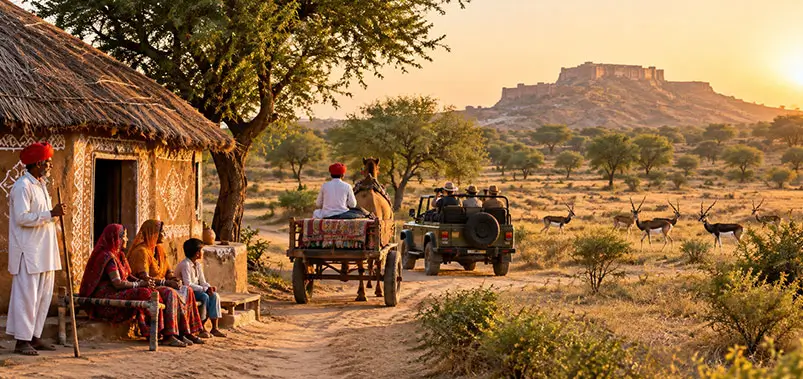
Bishnoi Village Safari Jodhpur: Complete Travel Guide for Visitors
Most visitors to Jodhpur spend their time between the towering walls of Mehrangarh Fort, the blue houses of the old city and the bazaars around the clock tower. Yet just 20 to 40 kilometres outside the city lies a completely different Rajasthan: flat scrubland dotted with thorny trees, round mud homes with thatched roofs, potters' wheels turning in courtyards, and herds of blackbuck antelope grazing fearlessly beside the villages. This is the land of the Bishnoi, a community that has protected trees and wildlife for more than five centuries, long before the word conservation was coined. A Bishnoi village safari from Jodhpur is a half-day trip into this world. Done well, it is one of the most rewarding experiences in western Rajasthan. Done badly, it becomes a rushed shopping trip. This guide explains who the Bishnoi are, what you will actually see, the realistic Bishnoi safari price, and how to book a tour that respects the people you visit.
Who the Bishnoi Are and Why Their Story Matters
The Bishnoi community was founded in the late 15th century by a spiritual teacher named Jambheshwar, who lived in the Thar Desert during a time of terrible drought. He watched people and animals die as forests were cut down and the land turned barren, and he set out 29 principles for his followers. Indeed, the name Bishnoi comes from the local words for twenty and nine. These principles cover daily life, hygiene, honesty and compassion. Among the most important are the commandments never to cut a green tree and to protect all living creatures. Bishnoi families follow a strict vegetarian diet and avoid harming animals, and many will not even use wood from a living tree for fuel.
The community's most famous moment took place in the village of Khejarli, about 25 kilometres from Jodhpur, in the early 18th century. Soldiers of the Maharaja of Jodhpur arrived to cut down the village's trees for lime kilns to build a new palace. A Bishnoi woman named Amrita Devi wrapped her arms around a tree and refused to move, declaring that a severed head was cheaper than a felled tree. She was killed, and so were her three daughters. One by one, more villagers stepped forward to hug the trees. By the time the Maharaja heard what was happening and stopped the felling, 363 Bishnoi men, women and children had given their lives. Shaken, the Maharaja issued a royal decree banning the cutting of trees and the hunting of animals in Bishnoi villages, a protection that still holds in spirit today.
That sacrifice inspired the famous tree-hugging movement in the Himalayas centuries later. India's national award for wildlife protection is also named after Amrita Devi. A memorial and a grove of trees stand at Khejarli today, and every year a fair is held there in her honour. Visiting the site with a knowledgeable guide gives the safari real depth, turning a pleasant drive in the countryside into a lesson in one of the world's earliest conservation movements.
The tree the Bishnoi died to protect is Prosopis cineraria, the state tree of Rajasthan. It is a hardy, deep-rooted tree that survives extreme heat and drought, provides fodder for animals, beans for food, wood for nothing, and shade for everyone. Driving through Bishnoi land, you will see these trees standing in the fields, never cut and only lightly pruned.
The same protective care extends to animals. Bishnoi villagers are famous for protecting blackbuck and Indian gazelle, and there are many accounts of Bishnoi women raising orphaned fawns alongside their own children. They will chase away poachers, report hunting to the police, and stand as witnesses in court. As a result, wildlife around Bishnoi villages is remarkably tame. Animals that flee at the sight of people elsewhere in India graze calmly just metres from Bishnoi homes.Top Indian Holidays guides on this route are local and know the families personally, which means you are welcomed as a guest rather than treated as a passing tourist.
Plan Your Private Jodhpur Village Tour
Explore Bishnoi culture, spot blackbucks in their natural habitat, and experience rural Rajasthan at your own pace. Plan a personalised village safari with expert local assistance.
What to Expect on a Bishnoi Village Safari
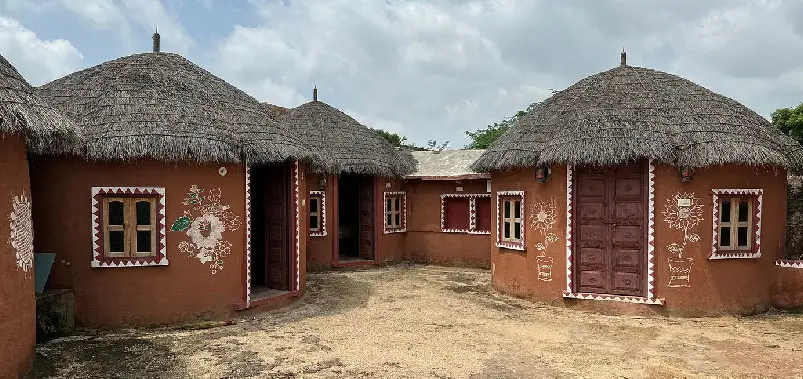
A typical Bishnoi village tour lasts four to five hours and starts either in the early morning, around 8:00 am, or in the afternoon, around 2:30 to 3:00 pm. You will be picked up from your hotel in Jodhpur in an open or covered jeep, usually a Mahindra or a Gypsy, with a driver and an English-speaking guide. The route heads south and southwest of the city, and within twenty minutes, the traffic and buildings give way to dry farmland, scrub forest and small clusters of homes.
The first stop is often a Bishnoi homestead, where a family welcomes you into their compound. Bishnoi homes are usually circular huts with mud walls and conical thatched roofs, set around a swept courtyard plastered with a mixture of clay and dung that keeps the floor cool and clean. Inside, everything is neat: stacked brass and steel utensils, grain stored in large clay containers, and simple bedding. Women in bright red and orange skirts and veils go about their work, grinding grain, fetching water or tending animals. The men may welcome you with water or tea and talk through the guide about farming, rain and the history of their people. Families are proud of their traditions and generally happy to answer questions about the 29 principles, their vegetarian diet and their relationship with the animals around them.
From there, the safari continues to villages known for their traditional crafts. In Kakani, families of potters work at hand-turned or electric wheels, shaping water jugs, cooking pots and decorative pieces from local clay before firing them in open kilns. You can try your hand at the wheel, which is harder than it looks, and buy pieces straight from the potter at fair prices, usually INR 200 to 2,000 depending on size. In Salawas, weavers produce flat-woven cotton and wool rugs on large pit looms, using techniques passed down for generations. A small rug costs around INR 3,000 to 8,000, while large room-sized rugs can cost INR 20,000 to 60,000 or more, with shipping arranged abroad. Some villages also have block printers and leather workers.
Most safaris include a stop at Guda Bishnoi, a village with a small lake. In winter, this lake attracts migratory birds such as cranes, ducks and waders, and the open land around it is one of the best places to see blackbuck grazing in herds. Many tours also stop at the Khejarli memorial to pay respects at the site of the sacrifice.
On morning tours, a village lunch is often included or available. It is usually served in a family home or a simple farm restaurant and features millet flatbread cooked over a wood fire, lentils, seasonal vegetables, fresh yoghurt and buttermilk. It is simple, wholesome and delicious, and it costs around INR 500 to 1,000 per person when not already included in the price. The safari ends with a drive back to Jodhpur, usually reaching your hotel by early afternoon for a morning tour or around sunset for an afternoon tour.
Wildlife, Crafts and Village Life on the Safari Route
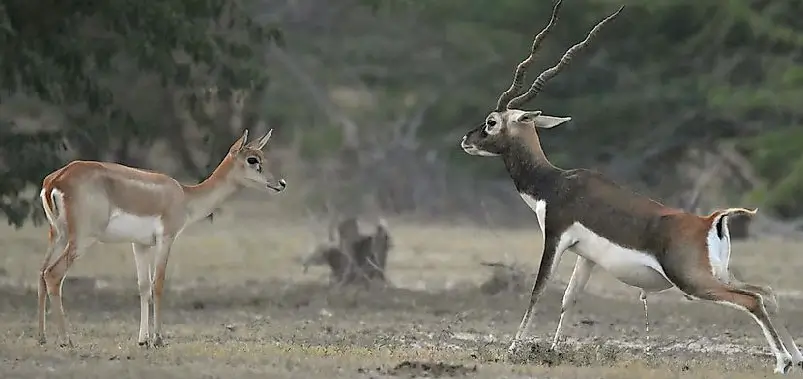
For many guests, the biggest surprise is the wildlife. The open grasslands and scrub around Bishnoi villages hold some of the healthiest populations of blackbuck in India. The males are especially striking, with jet-black and white coats and long spiralled horns, while the females and young are a soft tawny colour. Blackbuck are the fastest antelope in India and can sprint at more than 80 kilometres per hour, but here they often stand calmly as jeeps pass. Early morning and late afternoon offer the best chances to see them, along with males sparring and herds moving between fields.
You may also see the graceful Indian gazelle, smaller and paler, with short straight horns. Large blue bull antelope, the biggest antelope in Asia, wander through the fields in small groups. Desert foxes sometimes appear at dawn or dusk, and peacocks strut through the villages, so tame that they eat grain thrown by the women in the courtyards. Birdwatchers can spot grey francolin, Indian rollers, bee-eaters, larks, shrikes and raptors such as the black-shouldered kite and the tawny eagle. In winter, from about November to February, migratory cranes, ducks and waders visit the small lakes.
Photographers will love the light and the subjects, but courtesy matters. Ask before photographing people, especially women, who may prefer not to be photographed or may wish to cover their faces first. Children are usually delighted to pose and see their photos on your screen. Do not feed or chase the animals, and keep your voice low near herds. The calmness of the wildlife depends on the respect shown by everyone who visits.
The crafts you see are not staged for tourists. They are the working livelihoods of the families who make them. Buying directly from potters and weavers in their own homes means the money goes straight to the artisans, without the large commissions charged by city showrooms. Feel free to bargain gently, but remember that these are fair, often modest prices for hours of skilled work. If you are not buying, a small tip of INR 200 to 500 for the family who welcomed you into their home is a kind and appreciated gesture.
The day also offers a glimpse of everyday rural life in the Thar region: camel carts on dusty tracks, women carrying water pots on their heads, men tending goats and sheep, and children walking to the village school. Many Bishnoi families have converted traditional water-harvesting tanks into community resources. Your guide can explain how they collect and store rainwater through months of drought, a skill that has kept desert villages alive for centuries.Top Indian Holidays guests often say that this half day explained Rajasthan's desert life better than any museum. It works especially well paired with a visit to the Rao Jodha Desert Rock Park below Mehrangarh Fort, which restores native desert plants on the rocky hillside.
Experience Authentic Bishnoi Village Safari
Discover Rajasthan’s traditional village life, local handicrafts, and wildlife on a private Bishnoi Village Safari near Jodhpur. Enjoy an enriching cultural experience with a local guide.
Bishnoi Safari Price, Timings, Best Season and Booking Tips
The Bishnoi village safari price depends on the vehicle, the guide, the number of villages visited and whether lunch is included. At the higher end of the market, with a private open jeep, an experienced English-speaking guide, hotel pickup and drop-off, and visits to four to five villages, a private Bishnoi safari for two people costs around INR 4,500 to 7,500. With a village lunch, the price rises to roughly INR 6,000 to 9,000. For larger groups of four to six, the price per vehicle is about INR 7,500 to 12,000. Luxury hotels in and around Jodhpur, such as Umaid Bhawan Palace and RAAS Jodhpur, offer their own Bishnoi excursions for hotel guests at higher prices, often INR 10,000 to 18,000 for a private jeep, including refreshments. Heritage stays such as Rohet Garh, about 40 kilometres from Jodhpur and close to Bishnoi country, also arrange village and wildlife drives directly from the property.
As for timings, morning tours, starting around 8:00 am and returning by 1:00 pm, are best for wildlife and cooler temperatures, and they often include lunch. Afternoon tours, starting around 2:30 to 3:00 pm and returning around sunset, give lovely evening light for photography and good wildlife viewing as the heat fades.
The best time for a Bishnoi village safari is from October to March, when daytime temperatures are comfortable at 22 to 30°C and winter birds visit the lakes. December and January mornings can be cool, around 8 to 12°C, so carry a light jacket in the open jeep. From April to June, temperatures in the Thar often exceed 40 to 45°C, so only very early morning tours are practical. The monsoon months, from July to September, turn the desert unexpectedly green, but they are humid, and some village tracks can become muddy after heavy rain.
A few booking tips make the difference between an authentic visit and a disappointing one. Avoid touts near the clock tower and the old city who offer cheap village tours. These often turn into long stops at rug showrooms that pay commissions, with little time in the villages. Confirm in writing which villages are included, the total duration, whether the jeep is private and open, the guide's language, and whether lunch and bottled water are included. A good tour should include at least one genuine Bishnoi homestead, a craft village, a wildlife area and ideally the Khejarli memorial.
Wear comfortable clothes that cover your shoulders and knees, closed shoes for walking through village compounds, a hat and sunglasses, and sunscreen. Carry cash in small notes for crafts and tips, since there are no ATMs in the villages. Binoculars and a camera with a zoom lens greatly improve wildlife viewing.
The Bishnoi safari fits neatly into a Rajasthan tour. Most travellers spend two nights in Jodhpur, seeing Mehrangarh Fort, Jaswant Thada and the blue city on one day and joining the Bishnoi safari on the other, before continuing to Jaisalmer, Udaipur or Ranakpur. Top Indian Holidays includes this half-day safari in its Jodhpur itineraries with trusted local guides, a private jeep and a village lunch, so you see the real Bishnoi way of life.
Related Guides


 info@topindianholidays.net
 +91-8955000999