📅 Last Updated On: 02 Sep 2026
⏱ 10 Min Read
Mehandipur Balaji Temple: Timings, Rules, Darshan & Travel Guide
T
Top Indian Holidays
Ministry of Tourism Approved Tour Operator
Mehandipur Balaji Temple: Complete Travel Guide
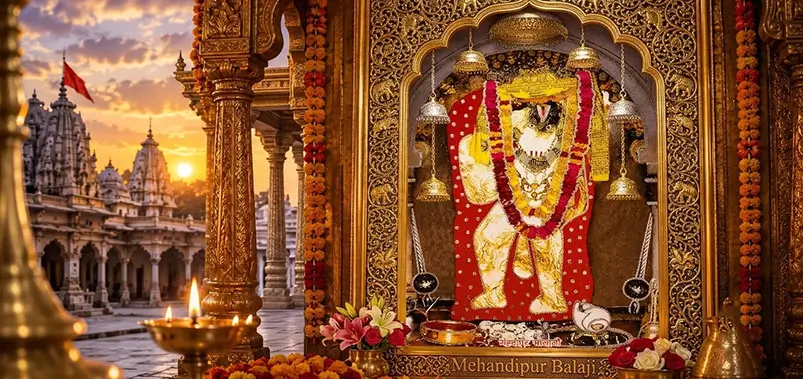
Mehandipur Balaji Temple is one of Rajasthan's most unusual and intensely devotional pilgrimage centres. Located in Dausa district, the temple is dedicated to Lord Hanuman, worshipped here as Balaji, and attracts large numbers of pilgrims from Rajasthan, Delhi, Uttar Pradesh, Haryana and other parts of India. Unlike temples visited mainly for historic architecture or elaborate sculpture, Mehandipur Balaji is known primarily as a living religious centre where devotees come for worship, personal prayers and traditional rituals connected with relief from spiritual distress.
The Government of India's national tourism information identifies the temple in Mehandipur, Dausa district, approximately 40 kilometres from the district headquarters along the route towards Mahwa and Agra. The location makes the temple accessible from both Jaipur and Agra, while Delhi travellers can reach it by road through the wider Delhi-Mumbai and Rajasthan highway network.
Visitors should arrive with realistic expectations. The temple complex is not a quiet heritage monument where tourists move through empty courtyards taking photographs. The surrounding streets can be densely crowded, particularly on Tuesdays, Saturdays, Sundays and important religious occasions. Shops selling offerings line the approaches, pilgrims queue through narrow sections, and worship practices can appear very different from those at many other Hanuman temples.
The shrine is also surrounded by stories about spiritual healing, possession and supernatural experiences. These beliefs are deeply important to many devotees, but visitors should distinguish religious tradition from medical fact. A person experiencing mental-health symptoms, seizures, severe anxiety, psychosis or another medical condition should receive qualified professional medical care. Religious worship may hold personal or cultural meaning, but it should not replace appropriate healthcare.
For ordinary travellers, the most useful preparation is straightforward: know the Mehandipur Balaji timings, arrive early, follow temple instructions, carry as little as possible, avoid unofficial intermediaries and allow enough time for traffic and queues.
A Journey Shaped by Faith and Understanding
Mehandipur Balaji is an active place of devotion, where centuries-old beliefs and deeply personal rituals continue to shape the experience.
Mehandipur Balaji Temple History and Its Religious Importance
The religious identity of Mehandipur Balaji Temple Rajasthan centres on Lord Hanuman in the form known locally as Balaji. The temple also contains sacred areas associated with Bhairav Baba and Pretraj Sarkar, and this combination has shaped the distinctive worship traditions for which Mehandipur is famous. The official temple website presents the daily schedule around worship of Balaji and confirms that the shrine continues to operate as a major active pilgrimage institution.
Local traditions describe the sacred manifestation at Mehandipur as ancient, although exact historical dating is difficult to establish through conventional archaeological evidence. The temple's reputation developed through generations of worshippers who believed that prayer at the site could bring protection from suffering, fear and negative spiritual influences. Over time, these traditions turned Mehandipur into one of northern India's most widely recognised Hanuman pilgrimage centres.
Its reputation differs substantially from temples such as Salasar Balaji or other major Hanuman shrines in Rajasthan. At Mehandipur, visitors may encounter individuals participating in intense religious rituals, praying loudly or behaving in ways that unfamiliar visitors may find emotionally difficult to observe. These acts belong to the religious environment of the site and should never be treated as entertainment.
Photography of vulnerable individuals is particularly inappropriate. Someone participating in a personal religious ritual has not consented to becoming a tourist photograph or social-media subject. Visitors should focus on their own worship or observation rather than recording people experiencing distress.
The atmosphere around the temple also explains why visitors sometimes leave with dramatically different impressions. A devotee familiar with the traditions may view the environment as deeply reassuring and sacred, while a first-time tourist may find the intensity surprising. Neither response changes the fundamental reality that Mehandipur Balaji is an active pilgrimage temple rather than a sightseeing attraction created for visitors.
Another distinctive feature is the traditional system of offerings connected with different sacred figures in the temple complex. Popular devotional practice associates sweets with Balaji and different food offerings with the other sacred areas. These practices follow specific local customs, and first-time visitors should obtain instructions only from recognised temple counters or trusted local religious representatives rather than accepting unsolicited guidance from anyone in the street.
The temple does not require visitors to know every traditional ritual before arriving. Ordinary devotees can enter for darshan without participating in specialised ceremonies. In fact, first-time travellers who are unfamiliar with local religious practices are usually better served by keeping their visit simple: enter through the official queue, pay respect at the principal sacred areas and leave according to temple instructions.
Current Mehandipur Balaji Temple Timings and Daily Darshan Schedule
The official Mehandipur Balaji Temple website currently provides a detailed daily timetable, making it the strongest reference for visitors arranging their arrival. Morning worship is listed from approximately 6:00 AM to 6:40 AM, followed by public morning darshan from 7:00 AM to 11:00 AM. A midday offering period takes place approximately between 11:30 AM and 12:00 PM, after which afternoon darshan continues until approximately 6:50 PM. The temple doors close for the night around 9:00 PM.
There is one especially important variation. According to the temple's current schedule, public darshan can be suspended between approximately 4:00 PM and 6:00 PM on Monday, Wednesday and Friday for special ceremonial preparation of Balaji. Travellers arriving in the afternoon on those days should therefore avoid assuming that continuous access will be available.
These published hours should still be treated as operational guidance rather than an absolute guarantee for every religious date. Major festivals, special ceremonies, exceptional crowd levels and temple management requirements can alter access. Visitors travelling from far away should confirm the current schedule through the temple's official information before departure.
For most first-time visitors, early morning is the strongest period for Mehandipur Balaji darshan. Arriving around the beginning of public access generally means cooler temperatures and a better chance of entering before the largest daytime crowds develop. The streets surrounding the temple can become considerably more congested later in the morning.
Tuesday and Saturday have particular significance for Hanuman worship and are normally among the busiest days. Sunday can also be crowded because many families arrive during the weekly holiday. A visitor interested in a calmer first experience should therefore favour a weekday morning other than a major religious occasion.
Queue duration cannot be predicted from the temple timetable alone. On a quiet weekday, ordinary darshan may be completed relatively efficiently. On a busy Tuesday or Saturday, waiting can increase significantly. Festival periods can require several hours.
Visitors should therefore avoid placing a fixed airport, train or long-distance transfer immediately after the temple visit. Keeping flexibility protects the rest of the itinerary when crowds are larger than expected.
There is no regular sightseeing-style admission fee for ordinary darshan. Current visitor information also identifies free general darshan, although specialised religious services may involve separate charges. Visitors should use official counters for any paid service and avoid individuals promising guaranteed access in exchange for unusually large payments.
Important Mehandipur Balaji Temple Rules and Local Religious Customs
The rules at Mehandipur Balaji Temple are one of the main reasons first-time visitors search for information before arriving. Some are formal visitor-management instructions, while others are religious customs followed by devotees because of beliefs associated with the temple. Keeping those categories separate prevents cultural traditions from being presented incorrectly as physical facts.
One of the best-known customs concerns food and offerings. Devotional tradition at Mehandipur has long held that certain ritual offerings should not be carried home after the temple visit. Recent reporting confirms that devotees are traditionally instructed not to take particular offerings, food or ritual items away from the temple because these items are connected with the spiritual-cleansing traditions practised there. A first-time visitor should therefore ask at the authorised temple counter exactly what should be offered, left behind or handled in a particular manner.
Another widely followed custom is leaving the temple without turning around after completing the traditional ritual sequence. Devotees interpret this symbolically as leaving unwanted spiritual influences behind. This should be described correctly as a religious belief, not as evidence that physical harm will occur if someone happens to look back.
Visitors are also commonly advised not to accept random objects, food or ritual services from unknown people. This recommendation has both cultural and practical value. A crowded pilgrimage environment can attract unofficial intermediaries, so keeping interaction limited to recognised temple personnel reduces confusion and the possibility of unwanted charges.
Food should not be casually consumed while moving through the primary sacred sections. Visitors should finish meals beforehand and carry minimal belongings into the temple.
Traditional dietary customs followed by some pilgrims include avoiding alcohol and non-vegetarian food before visiting. Some devotional sources extend these restrictions to onion and garlic as well. These are faith-based practices, and visitors who wish to follow the temple's traditional religious discipline can do so respectfully. They should not, however, be presented as scientifically required conditions for physical safety.
The same care applies to clothing. Modest clothing appropriate for a religious site is the sensible standard. There is no need to invent elaborate dress restrictions beyond what temple management actually requires. Comfortable clothes are particularly useful because queues can involve considerable standing.
Visitors should never touch or photograph individuals participating in intense rituals without consent. Some pilgrims at Mehandipur may be experiencing psychological distress or physical illness. Their dignity takes priority over visitor curiosity.
Parents travelling with young children should consider whether the environment will be comfortable for them. The combination of crowds, loud religious activity and emotionally intense rituals can be overwhelming for some children.
The most practical rule is to remain calm, follow authorised instructions and avoid allowing sensational stories about the temple to dictate behaviour. Respectful conduct at Mehandipur Balaji does not require fear.
What Visitors May See During Darshan and How to Approach the Experience
A first visit to Mehandipur Balaji Dham can feel substantially different from entering a conventional temple. Crowded approaches, repeated chanting, offerings, queues and intense acts of devotion may all occur within a relatively confined area.
The principal focus is darshan of Balaji. Devotees then recognise other sacred figures associated with the complex according to local worship traditions. Visitors unfamiliar with the sequence should simply follow the established queue and instructions rather than attempting to create their own route through the shrine.
Traditional offerings may be purchased from authorised or established shops near the temple. Prices vary according to the type and quantity of offering. A simple offering can cost a modest amount, while larger ceremonial arrangements naturally cost more. Agreeing on the amount before accepting an elaborate ritual service prevents confusion.
The temple is sometimes promoted sensationally online as an "exorcism temple." That description is incomplete and can easily become disrespectful. The religious traditions at Mehandipur do include beliefs concerning relief from spiritual affliction, and this is documented as a major reason some devotees visit the shrine. However, reducing an active Hanuman temple entirely to dramatic stories about possession ignores ordinary devotees who come simply for prayer, thanksgiving and religious observance.
Travellers may witness unusual behaviour among some visitors. The correct response is distance and privacy, not close observation or filming. If a person appears to be having a medical emergency, appropriate medical help should be sought through local staff rather than assuming every physical symptom is spiritual in origin.
There is also no reason for an ordinary visitor to seek out intense rituals merely because online videos portray them as part of the attraction. Someone who has come for Mehandipur Balaji darshan can have a complete religious visit without entering into specialised spiritual practices.
Families, international travellers and first-time Indian visitors who feel uncertain should consider using a reliable local guide or driver who understands the physical access arrangements. The guide does not need to participate in worship but can assist with parking, queues and finding the correct entrance.
Once darshan is complete, visitors should leave in an orderly way rather than standing in narrow passages. Keeping the flow moving is particularly important during crowded periods.
Beyond Sightseeing, Into Sacred Rajasthan
Some places are not meant to be simply photographed—they are meant to be approached with patience and respect. Include Mehandipur Balaji in your Rajasthan journey and discover a side of the state shaped by living faith.
How to Reach Mehandipur Balaji from Jaipur, Agra and Delhi
The location of Mehandipur Balaji Temple in Dausa district makes it unusually convenient for inclusion within a Rajasthan and Golden Triangle journey. Government travel information places the shrine approximately 40 kilometres from the Dausa district headquarters on the road towards Mahwa and Agra.
From Jaipur, the road journey generally requires approximately two to three hours depending on the starting point, traffic and current road conditions. The practical road distance is around the 100-kilometre range. An early departure from Jaipur makes it possible to reach the temple during the morning and return in the afternoon, although travellers should keep additional time for queues.
A private Jaipur return vehicle may cost approximately INR 5,000 to INR 8,000+ for a comfortable sedan or standard tourist vehicle, while a premium SUV can cost roughly INR 8,000 to INR 12,000+, depending on operator, vehicle class, waiting period, tolls and parking. These are higher-side budgeting figures rather than fixed tariffs.
From Agra, Mehandipur Balaji also works as a road excursion because the temple lies west of the city along the broader Rajasthan corridor. Travellers moving between Agra and Jaipur can incorporate the temple without returning to the same city afterward, although total driving time and darshan queues should be considered before adding additional monuments on the same day.
This is particularly useful for travellers following a Delhi-Agra-Jaipur route. Instead of making Mehandipur an independent return excursion, a private vehicle can leave Agra, stop at the temple and continue towards Jaipur. The exact route and timing should be adjusted around the temple's current opening hours.
From Delhi, a same-day return journey is possible but long. Travellers should expect roughly five to six hours of driving each way depending on traffic and the selected route. For most visitors, an overnight stop closer to Jaipur, Dausa or the Agra corridor produces a more comfortable journey.
Rail access is available through stations in the broader region, but the final temple transfer still requires road transport. Families, elderly pilgrims and travellers with luggage will generally find a private vehicle simpler than multiple public-transport changes.
The nearest major tourism airport is Jaipur International Airport, giving visitors easy access to Rajasthan's capital before continuing by road.
Top Indian Holidays can place Mehandipur Balaji within a private Jaipur-Agra journey without turning the temple into an exhausting standalone excursion. The key is to avoid combining a long temple queue with excessive monument sightseeing and another late-night drive.
Parking, Local Streets and the Real Experience Before Reaching the Temple
The final approach to Mehandipur Balaji Temple is very different from arriving at a spacious modern attraction with a large landscaped parking area directly beside the entrance. The pilgrimage settlement has narrow commercial streets, shops, local vehicles, pedestrians and substantial religious traffic.
Private tourist vehicles normally use designated or locally available parking areas and visitors continue on foot through the temple approach. Exact parking arrangements can change during peak periods, so drivers should follow current police and temple management directions rather than attempting to reach the closest possible point.
Visitors should expect the last section to be busy.
Shops sell flowers, sweets and religious offerings along the way. Vendors may call out to pilgrims, but there is no obligation to purchase from the first shop approached. Travellers unfamiliar with the rituals should keep purchases simple.
Wear footwear that can be removed easily where required. Expensive shoes are unnecessary at a crowded pilgrimage centre.
Large luggage should remain securely at the hotel or inside the vehicle under appropriate supervision. Bringing suitcases or bulky backpacks towards the temple creates practical difficulties.
Small amounts of cash are useful for offerings, parking and local expenses. Digital payment is increasingly common, but mobile networks can occasionally become congested when very large numbers of visitors gather.
Visitors should also watch personal belongings in crowded lanes in the same way they would at any busy pilgrimage or market district. This is ordinary travel awareness, not a reason for anxiety.
During hot months, the walk between parking and the temple can be uncomfortable in the middle of the day. Carry drinking water for the journey, but observe temple instructions regarding what can be taken into sacred areas.
Where to Stay Near Mehandipur Balaji Temple
Accommodation around Mehandipur Balaji primarily serves pilgrims rather than luxury leisure travellers. Visitors can find simple hotels, guesthouses and religious accommodation near the temple settlement, making an overnight stay practical for someone who wants early morning darshan.
Basic rooms in the immediate region can cost approximately INR 1,500 to INR 3,500 per night, while better local hotels may fall around INR 3,500 to INR 6,000+ depending on facilities and demand. Prices rise during major religious dates and busy weekends.
Travellers expecting international four- or five-star standards should stay in Jaipur or a higher-quality property along the wider route rather than selecting accommodation solely for proximity to the shrine.
Jaipur provides the greatest hotel range, from comfortable modern accommodation to some of India's finest heritage and palace hotels. A high-quality Jaipur hotel can cost roughly INR 10,000 to INR 25,000+ per room per night, while luxury palace properties can cost far more.
Dausa can serve as an intermediate base for travellers whose priority is geographical convenience rather than extensive hotel facilities.
For a first-time international traveller, staying in Jaipur, departing early, visiting Mehandipur Balaji and continuing according to the wider itinerary is often more comfortable than sleeping directly beside the temple.
Pilgrims who specifically want the earliest possible access may prefer local accommodation despite simpler facilities.
Best Time to Visit Mehandipur Balaji and Days to Avoid Heavy Crowds
Rajasthan's cooler months are the most comfortable period for a Mehandipur Balaji Temple visit because visitors often spend substantial time standing in outdoor or semi-covered queues.
From approximately October through March, morning temperatures are generally pleasant. Winter mornings can occasionally be cool, but conditions remain far more comfortable than the intense summer heat.
April through June can become extremely hot. An early morning visit is strongly recommended during this period.
The monsoon can bring temporary relief from heat but also increases humidity and occasional heavy rain. Footpaths and crowded streets can become slippery, making suitable footwear important.
Tuesday and Saturday are usually among the busiest days because of their strong religious association with Lord Hanuman. Current visitor information also reports heavier crowds on Tuesday, Saturday and Sunday.
Travellers who do not specifically want the atmosphere of a major devotional day should therefore select another weekday.
Large religious festivals can create substantially heavier crowds than ordinary weekends. On such occasions, police restrictions, altered parking systems and extended queues should be expected.
For most first-time visitors, a weekday morning shortly after normal darshan begins offers the best balance of manageable crowds and comfortable weather.
Temple Visit Costs and What You Actually Need to Pay For
The cost of visiting Mehandipur Balaji Temple Rajasthan is modest if the traveller is already in the region.
Ordinary darshan is free. There is therefore no need to purchase an expensive mandatory temple ticket.
Offerings can range from a few hundred rupees depending on what the devotee wishes to present. Special religious services may carry separate charges.
Parking and local transport remain minor expenses compared with private long-distance transportation.
A Jaipur return excursion with a private tourist car may require around INR 5,000 to INR 12,000+, depending on vehicle category and inclusions. Premium vehicles will be higher.
A professionally guided private visit with a dedicated car, driver and regional sightseeing can move well above that amount.
Accommodation is another variable. A simple pilgrimage trip can be inexpensive, while combining Mehandipur with luxury Jaipur accommodation can easily turn the same temple visit into part of a premium Rajasthan holiday.
Visitors should resist anyone claiming that a very expensive ceremony is mandatory to receive blessings. If a particular religious service is desired, prices and procedures should be confirmed through an authorised source.
Combining Mehandipur Balaji with Jaipur, Abhaneri and Agra
The temple's location allows it to fit particularly well with eastern Rajasthan travel.
Jaipur is the obvious major base. Amber Fort, City Palace, Jantar Mantar and the old-city markets require enough time of their own, so the temple should not be inserted into an already overloaded Jaipur sightseeing day.
Abhaneri, famous for Chand Baori stepwell, can fit naturally into the broader road region. Travellers interested in architecture may combine the pilgrimage atmosphere of Mehandipur with one of Rajasthan's most impressive historic stepwells.
Agra is another logical connection. A private journey between Jaipur and Agra can incorporate the temple according to current opening hours and crowd conditions.
Visitors moving from Delhi can create a wider northern India route rather than driving directly to Mehandipur and immediately returning.
This produces a much more rewarding journey: Delhi for Mughal and modern history, Agra for the Taj Mahal, Mehandipur Balaji for living religious culture and Jaipur for Rajput architecture.
The temple deserves its own identity within that sequence. It should not be described merely as an unusual stop between famous monuments.
A Responsible Way to Visit Mehandipur Balaji
Mehandipur Balaji attracts considerable curiosity because of the religious practices associated with spiritual healing. That curiosity needs to be balanced with respect.
Visitors should not arrive hoping to witness someone in distress for entertainment. Do not photograph vulnerable people. Do not provoke individuals taking part in rituals. Do not upload close-up videos of worshippers without consent.
Religious claims should also be treated responsibly. Many devotees sincerely believe in the spiritual power of the temple. Their beliefs deserve respect, but medical conditions remain medical conditions and should receive appropriate professional care.
A person can respect both faith and evidence.
The strongest visitor experience comes from approaching Mehandipur Balaji Temple as a living place of worship, following the official queue, observing its distinctive traditions, treating fellow pilgrims with dignity and leaving without sensationalising what has been seen.
Its importance does not depend on ghost stories. The temple is noteworthy because it represents a powerful regional tradition of Hanuman devotion and continues to draw enormous numbers of people who associate the shrine with courage, protection and relief from personal suffering.
Related Guides



 info@topindianholidays.net
 +91-8955000999