📅 Last Updated On: 20 Aug 2026
⏱ 10 Min Read
Patal Bhuvaneshwar Cave Temple: History, Timings, Darshan & Travel Guide
T
Top Indian Holidays
Ministry of Tourism Approved Tour Operator
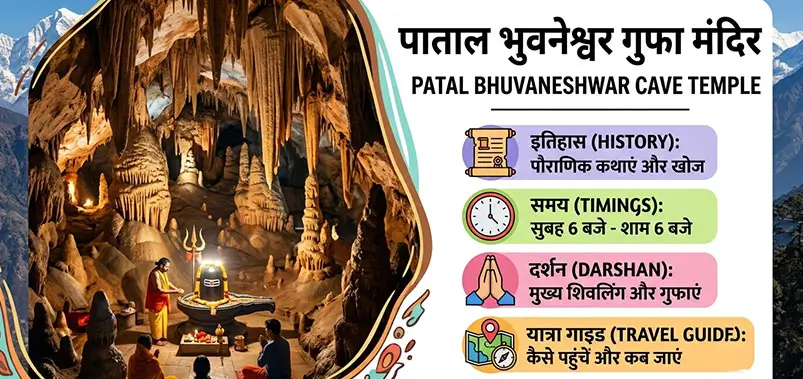
Patal Bhuvaneshwar Cave Temple: Complete Travel Guide
Deep in the Kumaon hills of Uttarakhand lies a place where pilgrimage requires visitors to leave the open mountain landscape behind and descend into a narrow limestone cave. Patal Bhuvaneshwar Cave Temple is located near Gangolihat in Pithoragarh district and is dedicated primarily to Lord Shiva. Unlike a conventional hill temple reached by a broad staircase or mountain trail, the sacred area lies underground, reached through a confined passage and a steep descent supported by iron chains.
The official Kumaon administration describes Patal Bhuvaneshwar as a pilgrimage centre near Gangolihat and records an 82-step descent through the narrow cave. Natural limestone formations inside are traditionally identified with Shiva, Ganesha, Shesh Nag and other figures from Hindu sacred tradition.
The physical setting is one reason the temple remains memorable. Visitors move from daylight into a cool, enclosed underground environment where water, stone formations, restricted space and religious beliefs become part of the same visit. It is not an attraction that should be treated as a quick roadside stop.
There is also an important current access issue. The cave has been temporarily closed to visitors from August 11 to October 10 because authorities identified low oxygen levels inside and ordered the closure as a safety measure. Travellers should therefore confirm that underground access has resumed before making a journey specifically for cave entry.
Where Is Patal Bhuvaneshwar Cave Temple and What Makes It Unusual?
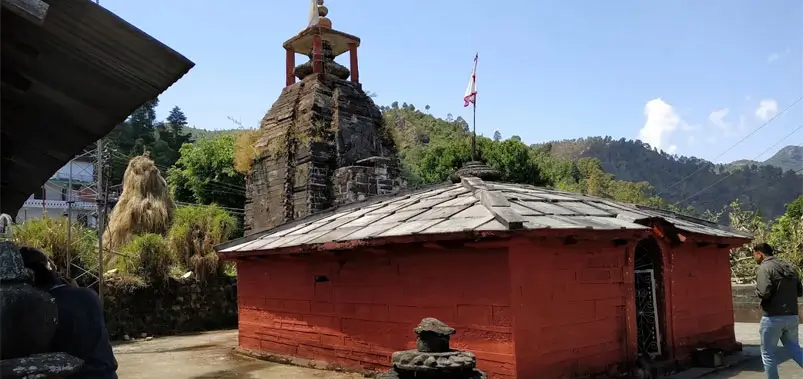
Patal Bhuvaneshwar Temple is situated in Pithoragarh district of Uttarakhand, approximately 14 km from Gangolihat. The Pithoragarh district administration identifies it as an underground shrine of Lord Shiva and places it about 91 km from Pithoragarh by its listed route. The location is part of the Kumaon Himalayan region, an area characterised by forested slopes, small settlements, winding mountain roads and distant Himalayan views.
The word "Patal" is associated with the subterranean realm, which is particularly appropriate here because the principal religious experience takes place beneath the ground. Visitors do not simply walk into a large horizontal cavern. They negotiate a narrow downward passage before reaching the sacred formations below.
Official Kumaon information states that the motorable road terminates roughly half a kilometre from the cave entrance. From there, visitors approach on foot before descending 82 steps into the cave. Iron chains provide support during the steep underground movement.
The cave's geology is inseparable from its religious significance. Water moving through limestone over long periods creates stalactites and stalagmites. At Patal Bhuvaneshwar, many of these natural shapes have been interpreted through Hindu sacred traditions. The official Kumaon description identifies formations associated with Ganesha, Shesh Nag, Garuda and Shiva, while Uttarakhand Tourism also notes that the cave is mentioned in the Skanda Purana and that water naturally falls over the Shiva Linga inside.
That combination gives the temple a character quite different from a conventional constructed shrine. Architecture does not dominate the sacred chamber; geology does.
The cave is also associated with numerous traditions concerning different ages of Hindu cosmology, the Pandavas, Shiva and ancient rulers. These accounts form an important part of the religious identity of the site, but visitors should distinguish between scriptural tradition, local belief and verifiable historical evidence. Doing so does not reduce the importance of the temple. It allows travellers to appreciate its religious meaning without presenting every traditional account as an archaeological fact.
For photographers and casual sightseers, another point matters: underground access is controlled, and photography restrictions can apply. Visitors should follow the instructions provided at the site rather than assuming that mobile phones, cameras or video equipment can be freely used inside.
Discover the Sacred Mysteries of Patal Bhuvaneshwar
Step beyond the ordinary and explore one of Uttarakhand’s most fascinating sacred cave temples. Experience ancient mythology, spiritual serenity and the mysterious beauty of Patal Bhuvaneshwar.
History, Sacred Traditions and the Limestone Formations Inside the Cave
The history of Patal Bhuvaneshwar Cave Temple Uttarakhand is preserved through a mixture of sacred texts, regional tradition and later pilgrimage history. The cave is associated with the Manas section of the Skanda Purana, and the official Kumaon administration specifically records that connection.
Traditional accounts say that King Rituparna of the Solar dynasty encountered the cave in an ancient age. The site is also associated with the Pandavas, who according to belief meditated here before their final Himalayan journey. These narratives remain part of the way priests, devotees and regional traditions describe the sacred landscape.
Another important figure connected with the cave is Adi Shankaracharya. Local and government tourism accounts associate his visit with the development of the site's later pilgrimage tradition. Exact dates given in popular retellings are not always consistent, so travellers are better served by treating the association itself as significant rather than relying heavily on a single disputed date.
Inside the cave, religious meaning is attached to naturally formed limestone features. Water continues to shape the rock, creating formations that devotees associate with divine figures and episodes from Hindu sacred tradition.
Shesh Nag is among the best-known associations. Certain formations are interpreted as the hood or body of the cosmic serpent. Other formations are connected with Ganesha, Shiva and different divine figures. Large stalactite structures are traditionally described as the matted locks of Lord Shiva.
These formations should not be viewed in the same way as carved statues in a conventional temple. Their importance comes precisely from the belief that they are naturally manifested forms.
The cave is sometimes described as containing several symbolic entrances associated with concepts such as righteousness, liberation, sin and conflict. Local traditions connect their opening or closing with major mythological events. Such accounts are part of the oral and devotional character of the cave and are normally explained during a guided visit.
For visitors unfamiliar with Hindu mythology, entering with a knowledgeable guide is particularly valuable. Without context, one might see only an unusual limestone formation. With the traditional account attached to it, the same formation becomes part of a much larger sacred narrative.
The atmosphere contributes just as much as the formations themselves. The cave is dim, confined and naturally damp. Voices carry differently underground. Movement is slow. Visitors cannot simply wander freely in every direction. These physical restrictions naturally produce a quieter, more deliberate visit.
This is one reason Patal Bhuvaneshwar pilgrimage should not be compared with an ordinary sightseeing cave. Religious conduct matters. Visitors should dress respectfully, follow instructions, avoid touching formations unless specifically permitted, keep noise controlled and never leave waste inside or near the cave.
Patal Bhuvaneshwar Timings, Cave Entry and What the Descent Is Really Like
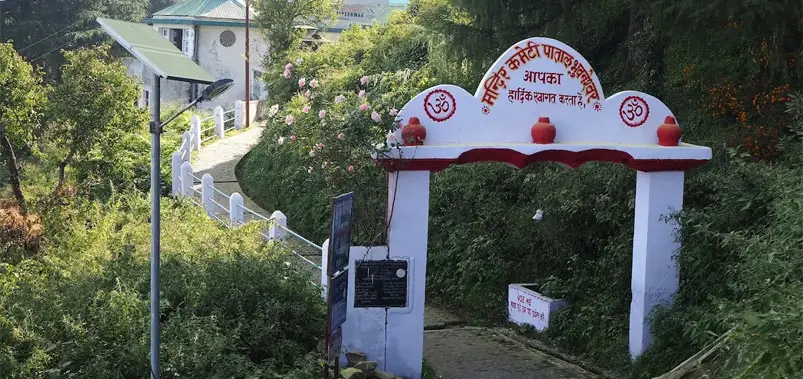
Visitors should treat Patal Bhuvaneshwar timings as seasonally variable rather than relying on one permanent schedule. Commonly reported operating hours are around 6:00 AM to 6:00 PM during the longer-day season, while winter access can be shorter, often around 9:00 AM to 5:00 PM. Local management can alter timings because of weather, daylight, crowd control or safety conditions.
The more important issue at present is that underground access is temporarily suspended from August 11 through October 10 because of concerns about low oxygen inside the cave. Authorities ordered the closure as a visitor-safety measure. Anyone travelling after the stated period should still reconfirm reopening before undertaking the long mountain journey.
When normal access operates, visitors generally enter in controlled groups rather than descending independently. The narrow passage makes unrestricted movement impractical.
The descent itself deserves serious attention.
Government information records 82 steps leading down into the cave. The passage is steep and narrow, and iron chains are installed so visitors can maintain balance. At certain points, a person may need to turn the body sideways, lower the head or carefully position the feet.
Anyone expecting a conventional temple staircase may be surprised.
The confined environment can be uncomfortable for people with claustrophobia, severe mobility limitations, significant breathing difficulties or medical conditions aggravated by restricted spaces and physical exertion. Recent oxygen-related safety concerns make it particularly important that visitors respect closure notices and local instructions rather than attempting access when authorities advise against it.
Footwear is generally removed before entering the sacred cave area, according to local temple practice. Visitors should wear clothes that allow comfortable movement. Very restrictive clothing is inconvenient during the descent. Loose items that can fall, expensive jewellery and unnecessary bags are better left securely outside.
A normal underground visit can take approximately 30 to 60 minutes, although waiting time may make the total visit considerably longer. Festival days and weekends can increase queues because the number of people inside the cave must be controlled.
Entry charges have historically been nominal rather than comparable with major ticketed monuments. Published information varies regarding the exact current Patal Bhuvaneshwar entry fee, and charges can be revised locally. Visitors should therefore carry cash and confirm the current entrance and guide charges at the authorised counter instead of relying on an old online price. An academic study of the site recorded an INR 20 visitor entry fee historically, demonstrating why older figures still circulate online but should not automatically be treated as the current tariff.
Allow two to three hours for the complete stop if arriving during a busy period. This provides time for parking, walking to the entrance, waiting for a group, completing the cave visit and returning without rushing.
How to Reach Patal Bhuvaneshwar by Road, Rail and Air
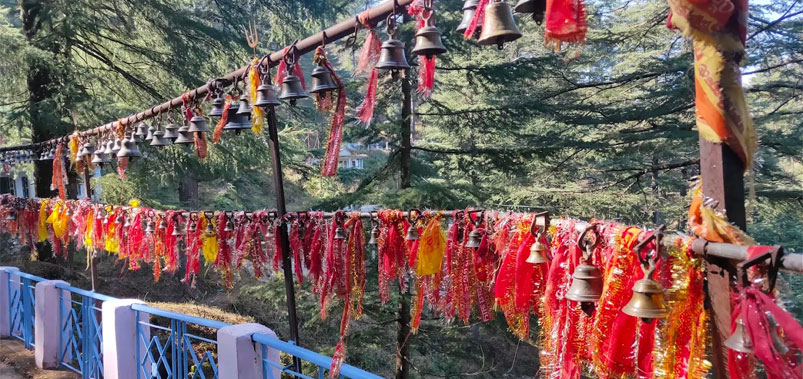
Reaching Patal Bhuvaneshwar in Uttarakhand is part of the experience because the temple sits far from the state's busiest tourism corridors.
The nearest practical approach is usually by road through the Kumaon region. Gangolihat is approximately 14 km from the cave area, according to district and Kumaon government information. Roads in this part of Uttarakhand are mountainous, so distance alone should never be used to estimate driving time.
For many travellers arriving from Delhi, the most practical rail gateway is Kathgodam. The Pithoragarh district administration lists Kathgodam at approximately 270 km from the site. A private vehicle from Kathgodam allows the journey to be divided comfortably through destinations such as Almora, Binsar, Jageshwar, Kausani or Chaukori.
Trying to arrive at Kathgodam by overnight train, drive all the way to Patal Bhuvaneshwar, enter the cave and return to Kathgodam on the same day creates an unnecessarily exhausting schedule. Mountain roads involve bends, variable surfaces, local traffic and occasional delays. A slower itinerary is safer and considerably more enjoyable.
Air access is less straightforward. The district administration lists Naini Saini Airport at approximately 90 km, but flight operations and connectivity should be checked for the actual travel date. For many international or long-distance domestic visitors, reaching Delhi and then travelling by train or road through Kumaon remains more practical.
One comfortable routing is Kathgodam – Almora – Jageshwar – Chaukori – Patal Bhuvaneshwar. This turns a remote temple visit into a broader Kumaon journey rather than a long drive undertaken solely for one attraction.
Chaukori is especially useful as a nearby overnight base because it combines Himalayan scenery with reasonable road access to the cave region. Gangolihat is another practical choice for travellers who want to remain closer to the temple.
A private car with an experienced hill driver is strongly recommended for travellers unfamiliar with Uttarakhand roads. After dark, mountain driving becomes more demanding and views disappear, so arriving at the overnight destination before evening is preferable.
Top Indian Holidays can also incorporate the temple into a private Kumaon route for travellers who want pilgrimage sites combined with mountain scenery rather than a rushed point-to-point transfer.
Travel Deeper. Discover Something Truly Extraordinary.
Some destinations are meant to be explored slowly. Experience the ancient spiritual character of Patal Bhuvaneshwar with comfortable private travel, thoughtful planning and an itinerary created around your interests.
Best Months to Visit and Weather Conditions That Matter
The most comfortable periods for a Patal Bhuvaneshwar trip are generally March to June and September to November, subject to current access conditions.
Spring and early summer offer comparatively comfortable daytime temperatures and generally better road conditions. The hills are active with vegetation, and visibility can be good, although Himalayan views always depend on atmospheric conditions.
The monsoon months require greater caution. Uttarakhand receives substantial seasonal rainfall, and mountain roads can be affected by landslides, falling rocks, temporary closures and slower traffic. A cave destination also requires additional attention during prolonged wet weather.
Autumn is particularly attractive. After the rains, the landscape is greener and clearer days can produce excellent Himalayan views from places such as Chaukori. Road journeys also become more predictable than during the peak monsoon.
Winter has a different appeal, with cold air and potentially sharp mountain views, but daylight hours are shorter. Morning and evening temperatures can become quite low, and cave access hours may be reduced.
Travellers visiting specifically for religious festivals should expect larger crowds. Maha Shivaratri has particular importance because the shrine is primarily associated with Lord Shiva. Religious dates can bring a powerful atmosphere, but visitors seeking an easy descent with minimal waiting may prefer a normal weekday.
Weather should always be checked before leaving the previous overnight stop. In the Himalayan region, conditions at the hotel can be perfectly comfortable while a road farther ahead is experiencing rain, fog or a temporary obstruction.
Where to Stay and How Much Time Is Worth Keeping for the Visit
Accommodation around Patal Bhuvaneshwar is generally simpler than the luxury inventory available in major Indian destinations. Travellers should adjust expectations accordingly.
Small hotels, guesthouses and homestays can be found around the cave region and Gangolihat. Chaukori offers another attractive base, particularly for travellers who value mountain scenery and want to combine pilgrimage with a relaxed Kumaon stay.
For comfortable accommodation in the wider region, travellers can also build the journey around better-established hotels in Almora, Binsar or nearby tourism centres and use simpler accommodation only where geography makes it necessary.
Room rates vary considerably by season and property quality. Basic guesthouses may fall around INR 1,500–3,000 per night, while better mountain hotels and resorts elsewhere on the Kumaon route can cost INR 5,000–15,000+ per night. Premium properties in Binsar and other established leisure areas can exceed these levels substantially.
Do not select accommodation purely by its stated kilometre distance from the cave. A hotel 30 km away on a mountain road can require much longer to reach than a traveller accustomed to city driving would expect.
A good schedule is to sleep within reasonable driving distance, leave after breakfast, reach the temple during daylight, complete the visit without rushing and continue to the next destination only if the drive is short.
For travellers particularly interested in religion and regional culture, two nights in the surrounding Kumaon region are preferable. The additional time can include Gangolihat's Hat Kalika Temple, Chaukori, Jageshwar or village landscapes.
Practical Safety and Visitor Advice Before Entering the Cave
Safety deserves more attention at Patal Bhuvaneshwar than at a conventional temple because visitors physically descend into a confined natural cave.
Never enter against an official closure or safety instruction. The current temporary closure due to low oxygen demonstrates that underground conditions can change and that visitor management is not merely administrative.
Anyone with serious breathing difficulties, severe claustrophobia, significant knee problems, recent surgery or limited mobility should assess the descent carefully. The challenge is not simply going down; visitors must also climb back out through the same restricted environment.
Carry water for the road journey but follow local rules about what can be taken underground. Keep luggage and large bags in the vehicle or hotel. Carry sufficient cash because mobile data and digital payment reliability can vary in remote mountain areas.
Photography rules should be respected without argument. Sacred underground spaces are not appropriate places for delaying a group in order to obtain photographs.
The strongest visit is usually the simplest: arrive with enough time, listen to the authorised guide, move carefully, observe the natural formations, respect worshippers and allow the cave's unusual physical environment to set the pace.
Related Guides



 info@topindianholidays.net
 +91-8955000999