📅 Last Updated On: 10 Sep 2026
⏱ 10 Min Read
Desert Camping in Rajasthan vs Camping in Europe: An Honest Comparison
N
Nand Singh Rathore
Travel & Tourism Expert specializing in India, Rajasthan, cultural experiences, luxury travel, and customized journeys for international travelers
Desert Camping in Rajasthan vs Camping in Europe: An Honest Comparison
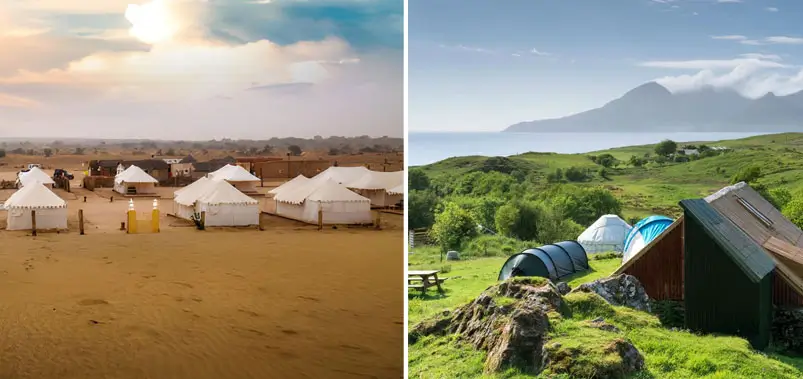
We get this question more than almost any other, and it nearly always arrives in the same shape. Somebody in England or Germany or the Netherlands is putting together a first trip to India, they have seen a photograph of a camp on the dunes outside Jaisalmer, and they want to know whether it resembles the camping they already do at home.
The honest answer is that it is the same idea carried out in a completely different set of conditions. If you camp regularly in Europe, roughly half of what you already know will transfer straight across and the other half needs throwing out. After twenty seven years of arranging this for guests, most of them from the United Kingdom, we have a reasonably clear picture of which half is which.
This is that picture, written plainly, including the parts that are less flattering to us and to the industry generally.
Start with what is genuinely the same
Both are canvas, a fire, and nothing solid between you and the landscape.
That sounds too obvious to state, but it is the reason desert camping in Rajasthan works so well for European campers in the first place. The instinct is already there. You know how to be comfortable outdoors, you know that a fire changes what an evening is for, and you are not going to be alarmed when the temperature drops after dark or when something moves outside the tent at two in the morning.
Guests who have never camped anywhere arrive at a Jaisalmer desert camp expecting a hotel with a canvas roof, and they are frequently thrown by it. Guests who camp at home arrive expecting camping. They tend to have a far better time, and they tend to book a second night.
So the shared ground is real. Everything below is where the two things part company.
The temperature swing is the single biggest difference
This is what we warn people about most often, and it is still the thing they are least prepared for.
An October afternoon in the Thar sits comfortably in the high twenties. That same night can fall to eight or nine degrees, and in December and January it goes lower. Sand holds no heat once the sun has gone, and there is nothing in the landscape to slow the drop down.
British camping does not train you for this. A cool night in Kent or Cornwall arrives gradually. In the desert it happens over about ninety minutes, usually while you are sitting by the fire feeling perfectly warm and assuming that it will stay that way.
Practically, this means one thing. Bring layers you would consider excessive for a hot country. A fleece, a proper jacket, and socks to sleep in. Every camp we work with provides heavy blankets and most will produce a hot water bottle on request, but guests who packed only for heat spend the small hours regretting it. Thar Desert camping in the good season is warm by day and genuinely cold by night, and both of those things are true on the same day.
Experience Authentic Desert Camping in Rajasthan
Discover the magic of Jaisalmer desert camping and add an unforgettable desert experience to your customized Rajasthan tour.
The sky is the part people talk about afterwards
We could describe it, but the fact that makes the point is this. Jaisalmer district has almost no settlement of any size for a very long way in most directions, and no industry generating light.
What that produces is a night sky where the Milky Way is not something you have to squint for. It arrives as a visible band across the whole thing, and on a moonless winter night you can read the shape of the dunes by starlight alone.
Europe has dark sky reserves and several of them are excellent, but there is a difference between somewhere protected as dark and somewhere that is simply empty. If you have ever had a properly clear night at a British campsite with no electric hook ups, this is that same experience with the volume turned up considerably.
If the sky is the reason you are coming, ask us to time your desert night close to a new moon. It costs nothing to plan around and it changes the night completely.
The word camp covers an enormous range here, and that matters
This is where most of the confusion comes from, and where a little honesty saves people a great deal of disappointment.
In Europe, a campsite is a fairly predictable thing. In Rajasthan the same word covers at least four different products, and they have very little in common with one another.
The large commercial camps
These sit near Sam Sand Dunes and they are the ones most visible online. They push hundreds of guests through in a single evening in peak season, with amplified music, a buffet, a dance performance and camel rides running in a queue. Some travellers enjoy the noise and the spectacle. Anybody who camps at home specifically for the quiet will not.
The mid range camps
Usually at Khuri, or slightly further out from the main dune areas. Smaller, calmer, rows of tents with attached bathrooms, dinner served communally, a fire in the middle. Perfectly pleasant and reasonably priced, and the option most of our guests end up choosing.
The luxury tented camps
Luxury tented camps in India are a different category altogether. Large canvas on raised platforms, proper beds, private bathrooms, occasionally a plunge pool. This is closer to a hotel with soft walls than it is to camping, and we say so openly. It is a lovely way to spend a night in a hot place. It is not the same activity as pitching your own tent in a field, and pretending otherwise helps nobody.
The private mobile camps
These are the closest thing to what a European camper would recognise as camping done properly. A small setup on a dune well away from everything, staff cooking over a fire, four or five tents, nobody else within sight. They need booking well ahead and they cost more than the mid range option. They are what we recommend to guests who camp seriously at home.
When somebody tells us they want to camp in the desert, our first job is working out which of those four they actually mean. Getting that wrong is the most common way a desert night disappoints.
You will not be pitching anything
Small point, but a real adjustment.
In Europe you arrive, unload, put up your own tent and cook your own food. Here the camp is standing before you get there, your bags are carried in, and dinner is cooked for you. Even at the simplest camps the labour is not yours.
Some guests love this. Others find that it takes something away, because the setting up and the cooking were half the point of camping in the first place. It is worth knowing in advance which sort of camper you are. If you are the second sort, the private mobile camps still give you the fire, the quiet and the space, and you can involve yourself in the cooking if you want to. The staff will find it mildly amusing but they will let you.
Facilities, honestly
Mid range and luxury camps will have attached bathrooms, running water, a generator supplying power for part of the evening, and sometimes patchy mobile signal. Simpler and more remote camps will have a bucket, a basic toilet tent and no power at all.
Neither is better. They are different trades. The remote camp gives you silence and stars and takes away the shower. The comfortable camp gives you the shower and takes away some of the silence, because a generator is a generator wherever in the world it happens to be running.
We will tell you which one you are booking before you book it, in plain terms. If a camp description avoids the subject of bathrooms entirely, that silence is usually informative in itself.
The season is the reverse of yours, and that is the useful part
Here is the piece of timing that makes this whole thing work for European travellers.
The best time to visit Rajasthan is October through to March. Dry, clear, and cool enough to walk around a fort at midday without suffering for it. April to June is genuinely punishing, and July to September brings the monsoon.
Which is to say that the good months here are precisely the months when camping at home has either finished or turned miserable. Most British sites run spring into autumn and shut for the winter, partly because of the ground and partly because off grid facilities that work beautifully in June work very badly in January. One eight acre car free meadow in the Kent Downs, regularly listed among the best campsites in Kent, closes for exactly that reason and openly tells its guests to go somewhere warm instead.
That is a sensible way to think about it. Two calendars that barely overlap, so you can have both rather than choosing between them.
The practical consequence is booking lead time. Our peak months fill early, particularly around Christmas, New Year, and the Pushkar and Jaisalmer festival dates. Four to six months ahead is realistic. If you are putting the tent away in October anyway, that is a good moment to be planning February.
Ready for an Unforgettable Rajasthan Desert Adventure
Experience desert nights, star-filled skies and authentic Rajasthan with a customized private tour planned around your interests.
What it costs, relative to home
Camping in Europe is cheap. A pitch fee is a pitch fee.
Desert camping here is not cheap in local terms, because you are paying for staff, transport, food and an entire setup that has to be carried to a place with nothing in it. That said, converted into pounds or euros, a good mid range camp including dinner and transfers costs less than a mid range hotel night in most European cities, and a genuinely remote private camp costs less than a night at a decent country hotel at home.
The luxury tented camps sit at proper hotel prices and are priced accordingly. There is nothing hidden in that, and anyone quoting you a luxury camp at a mid range price is quoting you something else.
How a desert night fits into a wider trip
Almost nobody comes to India purely to camp, and we would not suggest it.
The desert works as one or two nights inside a longer route. The natural version runs Delhi, Agra and Jaipur first, then onwards through Jodhpur to Jaisalmer, with the camp as the far point before you turn back. Our Golden Triangle tour packages and longer Rajasthan tour packages both extend in this direction.
One night on the dunes is memorable. Two is comfortable. Four is a commitment, and the forts and the cities are why most people came in the first place.
Getting there matters too. This is not a hike in. It is a long drive, and the last stretch is usually by jeep or camel across sand. With your own car and driver you can leave when you want and stop where you want along the way, which is the version most of our guests prefer once they have understood the distances involved.
Who it suits, and who it does not
It suits you if you camp at home for the quiet rather than for the facilities, if you are willing to be cold for a few hours in exchange for the sky, and if you are happy being looked after rather than doing everything yourself.
It suits you less if you need reliable hot water every day, if you dislike being cooked for, or if you were hoping for wilderness solitude at the large commercial camps, which is not what those exist to provide.
Either way, ask questions before booking. Ask how many guests are in camp, ask how far it is from the nearest road, ask whether there is amplified music, and ask what the bathroom arrangement actually is. Any camp worth staying at will answer all four without hesitating.
A short packing list
- Warm layers for the night, including something for your head
- Socks to sleep in, which sounds trivial until about one in the morning
- A torch, ideally a head torch
- Sunglasses and a scarf for daytime wind, which carries very fine sand
- Lip balm and moisturiser, because the air is extremely dry
- A power bank, since charging may be limited or unavailable
- Slip on shoes for sand and closed shoes for walking
That is nearly the same list you would take to a cold night in Europe, minus the waterproofs and plus the scarf.
The short version
Same canvas, same fire, same absence of a screen. Colder nights, darker skies, more staff, less setting up, and a season that runs when yours has closed.
If you camp in Europe you already have most of the instincts this needs. What you are adding is a landscape that behaves very differently once the sun goes down.
If you would like a desert night built into a wider Rajasthan route, send us your dates and a rough idea of the sort of camp you have in mind. We will come back with an itinerary that sets the options out plainly, including which camps we would steer you away from and why.


 info@topindianholidays.net
 +91-8955000999