📅 Last Updated On: 20 Oct 2026
⏱ 14 Min Read
Most Famous 7 Star Hotels in India: Palaces & Ultra-Luxury Stays
N
Nand Singh Rathore
Travel & Tourism Expert specializing in India
7 Star Hotels in India: Top Luxury Palace Hotels to Experience
Ask a travel agent in London or Sydney for the most famous 7 star hotels in India and you will hear the same names again and again: Rambagh Palace, Taj Lake Palace, Umaid Bhawan, the Oberoi "vilas" resorts. These are the hotels where a guest arrives to rose petals falling from a balcony, a butler learns how you take your tea by the second morning, and the view from the bath is a marble mausoleum or a palace floating on a lake. Yet the phrase itself needs a little honesty before we go further. India has no official seven-star rating at all. What it has is a handful of properties so far above the ordinary five-star hotel that travellers, journalists and booking sites reach for a bigger number to describe them.
This guide sorts those properties by region and style, from the royal palaces of Rajasthan to the grand city hotels of Delhi, Mumbai, Hyderabad and Chennai, and on to the safari camps and wellness retreats where the luxury is quieter. For each hotel you will find the location, the character of the place, the signature suites, realistic higher-side nightly rates in rupees with approximate US dollar equivalents, and the dining and experiences that justify the bill. The final sections cover when to travel, how to book well, and how to link these hotels into a private chauffeur-driven tour so that the road between them feels as considered as the rooms.
What a Seven-Star Hotel Really Means in India
The first thing to know is that "7 star" is not an official hotel rating in India. Hotel classification here is handled by the Ministry of Tourism through its Hotel and Restaurant Approval and Classification Committee, and the scale runs from one star to five stars, with five-star deluxe as the highest official category for modern hotels. Alongside that sits a separate set of heritage classifications for converted palaces, forts and old mansions, namely Heritage Basic, Heritage Classic and Heritage Grand, plus a newer Legacy Vintage tag for properties of special historic value. No government body awards a sixth or seventh star, and no hotel in India can legally present a seven-star certificate.
So where does the label come from? Partly from marketing in the Gulf, where the Burj Al Arab in Dubai was famously called a seven-star hotel by a visiting journalist, and the phrase stuck around the world. Partly from guests themselves, who leave a palace in Udaipur or a tented camp in the Aravalli hills feeling that the standard five-star description simply undersells what they received. In India the term has become shorthand for a small group of ultra-luxury hotels and palace stays that combine three things: a setting that cannot be copied, a ratio of staff to guests that often runs at two or three to one, and a level of personal service that anticipates rather than reacts.
Setting matters more in India than almost anywhere else. A newly built tower can match a palace on thread count, but it cannot give you the rooms where a Maharani once entertained Jacqueline Kennedy, or a dining table that seats a hundred and one guests under Venetian chandeliers. Many of the hotels in this guide are still partly owned or lived in by royal families. At Umaid Bhawan in Jodhpur, the current head of the Jodhpur royal family still occupies one wing while the Taj group runs the hotel in another. That sense of stepping into a living history is something no star rating can measure.
Service is the second test. At the very top end, a guest is met at the airport or railway station by the hotel's own car, welcomed by name, and allocated a butler who handles everything from pressing a linen shirt at midnight to arranging a private boat at sunset. Restaurants remember allergies across stays. Housekeeping notices which side of the bed you sleep on. At a good five-star hotel this happens on a good day; at the properties people call seven-star, it is simply the house standard.
The third test is space and privacy. Rooms at the Oberoi resorts in Rajasthan start at around 50 to 60 square metres, many with private gardens or semi-private pools, and the grounds run to dozens of acres. Suites at the top end can exceed 300 square metres with their own pools, dining rooms and staff quarters. Keep all of this in mind as you read the rates below: you are paying for land, history and people as much as for a bed. Prices quoted here are peak-season, higher-side figures before 18 per cent GST unless stated otherwise, converted at roughly ₹88 to the US dollar.
Royal Palace Hotels of Jaipur and Jodhpur
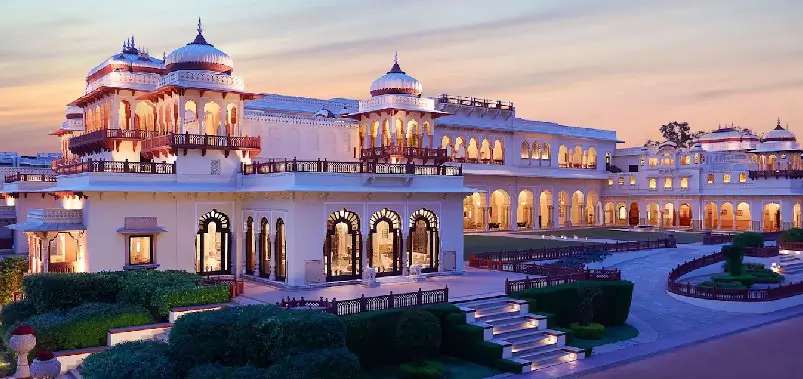
Jaipur is where most international guests first meet Indian palace hospitality, and Rambagh Palace is the reason. Set in 47 acres of Mughal-style gardens just south of the old walled city, it began life as a garden house for a royal nursemaid, grew into a hunting lodge, and later became the home of Maharaja Sawai Man Singh II and his famous wife, Maharani Gayatri Devi. The Taj group has run it as a hotel for decades, and it still feels like a private residence where you happen to have the keys. Peacocks strut across the lawns, the corridors are lined with polo trophies and old photographs, and the evening ritual of a band playing on the terrace has barely changed in generations.
Rooms here are graded from Palace Rooms through Historical Suites and Royal Suites to the Grand Presidential Suites, of which the Maharani Suite, once Gayatri Devi's own rooms, is the most requested. In the busy months between November and February, expect to pay ₹65,000 to ₹95,000 a night (about US$740 to US$1,080) for a Palace Room, ₹1,80,000 to ₹3,00,000 (US$2,050 to US$3,400) for a Historical or Royal Suite, and well over ₹6,00,000 (US$6,800 or more) for the Grand Presidential Suites. Dinner at Suvarna Mahal, the old royal banquet hall with its gilded ceiling and frescoes, is the signature meal, and a tasting menu with wine pairing can easily pass ₹20,000 for two. Lighter evenings belong to the Polo Bar and to Steam, a bar built inside a vintage steam locomotive parked in the gardens. Ask the concierge for a vintage car drive to the old city or a private polo lesson in the cooler months.
For guests who prefer a resort to a palace, The Oberoi Rajvilas sits about 8 km east of the centre on Goner Road, spread across 32 acres of gardens, fountains and reflecting pools. It was designed as a fortified village rather than a single building, so you walk between low pink-washed courtyards, a restored eighteenth-century Shiva temple, and an old heritage mansion now used as the spa. Premier Rooms come with canopied beds and sunken marble baths and cost roughly ₹55,000 to ₹90,000 a night (US$625 to US$1,020) in peak months. The luxury tents, raised on platforms with teak floors and brass fittings, are the guests' favourite and run around ₹75,000 to ₹1,10,000 (US$850 to US$1,250). The Royal Tent and the Kohinoor Villa, each with its own pool and butler, sit at several hundred thousand rupees a night. Dinner at Rajmahal, the hotel's Indian restaurant, and a nightcap at the Rajwada Library Bar complete the picture.
Five hours west by road lies Jodhpur and the most imposing palace hotel in the country. Umaid Bhawan Palace was built in the first half of the twentieth century by Maharaja Umaid Singh, partly as a famine-relief project that kept thousands of workers employed for well over a decade. Its golden Chittar sandstone dome rises above the city on Chittar Hill, and the building holds 347 rooms in total, though the Taj-run hotel uses only a fraction of them while the royal family occupies the rest and a museum takes another wing. The interiors are pure Art Deco, unusual for India, with black marble, geometric inlay and a magnificent underground indoor swimming pool decorated with zodiac mosaics.
Umaid Bhawan was once voted the best hotel in the world by Tripadvisor travellers, and it prices itself accordingly. Palace Rooms run from roughly ₹75,000 to ₹1,50,000 a night (US$850 to US$1,700) depending on the date, Historical Suites from about ₹2,50,000, and the Maharani and Maharaja Suites, with Art Deco bathrooms and private terraces, from around ₹7,00,000 (US$8,000) upwards. Dining is at Risala, a grand room lined with cavalry memorabilia, at Pillars on the colonnaded verandah, and at the Trophy Bar. Book a sunset drink on the lawns facing Mehrangarh Fort across the city; it is one of the finest views in Rajasthan.
Udaipur's Lake Palaces and Island Retreats
If Jaipur is about grandeur, Udaipur is about water, and no hotel says it better than the Taj Lake Palace. Built in the mid-eighteenth century by Maharana Jagat Singh II as a summer pleasure palace on Jag Niwas island in the middle of Lake Pichola, it appears to float when the lake is full. Guests reach it only by the hotel's boat from its own jetty beside the City Palace, a short crossing that sets the tone for the whole stay. Film fans will know it from the James Bond film Octopussy, but most guests remember it for the quiet: no traffic, only water, birdsong and the call of the boatmen.
The hotel holds just over 80 rooms and suites. Luxury Rooms with lake or lily-pond views cost around ₹75,000 to ₹1,10,000 a night (US$850 to US$1,250) at the busiest times. The Royal Suites, such as Basant Bahar, are priced in the region of ₹5,50,000 (US$6,250), and the Grand Royal Suites, including Sajjan Niwas and Sarva Ritu, with their stained-glass windows, miniature paintings and swing seats, cost more again. Neel Kamal serves Rajasthani and royal Mewar recipes and is open only to resident guests; Bhairo offers a seasonal European menu on the rooftop; and Amrit Sagar is the bar. The signature experience is a private dinner on the hotel's ceremonial barge, served on the water with the City Palace lit up behind you, which can add ₹40,000 or more for two.
Across the lake on its eastern shore stands The Oberoi Udaivilas, regularly ranked among the best resort hotels in the world. It occupies around 30 acres of the former hunting grounds of the Maharana of Mewar, with domes, courtyards and reflecting pools that run down to the water. Every room faces the lake or a garden, and the most sought-after categories open directly onto a semi-private pool that stretches the length of the wing. Premier Lake View Rooms cost roughly ₹80,000 to ₹1,30,000 a night (US$910 to US$1,480), while Premier Rooms with semi-private pools reach ₹1,20,000 to ₹1,60,000 (US$1,360 to US$1,820). The Kohinoor Suite, with its own 21-metre pool, marble fireplaces and a four-poster mahogany bed, has been reported at about ₹11,00,000 a night (around US$12,500), making it one of the most expensive hotel rooms in the country.
Dining at Udaivilas centres on Udaimahal for regional Indian cooking and Suryamahal for all-day meals, but guests most often book a private table by the lake or on a pavilion in the gardens. The resort's own boat runs to the City Palace and to the smaller island palace further down Lake Pichola, and the spa, built around old courtyards, offers Indian and Thai treatments. Wild boar and spotted deer still wander the adjoining nature reserve at dawn.
The newest name in Udaipur is Raffles Udaipur, which opened on a private 21-acre island in Udai Sagar lake, about 20 minutes from the airport and roughly 25 minutes from the old city. Guests drive to the shore and cross by boat, so the island stays entirely private. The 101 rooms and suites are decorated with hand-painted murals, carved furniture made by Rajasthani craftsmen, and terraces that look over the water; the upper categories add private gardens and plunge pools. Peak-season rates start at around ₹65,000 to ₹1,10,000 a night (US$740 to US$1,250), with signature suites considerably higher.
Raffles brings its own traditions to the lake. The Long Bar serves the signature Udaipur Sling, a local twist on the Singapore classic, while the Writers Bar is a quieter room for champagne and caviar. Sawai Kitchen serves recipes drawn from royal households, Harvest cooks with produce from the estate farm, and afternoon tea is served with a view of the hills. Many guests split their stay, spending two nights at Raffles or Udaivilas for space and calm, and one night at the Lake Palace for the sheer romance of sleeping in the middle of Lake Pichola. That combination is the most reliable way to see both faces of the city.
Ultra-Luxury Hotels in Delhi and Agra
Most first-time visitors begin in Delhi, and for many the standard-setter there is The Leela Palace New Delhi in Chanakyapuri, the city's leafy diplomatic enclave. It is a modern building, not a historic palace, but it was designed to feel like one, with Lutyens-inspired domes, gold-leaf detailing, enormous chandeliers and a rooftop infinity pool with views across the embassies. Its 254 rooms and suites are among the largest in the capital, and every guest has access to round-the-clock butler service. That combination of calm, space and polish makes it a natural first or last night for a luxury Golden Triangle tour.
Grand Deluxe rooms run at roughly ₹30,000 to ₹55,000 a night (US$340 to US$625) in the cooler months, Royal Club rooms with lounge access a little more, and the Maharaja Suite, spread over several hundred square metres with a private spa room, dining room and study, has been priced at about ₹5,50,000 a night (US$6,250). The dining is serious. Jamavar serves refined regional Indian cooking in a room inspired by the patterns of Kashmiri shawls, and its slow-cooked lamb curries are among the city's best; Megu is a Japanese restaurant with a striking glass and sculpture interior; The Qube serves what many travellers consider the finest hotel breakfast in India; and the Library Bar is the right place for a single malt after dinner. The spa offers Ayurvedic treatments tailored to individual body types, and the hotel can arrange a private chauffeured shopping tour of Delhi's best boutiques.
Delhi has other contenders at this level, notably the Taj Palace, The Oberoi New Delhi and the Imperial on Janpath, but the Leela Palace is the one that most consistently earns the seven-star label from returning guests.
From Delhi, the Yamuna Expressway carries you about 230 km south to Agra in roughly three and a half to four hours by car. Here there is really only one hotel that belongs in this list: The Oberoi Amarvilas, sitting about 600 metres from the Taj Mahal. Every single room and suite has an uninterrupted view of the monument, and that is the whole point. Waking up, drawing the curtains and seeing the white dome turning pink in the early light is the kind of moment guests talk about for years. The architecture borrows from Mughal and Moorish styles, with terraced lawns, fountains, pavilions and a long reflecting pool leading the eye straight to the Taj.
Premier Rooms with a Taj view cost roughly ₹70,000 to ₹1,25,000 a night (US$800 to US$1,420) in the peak months of November to February. Suites begin at around ₹3,50,000 (US$4,000), and the Kohinoor Suite, the hotel's finest with a private terrace facing the Taj, has been reported at about ₹11,00,000 a night (around US$12,500). The hotel's private golf carts take guests to the eastern gate of the Taj Mahal, saving a long walk, and the guest relations team can arrange sunrise entry with a licensed guide so that you reach the main platform before the day crowds arrive.
Dinner is at Esphahan, the Indian restaurant where a classical string musician performs most evenings and the menu leans towards rich North Indian and Mughal-style cooking, or at Bellevue, the all-day restaurant facing the gardens. A dinner for two with wine runs from about ₹13,000 to ₹20,000. The bar terrace at sunset is the hotel's quiet secret: a gin and tonic, a dusk sky and the Taj Mahal changing colour in front of you. For entry, foreign visitors pay ₹1,100 for the Taj Mahal plus an extra ₹200 for the main mausoleum, a figure your guide will handle on the day. Most guests spend two nights, giving one full day for the Taj, Agra Fort and the tomb of Itimad-ud-Daulah, sometimes called the "Baby Taj".
Grand Hotels of South and West India
Not every celebrated Indian hotel is in Rajasthan. On the waterfront of Mumbai, directly opposite the Gateway of India, stands The Taj Mahal Palace, the oldest grand hotel of the Taj group and the building that started Indian luxury hospitality as we know it. It opened in the early years of the twentieth century, founded by Jamsetji Tata, and its red-domed Palace Wing has hosted kings, prime ministers, musicians and Hollywood stars. The famous cantilevered staircase, the art collection worth a museum, and the view of boats rocking in the harbour all make it far more than a business hotel.
Rooms in the newer Tower Wing start around ₹25,000 to ₹40,000, but the reason to stay is the Palace Wing, where Luxury Grande and heritage rooms cost roughly ₹45,000 to ₹80,000 a night (US$510 to US$910) in the winter season. The Tata Suite, which has hosted presidents and film stars, covers two bedrooms, a living and dining room, a private office, a meeting room for 15, its own gym and a spa with a sauna; reported rates run from ₹7,00,000 to ₹12,00,000 a night (about US$8,000 to US$13,600). Dining choices include Wasabi by Morimoto for Japanese food, Golden Dragon for Sichuan and Cantonese cooking, Masala Kraft for modern Indian, and the Sea Lounge for afternoon tea above the harbour. Harbour Bar holds Mumbai's first bar licence and is worth one drink for the history alone. Ask for the heritage walk led by the hotel's own historian.
Roughly 700 km south-east of Mumbai, on a hilltop above Hyderabad's old city, sits Taj Falaknuma Palace, the former home of the Nizams of Hyderabad, who were once among the richest men in the world. Its name means "mirror of the sky", and the building is a confection of Italian marble, Venetian chandeliers, Belgian stained glass and an extraordinary library modelled on the one at Windsor Castle. Guests arrive at the foot of the hill and are carried up by horse-drawn carriage, then showered with rose petals at the entrance. The Taj group spent close to a decade restoring the palace before opening it as a hotel with 60 rooms and suites.
Palace Rooms here start from about ₹55,000 and climb to around ₹1,10,000 a night (US$1,250) at the busiest times. The Historical Suites face the city from private terraces, the Royal Suites sit in the former women's quarters, and the grand Nizam Suite has its own pool, garden and butler, priced at several hundred thousand rupees a night. The signature experience is dinner at the 101-seat dining table, among the longest in the world, where the Nizam once hosted royal guests; private dinners for groups can be arranged here at a considerable premium. Daily dining is at Adaa, which serves royal Hyderabadi recipes including a slow-cooked biryani, a layered rice and meat dish sealed under dough and cooked overnight, and at Celeste for Mediterranean and international food. High tea in the Jade Room is a ritual in itself, and the hotel's guided tour of the palace's state rooms is free for residents.
Chennai's contribution is ITC Grand Chola in Guindy, a vast hotel built in the style of the great Chola temples of Tamil Nadu, with carved stone pillars, towering gateways and around 600 rooms. It is less intimate than the palaces above, but its scale and finish are remarkable, and it is one of the few luxury hotels in India with a strong environmental certification. Executive Club rooms cost around ₹20,000 to ₹40,000 a night (US$230 to US$455), a fraction of Rajasthan's palace rates, while the Grand Presidential Suite is priced at several hundred thousand rupees. The hotel's real draw is food. Avartana serves a modern South Indian tasting menu that has won national awards, Peshawri offers North-West Frontier grills cooked in clay ovens, and Royal Vega is a dedicated vegetarian restaurant drawing on royal kitchens. The Kaya Kalp spa is among the largest hotel spas in South India.
Wildlife, Desert and Wellness Hideaways
Some of India's most memorable luxury stays have nothing to do with chandeliers. In the Thar Desert, about 14 km outside Jaisalmer on the road to the Sam sand dunes, Suryagarh is a modern fort built in the old style, with golden sandstone walls, courtyards and towers that glow at sunset. Pavilion and Heritage Rooms cost about ₹35,000 to ₹65,000 a night (US$400 to US$740) in winter, and the Suryagarh Suites, each with a private dining room and rooftop pool, run well above ₹1,00,000. The hotel is known for its theatrical experiences: the Thar Dinner, served in a caravan-style camp under the stars with folk musicians; the Chudail Trails, a night-time journey through the abandoned village of Kuldhara and other supposedly haunted corners of the desert; sundowners on the dunes; and breakfast with peacocks to the sound of a flute. Legends of Marwar is the fine-dining restaurant and Draksh the bar.
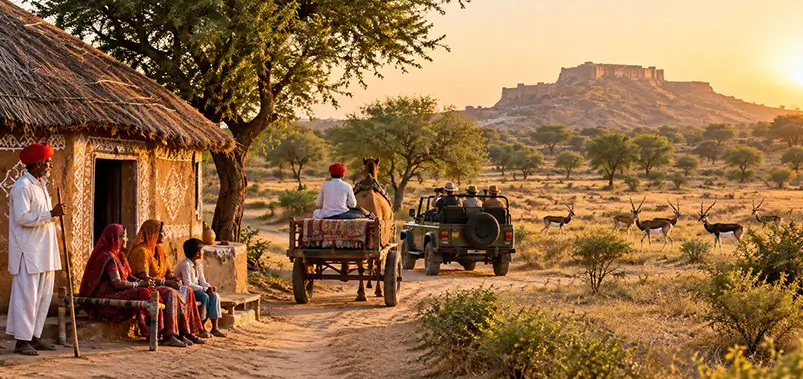
South of Jodhpur, between the granite hills of the Pali district, SUJAN Jawai is a tented camp of just 15 suites set in leopard country. The landscape is unlike anywhere else in India: huge boulders, scrub forest and a reservoir that attracts flamingos and crocodiles, all shared with the Rabari, a community of semi-nomadic herders who have lived alongside the leopards for centuries. The camp works on an all-inclusive basis, and published rates for the high season stood at around ₹1,25,000 to ₹1,37,000 per tent per night (US$1,420 to US$1,560) plus taxes for two guests, covering all meals, laundry, station transfers and two daily wilderness drives, with a conservation fee of ₹2,500 per person per night on top. The Royal Panthera Suite runs to about ₹2,75,000 (US$3,125), and the private Eden camp is priced above ₹4,00,000. Leopard sightings are common, and evening drinks are served on the rocks with the cats sometimes visible on the ridges opposite.
For tigers, the address is The Oberoi Vanyavilas at Ranthambore, about 180 km from Jaipur. Its luxury tents sit in 20 acres of gardens and orchards, each with a king-size four-poster, a claw-foot bathtub and a private walled garden. Peak rates around Christmas and New Year reach roughly ₹90,000 to ₹1,60,000 a night (US$1,020 to US$1,820), with the Royal Tent, which has its own pool, priced far higher. Jeep safaris into the national park are booked separately through the forest department, and the hotel arranges private vehicles with experienced naturalists. A bonfire dinner with folk dancers is the evening ritual.
Nearby, about 30 km north of Sawai Madhopur, Six Senses Fort Barwara occupies a restored fourteenth-century fort with 48 suites, a vast spa and views over a lake and the Aravalli hills. Suites cost about ₹90,000 to ₹1,50,000 a night (US$1,020 to US$1,700) in the festive weeks. It became famous after a high-profile Bollywood wedding, but its daily appeal is calm: yoga in the fort courtyards, sleep programmes, a temple still used by villagers, and tiger safaris in Ranthambore within an hour's drive.
Finally, in the Himalayan foothills above Rishikesh, Ananda in the Himalayas sits on a 100-acre estate around the old palace of the Maharaja of Tehri Garhwal at Narendra Nagar, roughly 45 minutes from Dehradun airport. This is India's best-known destination spa, combining Ayurveda, yoga, meditation and fitness. Deluxe rooms cost about ₹85,000 to ₹1,10,000 a night (US$970 to US$1,250) with meals, while the one-bedroom villas with heated pools and butlers cost far more. Most guests book a structured programme of a week or longer.
How to Book, the Best Season and What Makes a Stay Seven-Star
The best season for luxury hotels in India is October to March, when days are warm and dry and evenings are cool enough for dinner outdoors. In Rajasthan, Delhi and Agra, daytime temperatures in December and January sit around 20 to 24 degrees Celsius, falling to 6 to 10 degrees at night, which is perfect for terraces and bonfires. That comfort comes at a price: the window between 20 December and 5 January is the most expensive of the year, with rates often 30 to 50 per cent above November levels and minimum stays of two or three nights at many properties. October, early November, February and March offer the same weather with lower rates and better room availability.
The summer months of April to June are hot, with Rajasthan regularly passing 42 degrees, and the monsoon from July to September brings humidity and rain. Yet this is also when the palace hotels quietly cut their prices, sometimes by half. Rambagh Palace and Umaid Bhawan in July can cost what a mid-range suite costs in December, and the monsoon gives Udaipur's lakes their fullest and greenest look. Wildlife lodges are the exception: Ranthambore's core zones close from July to September, and the best tiger sightings come in the hot months of April and May when animals gather at water holes. SUJAN Jawai closes for part of the summer each year.
Booking well at this level is mostly about room choice and timing. At the Oberoi resorts, the jump from a Premier Room to a room with a semi-private pool is often the best-value upgrade you can make. At the Taj palaces, a Historical Suite usually gives far more character per rupee than a standard Palace Room. Always ask what is included: some rates bundle breakfast and airport transfers, others add a dinner or a spa credit, and the difference can be worth ₹15,000 to ₹25,000 a night. Remember that GST of 18 per cent applies to room rates above ₹7,500 a night, so a room quoted at ₹1,00,000 will cost ₹1,18,000 on checkout. Book four to six months ahead for winter, and nine months or more for Christmas, New Year or Diwali.
So what actually makes a stay feel seven-star? From the experience of guests who have stayed at most of these hotels, a few patterns appear. First is recognition: being greeted by name at arrival, and finding your pillow preference, newspaper and favourite drink already arranged on the second visit. Second is anticipation: the umbrella appearing before rain, the cushion placed behind your back before you ask, the car waiting at exactly the right gate after a monument visit. Third is place: a room or terrace with a view you could not find anywhere else on earth, whether that is the Taj Mahal, Lake Pichola or a leopard on a granite ridge. Fourth is food: kitchens that can cook a regional dish properly and adapt it to a guest's needs without fuss.
Finally, there is the invisible part. At the best properties, staff are drawn from local families who have worked in the same palace for two or three generations, and they carry stories the guidebooks leave out. Ask your butler about the hotel's history, request a walk with the house historian, or ask to see the kitchens; doors open in a way they never would at a standard hotel. That human connection is what turns an expensive night into a memorable one.
Building a Private Luxury Tour Around These Hotels
The hotels above are wonderful individually, but they reach their full value when linked by a well-paced private luxury tour of India. The classic starting point is the luxury Golden Triangle tour, pairing The Leela Palace or Taj Palace in Delhi with The Oberoi Amarvilas in Agra and Rambagh Palace or The Oberoi Rajvilas in Jaipur. A sensible pace is two nights in each city, giving time to rest between monuments rather than racing from one to the next. The road distances are manageable: Delhi to Agra is about 230 km on the Yamuna Expressway and takes three and a half to four hours, while Agra to Jaipur is about 240 km and takes four and a half to five hours with a stop at the abandoned Mughal city of Fatehpur Sikri.
From Jaipur, the natural extension is the Rajasthan palace circuit. Ranthambore lies about 180 km south-east, a drive of three and a half to four hours, and two nights at The Oberoi Vanyavilas or Six Senses Fort Barwara allow for three or four jeep safaris. Jodhpur is about 340 km west of Jaipur, roughly six hours on the road, and two nights at Umaid Bhawan Palace give time for Mehrangarh Fort, the blue lanes of the old city and a sunset on the palace lawns. From Jodhpur, Jaisalmer is about 285 km and five hours away, where two nights at Suryagarh fit perfectly around a dune dinner and a visit to the living fort.
On the return, SUJAN Jawai sits roughly 150 km from Jodhpur, around three hours by car, and two nights in leopard country make a peaceful change after the cities. From Jawai to Udaipur is another 150 km or so, about three hours, with the marble Jain temple at Ranakpur as a worthwhile stop on the way. Finish with three nights in Udaipur split between The Oberoi Udaivilas or Raffles Udaipur and the Taj Lake Palace, then fly back to Delhi or Mumbai. That full circuit runs to about 16 or 17 nights, and it can easily be shortened by dropping the desert or the wildlife leg.
Vehicle choice matters at this level. For couples, a Mercedes-Benz or Toyota Fortuner with a professional chauffeur makes long drives restful, and the luggage space suits the longer stays these itineraries involve. For families or small groups, an Innova Crysta or a Force Urbania gives more room without losing comfort. A chauffeur who knows the palace hotels by heart is a quiet advantage, because he knows which gate the porters use, how long the boat crossing to the Lake Palace really takes and where to stop for a clean washroom between Jodhpur and Jaisalmer.
Budget sensibly for the whole journey. On the higher side, a two-week luxury Rajasthan and Golden Triangle tour staying at the hotels in this guide, with a private car, licensed guides and monument entries, typically costs between ₹10,00,000 and ₹18,00,000 for two people (about US$11,400 to US$20,500), depending on room categories and season. Adding suites at Rambagh, Umaid Bhawan or the Oberoi resorts can push that well above ₹25,00,000. Pacing is the secret to value: fewer hotels, longer stays, and drives timed so that you arrive for lunch, not after dark.
Top Indian Holidays, a Ministry of Tourism approved operator based in Jaipur for more than a quarter of a century, regularly arranges private chauffeur-driven Golden Triangle tours with Taj, Oberoi and Leela hotels, and Rajasthan journeys built around Umaid Bhawan, Suryagarh and SUJAN Jawai, if you would like the routing and bookings handled as one trip.
Related Guides



 info@topindianholidays.net
 +91-8955000999