📅 Last Updated On: 15 Oct 2026
⏱ 9 Min Read
Jaipur to Sanwariya Seth Temple Distance by Road: Route, Time & Taxi Fare
N
Nand Singh Rathore
Travel & Tourism Expert specializing in India
Every month, on the night before the new moon, the highway south of Chittorgarh starts to fill up with cars, jeeps, tractors and packed buses all heading for one small village called Mandaphiya. Families from Jaipur leave after dinner so they can reach in time for the early morning prayer ceremony. Traders from Bhilwara come with a share of their profits set aside for the deity they call their business partner. Couples arrive with sweets to thank the Lord for a wedding fixed or a child born. The destination for all of them is the Sanwariya Seth Temple, also written Sanwaliya Seth, one of the most visited Krishna shrines in Rajasthan.
For pilgrims and travellers starting from the Pink City, the journey is long enough to need some thought but easy enough to manage in a single day of driving. This guide covers the Jaipur to Sanwariya Seth distance by road, the best route, honest driving times, toll costs and realistic taxi fares for a sedan, an Innova Crysta and a Tempo Traveller. It also explains temple timings, prayer ceremony times, the busy fair days, what to wear, where to sleep nearby, and how to turn a single temple visit into a short Mewar trip that includes Chittorgarh Fort, Nathdwara and Udaipur. If you prefer rail or bus, those options are covered too.
Jaipur to Sanwariya Seth Temple Distance by Road and the Best Route
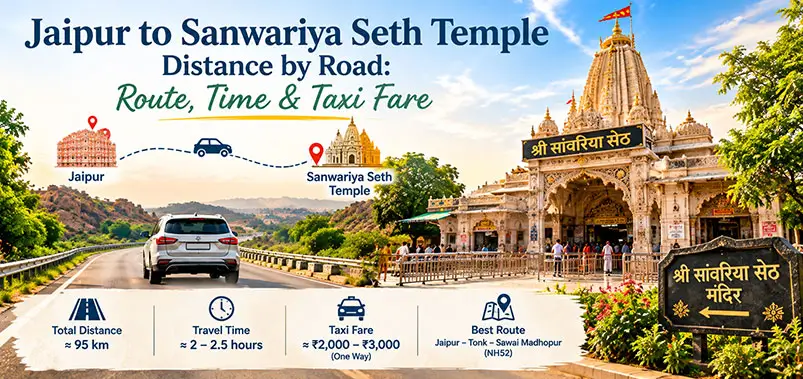
The Jaipur to Sanwariya Seth Temple distance by road is roughly 335 to 345 km, depending on where in Jaipur you start and whether you drive through Chittorgarh town or use the bypass. Most drivers settle on a working figure of about 340 km one way, which means close to 700 km for a return trip once you add a little local driving at the temple and in Chittorgarh. The temple itself sits in Mandaphiya village in Chittorgarh district, around 40 km south-west of Chittorgarh and a few kilometres off the main Chittorgarh to Udaipur highway near Bhadsora.
The best and most popular route is the NH48 route via Kishangarh, Bhilwara and Chittorgarh. You leave Jaipur by the Ajmer Road, pass Bagru and Dudu, and reach Kishangarh, the marble town, in about an hour and a half. From here the highway swings south past Nasirabad, skirting Ajmer, and continues on a wide divided road to Bhilwara, the textile city. Beyond Bhilwara the road runs through flat farmland, past Gangrar, and reaches the Chittorgarh bypass. A short way after Chittorgarh you join the highway towards Udaipur, which is shared by NH48 and NH27, and drive roughly 35 km more until the turn for Bhadsora and Mandaphiya. Signboards for the temple are clear and frequent on this last section, and any map app will take you straight to the parking area.
The great advantage of this route is the road quality. Almost all of it is four-lane or six-lane divided highway, with fuel stations, food courts and clean washrooms every 30 to 40 km. Night driving is also easier here than on narrower state roads, which matters for families who like to reach the temple before dawn. Most professional chauffeurs in Jaipur will choose this route without being asked.
There is a second, longer option via Tonk, Deoli, Bundi and the Chittorgarh to Kota stretch of NH27. This works out at about 440 to 460 km and adds roughly two hours of driving, so it only makes sense if you want to add Bundi's stepwells and palace to the trip or are coming back by a different road to see something new. A third option, through Tonk, Deoli and Mandalgarh, saves no time and uses narrower state roads, so it is rarely worth it.
For pilgrims coming from other cities, it helps to know the distances from nearby hubs. Chittorgarh railway station is about 41 km from the temple, Udaipur city is roughly 75 to 80 km away, and Maharana Pratap Airport at Dabok, Udaipur, the nearest airport, is about 65 km away. Nathdwara, home of the Shrinathji Temple, is around 100 km by road. These figures make it simple to link the temple visit with other places in Mewar, which we cover later in this guide.One practical tip on the route: fill up with fuel at Bhilwara or on the Chittorgarh bypass, especially if you are driving at night. Village pumps near the temple can be crowded on fair days, and queues for diesel stretch long. Keep the FASTag recharged with a comfortable balance too, because there are several toll plazas between Jaipur and Chittorgarh and a failed scan at midnight is a frustrating way to lose ten minutes.
Plan Your Sanwariya Seth Temple Darshan Trip
Make your temple visit smooth and convenient with a personalized travel plan from Jaipur to Sanwariya Seth Temple, Mandaphiya. Get assistance with taxi options, route planning, and return-trip arrangements.
Driving Time, Road Conditions, Tolls and Stops on the Way
The driving time from Jaipur to Sanwariya Seth is usually 5 hours 30 minutes to 6 hours 30 minutes of actual driving. Add a tea break, a meal stop and a short halt for fuel, and a realistic door-to-door time is 7 to 7 hours 30 minutes. On the monthly new moon fair days and during the Jaljhulni Ekadashi fair, the last 10 km near Mandaphiya can be slow, with traffic control, diversions and long walks from the overflow parking, so allow at least another hour on those dates.
The road between Jaipur and Kishangarh is a busy six-lane highway with heavy truck traffic, particularly around Bagru, Dudu and the Kishangarh marble markets. Early morning departures help. From Kishangarh to Bhilwara the highway is smooth and steady, and you can hold good speeds legally, though trucks often drift between lanes. Between Bhilwara and Chittorgarh the road is equally good. The final stretch from Chittorgarh towards Bhadsora is a divided highway too, and only the link road into Mandaphiya village is a narrower two-lane road with speed breakers and a lot of pedestrian traffic close to the temple.
Toll charges between Jaipur and Sanwariya Seth add up because you cross several national highway plazas. For a car or SUV, the one-way total generally comes to around ₹750 to ₹900, and close to double that for a return journey. A Tempo Traveller is classed as a light commercial vehicle and pays noticeably more, often ₹1,300 to ₹1,500 one way. Rates are revised every year, usually from April, so it is wise to budget on the higher side. With a taxi, ask whether tolls are included in the quoted fare or billed separately at actuals, because this can change the final bill by ₹1,500 to ₹3,000 on a round trip.
Stops make the drive far more pleasant, particularly with older family members on board. Kishangarh, about 100 km from Jaipur, has plenty of highway restaurants and is a natural place for breakfast. Bhilwara, roughly the halfway point, works well for a lunch stop, and travellers who want to stretch their legs can visit the Harni Mahadev Temple on the city's edge. Some families also take a short diversion to Menal, a group of carved Shiva temples beside a seasonal waterfall, which lies about 20 km off the route between Bundi and Chittorgarh and is at its best after the monsoon.
The most worthwhile stop of all is, of course, Chittorgarh Fort, which stands right above the highway. Even if your main purpose is the temple visit, it is worth giving the fort at least two to three hours either on the way down or on the way back. We return to it in more detail below.
For overnight drives, choose a well-rested driver and avoid pushing straight through. Many Jaipur families leave at 10 or 11 at night to reach Mandaphiya in time for the 5:30 am prayer ceremony. That is perfectly doable with a professional chauffeur who has slept during the day, but it is not something to attempt yourself after a full working day. If you are self-driving, a far safer pattern is to leave Jaipur in the morning, sleep in Chittorgarh, and drive the final 40 km at dawn.
Taxi Fare from Jaipur to Sanwariya Seth by Vehicle Type
Jaipur to Sanwariya Seth taxi fare depends on three things: the vehicle, whether you need a one-way drop or a return trip, and how many days the car stays with you. Outstation taxis in Rajasthan are normally charged per kilometre with a daily minimum of 250 to 300 km, plus a driver allowance for each night, plus tolls, state permits where needed and parking. The figures below are on the higher side of what reputable operators charge, so you are unlikely to be surprised by the final bill.
A sedan such as a Toyota Etios or Swift Dzire is the right choice for up to three adults with medium luggage. Expect around ₹14 to ₹15 per km. A one-way drop from Jaipur to the temple typically costs ₹7,500 to ₹8,500, as most operators charge for at least part of the empty return journey. A two-day round trip, covering about 720 km including local running, works out at roughly ₹11,500 to ₹13,500 including the driver allowance, with tolls added at actuals. This is the most economical option for a couple or a small family.
An Innova Crysta taxi from Jaipur to Sanwariya Seth is the most popular choice for families of four to six, and for anyone who values legroom on a long highway journey. Rates usually run at ₹20 to ₹22 per km. A one-way transfer is around ₹10,500 to ₹12,000, while a two-day round trip typically lands between ₹16,000 and ₹18,500, plus tolls. The Crysta's high seating, strong air conditioning and captain seats make a real difference on a seven-hour drive, especially for elderly parents.
A Tempo Traveller for a Sanwariya Seth group trip makes sense for nine to twelve passengers, which is common for extended family pilgrimages and office groups. The usual rate for a 12-seater is around ₹28 to ₹30 per km, sometimes slightly more for a luxury pushback-seat version. A one-way drop is roughly ₹14,000 to ₹16,500, and a two-day round trip about ₹22,000 to ₹26,000 plus tolls, which are higher for this vehicle class. Divided between twelve people, this is often cheaper per head than travelling in two separate cars.
Travellers who want more comfort can book a Toyota Fortuner or even a Mercedes-Benz for the same trip. These are less common for temple journeys but popular with business families from Jaipur who combine the visit with a stay at a heritage hotel. Expect roughly ₹28 to ₹35 per km for a Fortuner and considerably more for a luxury sedan.
A few points are worth checking before you confirm any booking. Ask whether the quote includes tolls, parking, the driver's food and night allowance, and whether the per-km rate applies from your hotel in Jaipur or from the operator's garage. Night driving between 10 pm and 6 am sometimes carries a small extra charge. On new moon fair days, parking near the temple can be several hundred metres away, so confirm the driver will wait for you at a fixed spot and keep his number saved. Finally, a same-day round trip of around 700 km is technically possible, but it means 13 to 14 hours on the road, which is tiring for passengers and unsafe for the driver. Two days, with a night in Chittorgarh or near the temple, is a far better arrangement.
The Story and History of the Sanwaliya Seth Temple at Mandaphiya
The story of the Sanwaliya Seth Temple history begins in the mid-nineteenth century with a cowherd named Bholaram Gurjar. According to local tradition, he dreamt that three idols of Lord Krishna lay buried in the Chhapar area at the border of Bhadsoda and Bagund villages. When the villagers dug at the spot he described, they found exactly what he had seen in his dream: three dark stone images of Krishna. One idol remained at the place where they were found, one was taken to Bhadsoda, and one was installed at Mandaphiya. In time, temples rose at all three places, each within about five kilometres of the others.
Many devotees believe the idols were once worshipped by the Krishna devotee Mirabai, the poet-princess of Mewar, and that they were hidden underground to protect them during the invasions of medieval times. This belief adds to the emotional pull of the place for families who also visit the Meera Temple inside Chittorgarh Fort on the same trip.
Of the three shrines, the temple at Mandaphiya has become by far the largest and best known. Pilgrims call it the main seat of the Lord, and the complex has grown into a grand structure of pink sandstone with carved pillars, decorated arches, broad courtyards and towering spires. The idol inside is of dark stone, which gives Krishna his name here, Sanwariya or Sanwaliya, meaning the dark-complexioned one. Many Vaishnav followers regard it as the second most important centre of their tradition in the region after the Shrinathji Temple at Nathdwara.
The word Seth, meaning a wealthy merchant, explains a great deal about the temple's character. Traders and businessmen across Rajasthan, Madhya Pradesh and Gujarat treat Sanwariya Seth as a partner in their business. It is common for a shop owner to pledge a fixed share of profits to the Lord and to bring that share in person, sometimes several times a year. Some devotees even record the deity as a partner in their account books. Offerings arrive in cash, gold, silver and occasionally in more unusual forms, such as silver models of cars, houses or tractors bought with the Lord's blessings.
This tradition has made the temple famous for the scale of its donations. The donation boxes are opened once a month, on the day before the new moon, and the counting, carried out by teams of staff and bank officers under camera supervision, often takes several days. Recent counts have regularly run into tens of millions of rupees in a single month, a figure that makes news across the state.
The temple is run by an official trust board, which uses part of the income for public works. Over the years the trust has funded roads, water supply, schools, cow shelters and pilgrim facilities in the surrounding villages, which explains why the Mandaphiya area looks better developed than many villages of its size.
Visiting today, you will see the temple at the centre of a small pilgrim town, with shops selling sweets, flower garlands, coloured cloth, framed pictures of the deity and souvenirs, and a steady stream of families arriving by every kind of vehicle. On ordinary weekdays the atmosphere is calm and devotional. On fair days the town turns into a sea of people, devotional music fills the air, and the whole area feels like a giant celebration.
Temple Timings, Prayer Ceremony Schedule and the Busiest Days
Sanwariya Seth Temple timings are generous, which is helpful when you are driving in from Jaipur. The temple normally opens at around 5:30 am for the first prayer ceremony and closes for the night at about 11 pm. There is a short midday closing, typically between 12 noon and 2 pm, when the Lord is believed to rest. Exact times shift a little with the season and on festival days, so it is sensible to check with the temple office or a local driver a day before you go. The temple office numbers commonly listed are 01470-242622 and 01470-242922.
The Sanwariya Seth prayer ceremony timings most commonly followed are as below.
- Early morning prayer ceremony: about 5:30 am
- Mid-morning food offering and viewing: about 10:00 am to 11:15 am
- Afternoon prayer ceremony: about 2:30 pm
- Evening prayer ceremony: about 8:00 pm to 9:15 pm
- Devotional singing: about 9:15 pm to 11:00 pm
The morning prayer ceremony is the one most pilgrims try hardest to attend. The courtyard fills with families who have driven through the night, and the moment the curtain opens to reveal the decorated idol is one of the most moving sights at the temple. The evening prayer ceremony is equally beautiful and usually easier to reach if you arrive the same day from Jaipur, since leaving the Pink City at around 11 am puts you at Mandaphiya by early evening with time to freshen up. There is no entry fee and no paid fast-track queue, so everyone stands in the same line.
The busiest day at Sanwariya Seth is the monthly new moon day, and the evening before it. On the fourteenth day of the waning moon, the donation boxes are opened in the presence of trust officials, and on the new moon day itself a large monthly fair is held with blessed food distributed to devotees. Hundreds of thousands of people can come in a single day, especially when the new moon falls on a weekend. Parking moves far from the temple, queues stretch for hours, and hotels in Chittorgarh fill up early. If you prefer a quiet temple visit, avoid these dates altogether.
The biggest event of the year is the Jaljhulni Ekadashi fair at Sanwariya Seth, a three-day celebration held on the eleventh day of the bright fortnight of the Hindu lunar month that usually falls in late August or September. On this day the deity is carried in a decorated procession to the temple pond for a ceremonial water ride. Devotees walk long distances to reach Mandaphiya, and many arrive on foot from Chittorgarh, Bhilwara and even further. The atmosphere is extraordinary, but crowds are enormous and you should allow plenty of extra time.
Other busy occasions include Janmashtami, the birthday of Krishna, which brings special decorations and midnight celebrations; Holi and the flower festival that follows it; Navratri; Ram Navami; Maha Shivaratri; Diwali; and the Annakoot festival the day after Diwali, when a mountain of food is offered to the Lord. Weekends, school holidays and the wedding season also see heavier footfall.
For a calm visit, the best time is a weekday morning that is not close to the new moon, ideally in the cooler months from October to March. Arrive by 7 am, after the first prayer ceremony crowd has thinned, and you can often view the idol with only a short wait. Midweek afternoons just after the temple reopens at 2 pm are also comfortable.
Dress, Temple Rules and Practical Tips for Pilgrims
The temple has no formal written dress code for Sanwariya Seth Temple, but modest clothing is expected and respected. For men, trousers with a shirt, or traditional long tunics with loose cotton trousers, are ideal; shorts and sleeveless vests are best avoided. Women are comfortable in traditional draped dress, a long tunic with trousers or long skirts, with shoulders covered. Many local women also cover their heads in the inner shrine as a mark of respect, and visitors who do the same are appreciated, though no one will insist. International travellers should simply dress as they would for any active place of worship, with knees and shoulders covered and a light scarf to hand.
Footwear must be removed before entering the temple complex. A shoe deposit counter is available near the entrance, and on busy days it is worth noting the token number carefully. Socks are a good idea in summer, when the stone floors heat up quickly by midday, and in winter mornings, when they are cold. Leather belts and wallets are generally tolerated, but many devout visitors prefer to leave them in the car.
Photography inside the main sanctum is not permitted, though you can usually take photos in the outer courtyards and of the temple exterior. Phones are allowed into the complex on most days, but security staff may ask you to switch them off or put them away near the idol. On fair days there are security checks at the entrance, and large bags, food items and anything that could be a safety risk may be stopped. Travel light, keep valuables in a zipped pouch, and leave everything non-essential in the car with the driver.
Offerings are a personal matter. Most devotees bring a box of sweets, coconuts, flowers, a small decorative cloth for the Lord, or a cash offering for the donation box. Shops around the temple sell offering baskets at fixed prices, usually between ₹100 and ₹1,100 depending on size and content. You do not need to buy anything elaborate; a simple flower garland and a heartfelt prayer are just as welcome. Blessed sweets are available from the temple counters after your visit, and many families buy a few boxes to share with relatives at home.
The temple trust runs drinking water points, washrooms, a shoe store, a cloakroom and large parking areas. CCTV cameras cover the complex, and staff and volunteers manage the queues efficiently even on crowded days. If you are travelling with elderly parents or anyone with limited mobility, ask the staff at the entrance about assistance, and try to visit on a weekday when queues are shorter and the walk from parking is not too long.A few more practical tips help the day go smoothly. Carry small change for the shoe counter, offerings and roadside snacks. Keep a water bottle in the car, since summer temperatures in Chittorgarh district cross 42°C between April and June. Eat a light breakfast before the morning prayer ceremony, and save a proper meal for later. Mobile network coverage is generally good on major Indian carriers, but on fair days the network can be congested, so agree a fixed meeting point with your group and your driver before you join the queue. Lastly, be patient and kind in the crowd. The temple visit here is a deeply emotional moment for many pilgrims, and the experience is better for everyone when the line moves calmly.
Book a Private Taxi from Jaipur to Sanwariya Seth Temple
Plan a comfortable and hassle-free journey from Jaipur to Sanwariya Seth Temple with a private taxi. Enjoy door-to-door pickup, flexible travel timings, and a relaxing road trip with an experienced driver.
Where to Stay Near Sanwariya Seth, and Combining Chittorgarh, Nathdwara and Udaipur
Accommodation close to the temple ranges from simple pilgrim rest houses to proper heritage hotels a short drive away. In and around Mandaphiya, the temple trust and various community organisations run guest houses and pilgrim rest houses near Sanwariya Seth, with basic clean rooms, attached bathrooms and air-conditioned options. Rates are modest, usually ₹800 to ₹2,500 a night, but rooms fill up fast before the new moon fair and on festival weekends. Several small private hotels on the highway near Bhadsora offer similar standards. These suit pilgrims who want to stay as close as possible to the morning prayer ceremony.
For greater comfort, most travellers from Jaipur prefer to stay in or near Chittorgarh, about 40 minutes away. Hotel Pratap Palace, a well-known heritage-style hotel in town, charges roughly ₹4,500 to ₹6,500 a night for a double room. Castle Bijaipur, a sixteenth-century castle hotel about 40 km from Chittorgarh, offers a peaceful rural setting with a pool, gardens and traditional Rajasthani cooking, typically at ₹9,000 to ₹13,000 a night. Bassi Fort Palace, around 25 km from Chittorgarh on the Bundi side, is another converted fort with large rooms at about ₹7,000 to ₹10,000. The RTDC Hotel Panna in Chittorgarh town is a dependable budget choice at roughly ₹2,500 to ₹3,500.
Linking the temple visit with Chittorgarh Fort is the obvious first step. The fort is the largest in India by area, spread across a hilltop plateau, and it holds the Vijay Stambh (Tower of Victory), the Kirti Stambh (Tower of Fame), Rana Kumbha's palace, Padmini's palace, the Meera Temple and the Kalika Mata Temple. Entry costs about ₹50 for Indian citizens and ₹600 for foreign nationals, and you need three to four hours to cover it properly by car with a guide. The evening sound and light show tells the story of the fort's three great sieges and is well worth staying for.
The second natural addition is Nathdwara and the Shrinathji Temple, about 100 km from Mandaphiya, a drive of around two hours through Kapasan and Mavli. Many families treat Sanwariya Seth and Shrinathji as a pair, visiting both on the same trip. Shrinathji has fixed viewing slots through the day with breaks in between, so time your arrival around the next opening. Nathdwara is also known for its colourful painted cloth hangings showing scenes from the life of Krishna, and for its sweet shops.
From Nathdwara, Udaipur is just 48 km further, making it easy to end the trip by the lakes. The direct distance from the temple to Udaipur is about 75 to 80 km, roughly an hour and a half. Udaipur offers some of India's finest hotels, including the Taj Lake Palace, The Oberoi Udaivilas and The Leela Palace Udaipur, where rates often begin around ₹45,000 to ₹65,000 a night in the cooler season. More moderate stays such as heritage hotels in the old city cost ₹6,000 to ₹15,000.
A comfortable three-day circuit from Jaipur might look like this in practice: drive to Chittorgarh on day one with an afternoon at the fort, attend the morning prayer ceremony at Sanwariya Seth on day two before moving on to Nathdwara and Udaipur, and return to Jaipur on day three by the Rajsamand and Ajmer road. A longer five-day version adds Kumbhalgarh Fort and Ranakpur's marble Jain temple, turning a single temple visit into a complete Mewar holiday.
Train and Bus Alternatives and the Best Time to Travel
Not everyone wants to spend seven hours in a car, and there are good train options from Jaipur to Sanwariya Seth. The nearest major station is Chittorgarh Junction, about 41 km from the temple. Several trains run between Jaipur and Chittorgarh via Ajmer and Bhilwara, including the Jaipur to Udaipur Vande Bharat Express, the Udaipur City Intercity Express and a few long-distance trains bound for Udaipur. The journey takes roughly four to six hours depending on the train. Udaipur City station, about 80 km from the temple, is another option if you are combining the trip with Udaipur and Nathdwara.
From Chittorgarh station, a taxi or a shared jeep to Mandaphiya is easy to arrange. A private taxi from Chittorgarh to Sanwariya Seth and back usually costs ₹1,800 to ₹2,500 for a sedan and ₹2,800 to ₹3,500 for an SUV, including waiting time. Shared jeeps and local buses run frequently from the Chittorgarh bus stand to the temple for a much lower fare, though they can be crowded on fair days.
Buses from Jaipur to Sanwariya Seth are another affordable choice. Rajasthan State Road Transport Corporation runs regular services from Jaipur's Sindhi Camp bus stand to Chittorgarh, and private operators run overnight sleeper buses towards Chittorgarh, Udaipur and Nimbahera. Some private and state buses also run directly to Sanwaliya Seth on new moon dates. Journey times are roughly seven to nine hours, and fares range from about ₹450 for a basic seat to ₹1,200 or more for an air-conditioned sleeper. Overnight buses suit pilgrims who want to reach the morning prayer ceremony without paying for a hotel, but sleep quality on the final stretches is limited.
Flying makes little sense from Jaipur, since there is no direct route and the drive is shorter than any connection. Travellers flying into Rajasthan from Delhi, Mumbai or abroad, however, can land at Udaipur's Maharana Pratap Airport, about 65 km from the temple, and reach Mandaphiya in around an hour and twenty minutes by car.
The best time to visit Sanwariya Seth Temple is from October to March, when days are pleasant at 22°C to 30°C and early mornings are cool and fresh. This is also peak season for heritage hotels and for Chittorgarh Fort, so book rooms early around Diwali, Christmas and New Year. The monsoon months of July to September bring green countryside, filled lakes and the grand Jaljhulni Ekadashi fair, though roads can be wet and some rain disruption is possible. April to June is very hot, with temperatures crossing 42°C, so if you must travel then, attend the morning or evening prayer ceremony and stay indoors through the afternoon.
Families who want a stress-free trip usually choose a chauffeur-driven car, since it removes the worry of night driving, parking on fair days and finding the way between temples. Top Indian Holidays, based in Jaipur, can arrange a private car with an experienced driver for the Sanwariya Seth temple visit, with optional stops at Chittorgarh Fort, Nathdwara and Udaipur.
Related Guides



 info@topindianholidays.net
 +91-8955000999