📅 Last Updated On: 22 Aug 2026
⏱ 10 Min Read
51 Shakti Peethas in India: Complete List, Locations & Temple Guide
T
Top Indian Holidays
Ministry of Tourism Approved Tour Operator
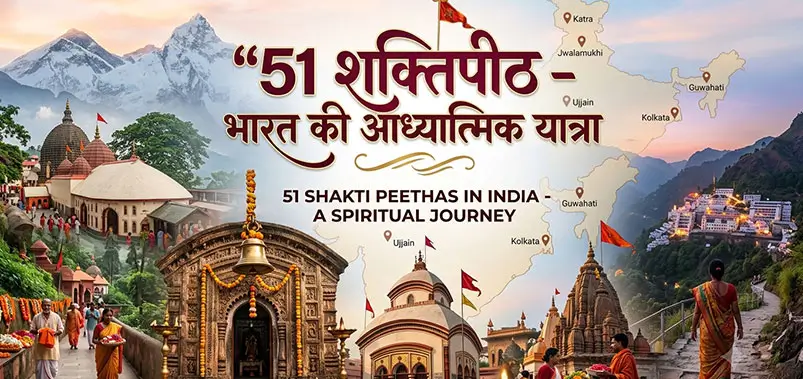
51 Shakti Peethas: Complete List, Locations and Pilgrimage Travel Guide
The 51 Shakti Peethas form one of the most sacred pilgrimage networks in the Hindu tradition. Dedicated to different manifestations of Adi Shakti, these holy sites are associated with the story of Goddess Sati and Lord Shiva. They extend far beyond a single state - or even a single country - from the Himalayan foothills and the plains of Bengal to Assam, Gujarat, Tamil Nadu, Nepal, Bangladesh, Pakistan and Sri Lanka.
For a traveller, the scale of this sacred geography raises practical questions: Which temples belong to the traditional list? Where are they located today? Which sites can be combined in one itinerary? How much time is required? This guide brings those details together while acknowledging an important fact: the names, locations and sacred associations of some Peethas vary between scriptures and regional traditions.
Important note: There is no single list accepted identically by every Shakta tradition. Some texts and communities recognise 51 Peethas, while others refer to 52, 64 or 108. Ancient place names have also been identified differently over time. The list below should therefore be used as a traditional pilgrimage guide rather than an undisputed geographical register.
What Is a Shakti Peetha?
A Shakti Peetha is a sacred place where the Divine Feminine is worshipped in a particular form. Each Peetha is traditionally connected with:
- A manifestation of Shakti or the presiding Goddess
- A corresponding Bhairava form of Lord Shiva
- A body part, ornament or sacred element associated with Goddess Sati
According to Hindu sacred tradition, Sati entered the sacrificial fire after her father, Daksha, insulted Lord Shiva. Overcome by grief, Shiva carried her body across the universe. To restore cosmic balance, Lord Vishnu used the Sudarshana Chakra to separate Sati's body. The places where her body parts or ornaments were believed to have fallen became centres of Shakti worship.
The number 51 is also linked in several Shakta interpretations with the letters or sound-units of the Sanskrit tradition, representing the Goddess as the source of creation, language and spiritual energy.
Why Do Different Lists of Shakti Peethas Exist?
Travellers often find conflicting lists online because Shakti Peetha traditions developed across different regions and texts. The differences generally arise from four factors:
-
Different scriptural enumerations: Religious texts do not all record the same total or sequence.
-
Changing place names: Ancient names cannot always be mapped precisely to modern districts or borders.
-
Regional traditions: More than one shrine may claim association with the same sacred event.
-
Living pilgrimage practice: A temple may be deeply revered as a Shakti centre even when its inclusion in a specific classical list is debated.
This explains why temples such as Tara Tarini, Vindhyavasini, Naina Devi, Chintpurni or Tarapith may appear prominently in broader Shakti pilgrimage circuits even when different lists classify them differently.
Plan a Sacred Shakti Peetha Temple Tour
Want to visit the sacred Shakti Peethas of India? We can help you plan a personalised temple journey covering important Shakti Peethas along with nearby pilgrimage sites, cultural attractions and comfortable stays.
Complete List of 51 Shakti Peethas and Their Locations
| No. |
Shakti Peetha / Temple |
Present-day location |
Traditional association* |
| 1 |
Hinglaj Shakti Peetha |
Balochistan, Pakistan |
Brahmarandhra or upper head |
| 2 |
Shankari Devi |
Trincomalee, Sri Lanka |
Groin or thigh region |
| 3 |
Sugandha Shakti Peetha |
Shikarpur, Barisal region, Bangladesh |
Nose |
| 4 |
Kashmir Mahamaya |
Kashmir region |
Throat |
| 5 |
Jwalamukhi Shakti Peetha |
Kangra district, Himachal Pradesh |
Tongue |
| 6 |
Jalandhar Tripurmalini |
Jalandhar region, Punjab |
Breast |
| 7 |
Vaidyanath Shakti Peetha |
Deoghar, Jharkhand |
Heart |
| 8 |
Guhyeshwari Shakti Peetha |
Kathmandu, Nepal |
Knees or sacred body region |
| 9 |
Manasa Shakti Peetha |
Near Lake Manasarovar, Tibet |
Right hand |
| 10 |
Biraja Shakti Peetha |
Jajpur, Odisha |
Navel |
| 11 |
Gandaki Shakti Peetha |
Gandaki region, Nepal |
Temple or cheek tradition |
| 12 |
Bahula Shakti Peetha |
Ketugram, West Bengal |
Left arm |
| 13 |
Ujani Shakti Peetha |
Bardhaman region, West Bengal |
Right wrist |
| 14 |
Tripura Sundari |
Udaipur, Tripura |
Right foot |
| 15 |
Chattal Bhavani |
Chattogram region, Bangladesh |
Right arm |
| 16 |
Trisrota Bhramari |
Jalpaiguri region, West Bengal |
Left leg |
| 17 |
Kamakhya Shakti Peetha |
Guwahati, Assam |
Yoni |
| 18 |
Prayag Lalita Devi |
Prayagraj, Uttar Pradesh |
Fingers |
| 19 |
Jayanti Shakti Peetha |
Jaintia Hills, Meghalaya |
Left thigh |
| 20 |
Yugadya Shakti Peetha |
Khirgram, West Bengal |
Right toe |
| 21 |
Kalighat Kali Temple |
Kolkata, West Bengal |
Toes of the right foot |
| 22 |
Kireeteshwari |
Murshidabad, West Bengal |
Crown |
| 23 |
Vishalakshi Shakti Peetha |
Varanasi, Uttar Pradesh |
Earring or eye tradition |
| 24 |
Kanyashram Shakti Peetha |
Kanyakumari region, Tamil Nadu |
Back |
| 25 |
Kurukshetra Savitri |
Kurukshetra, Haryana |
Ankle |
| 26 |
Manibandh Shakti Peetha |
Pushkar, Rajasthan |
Wrists |
| 27 |
Srisailam Bhramaramba |
Srisailam, Andhra Pradesh |
Neck or upper-lip tradition |
| 28 |
Kanchi Kamakshi |
Kanchipuram, Tamil Nadu |
Skeletal or navel association |
| 29 |
Kalmadhav Shakti Peetha |
Traditionally linked with central India |
Left buttock |
| 30 |
Shondesh Shakti Peetha |
Amarkantak region, Madhya Pradesh |
Right buttock |
| 31 |
Ramgiri Shakti Peetha |
Chitrakoot region |
Breast |
| 32 |
Vrindavan Bhuteshwar Shakti Peetha |
Mathura–Vrindavan, Uttar Pradesh |
Hair |
| 33 |
Suchindram Shakti Peetha |
Near Kanyakumari, Tamil Nadu |
Upper teeth |
| 34 |
Panchsagar Shakti Peetha |
Identification disputed |
Lower teeth |
| 35 |
Karatoya Tat Shakti Peetha |
Bogura region, Bangladesh |
Left ear |
| 36 |
Shri Parvat Shakti Peetha |
Location varies by tradition |
Right ankle |
| 37 |
Vibhash Shakti Peetha |
Tamluk, West Bengal |
Left ankle |
| 38 |
Prabhas Shakti Peetha |
Somnath region, Gujarat |
Stomach |
| 39 |
Bhairav Parvat Shakti Peetha |
Ujjain, Madhya Pradesh |
Upper lip |
| 40 |
Janasthan Shakti Peetha |
Nashik region, Maharashtra |
Chin |
| 41 |
Sarvashail Shakti Peetha |
Andhra Pradesh region |
Cheek |
| 42 |
Godavari Tir Shakti Peetha |
Godavari region, Andhra Pradesh |
Cheek |
| 43 |
Ratnavali Shakti Peetha |
Hooghly region, West Bengal |
Right shoulder |
| 44 |
Mithila Shakti Peetha |
Mithila region of Bihar–Nepal |
Left shoulder |
| 45 |
Nalhati Shakti Peetha |
Birbhum, West Bengal |
Throat tube |
| 46 |
Karnat Shakti Peetha |
Karnataka; exact identification varies |
Ear |
| 47 |
Vakreshwar Shakti Peetha |
Birbhum, West Bengal |
Mind or forehead tradition |
| 48 |
Yashore Shakti Peetha |
Jessore region, Bangladesh |
Palm |
| 49 |
Attahas Shakti Peetha |
Birbhum/Bardhaman region, West Bengal |
Lower lip |
| 50 |
Nandikeshwari Shakti Peetha |
Sainthia, West Bengal |
Necklace |
| 51 |
Lanka Shakti Peetha |
Sri Lanka; exact identification debated |
Anklet |
*Names, precise locations and body-part associations may differ between traditions. Before undertaking a specialised yatra, confirm the lineage or list followed by your priest, spiritual guide or pilgrimage organisation.
Detailed Guide to All 51 Shakti Peethas
The descriptions below follow commonly circulated Shakti Peetha traditions. The form of the Goddess, the corresponding Bhairava, the body part and even the modern location sometimes differ between textual and regional accounts. Where a site is disputed, the variation has been stated instead of presenting an uncertain identification as fact.
1. Hinglaj Shakti Peetha, Pakistan
Hinglaj Mata Temple lies in the Hingol region of Balochistan, inside the wider Hingol National Park landscape. It is commonly associated with Sati's Brahmarandhra or upper head. The Goddess is widely worshipped as Kottari or Hinglaj Mata, while the Bhairava is commonly named Bhimlochan. The shrine is inside a cave and remains an important pilgrimage centre, particularly for Pakistan's Hindu community. Travelling from India requires a Pakistani visa, local logistical arrangements and verification of current access conditions; it should not be planned as a casual extension to an India tour.
2. Shankari Devi, Sri Lanka
Shankari Devi is traditionally connected with Trincomalee in eastern Sri Lanka and is often associated with the ancient sacred landscape around Koneswaram Temple. Common lists connect the Peetha with Sati's groin or thigh region, although the exact association varies. The Goddess is worshipped as Shankari, with Rakshaseshwar named as Bhairava in several traditions. Trincomalee can be reached by road or rail from Colombo, but it is better included in a broader Sri Lanka itinerary with at least one local overnight stay.
3. Sugandha Shakti Peetha, Bangladesh
Sugandha Peetha is generally identified near Shikarpur in the Barisal region of Bangladesh, close to the Sugandha River. The site is associated with Sati's nose. The Goddess is commonly called Sunanda, and the Bhairava is known as Tryambak. Because local names and approach routes may not be obvious to an international visitor, pilgrims should arrange a knowledgeable local driver or guide and verify temple access before travelling from Dhaka or Barisal.
4. Kashmir Mahamaya Shakti Peetha
The Kashmir Peetha is traditionally associated with Sati's throat and the Goddess Mahamaya, accompanied by Bhairava Trisandhyeshwar. Its exact modern identification is debated: different traditions connect it with sacred locations in Kashmir, including areas associated with Amarnath or Kheer Bhawani. A travel article should therefore avoid giving one shrine an uncontested status. Visitors should first decide which religious tradition they are following and then plan according to current weather, security, registration and seasonal-access requirements.
5. Jwalamukhi Shakti Peetha, Himachal Pradesh
Jwalamukhi Temple in Kangra district is associated with Sati's tongue. The Goddess is worshipped through naturally occurring flames and is commonly called Siddhida or Jwalamukhi; the Bhairava is often identified as Unmatta Bhairava. The absence of a conventional idol makes the worship tradition particularly distinctive. The temple can be reached by road from Dharamshala, Kangra or Pathankot and can form part of a multi-day Himachal Devi circuit.
6. Jalandhar Tripurmalini Shakti Peetha, Punjab
This Peetha is associated with the Jalandhar region of Punjab and is commonly linked with Sati's left breast. The presiding Shakti is known as Tripurmalini, while the Bhairava is generally called Bhishan. Regional identification is often connected with the Devi Talab temple tradition. Jalandhar is well connected by road and rail, making this one of the more accessible northern Peethas. It can be combined with Amritsar or with the lower-Himachal goddess circuit.
7. Vaidyanath Shakti Peetha, Jharkhand
Vaidyanath at Deoghar is traditionally associated with Sati's heart. The Goddess is commonly called Jaya Durga, and the Bhairava is Vaidyanath. The destination is especially important because the same sacred landscape is associated with the Baidyanath Jyotirlinga. Deoghar now has air connectivity, while Jasidih is the principal nearby railway gateway. Shravan brings exceptionally heavy pilgrimage traffic, so travellers seeking easier movement should choose a non-festival weekday.
8. Guhyeshwari Shakti Peetha, Nepal
Guhyeshwari Temple stands close to Pashupatinath in Kathmandu and is one of Nepal's most important Shakti shrines. Traditions differ regarding the precise body association, with several accounts referring to the knees or another sacred body region. The Goddess is worshipped as Mahamaya or Guhyeshwari, and the Bhairava is often named Kapali. Its location makes it easy to combine with Pashupatinath, Boudhanath and other Kathmandu sites, subject to the temple's entry and photography rules.
9. Manasa Shakti Peetha near Lake Manasarovar, Tibet
The Manasa Peetha is traditionally connected with the Lake Manasarovar region and with Sati's right hand. The Goddess is commonly identified as Dakshayani, while the Bhairava is named Amar. This is not an ordinary temple-city visit: the journey involves high altitude, permits, controlled routing, physical preparation and weather-dependent travel. Pilgrims should use an authorised Kailash–Manasarovar operator and obtain medical guidance rather than treating the destination as a standard independent tour.
10. Biraja Shakti Peetha, Odisha
Biraja Temple is located at Jajpur in Odisha and is commonly associated with Sati's navel. The Goddess is worshipped as Biraja or Girija, while the corresponding Bhairava is often identified as Jagannath. The temple has deep importance within Odisha's sacred geography and can be combined with Bhubaneswar, Puri or other heritage sites, although Jajpur requires a separate road journey. Keeping time for the town's wider cluster of ancient shrines makes the visit more meaningful.
11. Gandaki Shakti Peetha, Nepal
The Gandaki Peetha is connected with the Gandaki river region of Nepal. The sacred association and exact location differ considerably between lists; some traditions connect it with Muktinath and refer to Sati's temple, cheek or another body element. The Goddess is often called Gandaki Chandi, with Chakrapani as Bhairava. If Muktinath is followed as the destination, travellers must plan for mountain weather, altitude, flight disruption and road conditions through the Pokhara–Jomsom region.
12. Bahula Shakti Peetha, West Bengal
Bahula Peetha is generally identified at Ketugram in the Purba Bardhaman region and is associated with Sati's left arm. The Goddess is worshipped as Bahula, and the Bhairava is commonly called Bhiruk. The shrine is rural compared with Kolkata's major temples, so a private vehicle is more practical than relying on a tightly timed public-transport connection. It can be included in a Bardhaman-based circuit with Ujani and Yugadya.
13. Ujani Shakti Peetha, West Bengal
Ujani, also linked in regional usage with Mangal Chandika, is located in the Bardhaman area and is commonly associated with Sati's right wrist. The Goddess is generally named Mangal Chandika, and the Bhairava Kapilambar. Ancient and modern place-name variations can confuse route planning, so the exact temple pin should be confirmed locally. A dedicated Bardhaman circuit is preferable to attempting the shrine as a rushed same-day detour from central Kolkata.
14. Tripura Sundari Shakti Peetha, Tripura
Tripura Sundari Temple, also known as Matabari, is located at Udaipur in Tripura and is associated with Sati's right foot in widely followed lists. The Goddess is worshipped as Tripura Sundari, and the Bhairava is commonly known as Tripuresh. The temple is among the best-known pilgrimage destinations in Northeast India. Agartala is the main air gateway, and Udaipur can be reached by road; one night in Agartala or Udaipur keeps the itinerary comfortable.
15. Chattal Bhavani Shakti Peetha, Bangladesh
Chattal or Chattogram Peetha is traditionally located in the Chattogram region of Bangladesh, often connected with the Sitakunda area. It is associated with Sati's right arm. The Goddess is commonly named Bhavani, and the Bhairava is Chandrashekhar. As the temple identification and local approach may vary in different guides, international pilgrims should confirm the recognised shrine with a local religious contact before arranging transport from Chattogram.
16. Trisrota Bhramari Shakti Peetha, West Bengal
Trisrota Bhramari is associated with the Teesta or Trisrota landscape of northern West Bengal, generally in the Jalpaiguri region. Common lists connect it with Sati's left leg and worship the Goddess as Bhramari, with Ambar as Bhairava. Because multiple place references circulate online, travellers should verify the precise shrine rather than navigating only by the Peetha name. It is best planned from Siliguri or Jalpaiguri with a local vehicle.
17. Kamakhya Shakti Peetha, Assam
Kamakhya Temple stands on Nilachal Hill in Guwahati and is associated with Sati's yoni, representing fertility and the creative power of Shakti. The Goddess is worshipped as Kamakhya, while the Bhairava is generally identified as Umananda. Worship centres on a naturally formed sacred stone within the sanctum rather than a conventional anthropomorphic idol. Guwahati is the air and rail gateway; travellers should allow several hours for darshan and expect major crowd controls during Ambubachi Mela and Navratri.
18. Prayag Lalita Devi Shakti Peetha, Uttar Pradesh
The Prayag Peetha is associated with Prayagraj and commonly linked with Sati's fingers. The Goddess is worshipped as Lalita, while the Bhairava is generally called Bhava. Prayagraj has more than one important Goddess shrine, including Lalita Devi, Alopi Devi and Kalyani Devi, so the exact pilgrimage tradition should be established in advance. The visit combines naturally with Triveni Sangam and can form part of a Prayagraj–Vindhyachal–Varanasi route.
19. Jayanti Shakti Peetha, Meghalaya
Jayanti Peetha is traditionally connected with the Jaintia Hills of Meghalaya and with Sati's left thigh. The Goddess is commonly called Jayanti, and the Bhairava is Kramadishwar. Different local identifications occur, and access can involve substantial hill-road travel. Shillong is the most practical major base for many visitors, but the exact route and road condition should be checked with a local operator before departure.
20. Yugadya Shakti Peetha, West Bengal
Yugadya, also written as Jogadya, is generally identified at Khirgram in Purba Bardhaman and is associated with Sati's right toe. The Goddess is worshipped as Yugadya, and the Bhairava is commonly named Khir Khandak. The shrine has a strong local festival tradition and is easier to understand with a regional guide. It can be combined with Ujani and Bahula in a Bardhaman-focused journey.
21. Kalighat Kali Temple, West Bengal
Kalighat in Kolkata is one of India's best-known Kali temples and is commonly associated with the toes of Sati's right foot. The Goddess is worshipped as Kalika, with Nakuleshwar as Bhairava. The temple sits in a busy market neighbourhood with narrow approaches, queues and persistent tout activity. Early morning is generally more manageable, and visitors should use authorised counters for any formal worship service.
22. Kireeteshwari Shakti Peetha, West Bengal
Kireeteshwari at Kireetkona in Murshidabad district is associated with Sati's crown or kireet. The Goddess is commonly called Vimala or Kireeteshwari, and the Bhairava is Sanwart. The rural location is best reached by private vehicle and can be combined with Murshidabad's historic attractions. An overnight stay in or near Berhampore is more practical than returning to Kolkata after a long temple and heritage day.
23. Vishalakshi Shakti Peetha, Uttar Pradesh
Vishalakshi Temple is located in the old city of Varanasi, close to the sacred Kashi temple landscape. Different traditions connect it with Sati's earring, eye or another facial element. The Goddess is worshipped as Vishalakshi, with Kala Bhairava commonly recognised as the corresponding Bhairava. The temple can be visited with Kashi Vishwanath and Annapurna Temple, but narrow lanes, security checks and crowds require extra time.
24. Kanyashram Shakti Peetha, Tamil Nadu
Kanyashram is traditionally associated with the Kanyakumari region and with Sati's back. The Goddess is commonly identified as Sharvani, and the Bhairava as Nimish. Some pilgrimage traditions connect the Peetha with the sacred landscape of Kanyakumari rather than one universally agreed temple. Travellers should therefore confirm the shrine followed by their tradition and can combine the visit with Kumari Amman Temple, Suchindram and the coastal landmarks of Kanyakumari.
25. Kurukshetra Savitri Shakti Peetha, Haryana
The Kurukshetra Peetha is commonly associated with Sati's ankle. The Goddess is worshipped as Savitri or Sthanupriya, and the Bhairava is generally called Sthanu. Regional tradition often connects the Peetha with the Bhadrakali temple landscape of Kurukshetra. The city is accessible by road and rail from Delhi and Chandigarh and can be combined with Brahma Sarovar, Jyotisar and other Mahabharata-linked sacred sites.
26. Manibandh Shakti Peetha, Rajasthan
Manibandh Peetha is associated with the Pushkar area and Sati's wrists. The Goddess is commonly called Gayatri, while the Bhairava is Sarvanand. Pushkar is easily reached by road from Jaipur and Ajmer and already has a wide range of accommodation. The Peetha visit can be planned alongside Brahma Temple, Pushkar Lake and Ajmer, making it one of the easiest Shakti-linked sites to include in a Rajasthan holiday.
27. Srisailam Bhramaramba Shakti Peetha, Andhra Pradesh
Bhramaramba Temple forms part of the Srisailam sacred complex and is associated in different lists with Sati's neck or upper lip. The Goddess is worshipped as Bhramaramba, while Mallikarjuna is the corresponding form of Shiva and one of the twelve Jyotirlingas. Hyderabad is the most common major gateway, followed by a long road journey. The hill and forest route, temple queues and large complex justify at least one overnight stay.
28. Kanchi Kamakshi Shakti Peetha, Tamil Nadu
Kamakshi Amman Temple stands at the spiritual centre of Kanchipuram. Traditions vary regarding the fallen element, with navel or skeletal associations appearing in different lists. The Goddess is worshipped as Kamakshi or Devgarbha, and the Bhairava name also varies by enumeration. Kanchipuram is accessible by road from Chennai and deserves a full day because its wider sacred landscape includes important Shiva and Vishnu temples.
29. Kalmadhav Shakti Peetha, Central India
Kalmadhav is associated in commonly circulated lists with Sati's left buttock. The Goddess is often named Kali, and the Bhairava Asitang. Its exact modern geographical identification is disputed, with different references placing it in parts of central India. This site should not be sold with a fixed coordinate without specialist verification. Pilgrims following Kalmadhav should obtain the recognised location from their spiritual lineage before booking transport.
30. Shondesh Shakti Peetha, Madhya Pradesh
Shondesh or Shon Peetha is commonly linked with the Amarkantak region and Sati's right buttock. The Goddess is often worshipped as Narmada, and the Bhairava is named Bhadrasen. Amarkantak is also revered as the source region of the Narmada and offers a broader sacred landscape beyond one shrine. Jabalpur, Bilaspur and Raipur may serve as gateways depending on the route, but road time should be planned carefully.
Discover India’s Most Sacred Temples
Turn your spiritual journey into a meaningful India tour by combining Shakti Peetha temples with famous pilgrimage destinations across the country. Choose your preferred destinations and travel at your own pace with a private tour.
31. Ramgiri Shakti Peetha, Chitrakoot Region
Ramgiri is traditionally associated with Sati's breast, though the side and exact shrine differ between accounts. The Goddess is commonly called Shivani, with Chanda as Bhairava. Many modern references connect Ramgiri with Chitrakoot, while some traditions identify it elsewhere. Travellers should follow the interpretation accepted by their guide. If visiting Chitrakoot, the Peetha can be included with Ramghat, Kamadgiri and other Ramayana-linked sites.
32. Vrindavan Bhuteshwar Shakti Peetha, Uttar Pradesh
The Vrindavan Peetha is associated with Sati's hair and with the Goddess Uma, while the Bhairava is commonly identified as Bhutesh. Regional identification is often linked with the Bhuteshwar sacred landscape of Mathura–Vrindavan rather than a single universally described Shakti temple. The destination is easily reached from Delhi or Agra and can be combined with Krishna temples across Mathura, Vrindavan, Govardhan and Barsana.
33. Suchindram Shakti Peetha, Tamil Nadu
Suchindram, located between Nagercoil and Kanyakumari, is associated with Sati's upper teeth. The Goddess is commonly named Narayani, and the Bhairava Sanghar. The town is best known for the Thanumalayan temple tradition, and the Peetha association belongs to its wider sacred identity. Suchindram can be visited by road from Kanyakumari or Thiruvananthapuram and fits naturally into a southern Tamil Nadu temple itinerary.
34. Panchsagar Shakti Peetha
Panchsagar is associated in traditional lists with Sati's lower teeth. The Goddess is commonly called Varahi, and the Bhairava is Maharudra. However, its modern location has not been established consistently across mainstream pilgrimage sources. For this reason, a responsible itinerary should mark Panchsagar as disputed rather than assign it an invented district or map pin. Specialist religious guidance is necessary before treating it as a visitable stop.
35. Karatoya Tat Shakti Peetha, Bangladesh
Karatoya Tat Peetha is connected with the banks of the historic Karatoya River, generally in the Bogura region of Bangladesh. It is associated in different accounts with Sati's left ear or another body element. The Goddess is commonly known as Aparna, and the Bhairava as Vaman. As river courses and place names have changed over time, travellers should confirm the locally recognised shrine and arrange transport from Dhaka or Bogura with knowledgeable support.
36. Shri Parvat Shakti Peetha
Shri Parvat is traditionally linked with Sati's right ankle, although both the body association and geographical location differ between lists. The Goddess is often named Shri Sundari, and the Bhairava Sundaranand. Some traditions identify the site with Srisailam, while others place it in a different Himalayan or southern location. The article should preserve this ambiguity and travellers should not plan Shri Parvat separately until their chosen tradition has been confirmed.
37. Vibhash Shakti Peetha, West Bengal
Vibhash Peetha is generally identified at Tamluk in Purba Medinipur and is associated with Sati's left ankle. The Goddess is worshipped as Kapalini or Bargabhima, and the Bhairava is commonly known as Sarvanand. Tamluk is accessible by road or rail from Kolkata, though a private car allows easier combination with other regional sites. The temple's living local identity is as important as its place in the classical list.
38. Prabhas Shakti Peetha, Gujarat
Prabhas Peetha is connected with the Somnath–Prabhas Patan sacred region and is associated in common lists with Sati's stomach. The Goddess is often called Chandrabhaga, and the Bhairava Vakratunda. The destination can be combined with Somnath Jyotirlinga, Triveni Sangam and other coastal sacred sites. Rajkot is a useful major air gateway, while Veraval provides nearby rail access.
39. Bhairav Parvat Shakti Peetha, Madhya Pradesh
Bhairav Parvat Peetha is associated with Ujjain and Sati's upper lip. The Goddess is commonly named Avanti, and the Bhairava Lambakarna. Identification within Ujjain's wider sacred landscape can vary, so local religious guidance is useful. The city is easily included with Mahakaleshwar Jyotirlinga, Harsiddhi Temple, Kal Bhairav and the ghats of the Shipra River.
40. Janasthan Shakti Peetha, Maharashtra
Janasthan Peetha is traditionally connected with the Nashik region and Sati's chin. The Goddess is commonly called Bhramari, and the Bhairava Vikritaksha. Nashik's sacred geography is extensive, and the exact Peetha identification may be presented differently by local sources. The visit can be combined with Panchavati, Trimbakeshwar Jyotirlinga and the Godavari ghats, using Nashik as the accommodation base.
41. Sarvashail Shakti Peetha, Andhra Pradesh
Sarvashail is associated with the Andhra region and, in several lists, with Sati's cheek. The Goddess is commonly called Rakeshwari, and the Bhairava Vatsanabh. Its modern identification is not uniform; some accounts connect it with a location near the Godavari. A precise tour stop should only be created after checking the tradition followed and obtaining a verified local temple reference.
42. Godavari Tir Shakti Peetha, Andhra Pradesh
Godavari Tir Peetha is located in the sacred geography of the Godavari River and is also associated with Sati's cheek in some enumerations. The Goddess is commonly named Vishweshwari or Rakini, and the Bhairava Dandapani. Different towns along the river are cited in different sources, which makes a generic map pin unreliable. Pilgrims should verify the recognised shrine before selecting Rajahmundry or another Godavari city as their travel base.
43. Ratnavali Shakti Peetha, West Bengal
Ratnavali is generally associated with the Hooghly region of West Bengal and Sati's right shoulder. The Goddess is commonly called Kumari, and the Bhairava Shiva. Local identification is often connected with the Khanakul area, but travellers should confirm the exact temple before leaving Kolkata. Because public transport may require multiple changes, a private regional vehicle is usually more practical.
44. Mithila Shakti Peetha, Bihar–Nepal Region
Mithila Peetha is associated with Sati's left shoulder and the historic Mithila region, which extends across modern Bihar and Nepal. The Goddess is often named Uma or Mahadevi, with Mahodar as Bhairava. Different traditions identify the shrine with different locations, including areas near Janakpur. Travellers must therefore establish whether their pilgrimage route follows an Indian or Nepali identification before arranging documents and transport.
45. Nalhati Shakti Peetha, West Bengal
Nalhati or Nalateswari Peetha is located in Birbhum district and is associated with Sati's throat tube or nala. The Goddess is worshipped as Kalika or Nalateswari, and the Bhairava is commonly named Yogesh. The shrine is accessible by rail and road, but it is most efficient as part of a Birbhum circuit with Nandikeshwari, Vakreshwar and nearby sacred sites. Festival dates can significantly affect crowd levels.
46. Karnat Shakti Peetha, Karnataka
Karnat Peetha is traditionally associated with Sati's ear. The Goddess is commonly called Jayadurga, and the Bhairava Abhiru. Its exact modern temple identification remains disputed, and references that simply assign it to the whole state of Karnataka are not sufficient for itinerary planning. A tour operator should request the traveller's accepted religious reference before proposing a city, shrine or driving route.
47. Vakreshwar Shakti Peetha, West Bengal
Vakreshwar, also written Bakreshwar, is located in Birbhum and is associated in different traditions with Sati's mind, forehead or the portion between the eyebrows. The Goddess is commonly named Mahishamardini, and the Bhairava Vakranath. The area is also known for hot springs and Shaiva worship. It can be combined efficiently with other Birbhum Peethas using Bolpur, Suri or another suitable town as a base.
48. Yashore Shakti Peetha, Bangladesh
Yashore or Jessoreswari Peetha is associated with the Jessore–Satkhira region of Bangladesh and Sati's palm. The Goddess is worshipped as Yashoreswari, and the Bhairava is commonly called Chanda. The shrine lies outside the principal Dhaka tourist circuit, so road time and local border-area conditions need attention. Indian travellers require the appropriate Bangladesh visa and should verify the current route and temple schedule before departure.
49. Attahas Shakti Peetha, West Bengal
Attahas is associated with Sati's lower lip and is generally located in the Birbhum–Bardhaman cultural region, though more than one local identification is discussed. The Goddess is commonly called Phullara, and the Bhairava Vishwesh. The rural approach makes local confirmation important. Attahas is best included in a carefully mapped West Bengal circuit rather than added as an unverified stop between distant temples.
50. Nandikeshwari Shakti Peetha, West Bengal
Nandikeshwari Temple is located at Sainthia in Birbhum district and is associated with Sati's necklace. The Goddess is worshipped as Nandini or Nandikeshwari, and the Bhairava is commonly called Nandikeshwar. Sainthia has rail connectivity and can serve as one point in a wider Birbhum pilgrimage. Combining the shrine with Nalhati and Vakreshwar is more efficient than making separate trips from Kolkata.
51. Lanka Shakti Peetha, Sri Lanka
Lanka Peetha is traditionally associated with Sati's anklet, but its exact modern location in Sri Lanka is debated. The Goddess is often named Indrakshi, and the Bhairava Rakshaseshwar. Some accounts link the tradition with Trincomalee or another ancient sacred site, creating overlap with the Shankari tradition. Travellers should therefore confirm whether their chosen lineage treats Lanka and Shankari as separate pilgrimage stops before designing the Sri Lanka route.
Major Shakti Peethas That Are Practical for Travellers
Kamakhya Temple, Assam
Located on Nilachal Hill in Guwahati, Kamakhya is among the most revered centres of Shakta and Tantric worship. The sanctum does not contain a conventional anthropomorphic idol; worship centres on a naturally formed sacred stone associated with the creative power of the Goddess.
Ambubachi Mela, usually observed during the monsoon period in June, is the temple's best-known annual gathering. It offers an intense spiritual atmosphere but also brings exceptional crowds, traffic controls and changes to normal darshan arrangements. First-time visitors seeking a calmer experience should choose an ordinary weekday and keep several hours available for the visit.
Travel gateway: Guwahati
Suggested stay: 2 nights
Can be combined with: Umananda Temple, Basistha Ashram, Guwahati riverfront or Kaziranga National Park
Kalighat and the West Bengal Shakti Peetha Circuit
Kalighat Kali Temple is Kolkata's most recognised Shakti shrine and is traditionally associated with the toes of Sati's right foot. Its dense urban setting, narrow approach roads and heavy footfall make an early-morning visit preferable.
West Bengal has one of the greatest concentrations of Peethas in the traditional list. Kireeteshwari, Bahula, Ujani, Attahas, Nandikeshwari, Nalhati, Vakreshwar, Yugadya, Vibhash and Ratnavali can be arranged into regional journeys through Bardhaman, Birbhum, Murshidabad, Hooghly and Tamluk.
Travel gateway: Kolkata
Suggested duration: 6–10 days, depending on the selected shrines
Planning advice: Use larger towns for overnight stays; attempting six or seven temples in one day produces long road hours and very little time for darshan.
Jwalamukhi and the Himachal Shakti Circuit
Jwalamukhi is distinctive because natural flames are worshipped at the shrine instead of a conventional stone image. The temple is traditionally associated with the tongue of Goddess Sati.
The wider Himachal circuit can include Brajeshwari Devi, Chamunda Devi, Chintpurni and Naina Devi. Their exact classification differs between traditions, but all are important living centres of Goddess worship.
Travel gateway: Chandigarh, Dharamshala or Pathankot
Suggested duration: 4–6 days
Planning advice: Mountain travel times are longer than map distances suggest. Choose an experienced hill driver and avoid compressing the route.
Vishalakshi, Prayagraj and the Uttar Pradesh Sacred Route
Vishalakshi Temple stands within Varanasi's sacred landscape and can be combined naturally with Kashi Vishwanath, Annapurna Temple, Ganga Aarti and the ghats. Prayagraj's Lalita Devi is also traditionally associated with the Peetha network, while Alopi Devi and Kalyani Devi are important regional Shakti shrines.
A practical route can connect Varanasi, Vindhyachal and Prayagraj. This gives pilgrims time for temple visits while also experiencing the Ganga, historic neighbourhoods and major sacred rituals.
Travel gateway: Varanasi or Prayagraj
Suggested duration: 4–6 days
Can be extended to: Ayodhya or Bodh Gaya
Manibandh, Prabhas and Central Indian Peethas
Manibandh near Pushkar fits easily into a Rajasthan holiday covering Jaipur, Ajmer, Pushkar or Jodhpur. Prabhas in the Somnath region can be combined with Somnath Jyotirlinga and the coastal pilgrimage sites of Gujarat.
Ujjain's Bhairav Parvat, the traditions around Amarkantak and the Chitrakoot region allow travellers to combine Shakti worship with Mahakaleshwar, the Narmada landscape and Ramayana-linked heritage.
Useful gateways: Jaipur, Rajkot, Indore and Jabalpur
Suggested duration: Plan each state as a separate regional journey
Planning advice: Rajasthan–Gujarat–Madhya Pradesh looks compact on a national map but creates excessive driving when treated as one short tour.
Kanchi Kamakshi, Suchindram and Srisailam
Kamakshi Amman Temple lies at the heart of Kanchipuram, one of India's great temple cities. Suchindram can be included in a southern Tamil Nadu journey with Madurai, Rameswaram and Kanyakumari. At Srisailam, Bhramaramba is worshipped in the same sacred complex as Mallikarjuna Jyotirlinga, giving the destination special importance to both Shakta and Shaiva pilgrims.
Travel gateways: Chennai for Kanchipuram; Madurai or Thiruvananthapuram for Suchindram; Hyderabad for Srisailam
Suggested duration: 7–12 days for a broader South India temple tour
Planning advice: Confirm dress codes, darshan procedures and festival schedules before departure.
Suggested Regional Shakti Peetha Tour Plans
| Circuit |
Key places |
Ideal duration |
Best suited for |
| Assam |
Guwahati, Kamakhya and nearby sacred sites |
2–3 nights |
First-time Shakti pilgrimage and Northeast extensions |
| West Bengal |
Kolkata, Bardhaman, Birbhum, Murshidabad and selected Peethas |
6–10 nights |
Travellers wanting the highest concentration of sites |
| Himachal Pradesh |
Jwalamukhi, Kangra, Chamunda, Chintpurni and Naina Devi |
4–6 nights |
Mountain pilgrimage and multi-temple darshan |
| Uttar Pradesh |
Varanasi, Vindhyachal and Prayagraj |
4–6 nights |
Ganga, temple and cultural experiences |
| Rajasthan |
Jaipur, Ajmer, Pushkar and Manibandh |
3–5 nights |
A spiritual extension to a Rajasthan holiday |
| Gujarat |
Ahmedabad/Rajkot, Somnath and Prabhas |
4–6 nights |
Shakti and Jyotirlinga pilgrimage |
| Central India |
Ujjain, Chitrakoot or Amarkantak as separate routes |
4–7 nights |
Pilgrimage with heritage and sacred landscapes |
| South India |
Kanchipuram, Madurai, Rameswaram, Suchindram and Kanyakumari |
7–12 nights |
Temple architecture and an extended spiritual tour |
How Long Does It Take to Visit All 51 Shakti Peethas?
There is no practical single-trip duration. Traditional locations extend across India, Nepal, Bangladesh, Pakistan, Sri Lanka and Tibet, and some identifications remain disputed. Visa rules, border conditions, remote terrain and seasonal access further affect planning.
Even an India-only journey should be divided into several circuits. A meaningful pilgrimage covering the accessible sites may require several months in total when completed over multiple trips. Regional planning is more comfortable, safer and spiritually rewarding than treating every temple as a checklist stop.
Best Time to Visit Shakti Peethas
The ideal season depends on the region:
| Region |
Generally comfortable period |
Main consideration |
| Himachal and Himalayan routes |
March–June and September–November |
Winter weather, monsoon disruption and mountain roads |
| Rajasthan, Gujarat and central India |
October–March |
High daytime heat outside winter |
| West Bengal, Assam and Northeast India |
October–March |
Humidity and heavy monsoon rain |
| Uttar Pradesh and Bihar |
October–March |
Summer heat and fog during parts of winter |
| Tamil Nadu and Andhra Pradesh |
November–February |
Heat, humidity and long outdoor queues |
Navratri creates an exceptional devotional atmosphere at many Shakti temples, but it also brings the year's heaviest crowds. Travellers prioritising festivals may choose Navratri; elderly travellers, families with young children and visitors seeking shorter queues may prefer ordinary weekdays outside festival periods.
Practical Travel Tips for a Shakti Peetha Pilgrimage
- Confirm temple information before departure. Timings, entry procedures and special darshan rules can change during festivals or local events.
- Keep buffer time. Queues, traffic diversions, mountain roads and religious processions can delay a tightly planned day.
- Dress respectfully. Modest clothing is appropriate, and some temples apply specific dress or entry rules.
- Carry light footwear that is easy to remove. Temple visits frequently require walking barefoot within the complex.
- Plan for elderly travellers. Check stairs, walking distance, wheelchair availability, toilets and vehicle drop-off points in advance.
- Avoid unofficial intermediaries. Use authorised counters or official booking channels for special darshan and puja services where available.
- Protect valuables. Busy temple streets and queues are not suitable places for unnecessary jewellery, large bags or expensive equipment.
- Respect photography restrictions. Cameras and mobile phones may be restricted inside sanctums or entire temple complexes.
- Choose location-based hotels. A cheaper hotel far from the temple can add hours of urban traffic to an early-morning visit.
- Check international requirements separately. Peethas outside India require country-specific visas, permits, insurance and current border guidance.
Planning a Private Shakti Peetha Tour with Top Indian Holidays
A Shakti Peetha journey works best when it is designed around the traveller rather than copied from a fixed nationwide checklist. Top Indian Holidays can help build a private regional itinerary based on:
- The Peethas and sacred cities you want to visit
- Available travel days and preferred pace
- Hotel category and transport requirements
- Elderly-friendly access and reduced walking needs
- Festival dates or quieter darshan preferences
- Extensions to Jyotirlingas, heritage cities, wildlife destinations or cultural routes
Instead of attempting an exhausting all-India itinerary, begin with one region - such as West Bengal, Himachal Pradesh, Varanasi–Prayagraj, Assam or South India - and expand the pilgrimage over future journeys.
Planning a Shakti Peetha pilgrimage? Share your preferred temples, travel dates, number of travellers and hotel category with Top Indian Holidays to receive a customised route and quotation.
Related Guides



 info@topindianholidays.net
 +91-8955000999