📅 Last Updated On: 06 Oct 2026
⏱ 10 Min Read
Varanasi Travel Guide: Ghats, Ganga Aarti, Boat Ride & Dev Deepawali
N
Nand Singh Rathore
Travel & Tourism Expert specializing in India
Varanasi Travel Guide: Ghats, Ganga Aarti & Boat Rides
Few places affect travellers the way Varanasi does. On one stretch of riverbank, you can watch a sunrise prayer, a wedding party, a cremation, a wrestling practice and a cow wandering past a five-star palace hotel, all within the same hour. For first-time visitors, the city can feel overwhelming, but it becomes far easier once you know which ghats to walk, when the evening ceremony begins, how much a boat should cost, and how the city changes during Dev Deepawali. This Varanasi travel guide covers all of that with real timings and realistic prices, so your days on the Ganges are spent watching the city, not haggling or waiting in the wrong place.
Varanasi Ghats Worth Walking and When to Go
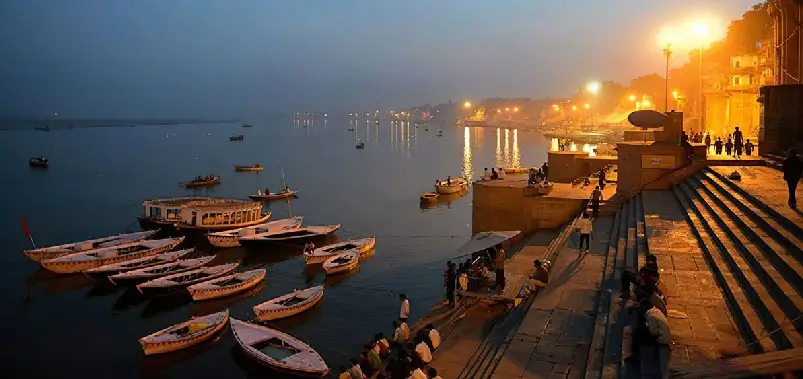
Varanasi has more than 80 ghats, the stone steps that lead down to the Ganges. Together they stretch for about six and a half kilometres along the western bank, from Assi Ghat in the south to Raj Ghat in the north. The best way to see them is on foot at dawn, starting at Assi Ghat and walking north. Assi is a lively, student-friendly ghat. Before 5:30 in the morning, it hosts a dawn programme of music, chanting and a small fire ritual, followed by a yoga session that visitors can join for free.
Walking north, you reach Tulsi Ghat, linked to the poet-saint who wrote a famous retelling of the Ramayana here. Next comes Harishchandra Ghat, the smaller of the two cremation ghats. Further on is Kedar Ghat, easy to spot by its red and white striped steps and its South Indian style temple. Chet Singh Ghat has the walls of an 18th-century fort, and the area also hosts a classical music festival. Darbhanga Ghat is home to a grand palace that is now the BrijRama Palace hotel. Then comes Dashashwamedh Ghat, the busiest and most important, where the main evening ceremony takes place.
A short walk beyond lies Manikarnika Ghat, the main cremation ground, where pyres burn day and night. Visitors may watch quietly from a distance, but photography is strictly forbidden. Ignore men who approach you claiming to collect money for wood for the poor, as this is a well-known scam. Further north, Scindia Ghat has a Shiva temple partly sunk into the river and tilting at an angle. Panchganga Ghat sits beneath a 17th-century mosque built by the Mughal emperor Aurangzeb.
Behind the ghats runs a maze of narrow lanes packed with tiny temples, silk shops, sweet stalls and old family houses. Wander them in daylight with a guide, as they are easy to get lost in and some stretches are quiet after dark.
The best time to visit Varanasi is from October to March, when days are pleasant at 18 to 28°C and mornings are misty and atmospheric. December and January nights can drop to 6 to 8°C, and fog sometimes delays flights. April to June are very hot, with afternoons often above 40°C. During the monsoon from July to September, the river rises sharply, many lower ghats go underwater, the evening ceremony shifts to rooftops, and boats are sometimes suspended.For hotels, BrijRama Palace on Darbhanga Ghat is the top riverside stay, at around INR 25,000 to 45,000 per night. Taj Nadesar Palace, a former royal guesthouse set in gardens away from the river, costs around INR 40,000 to 80,000. Suryauday Haveli on Shivala Ghat runs about INR 12,000 to 20,000. Most travellers fly into Lal Bahadur Shastri Airport, about 25 kilometres from the ghats and 45 to 60 minutes by car. Flights from Delhi take about one hour and twenty minutes.
Experience the Magic of Varanasi
From ancient temples and peaceful boat rides to the spectacular Dev Deepawali celebrations, create unforgettable memories with a specially planned Varanasi tour.
Ganga Aarti Timings, Seats and Where to Watch
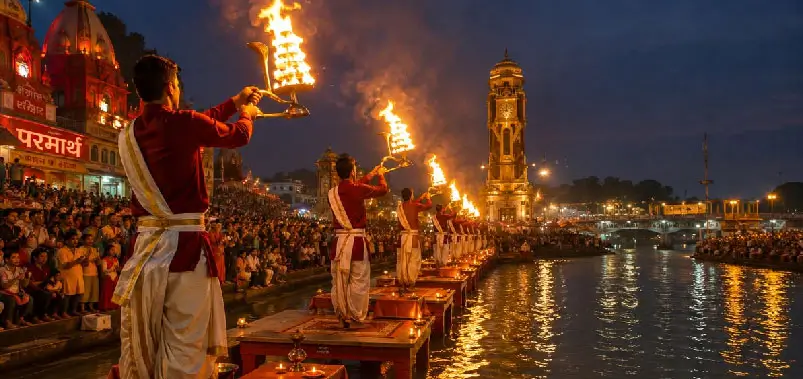
The Ganga Aarti at Dashashwamedh Ghat is the most famous evening ceremony in India. Every evening, a line of young priests in saffron and gold stand on raised wooden platforms facing the river. To the rhythm of bells, drums and chanting, they swing heavy multi-tiered brass lamps, conch shells, incense and yak-tail fans in perfectly synchronised movements. It lasts around 45 minutes. When the smoke drifts across the river and thousands of floating lamps bob past, very few people can watch it without being moved.
The Ganga Aarti timing changes with the season. It begins at roughly 6:00 to 6:45 pm in winter and 7:00 to 7:30 pm in summer, starting shortly after sunset. Arrive at least 60 minutes early for a good spot, as the steps fill up quickly, especially on weekends, holidays and festival nights. There is no ticket to watch from the steps. Vendors also rent cushions and plastic chairs on raised platforms for around INR 100 to 300, which is worth it if you want a clear view.
The finest view is from the water. Shared boats park in front of the ghat and charge around INR 200 to 400 per person for a seat during the ceremony. A private boat for two to four people, including a sunset ride along the ghats before the ceremony begins, typically costs INR 1,500 to 3,000. On festival evenings, prices rise sharply. Front-row boat spots are taken early, so a private boat should be booked in advance through your hotel or tour operator.
If Dashashwamedh feels too crowded, Assi Ghat holds its own smaller evening ceremony that is calmer and more intimate. Some travellers watch the dawn ceremony at Assi and the evening ceremony at Dashashwamedh on the same day, which gives a full picture of the river's daily rhythm.
During the ceremony, sellers offer small leaf boats filled with marigolds and a tiny oil lamp for INR 20 to 50. Floating one on the river with a silent wish is a lovely gesture. Keep phones and wallets secure, since pickpockets work the dense crowd at the top of the steps. Stay seated during the ceremony and avoid using flash photography, which disturbs both the priests and the people praying around you.
Many visitors combine the evening with the Kashi Vishwanath Temple, one of the holiest Shiva temples in India, now reached through a wide new corridor from the river. Phones, bags, pens and electronic items are not permitted inside, so lockers near the entrance are essential. Carry your passport for identification. Queues can stretch for hours on Mondays and festival days, while early mornings are usually calmer. Top Indian Holidays guides can help you time the temple visit around the ceremony so the evening flows smoothly.
Boat Ride in Varanasi: Routes, Timings and Prices
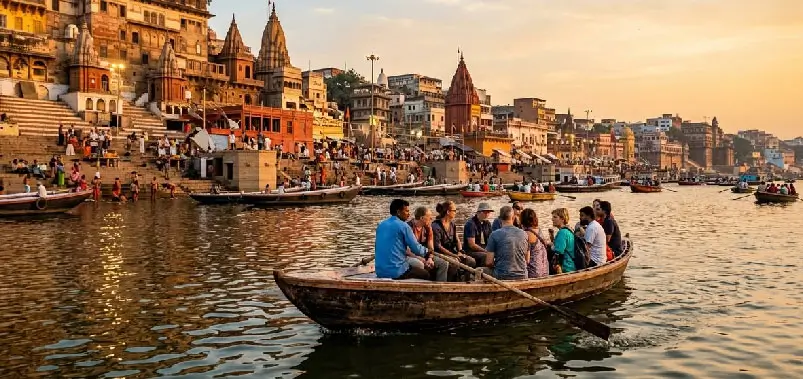
A boat ride in Varanasi is the single best way to understand how the city is laid out and how it lives along the water. There are two ideal times. The sunrise boat ride starts around 5:30 to 6:00 am in winter and as early as 5:00 am in summer. At this hour, the light turns the old buildings gold, pilgrims bathe and pray at the water's edge, laundry is beaten on the stones, and the city wakes slowly. The sunset ride offers softer light and ends neatly in front of Dashashwamedh for the evening ceremony.
The classic route for a sunrise ride runs from Assi Ghat downstream to Manikarnika or Panchganga, then back. It takes about one to one and a half hours. Rowing boats are slow and peaceful, ideal for photography and conversation. Motorboats cover a longer stretch faster, but they are louder and less atmospheric.
As for Varanasi boat ride prices, a private rowing boat for one hour usually costs INR 800 to 1,500. A private motorboat costs around INR 1,500 to 3,000 per hour. Shared boats charge about INR 150 to 300 per person but leave only when full. A two-hour private sunset ride with front-row viewing of the evening ceremony costs around INR 2,000 to 4,000. The city publishes official boat rates, but most boatmen quote their own prices, so agree on the price, the duration and the route before you step on board. Saying clearly whether the price is per person or per boat avoids arguments later.
For a more polished option, small cruise operators run covered boats with cushioned seating, tea and snacks, and a guide giving commentary. These cruises cost around INR 1,500 to 2,500 per person for an evening sailing. Several operators now use electric or gas-powered boats, which are quieter and cleaner than old diesel engines.
From the boat, you will pass the cremation ghats. Look respectfully, keep your voice low, and do not photograph the cremations, even from a distance. Ask the boatman to stop for a few minutes at the sandbank on the eastern bank, where you can stand on the soft sand and look back at the entire curve of the city. Further downstream lies Ramnagar Fort, the former residence of the Maharaja of Benares, which houses a quirky museum of vintage cars, weapons and palanquins. It is open roughly from 10:00 am to 5:00 pm, with a modest entry fee.Life jackets are supposed to be provided on every boat, but always check before departure, especially if you are travelling with children. During the monsoon from July to September, the administration often suspends boating when the river runs high and fast. Top Indian Holidays arranges private boats with trusted, regular boatmen, so prices are fixed in advance and you never have to bargain at the water's edge.
Plan Your Varanasi Travel Experience
Explore the sacred ghats, witness the mesmerizing Ganga Aarti, enjoy a sunrise boat ride on the Ganges, and discover the spiritual beauty of Varanasi.
Dev Deepawali in Varanasi: Dates, Crowds and Bookings
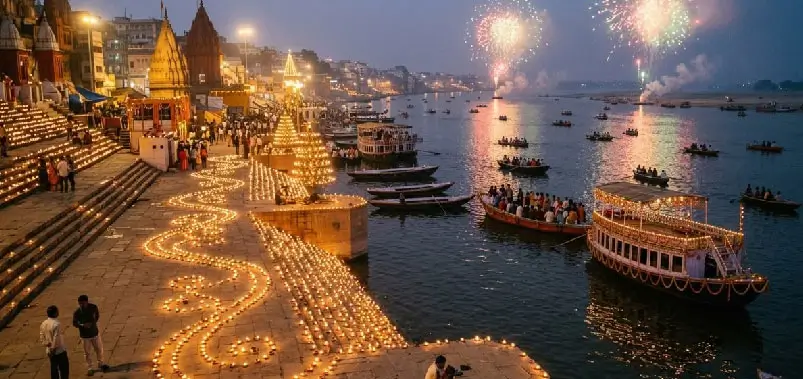
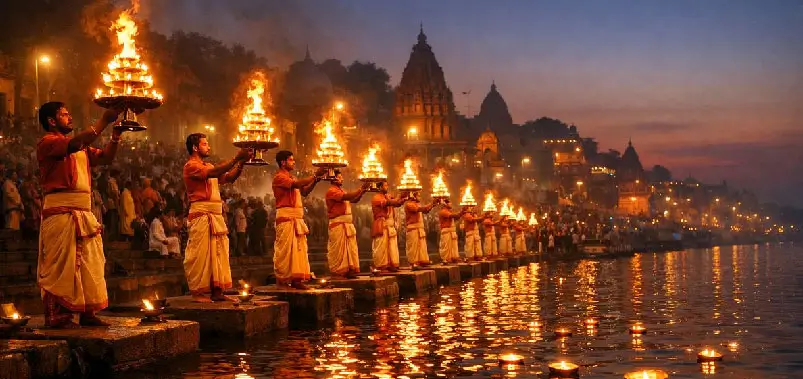
Dev Deepawali in Varanasi is the most spectacular night of the year on the river. It falls on the full-moon night of the Hindu month of Kartika, about fifteen days after Diwali, usually in November. The belief is that the gods themselves descend to bathe in the Ganges on this night. To welcome them, residents, temples and volunteers light more than a million small clay oil lamps on every step of every ghat, from Assi to Raj Ghat. The entire six-kilometre riverfront glows gold, reflected in the water, while fireworks burst over the river and a grand evening ceremony at Dashashwamedh is performed by a larger group of priests than usual.
Expect enormous crowds. Hundreds of thousands of visitors pour into the city, and police close roads near the ghats to vehicles from the early afternoon. Arrive in the city at least a day before and reach the riverfront by mid-afternoon, as entry points close as the crowds build. Staying in a hotel directly on the ghats is the most comfortable way to see the festival, since you can watch from a private terrace and avoid the crush on the steps.
Dev Deepawali boat booking is the biggest challenge. Every boat on the river is reserved weeks in advance. A private motorboat for the evening typically costs INR 15,000 to 40,000, depending on its size and position. A seat on a large double-deck boat costs around INR 3,000 to 8,000 per person, often including snacks. Prices are far higher than on normal evenings, and last-minute boats are nearly impossible to find.
Riverside hotels increase their rates sharply for this night. BrijRama Palace can charge INR 60,000 to 1,20,000 for a river-view room with a minimum stay. Most heritage hotels on the ghats sell out four to six months ahead. Booking early through an operator with local relationships is the only reliable way to secure a good room and a boat on the same night.
Dev Deepawali pairs beautifully with other autumn festivals. Many Top Indian Holidays guests celebrate Diwali in Jaipur, travel through the Golden Triangle, and then fly to Varanasi in time for the lamps two weeks later. If you have an extra day, add a half-day trip to Sarnath, 10 kilometres from Varanasi, where the Buddha gave his first sermon. Its great Dhamek Stupa and its fine archaeological museum, closed on Fridays, offer a quiet contrast to the festival intensity on the river.
Related Guides



 info@topindianholidays.net
 +91-8955000999