📅 Last Updated On: 13 Nov 2026
⏱ 6 Min Read
Jaipur vs Udaipur vs Jodhpur: Where to Spend Your Extra Nights in Rajasthan
N
Nand Singh Rathore
Travel & Tourism Expert specializing in India
Which Rajasthan City Is Best for Your Travel Style: Jaipur, Udaipur or Jodhpur?
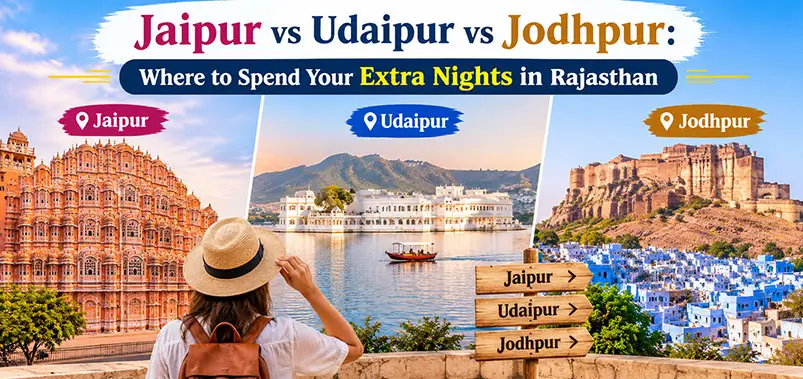
It usually happens at the final stage of booking. The route is set, the palace hotels are held, the flights are confirmed, and then a guest finds two spare nights. Perhaps a long-haul flight has moved, perhaps they have simply decided to slow down. The question that follows is always the same: should those nights go to Jaipur, to Udaipur or to Jodhpur? All three are royal cities with world-class hotels, and every travel forum seems to have a firm favourite. The difficulty is that each city rewards a different kind of traveller, and an extra night in the wrong place can feel like a lost day rather than a gift.
The honest answer depends on what that extra day actually gives you once the headline sights are done. In Jaipur, it adds depth, shopping and craft. In Udaipur, it adds stillness, water and long lakeside evenings. In Jodhpur, it adds the desert edge, village life and a slower look at one of India's greatest forts. Below, we compare the three as we do for our own guests, with what a Rajasthan extra night really includes in each city, the sights with timings and foreign visitor fees, the restaurants and experiences worth the time, the luxury palace hotels at peak-season rates, and the pace and season that suit each one best.
The Honest Starting Point: What Two Nights Already Cover in Each City
Before deciding where to add a night, it helps to be clear about what a standard stay already includes. Most Rajasthan luxury itineraries give each of these three cities two nights, which in practice means one arrival afternoon and one full day. That full day is enough to see the essentials, but rarely enough to enjoy them.
In Jaipur, two nights cover Amber Fort in the morning and the City Palace with Jantar Mantar in the afternoon, plus a quick stop at the Hawa Mahal facade. It is a full and slightly breathless day, because Jaipur traffic is heavy and the main sights are spread across the city, with Amber Fort about eleven kilometres north of the old walled centre. Most guests leave feeling they have seen the monuments but not the city itself, with its craft workshops, jewellers, gardens and evening life.
In Udaipur, two nights cover the City Palace museum and a boat on Lake Pichola, perhaps with a brief walk through the old town lanes to the Jagdish Temple. Because Udaipur is compact and much of its charm lies in simply sitting by the water, two nights here feel more complete than two nights in Jaipur. What gets lost is the countryside beyond the lakes, including the great fort of Kumbhalgarh, the Ranakpur temples and the Monsoon Palace on its hill.
In Jodhpur, two nights cover Mehrangarh Fort in the morning, Jaswant Thada just below it, and an evening walk through the clock tower market. The fort alone needs three to four hours to see properly, so the full day is fairly well used. What gets lost is the Bishnoi villages, the desert landscape outside the city and the old blue-painted lanes at a leisurely pace.
There is a second point that matters just as much. Your arrival day in any of these cities depends heavily on how you get there. A one-hour flight from Delhi to Jaipur or Udaipur can land you by late morning, giving you a useful afternoon. A five or six-hour drive from Jaipur to Jodhpur, or roughly seven hours by road from Jaipur to Udaipur, means you arrive in the late afternoon with energy only for dinner. The longer the journey into a city, the more an extra night there is worth.Finally, consider where you are in the trip. An extra night at the start, when guests are still adjusting to the time difference, is often spent resting. An extra night near the end, when the pace has caught up with them, is often the most valued night of the holiday. That timing, as much as the city itself, should shape the decision. With those starting points in mind, here is what an extra day actually adds in each place.
Create Your Custom Rajasthan Itinerary
From tasting Dal Baati Churma to exploring Udaipur’s charming old city, enjoy a Rajasthan journey tailored to your interests. Contact our travel experts to plan your ideal private experience.
What an Extra Day Adds in Jaipur
Jaipur is the city where an extra night makes the biggest practical difference, because it is the busiest of the three and has the most to see. With three nights instead of two, the sightseeing spreads across two mornings, and the city starts to feel like a place to enjoy rather than a list to complete.
The first full day can then focus on Amber Fort, ideally arriving close to its 8:00 opening, when the light is soft and the crowds are thin. The fort is open daily until about 5:30 in the evening, and foreign visitors typically pay around ₹500 for entry, or about ₹1,000 for a composite ticket valid for two days that also covers Hawa Mahal, Jantar Mantar, Nahargarh Fort and Albert Hall Museum. After Amber, there is time for a relaxed lunch and an afternoon at the City Palace, which opens from about 9:30 in the morning to 5:00 in the evening. Foreign visitors pay roughly ₹300 for general entry, with a substantially higher ticket of around ₹700 or more for access to the private rooms of the Chandra Mahal, still home to the royal family.
The extra day is where Jaipur's character comes through. A morning can begin with a hot air balloon flight over the Aravalli hills and the old forts, typically costing ₹15,000 to ₹20,000 per person, followed by a visit to Jantar Mantar, the eighteenth-century stone observatory beside the City Palace. Afternoons work beautifully for craft. Sanganer, about forty-five minutes from the centre, is home to hand block-printing workshops where you can print your own fabric, while the Anokhi Museum of Hand Printing near Amber gives the history in a restored mansion. Jaipur is also India's great centre for gemstones and fine jewellery, and an unhurried private appointment with a respected jeweller is a pleasure that simply does not fit into a two-night stay.
Evenings are when Jaipur rewards you most. Nahargarh Fort, on the ridge above the city, offers one of the finest sunset views in Rajasthan, and a private dinner there or on a palace terrace can be arranged for a special occasion. Fine dining in Jaipur is also the strongest of the three cities. Suvarna Mahal at Rambagh Palace serves royal Indian cuisine in a gilded former ballroom, Bar Palladio offers a stylish cocktail evening in a garden pavilion, and 1135 AD inside Amber Fort gives you dinner within the fort walls.
The extra day also allows for a half-day out of town. The ethical elephant sanctuaries near Amber, where guests feed and bathe elephants rather than ride them, cost roughly ₹8,000 to ₹12,000 per person. Samode Palace, about an hour north, makes a lovely lunch stop in a painted hall. For guests interested in architecture, the Panna Meena stepwell near Amber is best seen early in the morning before the light turns flat.
The one caution is pace. Jaipur is energetic, noisy and full of traffic, so an extra night here gives you more to see, but not necessarily more rest. Guests looking for calm often prefer to add their night elsewhere.
What an Extra Day Adds in Udaipur
Udaipur is the city where an extra night adds the most peace. It is smaller, slower and gentler than Jaipur, built around a chain of lakes ringed by hills, and its finest moments happen not in museums but on terraces, rooftops and boats as the light changes. With three nights instead of two, the city's mood finally has time to settle in.
The first full day typically covers the City Palace of Udaipur, the largest palace complex in Rajasthan, which rises above the eastern shore of Lake Pichola. The museum is open daily from around 9:30 in the morning to 5:30 in the evening, and foreign visitors usually pay roughly ₹600 to ₹700 for entry, with camera fees extra. Allow two and a half to three hours with a good guide for the courtyards, the peacock mosaics and the mirrored rooms. A sunset boat on Lake Pichola follows, typically ₹800 to ₹1,400 per person depending on the time and the stop at Jag Mandir island, or considerably more for a private boat arranged through the lakeside hotels.
The extra day is where Udaipur truly opens up. Most guests spend it on a full-day excursion to Kumbhalgarh Fort, about two hours north by road through the Aravalli hills. Its walls run for some thirty-six kilometres across the ridges, and the views from the top are among the most dramatic in the state. On the same day, it is easy to continue to the Ranakpur Jain temples, about an hour further, which are open to visitors from around midday to five in the afternoon and are carved from pale marble with more than a thousand individually decorated pillars. Foreign visitors typically pay a small entry fee of around ₹200 there, plus a camera fee.
Alternatively, the extra day can stay in town. The Monsoon Palace at Sajjangarh, on a hilltop west of the city, is best at sunset. Saheliyon ki Bari, an elegant eighteenth-century garden of fountains and lotus pools, is pleasant in the morning. Cooking classes, miniature painting workshops and a slow walk through the old town lanes behind the Jagdish Temple all fit comfortably. The evening folk dance performance at the old Bagore mansion on the waterfront, held around seven each night, is a popular and inexpensive way to end the day.
Dining is a central part of Udaipur's charm. Ambrai, on the western shore, has some of the finest views of the City Palace at night. Neel Kamal at Taj Lake Palace and the restaurants at The Oberoi Udaivilas and The Leela Palace offer refined Rajasthani and Indian menus with the lake as a backdrop. Private dinners on a boat, on a jetty or on a palace terrace are a speciality here, and for couples they are often the highlight of the whole holiday.
The main limitation of Udaipur is that its pace can feel almost too quiet for guests who want to stay busy. For honeymooners, anniversary couples and anyone who has driven hard through Rajasthan, however, that stillness is exactly what an extra night should buy.
What an Extra Day Adds in Jodhpur
Jodhpur is the city most often given only one night, and that is usually a mistake. It sits on the eastern edge of the Thar Desert, below one of the most powerful forts in India, and its character lies as much in the surrounding landscape as in the city itself. With an extra night, Jodhpur changes from a quick stop on the way to Jaisalmer or Udaipur into one of the most rewarding places in Rajasthan.
The first full day belongs to Mehrangarh Fort, which rises about 125 metres above the city on a sheer rock outcrop. The fort museum opens daily from 9:00 in the morning to 5:00 in the evening, and the international visitor ticket of around ₹800 includes an excellent audio guide. Allow three to four hours for the palaces, the armoury, the painted rooms and the views across the blue-painted old town. Below the fort, Jaswant Thada, a white marble royal memorial set above a small lake, charges foreign visitors a modest fee of around ₹100 and is best visited in the late afternoon. Many guests also take the Flying Fox zipline over the fort walls and lakes, which costs roughly ₹2,000 to ₹2,500 per person.
The extra day is where Jodhpur's countryside comes alive. A morning drive into the Bishnoi villages, about forty-five minutes south of the city, shows a farming community that has protected blackbuck, chinkara and desert trees for centuries. Guests often see antelope grazing near the villages, visit potters and weavers at work, and share a simple home-cooked lunch. In the afternoon, the Rao Jodha Desert Rock Park at the foot of the fort offers a quiet walking trail through restored desert plants, with entry for foreign visitors around ₹200.
The extra time also allows for the old city at a leisurely pace. The lanes around the clock tower and Sardar Market are full of spice merchants, textile shops and old silver dealers, and the stepwell at Toorji, recently restored and lined with cafes and design shops, is a pleasant place for an afternoon coffee. Mandore Gardens, about nine kilometres north, holds the old royal memorials of the earlier rulers and is free to visit.
Evenings in Jodhpur are memorable. Dinner on a rooftop facing the floodlit walls of Mehrangarh, such as Indique, is one of the great views of Rajasthan. At Umaid Bhawan Palace, Risala serves refined continental and Indian dishes in a grand Art Deco setting, and the terrace is one of the most elegant places in India for a sunset drink. The small museum at the palace, open to visitors for a modest fee, shows the family's collection of clocks, vintage cars and royal photographs.
The main limitation of Jodhpur is that its luxury hotel choice is smaller than Jaipur's or Udaipur's, and the old city can feel crowded at midday. For photographers, culture lovers and guests continuing into the desert, however, an extra night here often becomes the most surprising part of the trip.
Palace Hotels Compared: Where Your Extra Night Is Best Spent
For many luxury travellers, the extra night is really a question of which hotel they want more time in. All three cities have outstanding properties, but their character and prices differ, and the hotel is often what tips the decision. All rates below are approximate for good room categories in the October to March high season, before taxes.
In Jaipur, Rambagh Palace, the former residence of the royal family, typically runs from about ₹60,000 to more than ₹1,20,000 per night, with grand suites considerably higher. The Oberoi Rajvilas, set in thirty-two acres of gardens with private pool villas and luxury tents, sits in a similar band of roughly ₹55,000 to ₹1,10,000. SUJÁN Rajmahal Palace offers a smaller, boldly decorated palace stay from about ₹35,000 to ₹65,000, The Leela Palace Jaipur from about ₹30,000 to ₹55,000, and Fairmont Jaipur, near Amber, from roughly ₹22,000 to ₹40,000. Jaipur gives you the widest choice, which makes it easiest to find good rooms for an extra night at short notice.
In Udaipur, Taj Lake Palace, set entirely on the water in Lake Pichola, typically runs from ₹70,000 to ₹1,50,000 per night, and is reached only by boat. The Oberoi Udaivilas, on the lake shore with many semi-private pools, costs about ₹75,000 to ₹1,50,000 for premier rooms. The Leela Palace Udaipur, with direct lake views, runs from about ₹50,000 to ₹95,000, and Taj Fateh Prakash Palace, inside the City Palace complex, from about ₹40,000 to ₹70,000. RAAS Devigarh, about forty-five minutes north of the city, offers a restored hilltop fort with a calm, contemporary style from about ₹35,000 to ₹60,000. Udaipur's best rooms are the hardest of the three cities to secure in December and January.
In Jodhpur, Umaid Bhawan Palace is the showpiece, a vast sandstone palace partly still home to the royal family, with rooms typically from ₹70,000 to more than ₹1,50,000. RAAS Jodhpur, a restored mansion in the old city with a pool facing Mehrangarh, costs about ₹30,000 to ₹55,000. Just outside the city, Mihir Garh, a striking modern desert fort with suites only, runs from about ₹30,000 to ₹50,000, while Rohet Garh offers a charming countryside heritage stay from about ₹12,000 to ₹22,000.
This range shapes the decision. If your priority is to spend a full extra day enjoying a single hotel, the lake palaces of Udaipur and Umaid Bhawan in Jodhpur are hotels to linger in rather than simply sleep in. Jaipur's palace hotels are wonderful too, but the city's busy sightseeing often keeps guests out for most of the day.
Booking lead times matter as well. For Taj Lake Palace, Udaivilas, Rambagh and Umaid Bhawan in peak season, and around Diwali, Christmas and New Year, we recommend confirming four to six months ahead, and earlier for suites. If your preferred hotel is full on the extra night, it is often wiser to add the night in another city than to move to a lesser room.
Pace, Mood and Energy: How Each City Feels Over Three Nights
The three cities feel very different once you stay long enough to settle in, and that mood matters as much as the list of sights. Choosing where to add a night is partly a question of how you want to feel at that point in the trip.
Jaipur is the most energetic of the three. It is the state capital, with a large population, heavy traffic and a constant flow of visitors, and its main sights are spread across a wide area. Three nights let you see more, but they rarely feel restful. Days start early to beat the crowds at Amber Fort, afternoons are often spent in workshops or shops, and evenings bring sunset views and long dinners. For guests who love colour, craft and activity, that energy is exactly the attraction, and a Jaipur extra night feels like a richer day rather than a slower one.
Udaipur is the calmest. Its old town is compact, its hotels are built around water, and the natural rhythm of the day follows the light on the lakes. Mornings can begin with a quiet boat or a garden walk, middays are often spent by the pool, and evenings bring sunset drinks on a terrace facing the City Palace. Guests regularly tell us that a third night here is where the holiday finally slows down. For couples and anyone who has had a busy start to the trip, an Udaipur extra night delivers rest more reliably than any other choice.
Jodhpur falls between the two. The old city around the clock tower is lively, crowded and full of character, but the moment you drive out to the Bishnoi villages or sit on the terrace at Umaid Bhawan, the desert stillness takes over. Three nights let you balance both sides of the city: a morning in the fort, an afternoon in the countryside, an evening above the blue lanes. For guests who enjoy contrast, a Jodhpur extra night gives a little of everything.
Energy levels also depend on the journey. Reaching Jodhpur by road from Jaipur takes around five and a half to six hours, and reaching Jaisalmer from Jodhpur takes another five. If your route includes these long drives, an extra night in Jodhpur breaks up the road beautifully. Udaipur, by contrast, is easy to reach by a one-hour flight from Delhi, Mumbai or Jaipur, and so often works best as a final, restful stop before flying home.Family groups and multi-generation travellers should also think about walking. Mehrangarh Fort has a lift for part of the climb, but Amber Fort and Kumbhalgarh involve long, uneven ramps and steps. Udaipur's palace museum has many stairs, but its lakeside life is easy for all ages. Matching the extra night to the energy of the group, rather than the length of the sightseeing list, is usually what makes the trip feel generous rather than tiring.
Plan Your Rajasthan Trip
Explore Rajasthan with a customized travel plan covering heritage hotels, sightseeing, private tours, desert experiences, and transportation.
Season, Festivals and Weather in the Three Cities
Season can easily settle the question of where to spend an extra night, because the three cities change noticeably through the year. The main luxury travel season in Rajasthan runs from October to March, when days are warm and sunny and evenings are cool. Within that window, each city has its best moments.
Jaipur is pleasant through the whole season, but December and January bring cool mornings and occasional haze, while February and March offer clear skies and comfortable temperatures. The Jaipur Literature Festival, usually held in late January, brings writers and visitors from around the world and fills hotels quickly, so an extra night during that week needs to be booked early. Holi, usually in March, is celebrated with great energy in Jaipur, and many of the palace hotels host private celebrations for guests.
Udaipur is at its loveliest after a good monsoon, when the lakes are full and the hills are green, which makes October and November especially beautiful. In years when rains have been weak, the lakes can be lower by late spring. Winter evenings by the water can feel cool, so a light jacket is useful for sunset boats and rooftop dinners. Udaipur is also the most popular of the three for weddings and celebrations in the winter months, which can make its most sought-after hotel rooms very hard to secure around the main wedding dates.
Jodhpur sits at the edge of the desert, so its winters are drier and slightly colder at night, with clear skies that suit photography and fort views. The Rajasthan International Folk Festival is usually held at Mehrangarh around the full moon in October, with musicians performing late into the night inside the fort. From April onwards, Jodhpur heats up faster than Udaipur, and by May, daytime temperatures can pass forty-two degrees, which makes long fort visits tiring.
The summer months from April to June are the least comfortable time for all three cities, though hotel rates drop considerably. If you are travelling then, an extra night in Udaipur, with its lakes and gardens, is usually the most pleasant choice. During the monsoon, from July to September, Udaipur becomes green and atmospheric, with dramatic clouds over the lakes, while Jaipur and Jodhpur can feel humid between showers.
Festivals and holidays also affect cost. Diwali, Christmas and New Year are the busiest periods in all three cities, and the best palace hotels often apply minimum stays of two or three nights, which can decide where your extra night falls. Our advice is to check festival dates and wedding seasons before confirming the extra night, because the same city can feel very different from one week to the next.
Which City Earns Your Extra Night, Traveller by Traveller
After years of arranging Rajasthan journeys, we find that the right city depends far more on the traveller than on any ranking. Here is how we usually match the extra night to the guests who write to us.
First-time visitors who want to see as much as possible should usually add their night in Jaipur. It has the most to see, the widest choice of hotels and the richest mix of craft, shopping and history. Spreading Amber Fort, the City Palace and Jantar Mantar across two mornings, with a balloon flight or a block-printing workshop added, gives a far better sense of the city than a single rushed day.
Honeymoon and anniversary couples almost always gain most from an extra night in Udaipur. A third evening by Lake Pichola, a private dinner on a boat or terrace, and a full day either resting at the hotel or visiting Kumbhalgarh and Ranakpur make the trip feel romantic and unhurried. If budget allows, splitting the Udaipur stay between Taj Lake Palace and The Oberoi Udaivilas gives two completely different views of the same lake.
Photographers and culture lovers often find Jodhpur the most rewarding. The fort, the blue lanes, the Bishnoi villages and the desert light offer more variety than either of the other cities, and an extra night lets you be in the right place at dawn and at dusk. Guests continuing to Jaisalmer should almost always add a night here, because it breaks the long desert drive and gives Mehrangarh the time it deserves.
Families with children usually enjoy the variety of Jaipur most, with elephants, forts, puppet shows and craft activities, though Udaipur's boats and gardens suit younger travellers too. Multi-generation groups with older parents often prefer Udaipur, because its lakeside life is gentle and its distances are short.
Repeat visitors who have already seen Jaipur and Udaipur should give the extra night to Jodhpur, or use it for a countryside stay nearby such as Rohet Garh or Mihir Garh, which shows a quieter side of Rajasthan entirely.
Whichever city you choose, the same principles apply. Add the night where your journey into the city is longest, give your most special hotel a full evening and morning, and consider where in the trip you will most want rest. When we arrange a private Rajasthan tour, we look at the route, the season, the hotels and the energy of the group together, and the right place for that extra night usually becomes clear very quickly.
Related Guides
- Rajasthan in 7, 10, 14 or 21 Days: Which Route Should You Book?
- Eklingji Temple Udaipur: History, Timings, Dress Code & How to Reach
- 10 Famous Food Dishes in Udaipur & the Best Places to Try Them
- 11 Famous Food Dishes of Rajasthan You Must Try (and Where to Eat Them)
- Jaipur to Udaipur Road Trip by Car: Best Route, Stops & Travel Time
- Rajasthan Tour Cost 2027-28 : Complete Budget Guide for International Travelers
- Stay at a Luxury Fort in Rajasthan: A Unique Heritage Experience
- Bagore Ki Haveli Udaipur: History, Timings, Entry Fee & Visitor Guide
- Jagmandir Island Palace Udaipur: History, Timings, Entry Fee & Visitor Guide
- Devi Garh Palace Udaipur: History, Luxury Stay & Travel Guide
- Lakes in Udaipur: Complete Guide to the City of Lakes
- Bullet Baba Temple Rajasthan: Story, History & Complete Travel Guide
- Golf Holiday in Rajasthan: Royal Fairways & Palace Hotels
- Rajasthan in Summer - Is It Possible? An Honest Guide for International Tourists
- Top 10 Luxury Birthday Celebration Ideas in Rajasthan for International Guests
- Udaipur, Jaisalmer & Jaipur: Perfect Rajasthan Honeymoon Circuit
- Best Time to Visit Rajasthan for Honeymoon & Couple Tour
- Romantic Places to Visit in Rajasthan for Couples
- Best Rajasthan Tour Packages for Couples
- Rajasthan Honeymoon Tour Packages with Private Car & Driver
- Rajasthan Road Trip Itinerary – Explore Desert Cities with a Private Driver



 info@topindianholidays.net
 +91-8955000999