📅 Last Updated On: 18 Nov 2026
⏱ 10 Min Read
Where to Stay in Jawai: SUJÁN Jawai vs Boutique Leopard Camps vs Nature Stays
N
Nand Singh Rathore
Travel & Tourism Expert specializing in India
Which Jawai Stay Is Right for You: Luxury, Comfort or Nature?
The question usually arrives in the middle of a Rajasthan itinerary that is already looking very good. A couple has booked Jaipur palaces, a lake-view suite in Udaipur and a few nights in Jodhpur, and then someone mentions a place where leopards sit on granite boulders above village temples at sunset. They search for it, find a single famous tented camp at a rate that makes them pause, and write to ask whether there is anything else worth considering in Jawai, and whether the leopards are really as easy to see as the photographs suggest.
The short answer is that Jawai has changed a great deal. A few years ago, SUJÁN Jawai was almost the only serious luxury option. Today the area also has a small group of genuine boutique leopard camps, a handful of conservation-minded lodges and several simpler nature stays that still offer good drives with local trackers. Choosing between them is less about stars and more about what you want from your nights in leopard country: complete ease, privacy and polish, or a quieter, more personal stay at a fraction of the price. Below is how we weigh the options for our own guests, with tent rates on the higher side, realistic drive timings, honest sighting chances, transfer times from Udaipur and Jodhpur, and the number of nights that actually works.
Jawai in Brief: Granite Hills, Shepherds and Free-Roaming Leopards
Jawai sits in the Pali district of southern Rajasthan, roughly halfway between Udaipur and Jodhpur, in a landscape that looks nothing like the forests of Ranthambore or Kanha. Instead of teak and bamboo, you find huge domes of pink and grey granite rising out of scrub, mustard fields and grazing land, with the long reservoir of the Jawai Dam shining between them. The rocks are full of caves and ledges, and these natural shelters are what make the area such good leopard country.
The most striking thing about Jawai is that it is not a fenced national park. There are no forest gates, no zones, no permit lottery and no tiger reserve rules. The leopards live among villages, temples, farms and herding routes, and they have done so for generations. The local Rabari herding community, known for their white clothing and bright red turbans, have shared these hills with the cats for a very long time, and many regard the leopard as a protector of the land rather than a threat. Conflict is surprisingly rare, and it is common to see a leopard resting on a boulder while cattle graze below and a temple bell rings on the hillside.
Estimates of the local population vary, but most naturalists put the number of leopards in the wider Jawai area at somewhere between fifty and seventy. Part of the landscape has been declared the Jawai Leopard Conservation Reserve by the state government, and the rest is a mix of revenue land, village land and private farms. This patchwork is one reason why the quality of your stay matters so much. The better camps work with experienced local trackers who know individual leopards, their favourite caves and the paths they use in the evening, and that knowledge is the real difference between a good drive and a frustrating one.
Leopards are not the only reason to come. The reservoir holds a healthy population of mugger crocodiles, and in the cooler months it attracts large numbers of migratory birds, including bar-headed geese, ruddy shelducks, demoiselle cranes and, in good years, flamingos. Striped hyenas, jungle cats, Indian foxes, nilgai and the occasional sloth bear are also seen on drives, along with owls, vultures and eagles around the rock faces.For guests travelling between Udaipur and Jodhpur, Jawai also makes geographical sense. The great Jain temples of Ranakpur are roughly an hour and a half away by road, and the walls of Kumbhalgarh Fort are around two hours away, so a stay here fits naturally into a longer Rajasthan tour rather than requiring a long detour. That convenience, combined with the extraordinary scenery, is why the area has moved so quickly from a little-known secret to one of the most requested stops on a luxury Rajasthan itinerary.
Find Your Perfect Jawai Stay
Compare luxury camps, boutique leopard lodges and nature stays to find the ideal accommodation for your Jawai safari experience.
SUJÁN Jawai: Tents, Inclusions and What the Rate Really Covers
SUJÁN Jawai is the camp that put the area on the international map, and it remains the benchmark against which every other stay is judged. It was founded by Jaisal and Anjali Singh, a conservation-minded couple whose family also runs SUJÁN Sher Bagh near Ranthambore and the Serai near Jaisalmer, and it is a member of Relais & Châteaux. The setting is remarkable: the tents sit in a private wilderness area surrounded by granite outcrops, with no village or road in sight from most verandahs.
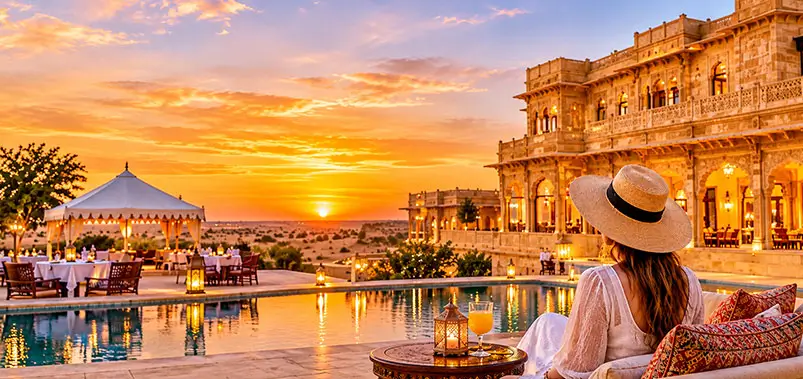
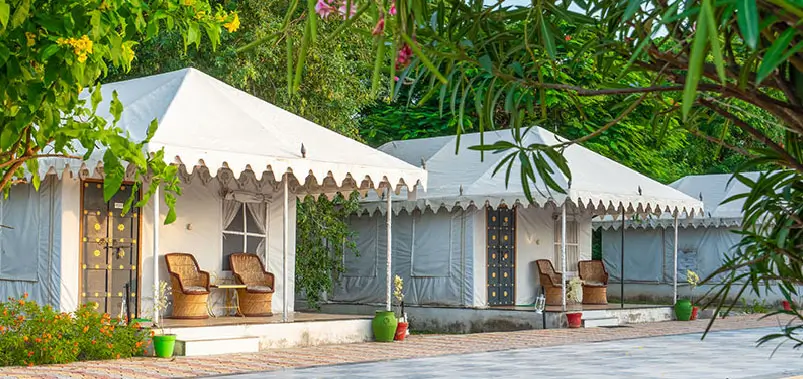
The camp is small, with ten tented suites in total. Most guests stay in the Rock Suites, spacious canvas tents with a large bedroom, an en suite bathroom with a freestanding bath, a dressing area and a private verandah facing the hills. The interiors blend safari style with Rajasthani craft, with embroidered textiles, campaign-style furniture, brass lamps and soft rugs over stone floors. For families there is a larger Felidae family suite, and for those who want the most space there is the Panthera royal suite, effectively two tents joined under a canopy, with its own pool. The camp also offers an exclusive private camp option for small groups who want an area to themselves. There is a shared swimming pool, a small spa, a dining tent and a bar, and dinners are often served outdoors by lantern light or around a fire.
The rate is the part that makes most guests pause, so it helps to be clear about what it covers. SUJÁN quotes per tent, per night, for two guests on a full board basis. That includes breakfast, lunch and dinner, two wilderness drives each day, laundry, Wi-Fi and transfers from the local railway station. It does not include drinks, spa treatments, excursions such as Ranakpur or Kumbhalgarh, boutique purchases or tips. A conservation fee of about ₹2,500 per person per night is added, and government tax is applied on top of the published figures.
In the high season, the Rock Suites typically run from roughly ₹1,25,000 to ₹1,45,000 per tent per night before tax, rising further over Christmas, New Year and other festive dates. The family suite sits at roughly ₹2,30,000 to ₹2,50,000, and the royal suite at roughly ₹2,60,000 to ₹2,90,000 or more. The private camp option is quoted in the region of ₹4,00,000 to ₹4,50,000 per night. Once tax and conservation fees are added, three nights in a Rock Suite for two people in peak season usually lands somewhere around ₹4,50,000 to ₹5,50,000, or roughly US$5,500 to US$6,600.
That is a significant sum, but the value is real. The guiding team is excellent, the trackers are among the most experienced in Jawai, and the camp holds access to a large private area that other operators cannot use. Service is warm, personal and unhurried, and the food, much of it grown in the camp gardens, is some of the best in rural Rajasthan. The camp is seasonal, typically open from early September until around mid-May and closed during the hottest months and the monsoon. Over the October to March peak, it fills months ahead, especially over Christmas and the spring holidays.
The Boutique Alternatives: Brij Pola, Zari Bijapur Lodge and Bera Safari Lodge
For guests who want a genuinely high-end stay but not necessarily SUJÁN, Jawai now offers a small number of credible boutique leopard camps. Each has its own character, and none is a cheaper copy of the original. They are simply different ways of enjoying the same hills.
Brij Pola is the newest of the high-end tented stays and the closest in spirit to SUJÁN in terms of scale and comfort. It belongs to Brij Hotels, a boutique group known for restored heritage properties across Rajasthan, which has recently become part of the IHCL family, the company behind the Taj brand. The camp has only a handful of very large tents, each around 2,500 square feet, which is larger than many city apartments. The signature tents come with a private heated plunge pool, stone bathtubs, large sit-outs and wildlife-inspired interiors. Morning and evening drives are led by a personal naturalist, and meals are served in different settings around the property, including breakfast beneath a large banyan tree. Rates for the top tents typically sit around ₹1,20,000 to ₹1,40,000 per night in peak season, depending on the tent category and the meal basis, so it is not a budget option. What it offers is a newer, more private feel, with very few other guests on the property at any time.
Zari Bijapur Lodge is another recent arrival, a six-suite retreat set on about five acres in the heart of leopard country. It is the first property of a young Indian boutique brand, and the emphasis is on personal service, privacy and a strong sense of place, with private drives led by naturalists, guided village walks, birdwatching, boat outings on the reservoir and yoga. Because it is so new, we suggest checking the latest guest feedback before committing, but the concept suits couples and small families who want a quiet lodge rather than a camp. Expect higher-side rates in the region of ₹60,000 to ₹1,00,000 per night, depending on the suite and the inclusions.
Bera Safari Lodge is very different in feel. Run as a family-owned lodge by a committed conservationist and wildlife photographer, it sits at the foot of Mount Liloda near the village of Bera, with roomy cottages that each have a private terrace looking out over the hills. Guests sometimes see a leopard from the cottages themselves. The cooking is home-style and generous, and the hosts are deeply involved in local conservation and community work. Rates on a full board basis with drives typically start around ₹27,500 and rise to roughly ₹35,000 to ₹40,000 per night for two in the best cottages at peak times. For photographers and repeat wildlife travellers, it is often the most rewarding choice in Jawai.
There are also more resort-style properties such as WelcomHeritage Cheetahgarh and Aaramgah Jawai, which offer pools, spa treatments and family activities, with leopard drives arranged as extras. These are comfortable rather than exceptional, and they suit families who want space and facilities. Rates at the better ones run roughly ₹20,000 to ₹30,000 per night before drives and meals. Between these properties and SUJÁN, there is now a real choice for every type of luxury guest.
Simpler Nature Stays and Value Camps Around Bera
Not every traveller needs a private plunge pool to enjoy a leopard. Some of our guests, particularly keen wildlife lovers, photographers and those adding Jawai to a long trip, are perfectly happy with a clean, comfortable tent or cottage as long as the tracking is good and the hosts are knowledgeable. Around the village of Bera, there are several simpler nature stays that fit this brief.
The most common format is the small tented camp on a farm. Varawal Leopard Camp offers Swiss-style tents on a private farm near the dam, with evening bonfires, open views over the fields and a relaxed, family-run atmosphere. Jawai Leopard Safari Lodge, Jawai Bera Leopard Camp and Thour Nature Resorts offer similar stays, with tents or cottages, home-style Rajasthani meals and drives led by local trackers. Some have air-conditioned tents, attached bathrooms with hot showers and small gardens, while others are more basic. The common thread is that the drives are run by people who grew up in these hills.
These stays usually cost between roughly ₹8,000 and ₹15,000 per night for two in peak season, often including breakfast and dinner, with drives priced separately or included in a package. At the top end, a two-night stay with all meals and four drives for two people can come in at around ₹35,000 to ₹50,000, which is less than a single night at SUJÁN. For travellers who are already spending heavily on palace hotels elsewhere in Rajasthan, this can be a sensible way to balance the overall budget.
The trade-offs are worth stating clearly. Service is friendly but not polished, rooms are simpler, the food is home-style rather than refined, and hot water, Wi-Fi and power can be less reliable. The bigger difference, however, is in the drives. The luxury camps use well-maintained open vehicles with good seating, experienced naturalists who speak fluent English and, in SUJÁN's case, access to a private area. At simpler stays, the vehicle may be an older open Gypsy or a modified jeep, the guide may be a skilled local tracker with limited English, and you may share popular viewpoints with several other vehicles in the evening.
Quality varies more at this level than at any other, so it is important to choose carefully. A good simple camp has a long track record, consistent recent guest reviews, its own vehicles rather than hired ones and a clear policy on staying at a respectful distance from the leopards. A poor one may promise guaranteed sightings, drive too close to the animals or crowd them with spotlights after dark, which is something we will not book.
For guests who want the best of both worlds, a split stay can work well. One night at a well-run simple camp followed by two nights at a boutique lodge, or vice versa, gives a sense of both worlds, keeps the budget sensible and still allows four or five drives in total. It is also a good way for first-time visitors to find out how much they enjoy wildlife before committing to a longer stay in the most expensive tent in Jawai.
Leopard Drives: Timings, Vehicles and Realistic Sighting Chances
Every stay in Jawai is built around two leopard drives each day, one in the early morning and one in the late afternoon and evening. Because there are no park gates, the timings are set by the light and the leopards rather than by forest department rules, and each camp runs its own schedule.
A typical morning drive starts around dawn, which means leaving the camp between roughly 6:00 and 6:45 depending on the season, with tea or coffee and a light snack before departure. It usually lasts about three hours, returning for a late breakfast around 9:30. The evening drive generally leaves between about 3:30 and 4:30 in the afternoon and continues past sunset, often until around 7:00 or a little later, with dinner served soon after you return. Some camps add a break at a scenic point for drinks at sunset, which is one of the loveliest moments of a stay here.
The drives are made in open 4x4 vehicles, usually with six seats or fewer. At the luxury camps, each vehicle carries a naturalist and a tracker, and the tracker often reads the hills with binoculars from a high point before deciding where to go. Leopards in Jawai have favourite rocks, caves and ledges, and much of the work involves checking these spots, listening for alarm calls from peacocks and langurs, and waiting. It is common to sit quietly for an hour or more beside a rock face before a cat appears. Guests who enjoy patience and scenery tend to love these drives, while those expecting constant action may find the slower pace surprising.
The good news is that sighting chances in Jawai are genuinely high compared with most Indian wildlife areas. Because the leopards are used to people and vehicles, and because they spend much of the day resting on exposed rocks, many guests see at least one leopard on a two-night stay, and those who stay three nights see one more often than not. Some evenings bring several sightings, including mothers with cubs. That said, no honest operator can guarantee a sighting. Weather, local events, the time of year and pure luck all play a part, and sightings are often at a distance of fifty to a few hundred metres rather than close up, so a good pair of binoculars and a camera with a long lens make a real difference.
If you stay at a simpler camp and book drives separately, a private vehicle for up to six guests typically costs roughly ₹4,000 to ₹8,000 per drive depending on the operator, the vehicle and the season, with specialist photographic drives at the higher end. At SUJÁN and the boutique camps, two drives daily are usually included in the rate. Extra full-day outings, sunrise picnics and photography-focused drives can be arranged at most properties at additional cost.
Ethics matter more here than in many parks, because the leopards share space with people. The best guides keep a respectful distance, avoid surrounding a leopard with vehicles, do not use strong spotlights after dark and never drive onto the rocks to get closer. Local rules on vehicle numbers and off-road driving are also evolving, so we always confirm current practice with the camp before you arrive.
Getting to Jawai from Udaipur, Jodhpur and Beyond
Jawai is easy to reach by road from either of the two main airports in southern and western Rajasthan, which is one of the reasons it fits so neatly into a longer private Rajasthan tour. Most of our guests arrive by private car with their own chauffeur, though a few combine a short flight with a transfer arranged by the camp.
From Udaipur, the distance to Jawai is roughly 130 to 145 kilometres depending on the exact camp, and the drive usually takes around two and a half to three and a half hours. The road climbs through the Aravalli hills past villages and farmland, and it can be combined with a visit to the Jain temples at Ranakpur, which are almost on the way. The temples are generally open to visitors from around noon until about 5:00 in the afternoon, so leaving Udaipur in the late morning, visiting Ranakpur after lunch and reaching Jawai before sunset makes a comfortable and beautiful travel day. Maharana Pratap Airport in Udaipur has frequent flights to Delhi, Mumbai and Jaipur.
From Jodhpur, the distance is roughly 150 to 170 kilometres, with a drive of about three to four hours on good roads through the Marwar countryside. Many guests travelling from Jodhpur towards Udaipur break the journey in Jawai for two or three nights, which turns a long transfer day into one of the highlights of the trip. Jodhpur Airport, a short drive from the city centre, has direct flights to Delhi, Mumbai and a few other cities.
Some guests travel by train. Jawai Bandh station and the nearby station at Falna lie on the main line between Ahmedabad and Delhi, and several of the luxury camps include or arrange transfers from the station. Trains are a pleasant option for those coming from Ahmedabad or Mount Abu, though for most international guests the flexibility of a private car is more practical.
If you are travelling with a dedicated chauffeur through Rajasthan, the car and driver typically stay with you during your nights in Jawai, even though the camp provides its own safari vehicles. A Toyota Innova Crysta with chauffeur usually costs roughly ₹5,000 to ₹6,500 per day including fuel, tolls and the driver's allowances, while a luxury sedan such as a Mercedes-Benz E-Class runs roughly ₹18,000 to ₹25,000 per day. For those flying in and out of Udaipur or Jodhpur with no car of their own, a one-way private transfer from either airport to the camp usually costs between ₹8,000 and ₹15,000 depending on the vehicle.Jawai also links well with the rest of the region. Kumbhalgarh Fort is around two hours by road, Mount Abu around two and a half hours, and the desert towns further west can be reached in a long day's drive. For guests coming from Jaipur, the most comfortable approach is usually to fly to Udaipur or Jodhpur and continue by road, rather than attempting a full day's drive across the state. Helicopter transfers are occasionally possible for special occasions, though permissions and costs make them rare.
Plan Your Jawai Leopard Safari
Get a personalised Jawai itinerary with the right stay, private safari experiences and comfortable transfers.
Best Season and How Many Nights to Stay
The best time to visit Jawai is from October to March, when the days are dry, clear and comfortable and the light on the granite is at its most beautiful. October and November are particularly good: the hills are still green from the monsoon, the reservoir is full and the first migratory birds are arriving. December and January bring cool, crisp mornings, sometimes close to freezing before dawn, so warm jackets, hats and blankets on the morning drives are welcome. February and March are warmer, and leopard sightings often improve as the vegetation thins and the cats spend more time on open rocks.
April and early May are hot, with daytime temperatures often climbing above forty degrees Celsius, but this is also a period when leopards are seen frequently near water and on shaded ledges. Some guests who cope well with heat find it a rewarding time, with lower rates and fewer vehicles. From mid-May until early September, most of the luxury camps close, and the monsoon months bring humidity, rain and lush green hills but limited operations. SUJÁN Jawai typically reopens in early September, and a few simpler camps stay open through the year.
Festive periods need careful thought. Christmas, New Year and the week around Diwali are the busiest times in Jawai, and the most popular tents and suites are booked many months ahead, often with minimum stay requirements and festive supplements. If your dates are fixed around these holidays, it is wise to secure your Jawai nights first and then arrange the rest of the itinerary around them.
As for the length of stay, the number of nights makes a big difference to the experience. One night allows only two drives, an evening and a morning, which is rarely enough to settle into the rhythm of the place and gives a lower chance of a good sighting. We generally advise against it unless your schedule is extremely tight. Two nights, with four drives, is the minimum we recommend for most guests, and it works well as a break between Udaipur and Jodhpur. Three nights, with six drives, is ideal for keen wildlife lovers, photographers and anyone staying at SUJÁN or one of the boutique camps, where the setting itself is part of the reason to come. It also leaves room for a half-day excursion to Ranakpur or Kumbhalgarh, a village walk with a Rabari family, or simply an afternoon by the pool.
Some guests combine Jawai with a tiger reserve such as Ranthambore on the same trip. This works very well, as the two places are entirely different in character: Ranthambore offers forest, lakes and ruined forts, while Jawai offers open granite, villages and leopards. Allow at least two nights in each, and three if possible, to give both places a fair chance.
For a typical twelve to fourteen night Rajasthan itinerary, we often place Jawai between Udaipur and Jodhpur with two or three nights, which keeps the travel days short and adds a strong wildlife element without disturbing the overall flow of the journey.
Matching the Stay to the Traveller and Booking Ahead
After sending many guests to Jawai over the years, we have found that the right stay depends far more on the traveller than on the brochure. The leopards are the same for everyone. What changes is the comfort, the privacy, the guiding and the price.
For honeymooners and couples celebrating a special occasion, SUJÁN Jawai or Brij Pola are usually the best choices. Both offer spacious tents, excellent food, private pools or plunge pools, and the kind of quiet, polished service that makes a short stay feel like a real retreat. SUJÁN has the edge in guiding and private access, while Brij Pola feels newer and even more private because it has so few tents. Either is a worthy splurge within a luxury India tour.
For families with children, SUJÁN's family suite works very well, as do the larger resort-style properties such as WelcomHeritage Cheetahgarh, which have more space and activities. It is worth noting that very young children may find the long, quiet waits on drives difficult, so we often arrange shorter drives, village walks and pool time to keep everyone happy.
For serious photographers and wildlife enthusiasts, Bera Safari Lodge is often the best fit. The hosts are passionate about the leopards, the guiding is personal and patient, and the rate leaves room in the budget for extra drives. Some photographers also book a simpler camp near Bera for a night or two and add private photographic drives.
For travellers on a long Rajasthan journey who are already spending generously on palace hotels, a simpler nature stay can be a smart choice. Two nights at a well-run camp near Bera with good local trackers offer the same leopards and the same scenery, and the savings can go towards an extra night at a lake palace in Udaipur.
Booking lead times are the final piece. For SUJÁN Jawai and Brij Pola in the October to March season, we suggest booking four to six months ahead, and nine to twelve months ahead for Christmas, New Year and Diwali. The boutique lodges such as Zari Bijapur Lodge and Bera Safari Lodge usually need around two to four months' notice in peak season, while simpler camps can often be arranged with a few weeks' notice outside the festive weeks. Cancellation terms at the luxury camps are strict, often with non-refundable deposits within sixty days of arrival, so comprehensive travel insurance is strongly advised.
When we put together a private Jawai leopard stay for our guests, we check availability at the preferred camp first, then build the surrounding days around it, choosing Udaipur or Jodhpur as the gateway depending on the rest of the trip. Getting the order right means shorter drives, better rooms and more time on the rocks with the leopards, which is exactly why guests come to Jawai in the first place.
Related Guides


 info@topindianholidays.net
 +91-8955000999