📅 Last Updated On: 16 Nov 2026
⏱ 8 Min Read
Suryagarh Jaisalmer for International Guests: Room Types, Experiences & Is It Worth It?
N
Nand Singh Rathore
Travel & Tourism Expert specializing in India
Is Suryagarh Jaisalmer Worth Staying at for International Travellers?
The question usually arrives late in the booking process. A couple from London or Chicago has settled on Udaipur and Jodhpur, they have chosen their palace hotels, and now they are looking at the far west of Rajasthan. They have seen photographs of a honey-coloured fortress rising out of the desert, read that it is a hotel rather than a historic monument, and noticed that it costs more than many palace stays elsewhere in the state. They want to know, quite simply, whether Suryagarh Jaisalmer is worth the journey and the rate, or whether a tented camp in the dunes or a small hotel inside the old fort would suit them better.
It is a fair question, and one we answer often for our guests. Suryagarh is not an old palace. It is a modern building, completed in the style of a desert fort, standing on the road west of Jaisalmer towards the Sam dunes. What makes it special is not age but atmosphere: thoughtful design, a strong sense of place, a programme of signature desert experiences and service that consistently impresses well-travelled visitors. As a travel agent, Top Indian Holidays books Suryagarh on behalf of guests but is not an official partner of the hotel, so what follows is an independent view. Below we set out the room and suite categories, the dining, the experiences, the location, how to get there, realistic higher-side rates and how it compares with other luxury hotels in Jaisalmer.
What Suryagarh Is, and Where It Stands
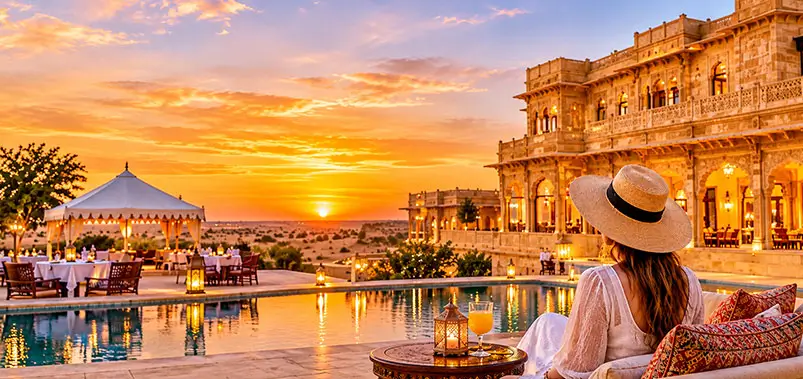
Suryagarh sits about fifteen kilometres west of Jaisalmer town, on the road that leads to the Sam dunes and the open Thar Desert. Seen from the highway, it looks like a fort that has always been there: high sandstone walls, bastions, carved balconies and a great gateway, all built from the same golden Jaisalmer stone as the old city. Step inside and the scale becomes clearer. Courtyards open one into another, corridors are lined with lanterns and carved screens, and terraces look across the scrubland towards the horizon. The effect is theatrical in the best sense, and most guests are won over within minutes of arriving.
The hotel is a member of Small Luxury Hotels of the World, which says something about the standard it aims for. It is privately owned and independently run, and that independence shows in the way it tells its own story. Rather than relying on royal history, Suryagarh leans on the culture of the desert itself: music, folklore, food, crafts and the landscape around it. Many guests arrive expecting a beautiful building and leave talking more about the people, the evenings and the stories they heard.
In size, the hotel is mid-scale by Rajasthan standards. Depending on how the standalone villas and apartments are counted, it has somewhere between seventy and ninety-five keys, with a large share of them suites. That is big enough to support several restaurants, a spa, two pools and a full programme of activities, but small enough that the staff come to know guests by name over a two or three night stay. Families, couples and small groups all fit comfortably, and the property rarely feels crowded even in peak season.
It is worth being clear about what Suryagarh is not. It is not in the old city, so you cannot step out of the gate and walk to the Jaisalmer Fort or the carved merchant mansions of the town. It is not a tented camp, so you will not wake up in the middle of the dunes. And it is not a heritage building, so guests who want genuine centuries-old walls around them may prefer a different style of stay. What it offers instead is space, comfort, a strong design identity and a location that sits neatly between the town and the desert, with easy access to both.For most international guests, that balance is exactly right. Jaisalmer town is crowded, with narrow lanes and limited hotel choice at the very top end, while the dune camps are wonderful for a night or two but simpler in their comforts. Suryagarh gives you a calm, polished base from which to see both sides of Jaisalmer, and to return each evening to a hot bath, a well-made cocktail and a quiet room.
Experience Luxury at Suryagarh Jaisalmer
Discover royal Rajasthani hospitality, elegant rooms and curated cultural experiences at one of Jaisalmer's finest luxury hotels.
Room and Suite Categories at Suryagarh
The Suryagarh room types follow a clear ladder, from well-sized entry rooms to private villas with their own pools. Categories can change over time, so we always confirm the current names and configurations at the time of booking, but the structure has been consistent for several seasons.
The entry level is the Fort Room, available with a king bed or twin beds, decorated with carved wood, textiles and lanterns inspired by eighteenth-century Rajasthani interiors. Fort Rooms are comfortable and well designed, though they are the most compact category, and some face inner courtyards rather than open views. They suit guests who will spend most of their days out on excursions and want a beautiful, quiet room to return to.
The Pavilion Room is a step up in feel, with a king bed, a seating area, a bath and separate shower, and views over the gardens. Many guests find it the best value in the hotel. The Heritage Room, available as a king or twin, is more spacious still and furnished in a richer, more ornate style, which makes it a good choice for families who want a little more room or for guests staying three nights or more.
Above these sit the suites. The Signature Suite, the smallest of the suite categories at just under sixty square metres, adds a proper living area. The Luxury Suite includes a private alcove for sitting and reading, and it suits couples on a special occasion who want more space without moving into the villa categories. At the top of the main building is the Suryagarh Suite, set on the upper floor with a private terrace and plunge pool, a freestanding bathtub and a walk-in shower. For honeymooners and anniversary couples, this is the room most likely to be remembered.
Beyond the main building, the hotel offers several standalone residences. These include apartment-style units for two or four guests, a penthouse for up to six and two categories of private villa named after Jaisalmer and the Thar. The smaller villa, a short walk from the main hotel, has its own courtyard, a separate living area, a freestanding bath and desert views. The largest, the Thar villa, extends to more than eight hundred square metres, with two double bedrooms, a living room, a kitchen and two private pools. It is ideal for families or two couples travelling together who want privacy, a private chef and the freedom of a home, while still having access to the hotel's restaurants and spa.
Across all categories, rooms include air conditioning, Wi-Fi, a minibar, tea and coffee facilities and well-equipped bathrooms. Winter nights in the desert can be cold, dropping close to five degrees Celsius in late December and January, and the rooms are well heated, which matters more than many visitors expect.
Signature Experiences: Dune Dinners, Night Trails and Desert Mornings
What sets Suryagarh apart from most luxury hotels in Rajasthan is the programme of experiences it designs around the desert. Many hotels can arrange a camel ride. Few have built such a distinctive set of evenings and outings that guests talk about long after they leave.
The best known is the dinner on the dunes. Guests are driven out into the sand in the late afternoon, watch the sun set over the Thar, and then sit down to a private or semi-private dinner by lantern and firelight, often with desert musicians playing in the background. It is the single experience most guests ask about before arrival, and it is worth arranging on a clear night when the stars are at their best. A related option is the sundowner on the dunes, a shorter outing with drinks, snacks and folk music, which suits guests who want the sunset without a full evening away from the hotel.
For those with an appetite for stories, the hotel offers a night-time trail through the desert built around local ghost legends. Guides lead guests by torchlight to abandoned settlements and old shrines, recounting the folklore of spirits said to haunt the dunes. It is atmospheric rather than frightening, and it gives a real sense of how the desert shaped the imagination of the people who lived here.
The hotel also arranges a sunset picnic at Kuldhara, the abandoned village around twenty minutes away, whose stone houses were deserted centuries ago and which carries its own legend of a village that left overnight. Seeing it in the soft evening light, with a picnic laid out nearby, is very different from visiting it at midday with tour groups.
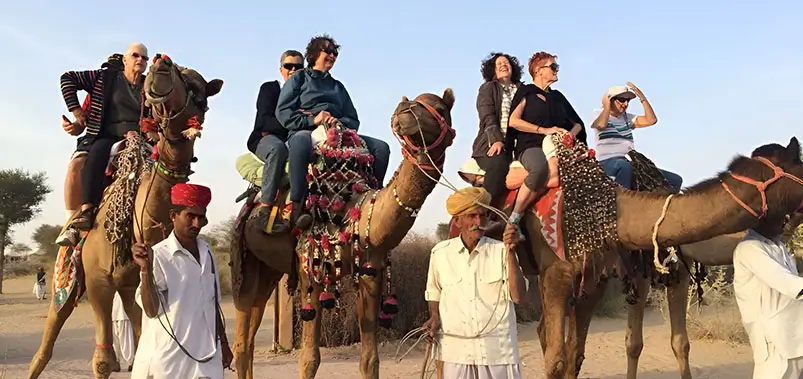
Mornings at Suryagarh are just as distinctive. Breakfast with the peacocks is served in a quiet spot where the birds gather at dawn, and it has become one of the hotel's best-loved rituals. Other mornings might bring yoga or meditation sessions, sunrise salutations on the terrace, traditional archery lessons, or a temple and village trail through the surrounding countryside, visiting small desert shrines and stopping to meet local families and craftspeople. Horse riding is available on site, and camel treks can be arranged in the dunes.
For geology enthusiasts and families with children, the hotel can arrange fossil-hunting outings in the surrounding desert, where marine fossils from an ancient sea are still found. Stargazing sessions are popular on clear winter nights, and the hotel can also arrange jeep drives across the dunes for guests who want a little adventure.
Most experiences are charged separately, and pricing varies by season and group size. As a rough guide on the higher side, a private dinner on the dunes for two typically costs between ₹20,000 and ₹40,000 depending on the menu, music and setup, while shorter outings such as a sunset picnic, a night trail or a village walk generally fall between ₹5,000 and ₹15,000 for two. We recommend reserving the signature dinner at the time of booking during the peak months.
Dining at Suryagarh
Food is taken seriously at Suryagarh, and for many guests, it is one of the clearest reasons to choose the hotel over simpler desert stays. The kitchen draws heavily on the cooking of Marwar and the old desert trade routes, and it presents it with a confidence that suits international palates without diluting the flavours.
The flagship restaurant is Legend of Marwar, a formal, adults-only dining room open for dinner, typically from around seven to half past ten in the evening. Its menu focuses on the royal and hunting-era cooking of the Marwar region, with slow-cooked meats, rich gravies, breads from the clay oven and desserts sweetened with jaggery and dried fruit. The signature dish is a multi-course Marwar tasting platter, served in many small bowls, which blends Rajasthani and Persian influences and takes the diner through the flavours of the region in a single sitting. It is a genuinely memorable meal, best reserved for your first or second night so that you can return to favourite dishes later.
For everyday dining, Nosh is the all-day restaurant, open from early breakfast until late evening. It serves international dishes alongside Indian favourites, from salads, pastas and grills to regional curries, and it is relaxed and family friendly, with high chairs for children. Breakfast here is generous, with fresh juices, baked goods, eggs to order and a selection of Rajasthani breakfast dishes for those who want to try something local.
The bar, Draksh, opens from late morning until late at night, with an imaginative cocktail list, a good selection of wines and the hotel's own signature drinks. On cool winter evenings, the courtyard seating beside the bar, with braziers and lanterns, is one of the most pleasant places in the hotel. Room service is available around the clock.
Beyond the restaurants, the hotel can arrange private dinners in courtyards, on terraces, beside the pool or out in the dunes. Families and groups staying in the private villas often have a dedicated chef, which allows meals to be tailored entirely to their tastes. For guests with dietary requirements, including vegetarian, vegan, gluten-free or Jain diets, the kitchen is flexible and experienced. Vegetarian cooking in particular is a strength, which reflects the culinary traditions of the region.
On the higher side, a dinner for two at Legend of Marwar typically runs between ₹10,000 and ₹18,000 with drinks, while lunch at Nosh costs considerably less. Many of our guests book half-board or full-board packages, which can be good value given that there are few dining alternatives of comparable quality near the hotel, and a dinner in town means a half-hour drive each way after dark.
Spa, Pools and Time at Leisure
A stay at Suryagarh is not only about excursions. Many guests come at the end of a long Rajasthan journey, and the hotel is well suited to slowing down for a day or two between outings.
The spa, named Rait, after the local word for sand, offers a menu built around desert ingredients and traditional Indian therapies. Its best-known treatment is a massage using warm pouches filled with Jaisalmer sand, which soothes tired muscles after long drives and long days of sightseeing. The menu also includes deep-tissue massages, salt and sand scrubs, facials and aromatherapy blends using oils such as cedarwood, patchouli, basil and rose. Facilities include a sauna and treatment rooms with private hot tubs. Treatments on the higher side typically cost between ₹6,000 and ₹15,000 per person, and couples' treatments can be arranged.
The hotel has an indoor pool, known as Neel, finished entirely in deep peacock blue, from the tiles to the ceiling. It is one of the most photographed spaces in the hotel, and it is heated and comfortable in winter when outdoor swimming in the desert can be chilly in the mornings and evenings. There is also an outdoor pool, and the Suryagarh Suite and the private villas have their own pools or plunge pools.
For guests who simply want to rest, the courtyards, gardens and terraces offer plenty of quiet corners for reading. The hotel also has a gym, a herb garden and a library, and there are activities for children, including animal encounters and supervised craft sessions, which makes it easy for families to balance sightseeing with downtime.
A sensible pattern for a three-night stay is to spend one morning on a guided visit to Jaisalmer Fort and the old town, one late afternoon at the dunes or Kuldhara, and one day almost entirely at leisure, with a spa treatment, a long lunch and an evening by the fire. Guests who cram every possible excursion into their stay often leave feeling they have not really seen the hotel, which is a shame given how much it offers within its walls.
In the warmer months, from April to September, temperatures in Jaisalmer regularly exceed forty degrees Celsius, and daytime excursions become uncomfortable. During this time, the hotel's indoor spaces, pools and spa become the heart of the stay, with outings limited to early mornings and late evenings. The best time for most international guests is between October and March, when days are warm and sunny and nights are cool and clear, ideal for dinners under the stars.
Location, the Fort and Getting to Jaisalmer
Suryagarh sits on the road west of Jaisalmer towards Sam, around fifteen kilometres from the town centre. The drive to the gates of Jaisalmer Fort typically takes twenty to thirty minutes, depending on traffic as you enter the old city. That distance is the main trade-off of staying here. You cannot stroll into town for an evening walk, but you also avoid the noise, congestion and narrow lanes of the old city, and the hotel's location puts you closer to the dunes, Kuldhara and the open desert.
For sightseeing, we usually arrange a morning in town with a private guide. Jaisalmer Fort is one of the very few living forts in the world, with homes, shops, hotels and temples still inside its walls, and its Jain temples are among the finest in Rajasthan. Below the fort, the carved merchant mansions of the Patwa family and other trading families are remarkable examples of sandstone carving. Gadisar Lake, an old reservoir lined with small shrines and pavilions, is beautiful at sunrise. A full day in town with a private guide and chauffeur can comfortably cover all of these, returning to Suryagarh by late afternoon.
Getting to Jaisalmer has become easier in recent seasons. Jaisalmer airport operates on a seasonal winter schedule, usually from October to March, with direct flights from Delhi, Mumbai, Bengaluru, Jaipur and Ahmedabad at various points in the season. Flights from Delhi take roughly an hour and a half. The airport is about 27 kilometres from Suryagarh, a drive of around thirty to forty minutes. Because flights are seasonal and schedules change from year to year, we always check the latest timetable before confirming an itinerary, and outside the winter months the airport is often closed to scheduled flights.
When flights are not available, or when guests are touring Rajasthan by car, Jaisalmer is reached by road from Jodhpur. The drive is roughly 285 kilometres and typically takes five to five and a half hours on good highways, with a stop for lunch along the way. Many guests break the journey at Pokhran or visit the old town of Osian if they are arriving from the Jodhpur direction. Trains from Jodhpur also take around five and a half hours, though the timings and comfort level make the private car the more popular choice for luxury travellers.
From Jaisalmer, onward travel to Jodhpur, Bikaner or Udaipur is usually by road, sometimes combined with a flight from Jodhpur. A private chauffeur-driven car from Jodhpur to Jaisalmer and on through western Rajasthan typically costs between ₹5,000 and ₹7,000 per day in an Innova Crysta, or ₹18,000 to ₹25,000 per day in a luxury sedan. For guests short on time, private charter flights into Jaisalmer can occasionally be arranged, though at a considerable premium.
What Suryagarh Costs on the Higher Side
Suryagarh rates vary widely by season, room category and length of stay. The lowest prices appear in the hot summer months and the monsoon, while the peak season runs from November to February, with the highest rates over Christmas and New Year, when minimum stays often apply and festive dinners are added to the package.
As a rough guide on the higher side for the peak season, a Fort Room or Pavilion Room typically ranges from about ₹35,000 to ₹50,000 per night for two, including breakfast and taxes. Heritage Rooms run from roughly ₹45,000 to ₹60,000. The Signature and Luxury Suites typically sit between ₹60,000 and ₹95,000 per night, while the Suryagarh Suite with its private terrace and plunge pool can range from around ₹1,00,000 to ₹1,50,000 per night. The private villas sit in their own band, and the largest Thar villa can run from ₹3,00,000 to well over ₹5,00,000 per night during the festive period.
Shoulder-season rates in October and March are often noticeably lower, and summer rates can fall to around ₹25,000 to ₹35,000 for an entry room. However, the summer heat means most international guests are better served by travelling in the cooler months, even at higher rates.
Meal packages can make a considerable difference to the total. Half-board and full-board packages typically add ₹8,000 to ₹15,000 per person per day, depending on the package and the inclusions. Taxes on luxury hotel rooms in India are charged at a higher rate above a certain tariff, so always check whether a quoted figure includes them before comparing hotels. Signature experiences, spa treatments and private dinners are usually extra. A three-night stay at Suryagarh for two in a suite, with half board, a dinner on the dunes, a spa treatment each and a private guided day in Jaisalmer, typically comes to between ₹3,50,000 and ₹5,00,000, or roughly US$4,200 to US$6,000.
Booking lead times matter, and they matter more here than in larger cities. The best suites and villas are often reserved three to six months ahead for the peak season, and the Christmas and New Year period fills even earlier. We recommend confirming Jaisalmer as early as possible in the booking process, since the town has fewer top-end hotels than Jaipur or Udaipur, and alternatives at the same level are limited.Compared with palace hotels such as Umaid Bhawan Palace in Jodhpur or Taj Lake Palace in Udaipur, Suryagarh sits in a similar or slightly lower band, and the value comes from the experiences and service rather than heritage alone. For many of our guests, it represents good value, especially when they make full use of the experiences and dining that set it apart.
Plan Your Luxury Jaisalmer Stay
Make your Jaisalmer trip special with a personalised itinerary featuring Suryagarh, desert experiences and private chauffeur services.
How Suryagarh Compares With Other Jaisalmer Stays
Jaisalmer has a small but varied choice of upscale hotels, and the right one depends on what you want from the desert.
The most direct alternative is SUJÁN The Serai, a luxury tented camp on a private estate of around a hundred acres, roughly forty kilometres from town near the village of Chandan. It has just over twenty tents, each spacious and beautifully furnished, with some featuring private plunge pools. The Serai is quieter, more intimate and more remote than Suryagarh, and it suits guests who want to feel truly immersed in the desert. Rates are higher, often from around ₹1,20,000 to ₹2,00,000 per tent per night on a full-board basis in peak season. The trade-off is distance from town and a simpler programme of activities, and the camp usually closes during the hottest summer months, so it is strictly a winter choice.
For guests who want to stay inside the old city, Killa Bhawan offers a handful of rooms built into the bastions of Jaisalmer Fort itself, with views over the rooftops and lanes below. It is atmospheric and characterful but small, simpler in its facilities and reached through narrow, crowded streets. It works well for a single night for guests who want the experience of sleeping in a living fort.
In town, a few boutique heritage hotels in restored mansions offer comfortable rooms at lower rates, typically between ₹10,000 and ₹25,000 per night. They place you within walking distance of the main sights but lack the space, dining and experiences of the larger hotels. Out on the Sam road, the Jaisalmer Marriott Resort and Spa offers a reliable international standard with a large pool, at rates generally lower than Suryagarh, though without the same sense of place.
Finally, there are the desert camps around Sam and Khuri. The best of these offer comfortable tents with private bathrooms, folk performances and camel rides, but they are generally much simpler than Suryagarh or The Serai, and the busiest camps near the main dunes can be crowded and noisy in peak season.
Many of our guests combine two styles. They spend two nights at Suryagarh for comfort, dining and town sightseeing, and then one night at The Serai or a quieter desert camp for the full experience of sleeping under the open sky. Others choose a night inside the fort at Killa Bhawan before moving to Suryagarh. Jaisalmer rewards a two or three night stay, and mixing hotels can capture both the old city and the open desert. Moving between properties is simple, because every hotel in the area is within an hour's drive of the others, and your chauffeur can transfer the luggage while you are out sightseeing.
Is Suryagarh Right for You?
After sending many guests to Suryagarh over the years, we have a clear sense of who loves it most and who might be happier elsewhere.
Couples on honeymoon or celebrating an anniversary are among the hotel's happiest guests. The Suryagarh Suite with its plunge pool, a private dinner on the dunes and an evening at Legend of Marwar make for a genuinely romantic stay, and the hotel's attention to detail suits a special occasion perfectly. Families with children are also well served, thanks to the generous rooms and villas, the indoor pool, the activities designed for younger guests and the flexible dining. The private villas, with their own pools and space for a dedicated chef, are particularly good for multi-generational families or two families travelling together.
Guests who value food, design and storytelling will feel at home here. Suryagarh is at its best when guests take part in its evenings and experiences rather than treating it simply as a base for sightseeing. Travellers who enjoy music, folklore and the culture of the desert will find more depth here than at almost any other hotel in western Rajasthan.
The hotel may suit others less well. Guests who want to wander the old city in the evening, step out for a sunset walk on the fort ramparts or browse the lanes after dinner will find the distance from town a limitation and may prefer a night inside the fort. Travellers seeking total solitude in the dunes might be better served by The Serai or a quieter desert camp, while guests who care most about authentic historic architecture may prefer one of the restored heritage hotels in town.
As a rule, we recommend at least two nights at Suryagarh, and ideally three. With only one night, guests often arrive in the late afternoon, leave after breakfast and miss most of what makes the hotel special. With three nights, there is time for the fort and the old city, an evening in the dunes, a visit to Kuldhara, a spa treatment and at least one long, slow afternoon at leisure.
So, is it worth it? For most of our international guests, the answer is yes, provided they arrive with the right expectations and give it enough time. Suryagarh is not a historic palace, and it is not in the dunes, but it offers a rare combination of comfort, character and memorable experiences in a remote corner of India. Booked through a thoughtful Rajasthan tour operator, with the right room, the right nights and a private car and guide waiting at the door, it can easily become the highlight of a luxury Rajasthan tour.
Related Guides



 info@topindianholidays.net
 +91-8955000999