📅 Last Updated On: 20 Nov 2026
⏱ 10 Min Read
Umaid Bhawan Palace Room Categories: Which Suite Should You Book?
N
Nand Singh Rathore
Travel & Tourism Expert specializing in India
Which Umaid Bhawan Palace Suite Offers the Best Stay for Your Trip?
The email usually arrives once the rest of a Rajasthan journey has fallen into place. A couple has chosen Rambagh Palace in Jaipur and a lake-facing suite in Udaipur, and now they want the one stay that everyone at home will ask about: a night or two inside Umaid Bhawan Palace in Jodhpur. They open the booking page and find a list of names that sound almost interchangeable. Palace Room, Historical Suite, Royal Suite, Grand Royal Suite and, at the very top, two signature suites with prices that run well into several lakh rupees a night. Which one is actually worth paying for?
The answer depends far more on what you want from the palace than on the size of the room. Some guests want to sleep in the grandest space possible and spend whole afternoons indoors. Others want a beautiful base from which to see Mehrangarh Fort, the old blue city and the desert villages beyond, and they will be out of the hotel for most of the day. The categories at this Taj palace hotel differ in floor area, views, interior style, position within the building and the level of personal attention, and those differences matter more on some itineraries than others. Below is how we guide our own guests through the choice, with sizes, higher-side rates, dining, museum access, the number of nights that works and how far ahead to book.
The Palace Behind the Rooms: Why Umaid Bhawan Is Different
Before comparing categories, it helps to know what kind of building you are sleeping in, because it explains why the rooms vary so much. Umaid Bhawan is not an old fort converted into a hotel, nor a centuries-old palace with small, dark chambers. It was the last great royal palace built in India, commissioned by the ruler of Jodhpur during a period of severe drought and famine, partly to give work to thousands of local people. It took well over a decade to complete, and it was finished in the closing years of princely rule, which is why it feels so modern compared with the forts and older palaces of Rajasthan.
The architect was Henry Vaughan Lanchester, a British contemporary of Edwin Lutyens, and the result is a remarkable blend of Indian, European and Art Deco design. The palace is built of the golden-beige sandstone quarried locally, with a great central dome rising more than a hundred feet above the entrance hall. Inside, the interiors were largely fitted out in the fashionable style of the time, with chrome lamps, lacquered furniture, mirrored bars, geometric floors and murals by the Polish artist Stefan Norblin. Very few buildings anywhere in the world preserve Art Deco interiors on this scale, and it is this character, rather than carved stone or painted miniatures, that defines the best rooms.
The palace has an extraordinary number of rooms, often quoted at around three hundred and forty, but only a part of it operates as a hotel. The building is divided into three sections. The royal family of Jodhpur still lives in one wing, which remains their private residence. A second section houses the Umaid Bhawan Palace Museum, open to the public. The third section, managed by the Taj group under a long-standing arrangement with the family, is the hotel, with about sixty-four rooms and suites.
This division shapes the guest experience in ways many people do not expect. The hotel occupies the grand public spaces, the gardens, the terraces and the great hall, so even guests in the entry-level category walk through some of the most theatrical interiors in India every day. At the same time, part of the building is a family home, which gives the palace a lived-in feel that a purely commercial hotel cannot match. Staff often speak about the family with genuine warmth, and on certain occasions guests may notice signs of private events in the residential wing.For travellers choosing a room, the key point is that every category shares the same palace, the same gardens, the same restaurants and the same views of the fort from the lawns. What changes is your private space: how large it is, how much of the original character it retains, which wing it sits in and what you see from your window or terrace. That is why the right answer is rarely simply "the biggest you can afford", and why it pays to look at each category in detail.
Explore Umaid Bhawan Palace Suites
Compare room categories, suite features and luxury experiences to find the perfect stay for your Jodhpur getaway.
Palace Rooms: The Entry Point to a Royal Stay
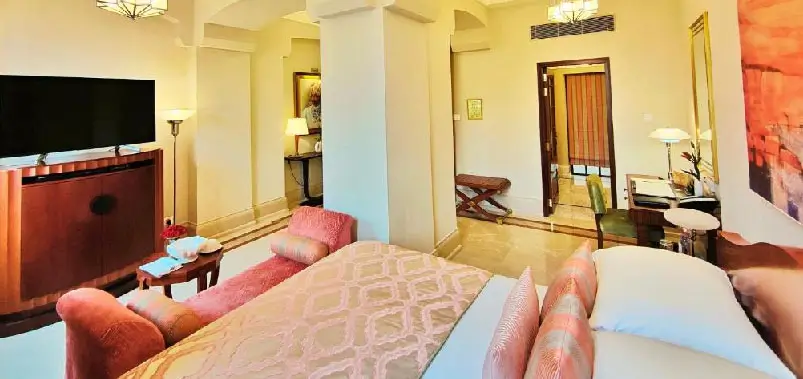
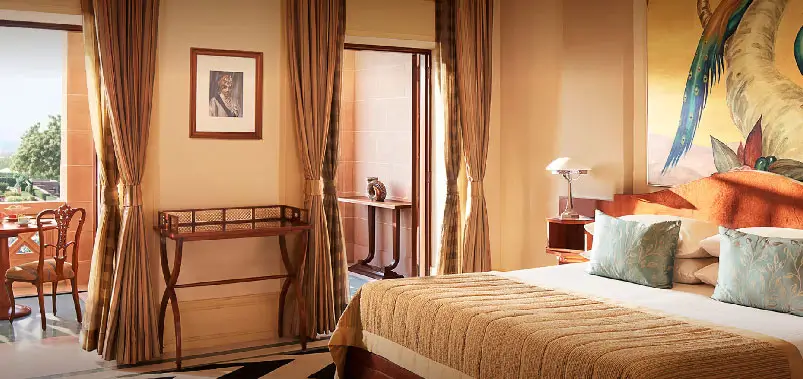
The Palace Room is the entry-level category at Umaid Bhawan, and it is the room most guests book for a short stay. Calling it entry level is slightly misleading, because these are large, elegant rooms by any normal standard, typically around thirty-seven to forty-eight square metres depending on the exact room. They are dressed in a refined Art Deco style, with clean lines, period-inspired furniture, soft lighting and fabrics in muted golds, creams and greens.
Each Palace Room has a king or twin bed, a comfortable seating area, a writing desk and a separate bathroom with good-quality amenities. The bathrooms are modern and well designed rather than palatial, but they are spacious and well lit. Most of these rooms face the gardens, with views over the lawns and the palace grounds rather than directly towards Mehrangarh Fort. Some have small balconies or window seats, while others are more enclosed, so it is worth asking for a garden-facing room on a higher floor if views matter to you.
What a Palace Room does not have is the sense of history found in the suites. These rooms were created during the conversion of the palace into a hotel, so while they are styled to match the building, they were not used by the royal household in the same way as the historical and royal suites. For many guests, this is not a problem at all. If you intend to spend your days at Mehrangarh Fort, the Jaswant Thada memorial, the old city markets and the countryside villages around Jodhpur, a Palace Room gives you full access to the palace, the pools, the spa and the restaurants at a much lower cost than the suites.
In the high season from October to March, Palace Rooms typically run from roughly ₹75,000 to ₹1,10,000 per night before tax, with the highest rates over Christmas, New Year and Diwali, when minimum stay requirements often apply. Rates with breakfast included are usually only modestly higher than room-only rates, and we generally recommend booking with breakfast, as breakfast on the terrace looking towards the fort is one of the nicest moments of a stay.
The Palace Room suits couples who will be out sightseeing for most of the day, guests visiting Jodhpur for one or two nights as part of a longer trip, and families who want to book two adjoining rooms rather than a single suite. It is also the category that most often sells out first in peak season, because it offers the palace experience at the lowest price. If you have fixed dates, booking early is the best way to secure one.
Historical Suites: Royal Character in a Manageable Size
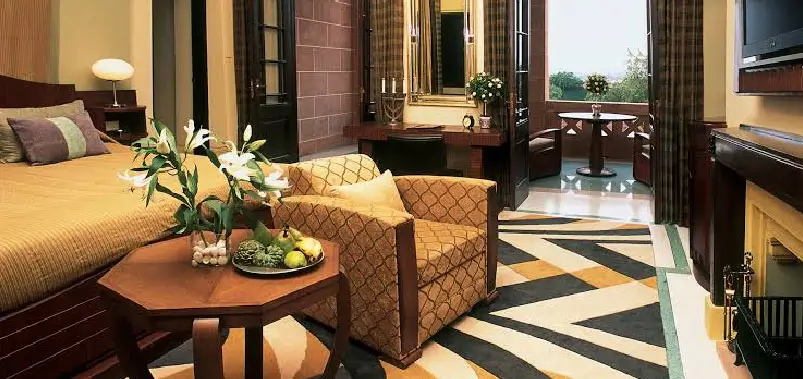
The Historical Suites are the category we recommend most often to guests who want a real sense of the palace without paying for the grandest suites. These are rooms that were once used by guests of the royal household, including visiting nobility and family members, and they have been restored with themed interiors that reflect their past. Sizes vary considerably, from roughly forty-seven to around a hundred square metres, so two Historical Suites can feel quite different.
The interiors are richer than those of the Palace Rooms. Each suite has its own decorative theme, often in deep greens, maroons or golds, with period furniture, artwork and decorative objects drawn from the palace collection. Many have a combined bedroom and sitting area rather than a fully separate living room, so the term suite should be understood loosely in the smaller examples. The larger ones have a clearly defined sitting space and sometimes a small dining area.
What sets the Historical Suites apart is the private sit-out. Most have a small terrace or veranda facing the lawns or the internal courtyards, a lovely place for morning coffee or a drink before dinner. The views are typically of the palace gardens and courtyards rather than the open sweep towards Mehrangarh Fort, but the sense of being inside a working palace is much stronger here than in the Palace Rooms. The bathrooms are generous, often with five fixtures, including a bathtub and a separate shower.
In the high season, Historical Suites typically range from roughly ₹1,40,000 to ₹1,90,000 per night before tax, and more over festive periods. That is a significant jump from the Palace Rooms, often almost double, so the question is whether the extra character and space will be used. For a stay of one night with a full day of sightseeing, the difference may feel less important. For a stay of two or three nights with time to relax at the palace, the Historical Suites offer a real step up.
Because sizes and layouts vary, this is the category where it pays most to ask questions before booking. Some suites are on the ground floor with direct access to the lawns, which suits older travellers and families, while others are on upper floors with better light and more privacy. Some face busier courtyards, while others are tucked into quieter corners of the palace. When we book a Historical Suite for our guests, we usually request a specific type of suite and position, and the hotel is generally helpful in matching requests where availability allows.
For couples on a special occasion, honeymooners who want a romantic setting without the cost of the royal suites, and guests who appreciate interiors and history, the Historical Suite is often the sweet spot at Umaid Bhawan. It offers much of the character of the larger suites at roughly half the cost, and it still leaves room in the budget for the rest of a luxury Rajasthan journey.
Royal and Grand Royal Suites: Space, Views and Original Art Deco
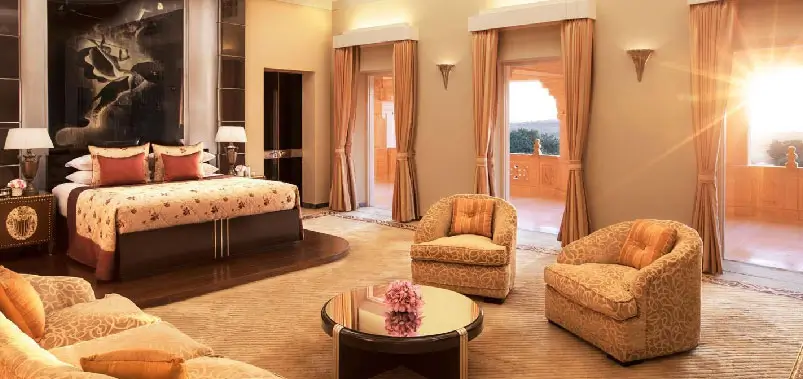
The Royal Suites and Grand Royal Suites are where Umaid Bhawan starts to feel genuinely grand, and they are the categories most guests mean when they imagine a royal stay in Jodhpur. Both are large, typically around a hundred and ten to a hundred and thirty square metres, with a separate bedroom and sitting room, a dressing area and a large bathroom finished in Makrana marble, the same white stone used for the Taj Mahal.
The Royal Suites are designed in the original Art Deco style of the palace, with mirror-finished terrazzo floors, period furniture, chrome fittings and a calm, elegant palette. The defining feature of the best Royal Suites is the view. Several have bay windows overlooking the Baradari Lawns, the formal gardens in front of the palace, with Mehrangarh Fort visible in the distance on its rocky ridge. Watching the fort turn gold in the late afternoon light from your own sitting room is one of the great pleasures of Jodhpur. The bathrooms typically include a deep bathtub, a separate shower and double vanities.
The Grand Royal Suites were once reserved for visiting royalty, and each has its own decorative theme. Where the Royal Suites feel crisp and architectural, the Grand Royal Suites feel more like private apartments, with original artworks, decorative objects from the palace collection and a richer, more layered style. They are similar in size to the Royal Suites, and the exact views depend on the suite. Some guests prefer the clean Art Deco lines of the Royal Suites, while others love the more personal, collected feel of the Grand Royal Suites.
In the high season, Royal Suites typically run from roughly ₹2,50,000 to ₹3,20,000 per night before tax, while Grand Royal Suites sit at roughly ₹3,00,000 to ₹4,00,000 or more, with festive dates higher still. For a two-night stay for two people in a Royal Suite, including tax, breakfast and a dinner or two, the total can easily reach ₹6,50,000 to ₹8,50,000, or roughly US$7,800 to US$10,000. Minimum stay rules often apply to these categories during busy weeks.
At this level, guests also tend to receive more personal attention. Suite guests are generally looked after closely by the guest relations and butler team, with help on unpacking, dinner reservations, private dining and arrangements for sightseeing, though the exact service varies by suite and occupancy, so we always confirm the details at the time of booking. Upgrades within the suite categories are sometimes possible outside peak weeks, but they should never be counted on.
These suites are ideal for milestone celebrations, longer stays of two or three nights, and travellers who enjoy spending time in their room as much as touring outside. They are also excellent for guests who want to entertain, as the sitting rooms are large enough for a private dinner or drinks served in the suite.
The Signature Suites: The Ruler's and Queen's Apartments and the Mehfil Suite
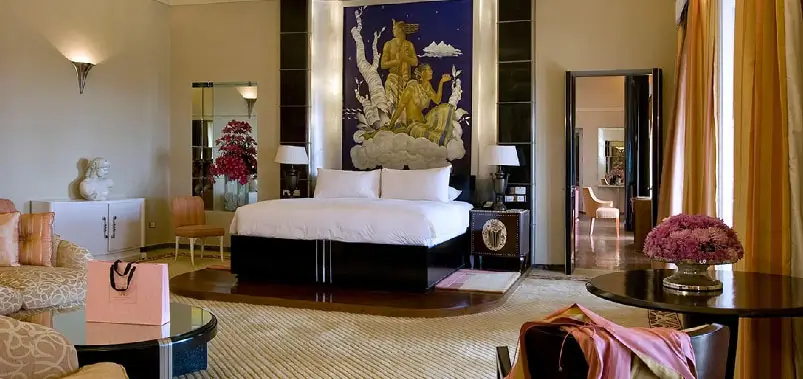
At the very top of the palace are the signature suites, a small group of extraordinary spaces that are among the most famous hotel rooms in India. Two of them were once the private apartments of the ruler who built the palace and his queen, and they are named after them. A third, the Mehfil Suite, is a vast entertaining space that takes its name from the traditional evening gatherings of music and poetry once held in royal homes.
The ruler's suite, often listed as the Grand Presidential Suite for the king, is well over three hundred and forty square metres, with some descriptions placing it above four hundred. It is a masterpiece of Art Deco design, with murals by Stefan Norblin, chrome torch lamps, sofas by the French designer Ruhlmann, a mirrored private bar and original pieces from the royal collection. It includes a grand bedroom, a sitting room, a dining room, a long balcony overlooking the courtyard and an in-room spa with a steam room. Staying here is less like booking a hotel suite and more like being given the keys to a museum apartment.
The queen's suite is the largest in the hotel at around four hundred and fifty square metres. Its interiors are famous for their pink, black and chrome palette, with a dressing room, a pink Italian marble bathtub, a massage room, a dining room with a private kitchen and a large private terrace looking over the palace gardens towards Mehrangarh Fort. It has hosted royalty, heads of state and some of the most celebrated weddings and celebrations held in India.
The Mehfil Suite, at around four hundred square metres, is designed with handcrafted furnishings, Makrana marble and embroidered details, and it faces the courtyard. It suits guests who want a very large, very private space for a celebration or a small family group.
Rates for these suites are not usually published in the same way as the other categories, and they are typically quoted on request. In peak season, guests should expect figures well above ₹8,00,000 per night, and in some cases considerably more, before tax, with dates around the festive season and the wedding season priced higher still. Availability is extremely limited, and the suites are sometimes taken for private events or weddings, so they can disappear months in advance.For most travellers, these suites are a once-in-a-lifetime indulgence rather than a practical choice. They make most sense for landmark anniversaries, proposals, family celebrations and guests who want the most exclusive stay in Rajasthan. When we arrange one, we work closely with the hotel on the details, from private dining in the suite to a special arrival, and we always recommend at least two nights so the space can actually be enjoyed.
Plan Your Luxury Jodhpur Stay
Get expert assistance with suite selection, palace reservations and a personalised Rajasthan travel itinerary.
Dining, the Spa and Life Inside the Palace
Whichever room you choose, the experience of Umaid Bhawan is shaped as much by the public spaces as by your private one. All guests share the same restaurants, terraces, pools and gardens, and these are among the finest hotel spaces in India.
The main fine dining restaurant is Risala, set in a grand room lined with portraits and memorabilia, serving refined Continental and Indian dishes inspired by royal recipes, with tasting menus for those who want a longer evening. Pillars is the all-day venue, an open veranda with tall columns looking out over the lawns, perfect for breakfast, a light lunch or afternoon tea with views towards the fort. In the cooler months, the Sunset Pavilion serves grills and barbecue in the garden, and the Trophy Bar, styled like an old hunting lodge with dark wood and leather, is the place for a drink before dinner. A dinner for two at Risala with wine typically runs roughly ₹20,000 to ₹35,000, and private dining on the lawns or terraces can range from roughly ₹40,000 to well over ₹1,00,000 for two depending on the setting and the menu.
The Jiva Spa offers Ayurvedic treatments, massages and signature royal baths, along with a sauna, steam room and jacuzzi. The most famous feature is the Zodiac Pool, an indoor pool in the lower level of the palace with mosaic tiles depicting the signs of the zodiac, which feels like a private bathhouse. There is also an outdoor lap pool with views over the city and the desert. A treatment at the spa typically costs roughly ₹10,000 to ₹20,000 per person.
The Umaid Bhawan Palace Museum occupies its own section of the building and is open to the public daily from about 10:00 in the morning to 4:30 in the afternoon. The entry fee for foreign visitors is about ₹100 per person. The museum displays photographs, clocks, weapons, paintings, crockery and other objects from the royal collection, and outside it there is a collection of vintage cars belonging to the family. Hotel guests can visit the museum easily during opening hours, and many also enjoy a guided heritage walk through the hotel itself, which tells the story of the building, the architect and the royal family.
Other experiences include sunrise and sunset viewing from the terraces, private yoga sessions, cultural evenings with traditional music and dance, and special welcomes for arriving guests. Many guests also book a private guided visit to Mehrangarh Fort, around fifteen to twenty minutes away by car. Foreign visitors pay roughly ₹600 to ₹800 for fort entry depending on the ticket type, plus extra for the audio guide or the museum galleries, and a licensed private guide typically costs roughly ₹3,000 to ₹6,000 for a half day.
For many guests, the best part of a stay is simply time in the palace itself: a slow afternoon by the pool, tea on the veranda of Pillars, a walk across the lawns at sunset and dinner under the dome. This is why we often suggest an extra night here rather than an extra hour on the road.
How Many Nights, Booking Lead Times and Getting There
The question of how many nights to stay at Umaid Bhawan is closely linked to the room category. One night is enough to experience the palace briefly, but it is usually a rushed stay. You arrive in the afternoon, spend the evening in the palace and leave the next morning, often after only a short look at the museum and the gardens. For guests in a Palace Room who want a taste of the palace on a busy itinerary, one night can work, but it rarely feels like enough.
Two nights is the length we recommend for most guests. It gives you a full day to visit Mehrangarh Fort, Jaswant Thada and the old city, while still leaving time to enjoy the palace, the spa and the restaurants. For guests in a Historical Suite or a Royal Suite, two nights allows the room to be properly used rather than simply slept in.
Three nights is ideal for those staying in the larger suites, travelling at a slower pace or adding excursions such as a village visit in the Bishnoi countryside, a day at the stepwells and temples of Osian, or a quiet afternoon at a desert lodge outside the city. It also makes sense for guests who want to make the most of the dining and spa, or who are celebrating a special occasion.
Booking lead times depend heavily on the season. For the October to March peak, we recommend booking Palace Rooms and Historical Suites three to six months in advance. For the Royal and Grand Royal Suites, four to eight months ahead is wise, and for the signature suites, six to twelve months or more. Christmas, New Year, Diwali and the winter wedding season fill the palace fastest, and some dates are closed entirely for private events. Cancellation terms are strict in peak season, often with non-refundable advance purchase rates and deposits well before arrival, so travel insurance is strongly advised.
Getting to the palace is easy. Jodhpur Airport is only a short drive away, usually around fifteen minutes, and it has direct flights to Delhi, Mumbai and several other cities. From Jaipur, the drive is roughly 340 kilometres, about five and a half to six hours. From Udaipur, it is roughly 250 kilometres, around five hours, or a little longer with a stop at the Jain temples of Ranakpur. From Jaisalmer, the drive is about 285 kilometres, around five hours. A Toyota Innova Crysta with chauffeur typically costs roughly ₹5,000 to ₹6,500 per day, while a luxury sedan runs roughly ₹18,000 to ₹25,000 per day.
Many of our guests combine Umaid Bhawan with Rambagh Palace in Jaipur and Taj Lake Palace in Udaipur, which together form a remarkable sequence of palace stays. In that case, placing Jodhpur in the middle of the journey, with two nights in a well-chosen room, usually works best.
Matching the Room to the Guest
After many years of booking Umaid Bhawan for guests from around the world, we have found that the right category depends on who is travelling, why they are coming and how long they will stay. The palace is extraordinary in every category, so the goal is to choose the room that will actually be enjoyed rather than the one that sounds grandest.
For first-time visitors on a fast-moving Rajasthan tour, with one or two nights in Jodhpur and full days of sightseeing, the Palace Room is usually the right choice. It gives full access to the palace, the gardens, the spa and the restaurants at the lowest cost, and the savings can go towards a better suite elsewhere on the journey, such as a lake-view room in Udaipur. Request a garden-facing room on an upper floor, and book with breakfast included.
For couples, honeymooners and anniversary travellers who want more romance and character, the Historical Suite is often the best balance. It offers a private sit-out, richer interiors and a stronger sense of history at roughly half the price of the larger suites. If the occasion is significant, a Royal Suite with fort views lifts the stay to another level.
For guests who enjoy spending time in their room, travelling at a slower pace or celebrating a milestone, the Royal Suite or Grand Royal Suite is the natural choice. Choose the Royal Suite for clean Art Deco design and, in the best rooms, views across the lawns to Mehrangarh Fort, or the Grand Royal Suite for a more personal, collected style. Two or three nights are ideal at this level.
For families, two connecting Palace Rooms or a Palace Room alongside a Historical Suite often work better than a single large suite, giving everyone space and privacy. The ground-floor suites with lawn access are particularly convenient for older travellers and young children.
For landmark celebrations, proposals and guests who want the most exclusive stay in India, the signature suites are in a category of their own. They should be booked well in advance, ideally for at least two nights, with private dining and special arrangements made ahead of arrival.
Whichever room you choose, the most important steps are the same. Decide how much time you will actually spend in the palace, book early for peak season, give yourself at least two nights, and let a knowledgeable luxury India tour operator match the category, position and view to the shape of your Rajasthan journey.
Related Guides
- Suryagarh Jaisalmer for International Guests: Room Types, Experiences & Is It Worth It?
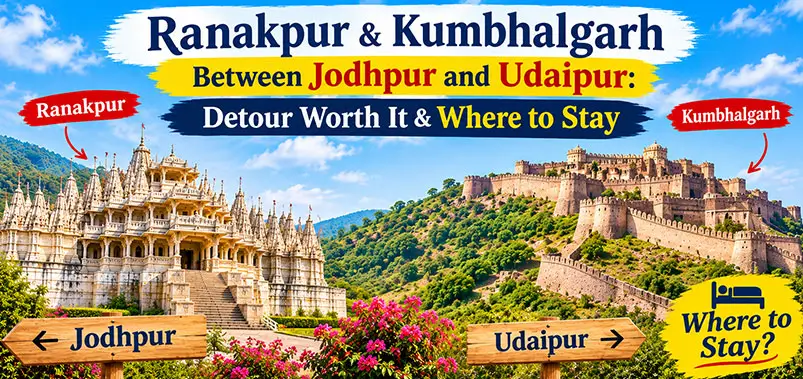
- Ranakpur & Kumbhalgarh Between Jodhpur and Udaipur: Detour Worth It & Where to Stay
- Jawai Leopard Safari from Jodhpur: Distance, Day Trip & Best Camps
- Most Famous 7 Star Hotels in India: Palaces & Ultra-Luxury Stays
- Jagmandir Island Palace Udaipur: History, Timings, Entry Fee & Visitor Guide
- Devi Garh Palace Udaipur: History, Luxury Stay & Travel Guide
- Lakes in Udaipur: Complete Guide to the City of Lakes
- Jodhpur Travel Guide: Forts, Blue Houses, Heritage Hotels & Local Experiences
- Top 10 Travel Agencies in India
- Best Travel Agency in India
- Best Palace Wedding Venues in Rajasthan for NRI Destination Weddings
- Udaipur Tour by Private Car & Driver - Lakes, Palaces & Heritage Walks
- Taj Rambagh Palace Jaipur: A Heritage Hotel Redefining Luxury in Rajasthan
- Rambagh Palace Jaipur: History, Stay, Dining and Visitor Guide



 info@topindianholidays.net
 +91-8955000999