📅 Last Updated On: 02 Nov 2026
⏱ 10 Min Read
Golden Triangle Route Order: Delhi–Agra–Jaipur or Delhi–Jaipur–Agra? Which Works Better
N
Nand Singh Rathore
Travel & Tourism Expert specializing in India
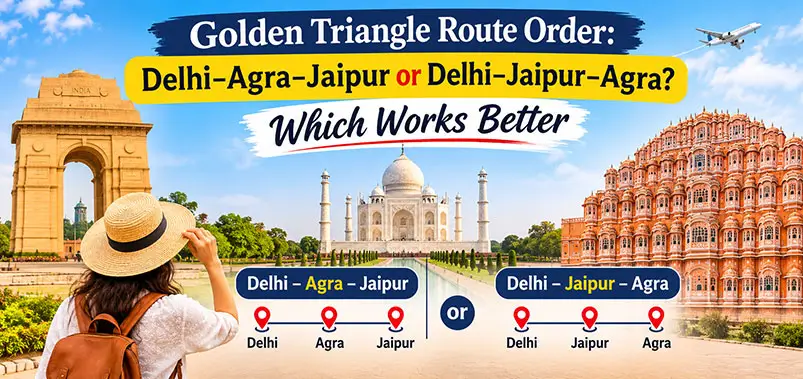
Choosing the Best Golden Triangle Route: Delhi–Agra–Jaipur vs Delhi–Jaipur–Agra
Every week, a guest writes to us with the same question, usually just after booking international flights into Delhi. They have six or seven nights, they know they want the Taj Mahal, the forts of Jaipur and the old lanes of Delhi, and they have read two different itineraries that run the loop in opposite directions. One sends them east to Agra first. The other sends them west to Jaipur first. Both look perfectly reasonable on paper, and both are sold by respectable companies.
The honest answer is that the Golden Triangle route order matters far more than most brochures admit. The direction you drive decides which day you stand in front of the Taj Mahal, whether the long highway leg falls on a fresh morning or a tired afternoon, how easily you can carry on to Ranthambore, Udaipur or Varanasi, and how relaxed your final evening is before a midnight flight home. On a private Golden Triangle tour with a dedicated car and chauffeur, you are not tied to a coach timetable, so the choice is entirely yours. Below is how we weigh it for our own guests, with real distances, realistic timings, ticket prices and the small calendar details that quietly make or break the week.
The Two Loops on a Map: Distances, Roads and Real Driving Hours
Draw the triangle on a map and it looks almost equilateral, but the three sides are not equal on the ground. The Delhi to Agra leg runs roughly 230 kilometres, most of it on the Yamuna Expressway, a straight, well-maintained toll road where a good chauffeur holds a steady pace. From a central Delhi hotel such as The Oberoi or The Leela Palace, allow three and a half to four hours door to door, because the first forty minutes are spent leaving the city through traffic that rarely clears before ten in the morning.
The Agra to Jaipur leg is around 240 kilometres and is the slowest of the three. The road itself is good, but this is the side of the triangle where most guests stop at Fatehpur Sikri, the abandoned red sandstone capital about forty minutes west of Agra, and many also detour to the Abhaneri stepwell, a thousand-year-old geometric well with more than three thousand steps cut into its walls. With both stops, a realistic travel day runs seven to eight hours from hotel to hotel, including a relaxed lunch. Without stops, it is about four and a half to five hours.
The Jaipur to Delhi leg is roughly 280 kilometres. On the older national highway through Gurugram, expect five to six hours, with the last hour almost always the slowest as you approach the capital. Many chauffeurs now use the newer Delhi–Mumbai Expressway section via Dausa, which can bring the drive closer to four hours when traffic is light, though the run into south Delhi still depends on the time of day.
Now lay those legs over the two directions. In the clockwise loop, Delhi–Agra–Jaipur, your first drive is the quick expressway run, your middle drive is the long sightseeing day through Fatehpur Sikri, and your last drive is the Jaipur to Delhi return. In the anticlockwise loop, Delhi–Jaipur–Agra, you start with the Delhi to Jaipur leg, do the same long sightseeing day in reverse, and finish with the shortest leg, Agra back to Delhi on the expressway.That final leg is the detail many people miss. Ending in Agra means your last drive into Delhi is the easiest and most predictable of the three, which suits guests catching a late-night international departure. Ending in Jaipur means your last drive is the longest, unless you continue deeper into Rajasthan or take a short flight out of Jaipur International Airport instead. Neither is wrong. They simply place the hardest road on different days, and the right choice depends on what comes before and after your Golden Triangle itinerary.
Plan Your Perfect Golden Triangle Tour
Explore Delhi, Agra and Jaipur in the best route order with a customised itinerary, private transport and expert travel assistance.
The Case for Delhi, Agra, Jaipur
The clockwise loop is the classic order, and there are good reasons it has stayed the default for so long. The first is momentum. Most international guests land in Delhi tired, spend a gentle first day seeing Humayun's Tomb, Qutub Minar and the lanes around Chandni Chowk, and then want the headline sight of the whole trip as soon as possible. Driving to Agra on day two or three puts the Taj Mahal early in the week, while energy and curiosity are at their highest, and it removes any anxiety about weather, illness or delays eating into the one visit nobody wants to miss.
The second reason is the road itself. The Delhi to Agra expressway is the smoothest drive of the trip, which makes it a gentle introduction to Indian highways for first-time visitors. A guest who has just flown fourteen hours from Los Angeles or Sydney will appreciate a calm, three and a half hour run with a coffee stop, rather than a five or six hour drive towards Jaipur on day two.
The third reason, and for many of our clients the most important, is what happens after Jaipur. Finishing the triangle in the Pink City leaves Rajasthan wide open. From Jaipur, Ranthambore National Park is about three and a half hours by road, Udaipur is a one hour flight or roughly six and a half hours by car, Jodhpur is around five and a half hours, and Pushkar is under three. If your trip runs ten, twelve or fourteen nights, the clockwise loop lets you treat the Golden Triangle as the opening act and continue straight into a Rajasthan tour without retracing a single kilometre.
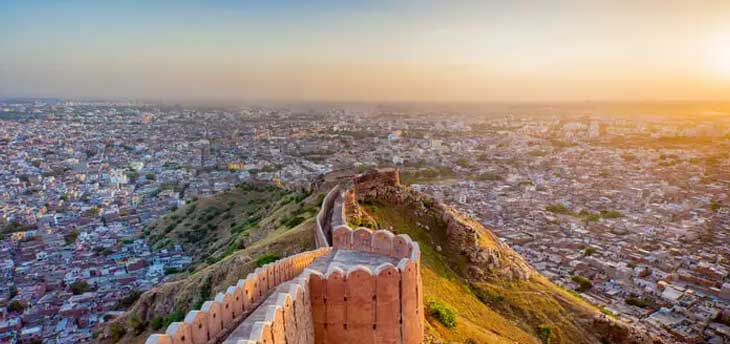
Jaipur is also a better place than Agra to slow down. Agra is essentially a one-sight city with a few excellent supporting monuments, and two nights there are plenty. Jaipur rewards three nights: the morning at Amber Fort, a full afternoon at the City Palace and Jantar Mantar, a sunset at Nahargarh Fort, a cooking class, a block-printing workshop in Sanganer, or a hot air balloon flight over the Aravalli hills. Ending there gives the trip a long, comfortable finish rather than a rushed one.
Finally, there is the hotel story. Many luxury guests like to build up to their grandest stay. Starting at a polished city hotel in Delhi, moving to The Oberoi Amarvilas with its Taj Mahal view, and finishing at Rambagh Palace or The Oberoi Rajvilas in Jaipur creates a genuine sense of arrival at each stop. The weakness of this order is simply the last day. If your international flight leaves Delhi that night, you face the longest drive of the week on your final afternoon, and a single slow stretch near Gurugram can turn a relaxed farewell lunch into a tense race to the airport.
The Case for Delhi, Jaipur, Agra
The anticlockwise loop has been quietly gaining ground among experienced travellers, and once you look at the final day, it is easy to see why. Ending in Agra means your last road transfer is the short, reliable expressway run back to Delhi. Leave Agra after lunch, and you can be at Indira Gandhi International Airport by early evening, in plenty of time for the late-night departures to London, Frankfurt, Paris, New York and the Gulf that leave between ten at night and three in the morning. For guests with a strict onward connection, this predictability is worth a great deal.
The second advantage is the order of the sights. Jaipur is colourful, busy and full of texture, and it eases guests into India with palaces, gardens and shopping before they reach the emotional peak of the trip. Arriving in Agra at the end means the Taj Mahal sunrise visit becomes the final memory of the holiday rather than something seen on day two and then quietly overshadowed. Many couples, and especially honeymooners or anniversary travellers, tell us they prefer the trip to build towards the Taj rather than start with it.
There is also a practical point about the first drive. If your flight lands in Delhi early in the morning, a short rest and a late lunch in the city followed by an early departure to Jaipur the next day works well. The Delhi to Jaipur leg is longer, but on a fresh morning with a good chauffeur, it passes comfortably, and you arrive in Jaipur by early afternoon with time for a gentle walk around the Hawa Mahal area or tea on a palace terrace.
The anticlockwise loop also suits guests continuing east rather than west. From Agra, it is a straightforward drive or train journey to Delhi for a flight to Varanasi, and some travellers continue south-east to Orchha and Khajuraho for the temple country of central India. If your extension lies towards the Ganges, the Himalayas or the temples of central India, finishing in Agra puts you on the right side of the map.
The weakness of this direction is that Jaipur, the city most guests want to linger in, comes early, when the trip still feels open-ended and some travellers are still adjusting to the time difference. It also makes a Rajasthan extension awkward. If you want to continue to Udaipur or Ranthambore after the triangle, you would have to drive back west from Agra, retracing the road you have already covered. For a pure six or seven night Golden Triangle tour with a late international departure from Delhi, however, the anticlockwise loop is often the more comfortable of the two.
The Friday Problem and Other Calendar Traps
Before choosing a direction, look at the calendar, because one rule overrides almost everything else. The Taj Mahal is closed every Friday for prayers at the mosque inside the complex. No exceptions are made for tourists, private guides or luxury packages. If your Agra day lands on a Friday, you will see the monument only from Mehtab Bagh across the river, which is lovely at sunset but not the same as walking through the great gateway. Every sensible route order starts by working backwards from the Taj visit and making sure it falls between Saturday and Thursday.
The Taj Mahal opens about thirty minutes before sunrise and closes about thirty minutes before sunset. For a Taj Mahal sunrise visit, that means being at the east gate between roughly 5:45 and 6:30 in the morning, depending on the season. The current entry fee for foreign visitors is ₹1,100, plus ₹200 if you want to enter the main mausoleum, so ₹1,300 per person in total. Night viewing is possible only on the full moon night and the two nights either side, never on Fridays, at ₹750 per person for foreigners, and tickets must be booked a day ahead with limited slots.
Delhi has its own traps. The Red Fort and the National Museum close on Mondays, so if your Delhi sightseeing falls on a Monday, the day needs rearranging around Humayun's Tomb, Qutub Minar and the lanes of the old city. Jaipur is far kinder, as Amber Fort is open every day from about 8:00 in the morning to 5:30 in the evening, with foreign visitor tickets at ₹500, or ₹1,000 for a composite ticket covering several Jaipur monuments over two days.
Weather adds another layer. From mid-December to mid-January, dense morning fog often settles over the Yamuna Expressway and the Agra plains. Drives start later, and a Taj Mahal sunrise visit can turn into a beautiful but ghostly white outline in the mist. Guests travelling in deep winter sometimes prefer to schedule the Taj for a late morning or afternoon instead, which makes the direction of travel less critical but changes which hotel night matters most.
Festivals also shift traffic and crowds. During Diwali, roads are busy and hotels fill quickly, while during Holi in March, many guests want to be in Jaipur or Vrindavan rather than on the road. Long weekends in India bring heavy domestic traffic to the Delhi–Jaipur highway. A good India tour operator will check every one of these dates before confirming your route order, and that check alone often settles the question of direction without any further debate.
Where Your Trip Goes Next: Rajasthan, Ranthambore, Varanasi and the Flight Home
The most useful question to ask before choosing a direction is not where the triangle starts, but where your holiday ends. The Golden Triangle is rarely a whole trip for luxury travellers who have flown halfway round the world. It is usually the core of a longer journey, and the extension decides the loop.
If you are adding Ranthambore for a tiger safari, the clockwise route is almost always right. Ranthambore sits roughly three and a half hours from Jaipur, so you drive from Jaipur to the park, enjoy two or three nights at Aman-i-Khas, SUJÁN Sher Bagh or The Oberoi Vanyavilas, and then return to Delhi by the morning train from Sawai Madhopur or by road. Safari jeeps run in two sessions daily, and park fees and a private six-seater vehicle for foreign guests typically cost between ₹12,000 and ₹18,000 per safari once permits, vehicle and naturalist are included. Placing Agra last here would mean doubling back across Rajasthan, which wastes a full day.
If you are adding Udaipur, Jodhpur or Jaisalmer, the clockwise loop wins again. From Jaipur you fly to Udaipur in about an hour, or drive west through the heart of Rajasthan. Your international flight can then leave from Udaipur or Jodhpur via Delhi or Mumbai, which avoids the long drive back to the capital entirely.
If you are adding Varanasi, the answer is more flexible. Varanasi is reached by flight from Delhi, so the anticlockwise loop, ending in Agra and driving back to Delhi, flows nicely into an evening or next-morning flight to the holy city. Some guests prefer to visit Varanasi first, then fly back to Delhi and run the triangle clockwise, finishing in Jaipur. Both work, and the choice usually comes down to which hotel nights are available at BrijRama Palace or Taj Nadesar Palace.
If you are adding Khajuraho and Orchha, end the triangle in Agra. The Gatimaan Express and other trains link Agra with Jhansi, the gateway to Orchha, and from there it is a scenic road journey to the temples of Khajuraho.
If there is no extension at all and you are flying home from Delhi, think carefully about your final day. A late-evening international departure fits the anticlockwise loop perfectly. A next-morning departure, with a final night at a Delhi airport hotel, makes the clockwise loop just as easy. Some of our guests choose a third option and fly from Jaipur to Delhi on their last afternoon, a flight of about one hour that removes the long highway drive altogether.
Hotels, Sunrise and the Order of Luxury
For luxury travellers, the route order is also a question of which hotel you want to wake up in on which morning. The hotels of the Golden Triangle are among the finest in India, and the sequence in which you meet them shapes the whole mood of the trip.
In Agra, the jewel is The Oberoi Amarvilas, where every room and suite faces the Taj Mahal about six hundred metres away. Rooms here typically range from ₹70,000 to more than ₹1,10,000 per night in peak season, and premier suites run far higher. The point of paying this rate is to see the monument from your balcony at dawn and at sunset, so you want at least one full evening and one morning there. Arriving at two in the afternoon and leaving at seven the next morning wastes the hotel. If you are booking Amarvilas, choose the route order that gives you a relaxed arrival day with the Taj seen from the terrace at sunset, followed by the sunrise visit the next morning. ITC Mughal and the newer Taj Hotel and Convention Centre are strong alternatives at lower rates, from roughly ₹18,000 to ₹35,000 per night.
In Jaipur, the choice is between palaces. Rambagh Palace, the former residence of the rulers of Jaipur, ranges from around ₹55,000 to more than ₹1,00,000 per night, while The Oberoi Rajvilas, with its private pool villas and tented rooms, sits in a similar band. The Leela Palace Jaipur offers a newer, grand style from about ₹30,000 to ₹50,000. Guests who want the trip to finish on a high note often book Rambagh as the final stop, which favours the clockwise loop, while guests who prefer to end at Amarvilas choose the anticlockwise route.
In Delhi, The Oberoi New Delhi, The Leela Palace and Taj Palace sit between ₹25,000 and ₹50,000 per night for good rooms. Because Delhi bookends both loops, many guests split their Delhi nights, staying one night on arrival and one on departure, which makes the triangle feel less rushed.
There is one more detail worth noting. Luxury hotels in Agra and Jaipur fill weeks ahead during the October to March season, and the most sought-after room categories, such as the Kohinoor Suite at Amarvilas or the palace rooms at Rambagh, are limited. Sometimes availability settles the route order before anything else. When we put together a luxury Golden Triangle tour, we check the three key hotels first, then choose the direction that gives the best rooms on the right nights, rather than forcing the hotels to fit a fixed itinerary.
Train, Car or Flight Between the Three Cities
Most private guests travel the whole triangle by car with the same chauffeur, and for good reason. A dedicated vehicle lets you stop at Fatehpur Sikri, linger at the Abhaneri stepwell, pause for coffee on the expressway and keep your luggage with you at all times. For two travellers, a Toyota Innova Crysta with a professional chauffeur typically costs between ₹4,500 and ₹6,000 per day including fuel, tolls and the driver's allowances. For a more refined ride, a Mercedes-Benz E-Class or similar luxury sedan runs from roughly ₹18,000 to ₹25,000 per day, depending on the season and the number of days.
Trains can still play a useful role, and they work better in one direction than the other. The Gatimaan Express leaves Delhi's Hazrat Nizamuddin station at about 8:10 in the morning and reaches Agra Cantonment in roughly one hour and forty minutes, making it one of the fastest trains in the country. It does not run on Fridays, which matches the Taj Mahal closure. The Shatabdi Express leaves New Delhi station at about 6:00 in the morning and reaches Agra in under two hours. Executive class seats on these trains cost roughly ₹1,500 to ₹2,500 per person. For the clockwise loop, taking a morning train to Agra while your chauffeur drives ahead with the luggage gives you a full sightseeing day, and you continue by car to Jaipur afterwards.
For the anticlockwise loop, the train is less helpful, because the Jaipur to Agra leg is better covered by road with stops along the way. However, the final run from Agra back to Delhi can be done by the evening Gatimaan, which reaches Hazrat Nizamuddin at around 7:30 in the evening, convenient for a late-night international departure.
Flights matter mainly at the edges of the triangle. Agra airport has very limited service, so it rarely features in luxury itineraries. Jaipur International Airport has frequent flights to Delhi, Mumbai, Udaipur and several Gulf hubs. A one-hour flight from Jaipur to Delhi, typically between ₹5,000 and ₹9,000 per person in economy, can replace the longest drive of the clockwise loop. Some guests also connect from Jaipur directly to international flights through Dubai or Abu Dhabi, avoiding Delhi completely on the way home.For guests with very limited time, a helicopter or private jet transfer between Delhi and Agra is also possible, though permissions and costs make it a special-occasion choice rather than a routine one. For almost everyone else, the right combination is a dedicated car for the whole loop, with one train or one short flight placed carefully to remove the most tiring leg.
Get Your Custom India Travel Itinerary
Not sure which route works best? Let our travel experts plan a seamless Golden Triangle journey around your dates and preferences.
What a Private Golden Triangle Costs in Either Direction
The good news is that the route order makes very little difference to the overall price. The same number of nights, the same hotels and the same chauffeur cost roughly the same whichever way you drive. What changes the price is the hotel category, the vehicle, the guides and the extras you add.
For a six-night private Golden Triangle tour for two people, staying in top luxury hotels such as The Oberoi New Delhi, The Oberoi Amarvilas and Rambagh Palace, the hotels alone can run from about ₹3,50,000 to ₹5,00,000 for the week in peak season, depending on room categories. A dedicated Innova Crysta with chauffeur for seven days adds roughly ₹35,000 to ₹42,000, or a Mercedes adds about ₹1,30,000 to ₹1,75,000. Licensed private guides in each city typically cost between ₹3,000 and ₹5,000 per half day and ₹5,000 to ₹8,000 per full day, with senior specialist guides at the higher end.
Monument entry fees for foreign visitors add up to roughly ₹4,000 to ₹5,000 per person across the week, including the Taj Mahal with mausoleum access at ₹1,300, Agra Fort at about ₹650, Fatehpur Sikri at about ₹610, Amber Fort at ₹500, the City Palace in Jaipur at around ₹700 to ₹1,000 depending on the access level, and Humayun's Tomb and Qutub Minar at about ₹600 each.
Extras then shape the final figure. A hot air balloon flight over Jaipur usually costs between ₹15,000 and ₹20,000 per person. A private dinner at a fort or a palace terrace can run from ₹25,000 to well over ₹1,00,000 for two depending on the venue and the menu. A morning at an ethical elephant sanctuary near Jaipur costs roughly ₹8,000 to ₹12,000 per person.
All together, a high-end private week for two usually lands between ₹5,00,000 and ₹8,00,000, or roughly US$6,000 to US$9,500, with ultra-luxury suites and special experiences pushing it higher. A comfortable five-star version with excellent but less famous hotels, such as ITC, Trident or Marriott properties, can come in at around half of that.
Where the route order does affect cost is the extension. Choosing the direction that avoids backtracking saves a day of driving, a night of hotel and sometimes an internal flight. On a ten or twelve night trip, picking the right loop can easily save ₹40,000 to ₹80,000 and, more importantly, a full day of your holiday.
Tipping is the one cost guests most often forget. On a week-long private car and driver tour, a chauffeur is usually tipped ₹1,000 to ₹1,500 per day and a city guide ₹1,000 to ₹2,000 per day, which adds roughly ₹12,000 to ₹18,000 to the week for two travellers.
Which Order Suits Which Traveller
After years of running private tours, we have found that the right direction depends far more on the traveller than on the map. Here is how we usually match the two loops to the guests who write to us.
First-time visitors on a six or seven night trip with a late-night flight home from Delhi are often happiest with Delhi–Jaipur–Agra. Jaipur eases them into India with colour and texture, the Taj Mahal becomes the grand finale, and the last drive back to Delhi is short and predictable. Honeymoon and anniversary couples often feel the same, because ending with a Taj Mahal sunrise and a final evening at Amarvilas makes the trip feel like it builds towards one perfect moment.
Travellers continuing into Rajasthan, whether to Ranthambore for tigers, Udaipur for its lakes or Jodhpur and Jaisalmer for the desert, should almost always choose Delhi–Agra–Jaipur. It avoids backtracking, keeps the long drives sensible and lets Jaipur become the gateway to the rest of the state.
Families with young children or older parents usually prefer the clockwise loop as well, because the first drive is the easiest and the Taj Mahal is seen early, before tiredness sets in. Starting with the expressway rather than the longer Jaipur road also helps guests who are still adjusting to the time difference.
Photographers have their own priorities. They want the Taj at sunrise in the best light, usually between October and March, and they often prefer the anticlockwise loop so that Agra arrives later in the trip, when they have learned to work comfortably around crowds and early starts.
Repeat visitors and travellers on longer journeys sometimes skip the question altogether by splitting the triangle. They fly into Jaipur from a Gulf hub, spend time in Rajasthan, drive to Agra and finish in Delhi. This version is becoming more common as international connections to Jaipur improve. It also suits guests who have already seen Delhi on an earlier trip and would rather spend those two nights in a quiet palace hotel in the Aravalli hills than in the traffic of the capital.
Whichever direction you choose, the rules that matter most stay the same. Keep the Taj Mahal visit away from Friday, give your best hotel a full evening and morning, avoid placing the longest drive on the same day as a long-haul flight, and let your extension decide the loop. A private Golden Triangle tour gives you the freedom to make these choices, and a thoughtful India tour operator will make sure the calendar, the hotels and the roads all point in the same direction before you ever leave home.
Related Guides



 info@topindianholidays.net
 +91-8955000999