📅 Last Updated On: 03 Nov 2026
⏱ 10 Min Read
Best Golden Triangle Extensions Compared: Udaipur vs Ranthambore vs Varanasi vs Jodhpur
N
Nand Singh Rathore
Travel & Tourism Expert specializing in India
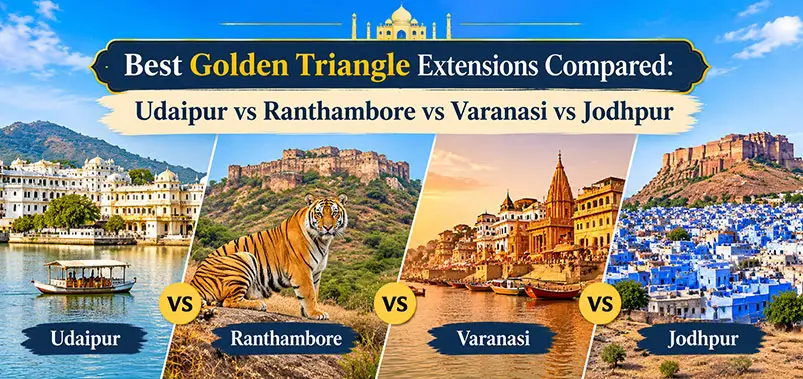
Which Golden Triangle Extension Should You Choose?
The conversation usually starts the same way. A couple from London or Melbourne has settled on a week in Delhi, Agra and Jaipur, the flights are booked, and then the question arrives: we have three or four more nights, where should they go? One friend swears by the lakes of Udaipur. Another has shown them a photograph of a tiger walking past a jeep in Ranthambore. A colleague says nothing compares to the river at Varanasi at dusk, and somebody else has mentioned a blue city under an enormous fort. All four are right, and that is exactly the problem.
Choosing between Golden Triangle extensions is less about which destination is best and more about which one fits your time, your energy and what you want to bring home. Each of the four delivers something completely different, needs a different number of nights, and connects to the triangle in a different way. Below, we compare Udaipur, Ranthambore, Varanasi and Jodhpur side by side for a guest on a private luxury Golden Triangle tour, with real drive and flight times, higher-side hotel rates, safari permit costs, the timing of the evening river ceremony and our honest view of who each one suits. We touch on route direction only briefly, since the extension you choose quietly settles that question for you.
How Many Extra Nights Each Extension Really Needs
The first filter is time, and it is the one guests most often underestimate. Every extension carries a travel cost on arrival and on departure, and the shorter your stay, the larger that cost looms. A destination that needs a five hour drive in and a flight out is not worth visiting for a single night, however beautiful the hotel.
Ranthambore is the most compact of the four. It sits roughly 180 kilometres from Jaipur, about three and a half hours by road, and the whole point of going is the safari. Two nights give you three game drives, typically the afternoon of arrival, the following morning and the following afternoon, with a final morning drive possible before you leave. Three nights give you four or five drives, and that is where the odds of a good tiger sighting rise noticeably. Tigers are wild animals and no honest operator can promise one, so each extra drive is genuinely valuable. We rarely suggest fewer than two nights, and serious wildlife lovers often take three.
Udaipur needs a minimum of two nights and is far happier with three. The city is small, but its pleasures are slow ones: a morning at the City Palace, a late afternoon boat on Lake Pichola, a lazy day at a lakeside hotel pool, a drive into the Aravalli hills to the Jain temples at Ranakpur or the hilltop walls of Kumbhalgarh. Guests who rush Udaipur in two nights often say afterwards that they wished they had stayed longer, because this is the extension where most people finally slow down.
Jodhpur works well in two nights. The great sights, Mehrangarh Fort, the Jaswant Thada memorial and the old blue-painted lanes below the fort, fit comfortably into one full day, and the second night lets you enjoy the hotel and perhaps a village drive into the countryside. Three nights make sense if you add a desert camp outside the city or a side trip to the temples at Osian.
Varanasi is best in two nights, and a single night is possible only if you are disciplined about flight times. The essentials are the evening lamp ceremony on the river, a sunrise boat ride, a walk through the old lanes and a visit to Sarnath, where the Buddha gave his first teaching. Two nights let you see the riverfront in both lights without a sprint. Three nights suit guests with a deeper interest in religion, philosophy or textiles.As a rough rule, a seven night triangle with a three night extension makes a very comfortable ten night holiday. If you have fourteen nights, two extensions become realistic, and the most popular pairings are Ranthambore with Udaipur, or Jodhpur with Udaipur, as both stay inside Rajasthan and flow naturally from Jaipur. Pairing Varanasi with a Rajasthan extension also works well, but it adds at least one extra flight day, so it suits guests with a full two weeks or more.
Plan Your Perfect Golden Triangle Extension
Extend your India journey with Udaipur, Ranthambore, Varanasi or Jodhpur. Get a personalised itinerary designed around your travel interests.
Getting There from Jaipur, Agra and Delhi: Drives, Flights and Trains
Where each extension sits on the map decides how you reach it, and how much of your holiday disappears into transit. A private car and chauffeur covers the triangle comfortably, but beyond it, a well-placed domestic flight often saves an entire day.
Ranthambore is reached most easily by road from Jaipur. The drive runs about 180 kilometres through farmland and small market towns, taking roughly three and a half hours, and your chauffeur from the triangle simply continues with you. From Agra, the road journey is longer, around 250 kilometres and five to six hours, though some guests break it at Fatehpur Sikri and the Abhaneri stepwell. The railway station at Sawai Madhopur sits on the main Delhi to Mumbai line, so many guests return to Delhi by train, a journey of roughly four and a half to five and a half hours depending on the service, while their luggage either travels with them or goes ahead by car.
Udaipur is about 395 kilometres from Jaipur, around six and a half hours by road on good highways, with Chittorgarh Fort as a worthwhile stop along the way. Most luxury guests prefer the flight, which takes about an hour from Jaipur. From Delhi, direct flights to Udaipur take around one hour and twenty minutes and run several times a day, which means Udaipur can also be your last stop, with a flight back to Delhi on the day of your international departure. Economy fares typically sit between ₹5,000 and ₹10,000 per person, rising in peak weeks, and business class is offered on some services.
Jodhpur lies roughly 340 kilometres west of Jaipur, around five to five and a half hours by road. The drive is pleasant, through open countryside, and many guests break it with lunch at a heritage hotel. Direct flights from Delhi to Jodhpur take about one hour and fifteen minutes, so the city works well as an exit point. Jodhpur is also about four and a half to five hours by road from Udaipur, via Ranakpur, which is why the two pair so well on longer journeys.
Varanasi is the odd one out. It lies far to the east in Uttar Pradesh, about 600 kilometres from Agra, and no sensible luxury itinerary drives it. Flights from Delhi take roughly one hour and twenty minutes and depart many times a day. There are also flights from Jaipur, some direct and some via another city, so check the schedule for your dates. Overnight trains run from Agra and Delhi, but for most of our guests, flying is the comfortable choice, with a car and guide waiting at Lal Bahadur Shastri Airport, which sits about 25 kilometres and roughly an hour from the old city.
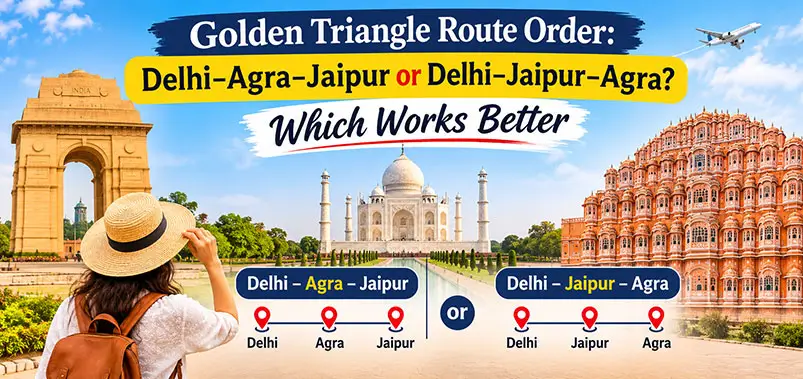
This is also where route direction comes in, briefly. A Rajasthan extension sits naturally after Jaipur, which favours running the triangle Delhi, Agra and then Jaipur. A Varanasi extension can sit at either end, because it is always reached by air from Delhi, although some guests also fly in or out via Jaipur. Our earlier guide to triangle route order covers this in more detail. The point to take away is simple: choose the extension first, and the loop will follow.
Remember too that a one hour flight is never a one hour journey. With hotel checkout, the drive to the airport, security and the transfer at the other end, a domestic flight day usually takes four to five hours door to door. It is still far less tiring than a six hour drive, but it is worth placing it on a morning when you have nothing else scheduled.
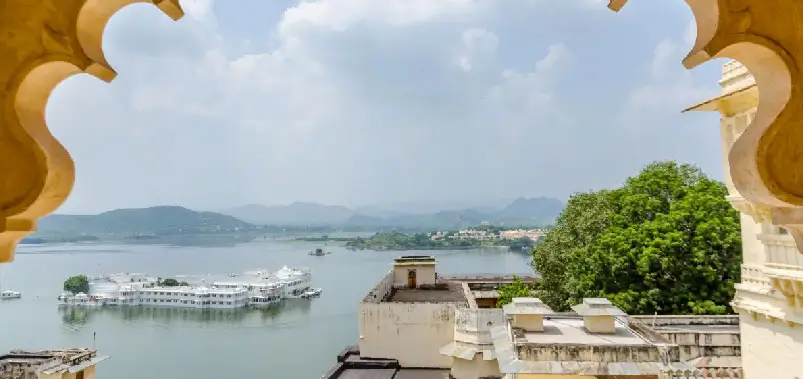
If one extension feels most like a reward after the noise of Delhi and the crowds of Agra, it is Udaipur. Built around a chain of lakes and ringed by green hills, the city has a gentleness that the rest of the Golden Triangle rarely offers. Days here start late, lunches are long, and evenings are spent watching the light fade over the water.
The centrepiece is the City Palace, a vast complex of courtyards, balconies and mirrored rooms that rises directly from the eastern shore of Lake Pichola. It is still partly home to the former royal family of Mewar, and a private guide can bring its history to life over two to three hours. Entry for foreign visitors is typically around ₹400 to ₹500 for the museum, with camera and special access charges on top, so allow roughly ₹700 to ₹1,000 per person with extras. Below the palace, a boat ride on Lake Pichola passes the island palaces and temples, and a private boat at sunset is one of the quiet highlights of any Rajasthan trip.
Beyond the city, Udaipur makes an excellent base for day trips. The Ranakpur Jain temples, around 90 kilometres and two hours away, are carved from pale marble with more than a thousand columns, each different from the next. The hilltop fortress of Kumbhalgarh, with walls that run for over thirty kilometres across the ridges, can be combined with Ranakpur in a long day, or visited on the road to Jodhpur. Closer to town, the Saheliyon ki Bari garden, the vintage car collection and the Monsoon Palace viewpoint make a relaxed half day.
The hotels are a major reason guests choose Udaipur, and many travellers build the entire extension around one property. Taj Lake Palace, the white marble palace that seems to float in the middle of Lake Pichola, is reached only by boat and is among the most photographed hotels in the world. Rooms in peak season typically range from roughly ₹60,000 to more than ₹1,20,000 per night, with grand suites far higher. The Oberoi Udaivilas, on the opposite shore, is a sprawling domed estate with semi-private and private pool rooms, usually between ₹70,000 and ₹1,40,000 per night in high season. The Leela Palace Udaipur offers lake views and a polished modern style, generally from about ₹45,000 to ₹85,000. Raffles Udaipur, on its own island in Udai Sagar lake a short drive out of the city, is quieter and more secluded, with rates broadly in the ₹50,000 to ₹90,000 range.
What Udaipur does not deliver is wildlife or deep spirituality. It is romantic, scenic and restful rather than intense. That is precisely its appeal for honeymooners, anniversary couples and guests who want their holiday to end on a note of calm. It is also ideal for travellers who have found the triangle tiring and want somewhere they can simply enjoy the hotel without feeling they are missing a sight.
The best time to visit is October to March, when days are warm and evenings cool enough for a terrace dinner. After a good monsoon, the lakes are full and the hills green, which many repeat guests consider Udaipur at its most beautiful.
Ranthambore: Tiger Safaris, Jungle Lodges and Early Mornings

Ranthambore National Park offers something the other three extensions cannot: the chance to see a wild Bengal tiger in its natural habitat. The park covers dry deciduous forest, lakes and rocky ridges around a tenth century fort, and its tigers are famously relaxed around vehicles. Sightings are never guaranteed, but on a stay of three nights with four or five drives, a large share of our guests come home with at least one memorable encounter.
The park is open from the start of October to the end of June and closes for the monsoon from July to September, when the core zones are shut. Safaris run in two sessions a day of about three and a half hours each. In the cooler months, morning drives typically start between 6:30 and 7:00 and afternoon drives around 2:00 to 2:30, while in April to June the morning start moves earlier and the afternoon later. Rules on weekly closure days and zone allocation have changed in recent seasons, so we always confirm the current park calendar before confirming your nights.
Visitors travel either in a six-seat open Gypsy jeep or a larger twenty-seat Canter. For a private luxury guest, the Gypsy is the only sensible choice. Under the latest fee revision, the official per-person charge for foreign visitors is roughly ₹3,000 in a Gypsy and about ₹2,400 in a Canter, but that figure covers only one seat on a shared vehicle in an allotted zone. To have an entire Gypsy to yourselves with a dedicated naturalist, you pay for all six seats plus booking and guide charges, which usually brings a private jeep safari to roughly ₹18,000 to ₹28,000 per drive, depending on the lodge and the season. Over four drives, a couple should allow about ₹75,000 to ₹1,10,000 for safaris alone. Permits are released online well in advance and the most popular zones sell out, so book at least sixty to ninety days ahead for the October to April season.
The lodges are part of the appeal. Aman-i-Khas is a camp of air-conditioned luxury tents on the park's edge, with rates often from around ₹1,50,000 per night including meals and some activities, making it one of the most exclusive stays in India. SUJÁN Sher Bagh is a classic tented camp with an old-world style, usually between ₹70,000 and ₹1,10,000 per night all-inclusive with safaris arranged. The Oberoi Vanyavilas has luxury tents set in landscaped gardens, typically from about ₹70,000 to ₹1,20,000 in peak season. Six Senses Fort Barwara, a restored fourteenth century fort roughly 30 kilometres from the park, adds a spa-led stay for guests who want comfort as much as wildlife, with rates generally from ₹70,000 upwards.
Ranthambore demands early starts, dusty roads and patience. Between drives, the days are slow, with time for the pool, a spa treatment or a visit to the fort inside the park. The best months for sightings are March to May, when the forest thins and animals gather at water, although the heat in May is intense. For most of our guests, November to March offers the best balance of comfortable weather and good wildlife.
Varanasi: The River, the Evening Ceremony and the Oldest Living City
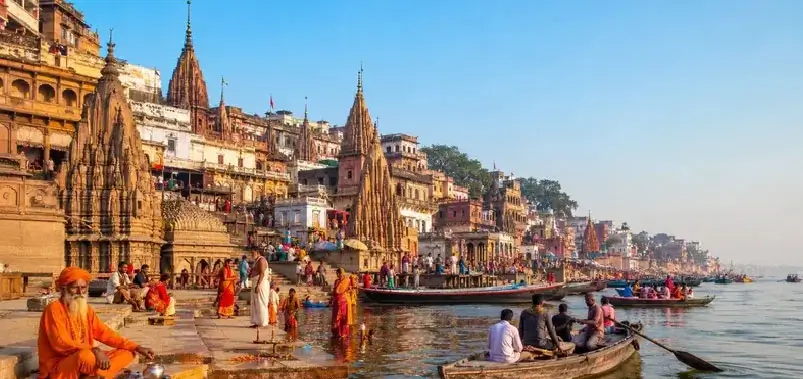
Varanasi is the most powerful of the four extensions and the one that stays with guests longest. It is one of the oldest continuously inhabited cities on earth, and life along the river runs much as it has for centuries. Pilgrims bathe at dawn, families bring their dead to the cremation grounds, priests chant, and boats drift past temples and mansions stacked along the curving western bank of the Ganges. It is not always comfortable, but it is never dull.
The highlight for most visitors is the evening lamp ceremony at Dashashwamedh, the main riverfront steps in the heart of the old city. Each evening, a line of young priests in matching robes performs a synchronised ritual with large brass lamps, incense, conch shells and bells, accompanied by chanting and music. The ceremony starts shortly after sunset, typically around 6:00 in the evening from October to March and closer to 7:00 in the summer months, and runs for about forty-five minutes to an hour. Crowds are large every night, and on festival evenings such as Dev Deepawali in November, when the entire riverfront is lit with thousands of small lamps, they become enormous.
There are two ways to watch. The first is from a reserved seat or rooftop near the steps, which gives a close view but can feel crowded. The second, and the one we usually recommend, is from a private boat moored on the river facing the ceremony. You see the whole performance framed by the lights of the city, without the crush. A private motorboat or rowing boat for the evening, with your guide on board, typically costs between ₹4,000 and ₹10,000 depending on the boat and the date, and higher on festival nights, when boats need to be reserved weeks ahead.
The second essential is the sunrise boat ride. Before dawn, a boat takes you slowly along the river as the sun rises over the eastern bank, lighting up bathers, yoga groups, flower sellers and the smoke of the cremation grounds at Manikarnika. This is the best way to see the riverfront in calm light, and most guests find it the most moving hour of their entire trip. At Assi, the southern end of the riverfront, a morning ceremony with music and chanting takes place around dawn.
During the day, a guided walk through the narrow lanes leads past small shrines, silk weavers and sweet shops towards the area of the Kashi Vishwanath Temple, one of the holiest sites in Hinduism. Entry rules for non-Hindu visitors and restrictions on phones and bags change from time to time, so your guide will advise on the day. A half day trip to Sarnath, about 10 kilometres away, visits the stupa and ruins where the Buddha gave his first sermon, with a modest entry fee of around ₹300 for foreign visitors and an excellent small museum.Hotels in Varanasi are fewer than in Rajasthan, but two stand out. BrijRama Palace, an eighteenth century riverfront palace right on the steps, offers rooms with river views and the rare luxury of stepping straight from the hotel into your boat, with rates roughly between ₹30,000 and ₹65,000 per night in high season. Taj Nadesar Palace, a former royal guest house set in quiet gardens in the cantonment area, is calmer and more private, typically from about ₹35,000 to ₹60,000. Guests who want the river on their doorstep choose BrijRama, while those who prefer a peaceful retreat after a busy day on the water often choose Nadesar.
Get Your Custom India Tour Itinerary
Not sure which destination to choose? Talk to our travel expert and find the perfect Golden Triangle extension for your trip.
Jodhpur: The Blue City, Mehrangarh and Desert Edges
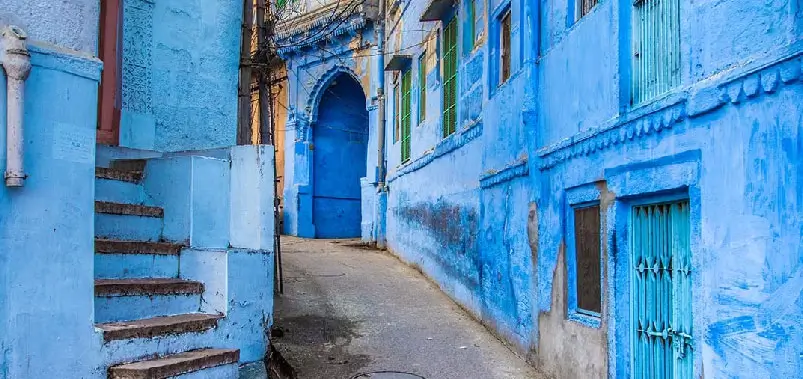
Jodhpur is the most underrated of the four, and it often surprises guests who added it almost as an afterthought. The city sits on the edge of the Thar Desert, beneath one of the most dramatic forts in India, and its old quarter of blue-painted houses creates a view that seems almost unreal from the ramparts above.
The great sight is Mehrangarh Fort, built on a rocky ridge that rises sharply above the city. Its walls are immense, its palaces finely carved, and its museum among the best in Rajasthan, with collections of paintings, armour, textiles and royal palanquins. The fort is open daily from about 9:00 in the morning to 5:00 in the evening, and entry for foreign visitors is around ₹600, including an audio guide, with an extra charge for cameras. A private guide makes a real difference here, turning a beautiful building into a vivid story of battles, rulers and the city they built. Allow three hours at least.
Below the fort, the Jaswant Thada, a white marble memorial, looks especially lovely in late afternoon light. A guided walk through the old blue lanes, past spice sellers, step wells and small temples, ends near the clock tower and the market around it, where shops sell textiles, spices and antiques. For guests who enjoy a little adventure, the zip-line tour across the walls and lakes of the fort is surprisingly gentle and offers views few visitors see.
Jodhpur's countryside is another reason to come. A village drive through the farming communities to the south introduces artisans, potters and weavers, while further out, luxury desert camps offer sunset dinners on the dunes. Osian, with its old temples and sand dunes, is about an hour's drive to the north and can be combined with a night under canvas.
The hotels are strong. Umaid Bhawan Palace, one of the largest private residences in the world and still partly home to the former royal family of Jodhpur, is a grand Art Deco palace on a hilltop facing the fort. Rooms in peak season typically range from roughly ₹60,000 to more than ₹1,30,000 per night, with historical suites considerably higher. RAAS Jodhpur, a boutique hotel in the old city with direct views of Mehrangarh from almost every room and its pool, offers a more intimate stay at around ₹30,000 to ₹55,000 per night. Several smaller heritage hotels and mansions in and around the old city sit at lower rates for guests who prefer character over grandeur.
Jodhpur suits guests who love history, architecture and photography, and who want a taste of the desert without travelling all the way to Jaisalmer. It also works well paired with Udaipur, as the scenic drive between them passes Ranakpur and Kumbhalgarh, turning a transfer day into one of the best sightseeing days of the trip. Like the rest of Rajasthan, it is most pleasant from October to March, and noticeably hot by April.
What Each Extension Adds to Your Budget
Extension costs vary more than guests expect, because each destination has its own mix of hotel prices, activities and transport. Here is a realistic view for a couple on a private luxury trip in peak season, on the higher side.
A three night Udaipur extension usually costs the most in hotel terms, because the famous lake hotels sit among the most expensive in India. Three nights at Taj Lake Palace or The Oberoi Udaivilas in a good lake view room typically run from about ₹2,00,000 to ₹4,00,000. Add a flight from Jaipur and a return flight to Delhi at roughly ₹20,000 to ₹35,000 for two, a car and chauffeur for local touring at around ₹5,000 to ₹7,000 per day, a private guide at ₹5,000 to ₹8,000 per full day, and a sunset boat on the lake. A realistic total lands between ₹2,60,000 and ₹4,80,000 for the couple, or roughly US$3,100 to US$5,700.
A three night Ranthambore extension has the highest activity costs. Lodges such as SUJÁN Sher Bagh or The Oberoi Vanyavilas often include meals, so the nightly rate covers more than it does elsewhere. Three nights typically cost between ₹2,10,000 and ₹3,50,000, rising sharply at Aman-i-Khas. Private safaris for four drives add around ₹75,000 to ₹1,10,000. Transport is cheap, as your chauffeur continues from Jaipur, and the return to Delhi by train in an air-conditioned class is modest. Allow roughly ₹3,00,000 to ₹4,80,000 in total.
A two night Varanasi extension is usually the most affordable of the four, because the stay is shorter and the hotels are slightly less expensive. Two nights at BrijRama Palace or Taj Nadesar Palace run from about ₹60,000 to ₹1,30,000, flights from Delhi and back add roughly ₹20,000 to ₹35,000 for two, and a local car, guide, two private boat rides and the Sarnath visit add around ₹30,000 to ₹45,000. A realistic total is ₹1,10,000 to ₹2,10,000.
A two night Jodhpur extension sits between the others. Two nights at Umaid Bhawan Palace cost from about ₹1,20,000 to ₹2,60,000, while RAAS comes in at around half that. With the drive from Jaipur, a full-day guide, fort tickets, a village drive and a flight back to Delhi, the extension typically lands between ₹1,60,000 and ₹3,20,000.
Some costs are easy to forget. Chauffeur tips and guide tips add a few thousand rupees per day. Festival periods such as Diwali and the Christmas to New Year weeks bring sharply higher hotel rates and minimum night stays at the leading palace hotels, sometimes three or four nights. Private safari jeeps and festival boat bookings in Varanasi need to be paid in advance and are often non-refundable. When we put together a luxury India extension, we confirm the hotel and the activity together, because a palace room without a safari permit or a boat on the evening that matters is only half the experience.
Matching the Extension to the Traveller
After many seasons of arranging these trips, we find that guests usually know which extension is right for them once they see the options side by side. The destination matters less than the kind of memory you want to bring home.
Honeymooners and anniversary couples are almost always happiest in Udaipur. The lake hotels, sunset boats and slow mornings create the romantic finish that a busy triangle sometimes lacks. If they have extra time, adding two nights in Jodhpur before Udaipur gives the trip a satisfying arc from desert fort to lakeside calm.
Families with children aged eight and above tend to love Ranthambore. Few things capture a child's imagination like a tiger walking down a forest track, and the lodges are spacious, safe and full of activities between drives. The early starts can be hard for very young children, and some lodges have minimum age rules for safaris, so check before you book. Families with teenagers who enjoy history often find Jodhpur equally rewarding.
Wildlife enthusiasts and photographers should choose Ranthambore and stay at least three nights. Those with a serious interest might add a second park later in the trip. Photographers who prefer architecture and street life will find Jodhpur and Varanasi more rewarding, as both offer extraordinary light and scenes at dawn.
Culturally curious travellers, including those with an interest in religion, philosophy or history, should go to Varanasi. It is the most intense of the four and asks more of its visitors, but it offers a direct, unfiltered encounter with a living tradition that no museum can match. It is also the best choice for repeat visitors who have already seen Rajasthan and want something completely different.
First-time visitors with limited time who want the classic Rajasthan picture should choose Jodhpur or Udaipur, depending on whether they lean towards forts and markets or lakes and relaxation. Jodhpur suits guests who want more sightseeing, while Udaipur suits those who want more rest.
Older travellers or those with mobility concerns generally find Udaipur the easiest, with gentle sightseeing and hotels designed for comfort. Varanasi requires walking through crowded lanes and climbing steps, and Ranthambore involves bumpy jeep rides, so both need a little more energy.
Whichever you choose, the same few principles apply. Give each extension at least two nights, place the travel days carefully, book your key hotel and any safari or boat early, and choose the extension before you fix the direction of your triangle. A private Golden Triangle tour with extension is at its best when every part of the journey has been fitted together with care, so that the final days feel just as special as the first.
Related Guides



 info@topindianholidays.net
 +91-8955000999