📅 Last Updated On: 24 Oct 2026
⏱ 8 Min Read
10 Famous Food Dishes in Udaipur & the Best Places to Try Them
N
Nand Singh Rathore
Travel & Tourism Expert specializing in India
Famous Rajasthani Dishes to Try During Your Udaipur Trip
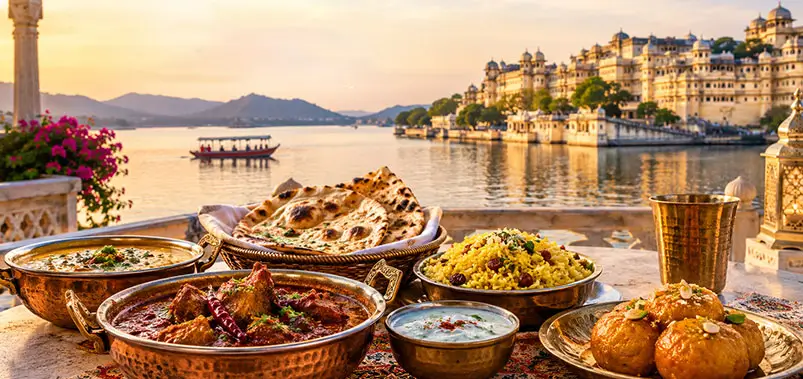
Udaipur feeds you differently from Jaipur or Jodhpur. The city sits in the green, hilly heart of Mewar, the old kingdom of the Sisodia Rajputs, and its cooking reflects that geography: more maize than the desert districts, more forest produce, a fondness for slow-cooked game dishes from the royal hunting lodges, and a powerful Gujarati influence that drifts up the highway and sweetens the breakfast counters. Spend an evening on a rooftop above Lake Pichola and you will taste a fiery mutton curry the Maharanas once ate after a hunt; walk into the old city at eight the next morning and you will find steaming flattened rice next to coils of syrupy fried batter, a pairing borrowed from Indore and Gujarat that locals now treat as their own.
This guide is built around Udaipur food specifically rather than generic Rajasthani cooking. We have grouped the city's most famous dishes by the kind of meal they belong to, and paired each one with real places that have been feeding locals and visitors for years, from family-run snack counters near Surajpole to candlelit tables at the Taj Lake Palace. Prices are quoted on the higher side of what you are likely to pay, so you will rarely be caught short, and we have added opening hours, the best time of day for each stop and some honest advice on keeping your stomach happy. Read it before your trip, then let your appetite set the route.
Dal Baati Churma, Gatte and the Mewari Platter at the Old Dining Halls
If you eat only one traditional meal in the city, make it Dal Baati Churma in Udaipur. The dish is a trio: Dal, a thick, tempered lentil stew; Baati, hard wheat dumplings baked over coals or in an oven until the crust cracks; and Churma, a sweet crumble made by pounding baked dough with clarified butter and jaggery or sugar. You break the dumpling with your fingers, pour clarified butter over it, ladle the lentils on top and eat the sweet crumble alongside. Farmers and soldiers in Mewar valued it because the dumplings kept for days and could be buried in hot sand or embers on campaign. Today it is the dish every visitor asks for, and the quality varies enormously, so it is worth going to the specialists.
Krishna Dal Bati Restro is the name most Udaipur families will give you. It sits on the first floor of a small market on Gulab Bagh Road, a short auto-rickshaw ride from the Jagdish Temple, and opens from roughly 11.30 am to 4.30 pm and again from 7 pm to 10 pm. The room is plain and busy, and that is the point. A full portion of the baked dumplings with lentils and sweet crumble, refilled until you stop them, costs around ₹350 to ₹400 per person, and a meal for two with buttermilk and extras comes to about ₹800. Ask for the dumplings "fried" if you prefer them softer, or "baked" for the classic hard crust. Go at lunch, when the dumplings come straight out of the oven and the clarified butter has not yet been rationed for the evening crowd.
Natraj Dining Hall in the city centre near the bus stand area is the other institution, and it is where you meet the Mewari platter: an unlimited, constantly refilled steel tray of lentils, three or four vegetable curries, flatbreads, rice, pickles, sweets and buttermilk. Natraj serves vegetarian Rajasthani and Gujarati food from about 11 am to 3.30 pm and 6.30 pm to 10.30 pm, and expects a queue at weekends, so arrive before noon or after 8.30 pm. Budget ₹450 to ₹500 per person for the unlimited platter. Waiters move fast, so if you are full, put your hand flat over the tray, which is understood everywhere in Rajasthan as "no more, thank you".
On that tray you will almost certainly find Gatte ki Sabzi, gram-flour dumplings poached and then simmered in a sour yoghurt gravy. Gram flour is a pantry staple across dry Rajasthan because it stores well and needs no fresh vegetables, and Mewar cooks make the dumplings slightly larger and the gravy a little tangier than you will find in Jaipur. Santosh Bhojnalaya, a modest dining hall often recommended by local food writers, is particularly praised for its gram-flour dumplings in yoghurt curry, and a full meal there rarely goes beyond ₹350 per person.A few tips make these dining halls more enjoyable. Lunch is the main meal of the day here, so the kitchens are at their freshest between noon and 2 pm. Most halls do not serve alcohol and many are strictly vegetarian, with no onion or garlic in certain dishes. Water is offered in steel tumblers, but bottled water is always available if you ask. And do not skip the sweet crumble on the side: Mewari cooks often enrich it with cardamom and dried fruit, and it is the part of the meal locals argue about most.
Discover Udaipur with a Private Tour
Explore Udaipur’s beautiful lakes, royal palaces and authentic Rajasthani cuisine with a personalised private tour. Let our travel experts help you discover the city’s local flavours and hidden gems.
Mewari Laal Maas and the Royal Hunting Kitchen
Udaipur's most famous non-vegetarian dish carries a reputation that arrives before the plate does. Mewari Laal Maas, literally "red meat", is mutton slow-cooked in clarified butter with a heavy dose of dried Mathania red chillies, yoghurt, garlic and whole spices, until the gravy turns a deep brick colour and the meat almost falls from the bone. It began in the hunting kitchens of the Mewar nobility, where wild boar or venison was cooked in a pot over an open fire and the chillies masked the gamey taste. Hunting is long gone, mutton has replaced game, but the method has barely changed. Restaurant versions range from mild to properly fierce, so tell the waiter how much heat you can take before you order.
Its gentler cousin is Safed Maas, "white meat", in which the mutton is cooked with cashew paste, cream, cardamom and white pepper for a pale, rich, almost Mughal-style curry. Many Mewar kitchens also serve Jungli Maas, a deliberately rustic version with nothing but meat, clarified butter, salt and chillies, which recalls the original hunting camp recipe. Order one red and one white and share them; the contrast tells you a lot about how courtly cooking developed here.
For a Laal Maas in Udaipur with a lake view, three places stand out. Upre by 1559 AD sits on the roof of the Lake Pichola Hotel in the Chandpole neighbourhood, looking straight across the water at the City Palace and the floodlit Lake Palace. The kitchen does traditional Indian food alongside Italian and continental dishes, and a dinner for two with a mutton curry, breads and a vegetable dish comes to around ₹3,000 before drinks, with last orders close to 10.30 pm. Book a table along the parapet and arrive half an hour before sunset.
Jagat Niwas Palace, a converted seventeenth-century mansion on the eastern shore near the Jagdish Temple, has a rooftop restaurant with low cushioned seating and arches framing the lake. It is a favourite with returning British and European guests who want a quieter, more traditional setting, and the Rajasthani menu includes a well-balanced red mutton curry. Expect ₹2,500 to ₹3,000 for two.
Ambrai, on the western shore below the Amet family's old mansion, has the most photographed view in the city: tables at water level, with the palace walls lit gold across the lake after dark. It serves Indian and continental food from breakfast through dinner, roughly 7.30 am to 11 pm, and dinner for two with a mutton curry, breads, rice and a dessert runs to ₹3,500 to ₹4,000 plus drinks. Reservations are essential from October to March, and you should ask specifically for a lakeside table rather than the terrace behind.
A practical word on chilli: the best Mewari mutton curry is hot in a slow, building way rather than an instant burn. Eat it with plain flatbread or a millet bread rather than rice, keep a bowl of yoghurt close, and do not drink iced water, which only spreads the heat. If you are travelling with children or anyone sensitive to spice, the white cashew curry is a safe and delicious alternative that still feels distinctly Udaipur.
Kachori and Mirchi Vada at Udaipur's Famous Snack Stalls
Udaipur runs on fried snacks, and the best of them are eaten standing up on a pavement with a paper plate in one hand. The king of the morning is the Kachori, a flaky, deep-fried pastry stuffed with spiced lentils or onions, broken open and doused with tamarind and green coriander relishes. Kachori in Udaipur has a slightly different personality from the Jodhpur version: here you will often find the Hing Kachori, a smaller pastry flavoured strongly with asafoetida, and the Dahi Kachori, the same pastry crushed and topped with sweetened yoghurt, spiced powder and crunchy gram-flour strands.
Jagdish Mishthan Bhandar, usually shortened to JMB, is the best-known address. Its main shop is on Sarang Marg near Surajpole, with a presence in the busy shopping streets around Bapu Bazar, and it opens from about 7 am to 10 pm. Locals come for onion kachoris, samosas, steamed gram-flour rolls called Khandvi, which are thin savoury roulades topped with mustard seeds, and an enormous counter of sweets. A plate of two kachoris costs around ₹50 to ₹60, and a mixed snack plate for two with tea comes to roughly ₹250. Come before 10 am, when the pastries are leaving the oil every few minutes and the crust is still shattering.
For the asafoetida pastry, Paliwal Restaurant in the old city is the long-standing name. It is very much a morning operation, open roughly 8 am to 2 pm with shorter hours on Sundays, and the kachoris often sell out by late morning. Expect to pay around ₹30 to ₹40 per piece. Another local favourite is the Pratapgarh Chaat Wala, a roadside stall outside the Central Jail, known for crisp lentil pastries piled with relishes and yoghurt; budget ₹60 to ₹80 for a loaded plate.
Then there is the Mirchi Vada, a large green chilli, slit, stuffed with spiced potato, dipped in gram-flour batter and deep-fried until blistered. Udaipur's twist is the mini version, smaller, less fiery chillies that you can eat in three bites, served with tamarind relish. The most famous queue for mirchi vada in Udaipur forms in the evening at Manak Balaji, where the stall works from around 6.30 pm to 10 pm and the frying never stops. A plate of mini chilli fritters costs about ₹40 to ₹50. Monsoon evenings, from July to September, are when locals crowd these stalls most, eating hot fritters under umbrellas with a glass of sweet ginger tea.
A few rules for the snack trail. Choose stalls with a fast turnover, where you can see the food going straight from the pan to the plate; that heat is your best protection. Skip the raw onions and tap-water relishes if your stomach is new to India, and ask for the tamarind relish, which is usually boiled. Carry small notes and coins, since many stalls do not take cards, although almost every vendor now accepts UPI phone payments. Finally, eat kachoris in the morning and chilli fritters in the evening, which is exactly how Udaipur does it. Order the other way round and you will get yesterday's batch.
Poha with Jalebi and the Udaipur Breakfast Habit
Walk through the old city lanes between 7 and 9.30 am and you will see the same breakfast on almost every counter: a mound of Poha, flattened rice softened and tossed with mustard seeds, curry leaves, turmeric, peanuts and a squeeze of lime, sprinkled with fine gram-flour strands and pomegranate, served beside a heap of Jalebi, spirals of fermented batter fried crisp and soaked in saffron sugar syrup. The combination reached southern Rajasthan from Malwa and Gujarat, and Poha with Jalebi in Udaipur has become a morning ritual for office workers, students and shopkeepers before the markets open. The salty, citrusy rice and the hot, syrupy spirals sound odd together but work beautifully, especially with a small glass of strong, sweet ginger tea.
The breakfast counters are humble, cheap and quick. Jain Nashta Centre is one of the best-loved, serving flattened rice, samosas and tea from early morning; a plate of rice flakes costs about ₹40 to ₹50, and a 100-gram portion of the syrupy spirals adds another ₹40. Trivedi Upahar Grah is another long-running breakfast stop where locals queue for the same pairing plus fried snacks, and a full breakfast for two rarely goes beyond ₹200. For the sweet half alone, Bhole Mishthan is often praised for its cardamom-scented fried spirals, and it is worth buying a quarter-kilo box to share, which costs around ₹120 to ₹150.
The market streets of Bapu Bazar and Bombay Bazar, close to the clock tower, are the best places to wander in the morning while you eat. Shops are only just lifting their shutters, flower sellers are unloading marigolds for the temples, and the lanes are cooler than they will be at any point until night. It is also the best time to photograph the old city without crowds. Start at the Jagdish Temple at around 7.30 am, walk down towards the clock tower, eat as you go, and you will be back at your hotel well before the heat and traffic build.
Udaipur's breakfast table has a few more dishes worth trying while you are out. Sev Tamatar, a tomato curry topped with crisp gram-flour noodles, is often eaten with flatbread in the morning. Khaman, a soft steamed gram-flour cake sprinkled with mustard seeds and green chillies, is a Gujarati import sold at most sweet shops for about ₹60 to ₹80 a plate. And Kadhi, a thin, tangy yoghurt and gram-flour soup, sometimes appears as a dipping sauce for fried pastries at places like JMB.
If you are staying at a heritage hotel on the lake, do not let the hotel breakfast buffet trap you every day. Hotel breakfasts are comfortable and safe, but the best breakfast in Udaipur is on the street, and it costs a fraction of the price. Many guests do one hotel breakfast and one street breakfast on alternate mornings, which gives the stomach time to adjust. The flattened rice is cooked and served hot, and the fried spirals come straight from the oil, so this is one of the safer street meals for first-time visitors. Avoid any toppings that have been sitting uncovered, and ask the vendor to serve from a fresh pan if the tray looks tired.
Ker Sangri, Makki ki Dhokli and the Produce of Mewar
Mewar is greener and hillier than western Rajasthan, but the region still shares the desert's genius for turning dried, preserved ingredients into memorable food. The best-known example is Ker Sangri, a dish of dried wild desert berries (ker) and the long beans of the khejri tree (sangri), soaked overnight and then cooked with mustard oil, dried red chillies, dried mango powder and yoghurt. The result is tangy, slightly bitter and chewy, rather like a pickled bean salad served warm. It was once the food of drought years, since both ingredients can be stored for months, and today it appears on royal menus as a symbol of Rajasthani resilience. Look for Ker Sangri in Udaipur at Natraj, at Krishna Dal Bati Restro, and on the Rajasthani pages of the rooftop restaurants above Lake Pichola, where a portion costs around ₹350 to ₹450.
The dish that sets Udaipur apart from the rest of the state is Makki ki Dhokli, steamed maize-flour dumplings flavoured with green chillies, ginger and fenugreek, then sliced and sometimes shallow-fried or tossed in a light yoghurt gravy. Maize grows well in the Aravalli valleys around Udaipur, especially in tribal Bhil villages to the south and west of the city, and maize bread and dumplings were the everyday staple long before wheat became common. Makki ki Dhokli in Mewar is above all winter food, cooked when fresh maize flour is plentiful between November and February, and it is often served with garlic relish, buttermilk and a jaggery sweet. You will find it more easily in homes, village kitchens and cooking classes than in tourist restaurants, so it is worth asking your hotel or guide to point you to a place serving it that day.
The most rewarding place to try Mewar's grains is Millets of Mewar, a small, open-air restaurant on the western side of Lake Pichola in the Chandpole area. Founded by Surendra Gandharva and his friend Manoj Prajapati, it cooks with finger millet, pearl millet, foxtail millet and sorghum, the grains Mewar families ate for centuries before rice and wheat replaced them. The menu mixes local dishes, including a millet version of the baked dumplings with lentils and sweet crumble, with sorghum pancakes, millet pizzas, Middle Eastern plates and a millet vegetable rice dish. It also runs cooking lessons and has taught thousands of guests over the years. Open roughly 9 am to 11 pm, it is a lovely place for a long, unhurried lunch, and a meal for two costs about ₹1,000 to ₹1,200. Vegans and gluten-sensitive travellers will find more choice here than almost anywhere else in the city.
Alongside these, ask about Bajre ki Roti, a thick pearl-millet flatbread brushed with clarified butter and eaten with jaggery or garlic relish in the colder months, and Raab, a warm, thin drink of millet flour and buttermilk that farmers sip in winter mornings. Both reflect the same logic: grains that grow without much water, prepared in ways that keep a family warm and full through a hard day in the fields.
These dishes are the best argument for leaving the lakeside for at least one meal. They are less photogenic than a palace dinner, but they tell you how ordinary Mewar actually eats, and they are often lighter and easier on the stomach than the clarified-butter-rich banquet food the region is famous for. Pair a millet lunch with an afternoon at the Fateh Sagar lakefront, about 3 km north of the old city, and you will have an Udaipur day that most tourists never see.
Malpua, Mawa Kachori, Kulfi and Lassi for the Sweet Tooth
Mewar takes dessert seriously. Weddings, festivals and temple offerings all revolve around sweets, and Udaipur's confectioners make some of the richest you will taste in Rajasthan. Begin with Malpua, a soft, lacy pancake of flour, milk and fennel, deep-fried in clarified butter, soaked in sugar syrup and usually topped with Rabri, a thick sweetened reduced milk with cardamom and saffron. Malpua in Udaipur is especially popular during the monsoon and around the Teej and Gangaur festivals, when sweet shops fry them all day. Served warm with the reduced milk, a plate of two costs around ₹120 to ₹150 at the larger sweet shops, including Jagdish Mishthan Bhandar.
Next comes the Mawa Kachori, a flaky pastry filled with reduced milk solids, nuts and cardamom, fried and dipped in sugar syrup. It is originally a Jodhpur speciality, but Udaipur has adopted it enthusiastically, and the Jodhpur-style sweet shops are the place to find it. Jodhpur Mishthan Bhandar on 80 Feet Road in the Sajjan Nagar area, open roughly 7 am to 9.30 pm, is a large sweet shop where you can sample several confections before buying, and it also sells savoury pastries and samosas. Expect to pay around ₹60 to ₹80 for one syrup-soaked milk pastry. It is extremely rich, so share one between two.
Ghevar, a disc of honeycomb-like fried batter soaked in syrup and sometimes covered in reduced milk, is another festival sweet, available mostly in the monsoon season from July to August, at about ₹800 to ₹1,000 per kilo for the reduced-milk-topped version. Sweet shops will sell you a single piece, which is a better idea than a whole kilo.
On a hot afternoon the city switches to cold sweets. Kulfi, a dense frozen milk dessert flavoured with pistachio, saffron or rose and cut from a cone-shaped mould, is sold from carts along the Fateh Sagar lakefront in the evenings, typically ₹60 to ₹100 a piece. The lakefront promenade comes alive after 6 pm, when families stroll, camel and pony rides wait along the wall and the breeze off the water drops the temperature noticeably. Many visitors also try Falooda, a layered dessert drink of rose syrup, vermicelli, basil seeds and frozen milk, sold at well-known stalls in the old city; arrive before 8 pm, as the best ones sell out.
Lassi, a thick, churned yoghurt drink served sweet, salted or flavoured with saffron and fruit, is the city's favourite way to cool down at lunchtime. The sweet shops near Surajpole and the cafés along the lake serve it in clay cups for around ₹80 to ₹120. A salted version with roasted cumin is the better choice after a heavy meal of dumplings and lentils, while the sweet saffron version is almost a dessert in itself.
When buying sweets as gifts, choose dry items that travel well, such as gram-flour fudge, cashew diamonds or sesame brittle, and ask for a sealed box. Milk-based sweets spoil quickly in the heat, so keep the rich syrupy pastries and reduced-milk desserts for eating on the spot. If you are flying home, sweet shops will pack boxes for hand luggage, and most of the larger ones accept cards.
Lakeside Fine Dining at Taj Lake Palace, Oberoi Udaivilas and Raffles
Udaipur is one of the few places in India where the grandest meal of your trip may also be the most memorable view of your life. Three luxury hotels set the standard, and each serves Mewari cooking in a refined, palace-kitchen style that is quite different from the dining halls of the old city.
The most famous is Neel Kamal at Taj Lake Palace, the hotel's Indian restaurant inside the eighteenth-century white marble palace that seems to float in the middle of Lake Pichola. The kitchen specialises in Rajasthani and north-western Indian dishes, and the signature is a deeply flavoured red mutton curry made in the traditional royal way. Dinner runs from about 7.30 pm to 10.30 pm. Budget ₹6,000 to ₹8,000 per person before taxes for a full meal with wine, and more for a tasting menu. Non-residents can sometimes dine here, but tables are limited and hotel guests get priority, so you must book well in advance through the hotel on +91 294 242 8800. The hotel boat collects diners from its jetty inside the City Palace complex, and the short crossing at dusk is part of the magic. Dress smartly; this is not a shorts-and-sandals evening.
The Oberoi Udaivilas, on the western bank of the lake, is regularly ranked among the best hotels in the world. Its specialty Indian restaurant, Udaimahal, serves Rajasthani and north Indian food in a candlelit dining room, while Suryamahal handles international cuisine. The hotel's private dining options, from tables beside the reflecting pools to a candlelit dinner by the lake, are among the most requested experiences in Udaipur for honeymooners and anniversaries. Budget ₹7,000 to ₹9,000 per person for dinner at the Indian restaurant with drinks, and considerably more for a private set-up. Non-resident bookings are subject to availability and are best arranged through your hotel or travel company several days ahead.
Raffles Udaipur takes a different approach. The hotel occupies its own island on Udai Sagar Lake, about 22 km east of the old city, roughly 40 minutes by car, and guests reach it by a short boat ride. Its Indian restaurant serves elegant regional dishes, and the setting is quieter and more secluded than the city lakeside. Expect ₹6,000 to ₹8,000 per person for dinner with wine. Because of the distance, many travellers combine a Raffles meal with a late-afternoon drive and a sunset on the lake, then return to the city by car afterwards.
Beyond the three big names, the city's heritage hotels offer palace-style dining at more approachable prices. Sunset tables at hotels such as Jagat Niwas Palace and the rooftop at the Lake Pichola Hotel give you a similar view of the Lake Palace from the shore, at roughly a third of the cost.A few tips for fine dining. Book a table for 30 minutes before sunset to see the lake turn gold and then the palaces light up. Ask for the chef's Mewari tasting menu if one is available; it is the best way to try red and white mutton curries, game-style dishes and festival sweets in one sitting. Many luxury kitchens will tone down chilli on request without losing the flavour, so ask. And if you have a proposal or anniversary dinner, tell the hotel in advance: these properties are extraordinarily good at quiet, discreet touches.
Create Your Custom Rajasthan Itinerary
From tasting Dal Baati Churma to exploring Udaipur’s charming old city, enjoy a Rajasthan journey tailored to your interests. Contact our travel experts to plan your ideal private experience.
Food Walks, Cooking Classes and Eating Safely in Udaipur
The quickest way to get under the skin of Udaipur's food is to walk it with someone who grew up here. Guided food walks in Udaipur usually run in the morning, from about 7.30 am to 10.30 am, or in the evening from about 6 pm to 9 pm. A morning walk typically covers flattened rice with syrupy spirals, asafoetida pastries, steamed gram-flour cakes, ginger tea and a sweet shop or two, starting near the Jagdish Temple and finishing in the market lanes around the clock tower. Evening walks focus on chilli fritters, crisp hollow puffs filled with spiced water, sandwich stalls and frozen milk desserts by Fateh Sagar. Expect to pay ₹2,500 to ₹3,500 per person for a private walk including all tastings, and slightly less for a shared group. A good guide will steer you to the busiest, freshest stalls and will also explain the stories behind the dishes, from royal hunting kitchens to temple offerings.
Cooking classes in Udaipur are one of the city's most popular activities, and many travellers rate them as the highlight of their visit. Shashi Cooking Classes, run by a local woman in the old city, is one of the best known, with small groups of three or four, two sessions a day around 10.30 am and 5.30 pm, and a fee of about ₹1,000 to ₹1,500 per person including the meal you cook. Dishes usually include spiced tea, onion and potato fritters, vegetable rice, flatbreads and curries. Millets of Mewar also runs cooking lessons centred on traditional grains, while several heritage homes and boutique hotels offer private royal cooking sessions for ₹3,000 to ₹5,000 per person. If you want to learn the baked dumplings with lentils or maize dumplings specifically, ask in advance.
Timing matters as much as choice. Eat kachoris and fried spirals early in the morning, when they are freshest. Take your big traditional meal at lunch, between noon and 2 pm, when dining halls and specialist dumpling restaurants are at their best. Spend late afternoon at Fateh Sagar with a frozen milk dessert or a yoghurt drink, and save the rooftop or palace dinner for sunset. Evening street stalls work best from 6.30 pm to 9.30 pm, before the oil has been reused too many times.
Food safety in Udaipur is mostly common sense. Drink bottled or filtered water, and check the seal before you open a bottle. Avoid ice in drinks at street stalls, raw salads and cut fruit that has been sitting out. Choose stalls with long queues and food cooked in front of you, and carry hand sanitiser and wet wipes. Introduce rich, clarified-butter-heavy dishes slowly, perhaps one per day at first, and keep a probiotic or oral rehydration salts in your bag just in case. From April to June, when temperatures cross 40°C, be extra careful with milk-based sweets and anything served lukewarm. The most comfortable season for food walks and rooftop dining is October to March, when evenings on the lake are cool and clear.
Getting between food stops is easy if you have a car and driver. The old city lanes are narrow, distances to Fateh Sagar, Sajjan Nagar and the Raffles island are longer than they look on the map, and auto-rickshaws can be hard to find late at night after a palace dinner. Top Indian Holidays can arrange a private chauffeur-driven car with a local guide for your Udaipur days, so you can eat your way from breakfast stalls to lakeside dinners without worrying about the logistics.
Related Guides



 info@topindianholidays.net
 +91-8955000999