📅 Last Updated On: 28 Oct 2026
⏱ 7 Min Read
Eklingji Temple Udaipur: History, Timings, Dress Code & How to Reach
N
Nand Singh Rathore
Travel & Tourism Expert specializing in India
How to Reach Eklingji Temple from Udaipur: Complete Guide
Drive north out of Udaipur on the Nathdwara highway early in the mor
ning and, after about 22 km of winding road through the Aravalli hills, you reach the small village of Kailashpuri. Here, behind tall fortified walls, stands the Eklingji Temple, the shrine of the guardian deity of Mewar and one of the most important Shiva temples in Rajasthan. It is not a grand tourist attraction in the way the City Palace is. It is a living place of worship, busy with local families, chanting priests and the ringing of brass bells, and that is exactly why so many travellers come away saying it was the most memorable part of their stay in Udaipur.
For more than twelve centuries the rulers of Mewar have treated Eklingji as the true king of their land, governing only as his regents. That idea shaped the whole history of the region, and you can still feel it when you step through the gateway. This guide covers everything a visitor needs: the history of the temple, what you will see inside, the Eklingji Temple timings for its separate morning, late-morning and evening opening windows, the dress code and the strict phone and photography rules, how to get there from Udaipur and what it costs, and how to combine the visit with Nagda, Haldighati, Nathdwara and Kumbhalgarh in a half-day or full-day outing.
The Story of Eklingji: Kings Who Ruled as Regents of Shiva
The origins of the Eklingji Temple go back to the eighth century and to Bappa Rawal, the legendary founder of the Mewar dynasty. According to the story told in Mewar to this day, the young Bappa Rawal grew up as a cowherd in these hills and came under the guidance of a sage named Harit Rashi, who lived in a hermitage near the spot where the temple now stands. The sage was a devotee of Shiva, and with his blessing Bappa Rawal went on to win the fort of Chittorgarh and establish a kingdom. In gratitude he consecrated a shrine to Shiva in the form of Eklinga, the "one lingam", and declared that the deity, not he, was the true sovereign of Mewar.
That declaration became the political foundation of the state. Every ruler who followed called himself the chief minister of Eklingji, a title that means chief minister or regent of the god. The Maharanas of Mewar issued orders in the deity's name, signed documents as his servants, and visited the temple before major decisions, coronations and battles. Even Maharana Pratap, who fought the Mughal army at Haldighati, is said to have drawn strength from this belief that he was defending the land of Shiva rather than a personal kingdom. The present head of the former royal family still holds this ceremonial role, and members of the family traditionally come to worship here, particularly on Mondays.
The temple you see today is not the original eighth-century building. The complex was attacked and damaged more than once by the armies of the Delhi Sultanate and later by forces from Malwa and Gujarat, and traces of that damage can still be seen on some of the older stone carvings. Each time, the rulers of Mewar rebuilt. The most significant reconstruction came under Maharana Raimal in the late fifteenth century, who restored the main sanctum and installed the black stone image of Shiva that is worshipped now. An inscription on the south wall of the temple records his work and also recalls Bappa Rawal's original consecration. Later Maharanas added shrines, gateways, halls and water tanks, so the complex grew in layers over several hundred years.The temple is also important to the history of Shaivism in western India. Close to the main shrine stands the Lakulisa temple, built in the tenth century and dedicated to the founder of the Pashupata sect of ascetics. Its inscription is one of the oldest dated records in the region, and it shows that Kailashpuri was a serious centre of learning and worship long before the later rebuilding. For anyone interested in Mewar history, this makes Eklingji far more than a pilgrimage stop. It is the spiritual and political anchor of a dynasty that ruled for more than a thousand years, and the reason the Sun-emblem flag of Udaipur still flies with such pride across the region. Standing in the courtyard while the priests chant, you are watching a tradition that has continued almost without break since the days of Bappa Rawal.
Book a Private Taxi to Eklingji Temple
Travel comfortably from Udaipur to Eklingji Temple with a private taxi. Enjoy flexible pickup, convenient travel, and the freedom to explore nearby attractions at your own pace.
Architecture Inside the Walls: The Four-Faced Image and 108 Shrines
From the road, the Eklingji temple complex looks almost like a small fort. High whitewashed walls enclose an area crowded with domes and spires, and you enter through a gateway from a narrow lane lined with flower and offering stalls. Once inside, you find yourself in a paved courtyard surrounded by around 108 temples and shrines of different sizes and ages, built mostly in white marble and local granite. Some are tiny niches with a single carved image; others are proper temples with their own halls and spires. Together they create a dense, atmospheric space that feels very different from the open, manicured settings of many monuments.
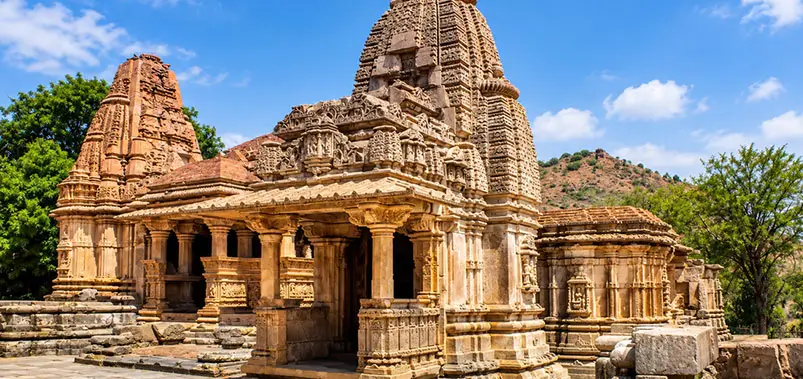
The main temple stands at the heart of the courtyard. It is built in the Nagara style of north Indian temple architecture, with a tall curved spire rising over the sanctum and a large pillared hall in front of it. The hall is two storeys high and is covered by a distinctive pyramidal roof made up of hundreds of small, rounded turrets, which gives the building a layered, almost honeycomb profile when seen from outside. Inside, the hall is lit by brass lamps and filled with the sound of drums and conch shells during ritual times. A silver door, decorated with figures of Ganesh and Kartikeya, leads towards the sanctum.
The focus of everything is the four-faced Shiva image carved from polished black marble. This is a lingam with four faces looking out in the four directions, each representing a different aspect of the divine. The face to the east is identified with Surya, the sun; the west with Brahma; the north with Vishnu; and the south with Rudra, the fierce form of Shiva. The top of the lingam is understood as Sadashiva, the eternal form, sometimes shown with the goddess. The image is draped in silver and decorated with flowers and sandalwood paste, and a silver serpent coils around it. You view it from the hall rather than from close quarters, and in the flickering lamp light it is a striking sight.
In front of the sanctum sits a large Nandi, the sacred bull who serves as Shiva's mount, facing his master as he does in every Shiva temple. Here there is more than one Nandi: a silver figure close to the sanctum, along with others in stone and brass in the courtyard. Look out too for images of the river goddesses Yamuna and Saraswati near the entrance, and for small carvings of Parvati, Ganesh and other deities on the outer walls. To the north of the complex are two sacred water tanks, Karz Kund and Tulsi Kund, whose water is used in the rituals.
Many of the surrounding shrines are worth a slow walk, even though you cannot photograph them. The Lakulisa temple, with its tenth-century inscription, is one of the most historically significant. Others are dedicated to Ganesh, Amba and various forms of Shiva. Just outside the walls lies Indrasagar, a small lake that reflects the temple domes beautifully on still mornings. Do not expect museum signage or labelled displays, because this is a working temple, not a monument with interpretation panels. A local guide from Udaipur adds a great deal, pointing out details such as the battle-scarred older stones and explaining which Maharana built which shrine.
Eklingji Temple Timings and the Daily Ritual Schedule
The most common mistake visitors make is arriving in the middle of the afternoon and finding the sanctum closed. Unlike many monuments, the Eklingji Temple timings are divided into separate windows built around the ritual routine of the deity, who is woken, bathed, dressed, fed and rested each day just as a king would be. The temple is open every day of the year, and entry is free, but the main hall and viewing of the image are only possible during set periods.
Based on the current schedule followed by the temple trust, the morning opening runs from about 4:30 am to 7:00 am. This is the quietest and most atmospheric time, when the first ritual of the day takes place around 5:30 am and local devotees arrive before work. The second window, often treated as the late-morning or midday session, runs from roughly 10:30 am to 1:30 pm. This is when most day-trippers from Udaipur arrive, and when tour groups combine the visit with Nagda and Nathdwara. The temple then closes its main doors for the afternoon rest of the deity. The evening session runs from about 5:00 pm to 7:30 pm, with the evening lamp ritual taking place around 6:30 pm, when priests circle burning lamps in front of the image to the sound of bells, drums and chanting. It is the most moving time to be there.
Several smaller rituals take place within these windows, including offerings at around 8:15 am, 9:15 am and 11:30 am, and the temple performs short ceremonies at about 3:30 pm and 4:30 pm behind closed doors before the evening opening. On Mondays, which are sacred to Shiva, and on certain auspicious days in the lunar calendar, the temple typically opens around fifteen minutes earlier and closes fifteen to twenty minutes later. Timings can also change on festival days and during eclipses, so it is sensible to ask your hotel or driver the evening before. If you are reaching from Udaipur, leaving by 9:30 am gets you to the gate comfortably for the late-morning window.
Monday crowds are something to factor in. Mondays bring a steady flow of local worshippers, and queues inside can be long between 10:30 am and noon. If you prefer a calmer visit, Tuesday to Saturday mornings are best. Sundays and public holidays bring family groups from Udaipur and nearby towns.
The biggest occasion of the year is Maha Shivratri, the great night of Shiva, which falls in February or March. On that night the temple stays open far longer than usual, sometimes through the night, with special rituals every few hours. Tens of thousands of pilgrims come from across Mewar, the road from Udaipur is lined with stalls and volunteers, and traffic slows to a crawl near Kailashpuri. It is a powerful spectacle if you are comfortable with very large crowds, but expect long waits, heavy security and no chance of a quiet look at the architecture. The monsoon month sacred to Shiva, roughly July to August, also brings busy Mondays.
Dress Code, Photography Ban and Rules at the Gate
Eklingji is run as a strictly traditional temple, and the rules are enforced more firmly than at many places of worship in Rajasthan. Knowing them before you arrive saves time at the gate and avoids embarrassment. The good news is that none of them are difficult, and the staff and priests are used to visitors from overseas who are simply unaware of local customs.
The Eklingji Temple dress code is modest clothing for everyone, men and women alike. Shoulders and knees should be covered. For women, a long skirt, loose trousers, a long tunic with trousers or a dress below the knee with a scarf or shawl over the shoulders works perfectly. Sleeveless tops and short skirts are not acceptable. For men, long trousers and a shirt or T-shirt with sleeves are appropriate; shorts, vests and sleeveless tops are likely to be turned away. There is no requirement to cover the head, though some local women do so out of habit, and carrying a light scarf is useful in any case. Clean, simple clothing is respected; you do not need to dress up. In summer, loose cotton or linen in light colours keeps you comfortable while respecting the rules.
The most important rule to know is the photography ban. Photography and video are strictly prohibited inside the temple complex, and this includes the courtyard as well as the main hall and sanctum. Cameras are not allowed in, and phones are not permitted either. Visitors are expected to leave mobile phones, cameras, bags and other electronic items in the lockers or deposit counter near the entrance, where a small fee or donation is usually charged. Security staff check at the gate, and attempting to sneak a phone inside is taken seriously. If you want a souvenir picture, take it of the outer walls and gateway from the lane before you go in, or from the banks of Indrasagar.
Leather items are also not allowed inside. That means belts, wallets, handbags and watch straps made of leather should be left in the car or in the locker. Many visitors forget about belts, so it is worth checking before you leave the vehicle. Shoes are removed at the entrance and left at the free shoe-keeping counter, and you walk barefoot across the stone courtyard. On a hot day in May or June the stone can become very warm by midday, so socks are a sensible idea, and they are acceptable inside.
Inside, keep your voice low, follow the flow of devotees around the hall, and do not touch the images or step over offerings placed on the floor. Priests may offer you a sweet offering or a sprinkle of holy water as you pass; accepting with your right hand is polite, and a small donation in the box is welcome but entirely optional. Non-Hindus are allowed into the temple, and foreign visitors generally receive a warm welcome as long as they follow these basic rules. Smoking, alcohol and food from outside are not permitted, and you should avoid public displays of affection anywhere within the walls.
How to Reach Eklingji from Udaipur
Kailashpuri lies roughly 22 km north of Udaipur city on National Highway 48, the main road towards Nathdwara, Rajsamand and Ajmer. The drive takes about 35 to 45 minutes from the old city, depending on traffic around the Fatehpura and Sukher areas, and the road is good, passing through rocky hills and small villages. There is no railway station at Kailashpuri itself; the nearest is Udaipur City station, and the nearest airport is Maharana Pratap Airport at Dabok, about 40 km away on the other side of the city. So for nearly every visitor, the journey begins in Udaipur.
The most comfortable option is a taxi from Udaipur to Eklingji. For a simple round trip with waiting time of an hour or so, expect to pay around ₹1,800 to ₹2,200 for a sedan such as a Toyota Etios or Swift Dzire, and around ₹2,800 to ₹3,200 for a larger Toyota Innova Crysta. If you add Nagda's Sas-Bahu temples, which are only about 3 km further on, the price rises only slightly. For a half-day package covering Eklingji, Nagda and Nathdwara, budget about ₹2,800 to ₹3,500 in a sedan. App cabs work in Udaipur, but drivers often refuse or charge extra for the return leg from Kailashpuri, so a pre-booked car with waiting is far more reliable.
An auto rickshaw is the budget-friendly alternative. A round trip from the old city with waiting time costs around ₹700 to ₹1,000 after bargaining. It is a fun, breezy ride in winter, but on a highway with fast trucks and in summer heat it can be tiring, and the open sides offer little protection from dust. Agree the fare, including waiting time and any extra stops, clearly before setting off.
Public transport is also possible. Rajasthan State Road Transport Corporation buses and private buses heading towards Nathdwara, Rajsamand and Kankroli leave regularly from the Udaipur central bus stand and from points along the highway, and they stop at Kailashpuri on request. The fare is around ₹40 to ₹60 per person, and the journey takes about 45 minutes to an hour. Buses are crowded at peak times and you will need to walk a few hundred metres from the highway to the temple gate. Shared jeeps also run on this route.
If you are travelling on a longer Rajasthan itinerary with a private car and driver, Eklingji fits neatly into the route between Udaipur and Kumbhalgarh, Ranakpur or Jodhpur, or between Udaipur and Pushkar or Jaipur, as the highway runs right past the village. Parking is available near the temple for a small fee, and drivers know the drill with phones and leather, so they will usually keep your belongings safely in the vehicle. Early starts are recommended in summer, when temperatures climb above 38°C by noon.
Nearby Sights: Nagda, Haldighati, Nathdwara and Kumbhalgarh
One of the best things about visiting Eklingji is that it sits at the centre of a remarkable cluster of sights, and with a car you can easily turn a short temple visit into a rewarding Eklingji half-day or full-day circuit. The closest is Nagda, just 3 km away, where the Sas-Bahu temples stand beside Lake Bagela. These twin temples date from the tenth century, when Nagda was the early capital of the Mewar rulers, and their name is a local corruption of Sahastra Bahu, a "thousand-armed" form of Vishnu. The carving on the pillars, ceilings and doorways is extraordinarily fine, with dancers, musicians, deities and floral patterns cut into the stone. Unlike Eklingji, photography is allowed here, and the site is quiet and peaceful, which makes it a perfect counterpoint to the busy main temple. There is a modest entry fee, and you need around 30 to 45 minutes.
For a classic half-day outing, leave Udaipur at about 9:30 am, reach Eklingji for the late-morning opening, spend an hour inside, then drive to Nagda for the Sas-Bahu temples and return to Udaipur for a late lunch. Alternatively, continue another 26 km north on the highway to Nathdwara, home of the famous Shrinathji temple, dedicated to Krishna in the form of a seven-year-old child. Nathdwara is one of the most important pilgrimage towns for followers of the Pushtimarg tradition, and its viewing sessions are short and tightly timed, eight times a day, with long breaks in between, so check the schedule on the day. The same rules apply as at Eklingji: no phones, cameras or leather, and modest dress. The town's lanes are famous for Pichhwai paintings, the detailed cloth paintings of Krishna, and for meenakari enamel jewellery.
A full-day circuit can add Haldighati, about 40 km from Udaipur and roughly 20 km from Nathdwara. This is the narrow pass where Maharana Pratap fought the Mughal army under Man Singh in the sixteenth century. The Maharana Pratap Museum here, open from 8:00 am to 6:00 pm, tells the story through dioramas, paintings and a short film, with entry of around ₹50 for foreign visitors and ₹20 for Indians, plus around ₹35 for the light and sound show. Nearby are the Chetak Memorial, honouring Pratap's loyal horse, and Badshahi Bagh, the garden where the Mughal army camped. The area is also known for gulkand, a sweet preserve made from rose petals, sold by small shops along the road.The most ambitious version continues to Kumbhalgarh Fort, about 85 km from Udaipur and about 65 km from Eklingji via Nathdwara. Its 36 km wall is one of the longest in the world, and the views from Badal Mahal at the top are spectacular. Kumbhalgarh needs at least two to three hours, so a full day of Eklingji, Nagda, Haldighati, Nathdwara and Kumbhalgarh is long, typically eleven or twelve hours. For that route, expect to pay around ₹4,500 to ₹5,500 for a sedan and ₹6,000 to ₹7,000 for an Innova Crysta. Many travellers prefer to stay a night near Kumbhalgarh and return the next day, which makes for a far more relaxed trip.
Plan Your Visit to Eklingji Temple
Planning a visit to Eklingji Temple near Udaipur? Get help planning your temple visit, local sightseeing, and convenient transportation for a smooth travel experience.
Best Time to Visit and Where to Eat Nearby
The best time to visit Eklingji is from October to March, when Udaipur's weather is at its most pleasant. Days are sunny and around 24°C to 30°C, mornings in December and January can drop to 8°C or 10°C, and walking barefoot across the stone courtyard is comfortable. This is also the main tourist season in Udaipur, so the late-morning window gets busier with visitors, but it rarely feels overwhelming outside Mondays and festivals. If you have the flexibility, the early-morning opening in winter is wonderful, with mist over Indrasagar and the courtyard filled with the sound of chanting and bells.
April to June is hot, with afternoon temperatures easily crossing 40°C. A visit is still perfectly possible if you go early, reaching the temple in the 4:30 am to 7:00 am window or at the start of the late-morning session, and returning to the cool of your hotel before noon. The stone floors become uncomfortably hot later in the day. The monsoon, roughly from July to September, turns the Aravalli hills green and fills Indrasagar and Lake Bagela, which makes the drive very scenic. It is also a time of heightened devotion to Shiva, so Mondays during this season are especially crowded. Short heavy showers are common, but they rarely disrupt a visit for long.
Food options at Kailashpuri itself are simple. The lane leading to the temple has small sweet shops and roadside eateries selling tea, snacks and basic vegetarian meals, and everything around the temple is strictly vegetarian, with no eggs, meat or alcohol. Look for fresh kachori, a deep-fried pastry stuffed with spiced lentils, and poha, a light breakfast dish of flattened rice cooked with onion, peanuts and mild spices. A plate of either costs around ₹40 to ₹80. Hygiene standards vary, so many overseas visitors stick to packaged snacks and bottled water here and eat a proper meal later.
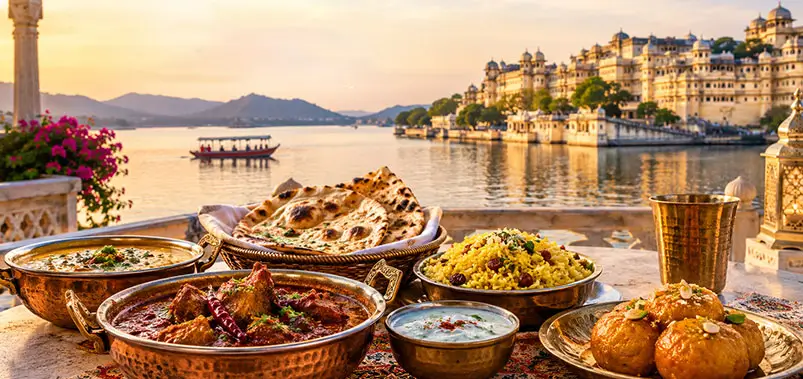
For a sit-down lunch, Nathdwara has a range of vegetarian restaurants serving Rajasthani and Gujarati food, and the town is well known for its sweets, especially those prepared in the style of the temple kitchen. If you return to Udaipur, there are excellent choices for every budget. Natraj Dining Hall, near the railway station, is famous for its unlimited Gujarati and Rajasthani vegetarian platter, at around ₹350 to ₹400 per person. For a lake view, Ambrai Restaurant on the banks of Lake Pichola, facing the City Palace, is a favourite for dinner, with mains at about ₹600 to ₹900. Upre by 1559 AD, on the rooftop of Lake Pichola Hotel, offers similar views at slightly higher prices.
If you are continuing to Kumbhalgarh, the restaurants at The Aodhi and other heritage hotels near the fort offer reliable buffets and à la carte menus, with lunch at around ₹1,200 to ₹1,800 per person. On a full-day circuit, it makes sense to carry fruit, biscuits and water in the car, because the stretches between Haldighati and Kumbhalgarh have few comfortable places to stop.
Tips for Foreign Visitors to Eklingji
For international travellers, a visit to Eklingji can be one of the most authentic cultural experiences of a Rajasthan trip, precisely because it is not designed around tourists. A little preparation makes it smooth and enjoyable. The first tip is to treat the visit as attending a religious service rather than seeing a monument. Arrive with time to spare, sit quietly for a few minutes in the hall if there is space, and watch the rituals rather than rushing through. Many visitors find that the twenty minutes they spend simply listening to the chanting are the highlight of the day.
Prepare for the no phones and no cameras rule before you leave Udaipur. Decide what you will carry, because anything electronic will have to be deposited at the entrance. The simplest solution is to leave phones, cameras, leather belts and handbags with your driver in the car. If you are travelling by auto rickshaw or bus, use the locker counter near the gate and keep the token safely. Carry a little cash in a cloth pouch for the shoe counter, the locker fee and any donation you want to make. Small notes of ₹10, ₹20 and ₹50 are useful.
Dress modestly but comfortably. A light scarf or shawl is the most useful item a woman can carry in India, as it covers shoulders instantly and doubles as a sun shield. Men should avoid shorts entirely for this trip. Wear shoes or sandals that are easy to slip off and on, because you will remove them at Eklingji, Nagda and Nathdwara. Socks help on hot or very cold stone floors.
Be prepared for crowds and close contact during busy times. Queues in India can feel informal, with people pressing forward, especially near the sanctum. Stay calm, keep moving with the flow, and hold on to your belongings. The priests and temple staff are generally helpful, and a polite smile goes a long way. If someone offers to act as a guide inside the temple, agree on a price first, or better still, arrange an English-speaking guide in Udaipur who can explain the history, rituals and symbolism before you enter, since you cannot take notes or photographs inside.
Respect the customs you see. You may notice devotees touching the threshold, ringing bells or walking clockwise around shrines. You are welcome to observe, and to join in quietly if you wish, but never feel obliged to. If you accept a sweet offering from a priest, it is considered polite to eat it rather than throw it away. Keep hydrated, apply sunscreen in the car before you get out, and carry hand sanitiser for after the visit. Finally, build in buffer time. Temple timings, Monday queues and highway traffic all make it unwise to schedule Eklingji tightly between other commitments. For travellers who prefer not to manage these details, Top Indian Holidays can arrange a private chauffeur-driven car with an experienced driver for the Eklingji, Nagda and Nathdwara circuit, or include it as part of a longer tailor-made Rajasthan tour.
Related Guides
- 10 Famous Food Dishes in Udaipur & the Best Places to Try Them
- Most Famous 7 Star Hotels in India: Palaces & Ultra-Luxury Stays
- Jaipur to Udaipur Road Trip by Car: Best Route, Stops & Travel Time
- Bagore Ki Haveli Udaipur: History, Timings, Entry Fee & Visitor Guide
- Jagmandir Island Palace Udaipur: History, Timings, Entry Fee & Visitor Guide
- Desert Camping in Rajasthan vs Camping in Europe: An Honest Comparison
- Devi Garh Palace Udaipur: History, Luxury Stay & Travel Guide
- Lakes in Udaipur: Complete Guide to the City of Lakes
- Mehandipur Balaji Temple: Timings, Rules, Darshan & Travel Guide
- Shrinathji Temple Nathdwara: Darshan Timings, History & Travel Guide
- Bullet Baba Temple Rajasthan: Story, History & Complete Travel Guide
- 51 Shakti Peethas in India: Complete List, Locations & Temple Guide
- Top 10 Travel Agencies in India
- Best Travel Agency in India
- Udaipur, Jaisalmer & Jaipur: Perfect Rajasthan Honeymoon Circuit
- Udaipur Tour by Private Car & Driver - Lakes, Palaces & Heritage Walks



 info@topindianholidays.net
 +91-8955000999