📅 Last Updated On: 12 Nov 2026
⏱ 8 Min Read
Rajasthan in 7, 10, 14 or 21 Days: Which Route Should You Book?
N
Nand Singh Rathore
Travel & Tourism Expert specializing in India
Choose the Best Rajasthan Tour Route Based on Your Travel Days
The email usually arrives with a map attached. A couple from London or Melbourne has circled Jaipur, Udaipur, Jodhpur and Jaisalmer, added Ranthambore because they would love to see a tiger, and then written underneath: "We have ten days. Is that enough?" Sometimes it is seven days, sometimes a generous three weeks, but the question is always the same. Rajasthan is the size of a large European country, its great cities sit five to seven hours apart by road, and every extra stop on the map costs a travel day that never appears in the glossy brochure.
The good news is that every trip length has a natural shape. A week gives you a polished short Rajasthan tour with two cities done properly. Ten days adds the classic royal circuit. Two weeks brings in the desert. Three weeks lets you see the state almost in full, with time to stay still. Below, we set out the realistic route for each length as we arrange it for our own guests, with the nights, the kilometres, the hours in the car, what you will have to leave out, the best luxury hotels in Rajasthan on each route at peak-season rates, and a rough total for two people travelling on a private luxury Rajasthan tour with a dedicated car and chauffeur.
Distances, Drive Times and the Real Pace of Rajasthan
Before choosing a trip length, it helps to know what the roads actually feel like. Rajasthan's highways have improved enormously, and most of the main city-to-city routes are now smooth four-lane roads. Even so, a Rajasthan road trip is measured in hours, not kilometres. Towns, villages, livestock, trucks and toll plazas all slow the pace, and a good chauffeur will hold a steady, safe speed rather than a fast one. As a rule, we budget about one hour for every fifty to sixty kilometres, plus a coffee stop and lunch.
The key distances shape every itinerary. Delhi to Jaipur is roughly 280 kilometres and takes four and a half to six hours depending on traffic leaving the capital. Jaipur to Ranthambore is about 160 kilometres, or three to three and a half hours. Jaipur to Jodhpur is around 340 kilometres, a long day of five and a half to six hours. Jaipur to Udaipur is close to 400 kilometres by road, six and a half to seven hours, which is why most guests fly that leg in about an hour. Jodhpur to Jaisalmer runs roughly 285 kilometres through open desert, about five hours. Jodhpur to Udaipur is about 250 kilometres, but most guests take the scenic road through the Aravalli hills via the Ranakpur temples, which turns it into a full day of seven to eight hours with the visit included.
Flights help, but only on some routes. Jaipur, Udaipur and Jodhpur all have airports with daily flights to Delhi and Mumbai, and there are direct services between some of them, though schedules change by season. Jaisalmer's small civil airport generally operates only in the winter months, so it cannot be relied on for every date. Trains such as the Shatabdi between Delhi and Jaipur, or the morning service from Sawai Madhopur, are useful for single legs but rarely suit a full luxury circuit, mainly because of luggage and station timings.
The most important rule is simple. A travel day is not a sightseeing day. If you drive five hours to Jodhpur, you arrive around mid-afternoon, check in, and perhaps walk the clock tower market at dusk. Mehrangarh Fort waits until the next morning. That means a city with two nights really gives you one full day, and a city with three nights gives you two. Most disappointing itineraries we see from other sources are simply too fast, with one-night stops that look efficient on paper but leave guests living out of a suitcase.For luxury travellers, we also advise against more than two long drives in a row, and we try to keep any single road day under six hours of actual driving. Where a leg is longer, a night at a countryside heritage hotel in between, or a one-hour flight, turns a tiring day into a pleasant one. With that pace in mind, here is how each trip length really works.
Plan Your Rajasthan Trip
Explore Rajasthan with a customized travel plan covering heritage hotels, sightseeing, private tours, desert experiences, and transportation.
Seven Days: Two Cities Done Properly
A week in Rajasthan is shorter than most guests expect once travel time is counted, so the best 7 day Rajasthan itinerary focuses on two places and lets them breathe. Assuming you arrive in Delhi and have six nights for the state itself, our most popular version starts with an early morning drive or train from Delhi to Jaipur. You arrive by lunchtime and spend three nights in the Pink City. The first afternoon is gentle, perhaps tea on a palace terrace and an evening walk near the Hawa Mahal. The next day belongs to Amber Fort in the cool of the morning, followed by the City Palace and Jantar Mantar after lunch. The third day is free for a block-printing workshop in Sanganer, a cooking class, a sunset at Nahargarh Fort or a hot air balloon flight at dawn.
On the fourth morning, you fly from Jaipur to Udaipur in about an hour and spend three nights beside the lakes. Udaipur is the slowest, most romantic city in the state, and three nights let you visit the City Palace museum, take a sunset boat on Lake Pichola, drive up to the Monsoon Palace at Sajjangarh, and still have a full day for a trip to the Kumbhalgarh fort walls, about two hours away by road. From Udaipur, you fly back to Delhi or Mumbai for your international connection, which avoids a long final drive entirely.
The alternative week swaps Udaipur for wildlife. In this version, you spend three nights in Jaipur, then drive about three and a half hours south to Ranthambore National Park for three nights and four or five jeep safaris, before returning to Delhi by the morning train from Sawai Madhopur or by road in around six hours. Guests who dream of a tiger often choose this, and it is the right answer for families with children who will tire of palaces before they tire of jungle.
A third, more compact option suits guests who have already seen Agra and Delhi on an earlier trip: Jaipur for three nights, a scenic drive of about two and a half hours to Pushkar or a country retreat near the Aravallis for one night, and Jodhpur for two nights, flying out of Jodhpur.
What gets left out in seven days is significant, and it is better to accept it honestly. You will not see the Thar Desert, Jaisalmer's golden fort or the sand dunes. You will choose between Jodhpur and Udaipur rather than seeing both, and you will have to pick either lakes or tigers. The Shekhawati painted towns, Bikaner, Bundi and Chittorgarh are all out of reach. What you gain is a calm, deeply comfortable week in two of the finest hotels in India, with no rushed one-night stops, which for many first-time visitors is exactly the right introduction.
Ten Days: The Classic Royal Circuit of Jaipur, Jodhpur and Udaipur
Ten days is the length we recommend most often, because it is the shortest trip that captures the full character of the state. The classic 10 day Rajasthan tour runs on nine nights and links the three great royal cities, Jaipur, Jodhpur and Udaipur, with one beautiful countryside stop on the way.
You begin with three nights in Jaipur, reached by road from Delhi or by a short flight. The extra day here gives time to see the city slowly, with Amber Fort, the City Palace and Jantar Mantar spread across two mornings rather than squeezed into one. From Jaipur, the drive west to Jodhpur takes around five and a half to six hours, with an optional lunch stop at Pushkar adding about an hour. Guests who prefer to avoid the full drive can fly, though the timings between these two cities are not always convenient.
Jodhpur deserves two nights. The great Mehrangarh Fort rises straight out of the rock above the blue-painted old town, and a morning there with an audio guide or a private guide takes three to four hours. Afternoons can include Jaswant Thada, the white marble memorial below the fort, a walk through the old city lanes, or a jeep visit to the Bishnoi villages, where families have protected blackbuck and desert trees for centuries. Many guests also enjoy the zipline course over the fort walls.
From Jodhpur, the road south towards Udaipur is one of the loveliest drives in India. Rather than doing it in a single tiring day, we usually break the journey with a night at a heritage hotel near Ranakpur or Narlai, about three hours from Jodhpur. This puts you close to the marble Jain temples of Ranakpur, which are open to visitors from around midday until five in the afternoon, and lets you see them without hurrying. The next morning, the drive to Udaipur is just two to two and a half hours.
You finish with three nights in Udaipur, which gives the trip a slow, lakeside ending. There is time for the City Palace, a boat on Lake Pichola, a sunset dinner on a rooftop, and a day trip to Kumbhalgarh if you did not visit it on the way. You then fly out of Udaipur to Delhi or Mumbai for your international flight.
What gets left out on this route is mainly the desert and the wildlife. Jaisalmer is a five-hour drive west of Jodhpur, and adding it properly requires at least two more nights. Ranthambore sits in the opposite direction, south-east of Jaipur, and needs two or three nights of its own. Some guests swap the Ranakpur night for a final night in a different Udaipur hotel, or replace Jodhpur with Ranthambore, but each swap means losing something. The ten-day route works so well because it moves in one direction, from Jaipur in the north-east to Udaipur in the south, with no backtracking and only one long drive.
Fourteen Days: Adding the Desert at Jaisalmer and the Ranakpur Road
Two weeks opens up the Thar Desert, and for many travellers this is where Rajasthan becomes truly memorable. The 14 day Rajasthan itinerary we arrange most often runs on thirteen nights and follows a wide loop from Jaipur out to Jaisalmer and back down to Udaipur.
The route starts with three nights in Jaipur, exactly as on the ten-day trip, giving you the city at a relaxed pace. From there, you drive about five and a half to six hours to Jodhpur for two nights, with Mehrangarh Fort, the old city and the Bishnoi villages filling the full day in between.
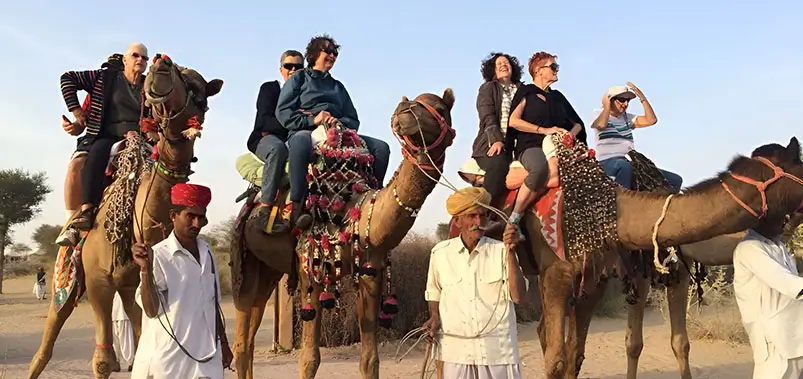
From Jodhpur, the road heads west across open desert to Jaisalmer, a drive of about five hours. This is where the trip changes mood. Jaisalmer is a golden sandstone city with a living fort, still home to several thousand residents, and a set of richly carved merchant mansions known as the Patwon mansions, a short walk below the walls. We suggest three nights here, ideally split between a hotel near the town and a luxury desert camp. The camp night is the highlight for many guests, with a camel ride or jeep drive into the dunes, a private dinner under the stars and a sky that is genuinely dark. Jaisalmer is also the point of the trip furthest from any big city, so the silence and space feel very different from Jaipur's traffic.
From Jaisalmer, the return journey is long, so we break it. A drive of about five and a half hours brings you back towards Jodhpur, where a night at a countryside heritage hotel such as Rohet Garh, a short distance south of the city, avoids an exhausting day. The next morning, you continue about two and a half hours to Narlai or Ranakpur for one night, visiting the Jain temples in the afternoon, before reaching Udaipur the following morning for three final nights.
That gives three nights in Jaipur, two in Jodhpur, three in Jaisalmer and its dunes, one near Jodhpur, one near Ranakpur and three in Udaipur, which adds up to thirteen nights. If Jaisalmer's seasonal flights are operating, you can cut the return drive by flying from Jaisalmer to Delhi and connecting onward, but schedules are limited and we never build a trip that depends on them.
What gets left out is still meaningful. A fourteen-day route with the desert usually means no Ranthambore, because the park lies on the other side of the state. Guests who want both tigers and dunes in two weeks can do it by dropping the Ranakpur night and one Udaipur night, but the trip becomes noticeably faster. The Shekhawati painted towns, Bikaner, Bundi and Chittorgarh also remain out of reach. Our honest advice is to choose the desert or the tiger for a two-week trip, and save the other for a return visit or a three-week journey. Travelled this way, the Rajasthan desert tour gives you the full sweep of royal cities, open sand and lakeside calm without a single day that feels rushed.
Twenty-One Days: The Full Circle From Shekhawati to the Southern Forts
Three weeks is the length that lets you see almost the whole of Rajasthan without a sense of hurry. The 21 day Rajasthan tour we put together for guests with time to spare runs on twenty nights and makes a complete circle, starting in the north, sweeping out to the desert, curving down to the lakes and returning through the forts and forests of the south-east.
From Delhi, the first drive is about five to six hours north-west into Shekhawati, the region of painted merchant mansions around Mandawa and Nawalgarh. Two nights at a heritage hotel such as Alsisar Mahal give you a full day to walk through towns where almost every wall is covered in old frescoes. From there, the road runs about three and a half hours west to Bikaner for one night, with the red sandstone Junagarh Fort and the camel research farm on the edge of town.
The next drive, roughly five and a half to six hours, takes you to Jaisalmer for three nights, again split between the town and a desert camp. You then drive about five hours back east to Jodhpur for two nights, and continue south to a countryside heritage stay near Narlai or Ranakpur for one night, before arriving in Udaipur for three nights of lakeside calm.
Instead of flying home from Udaipur, the three-week route keeps going east. A drive of about two hours brings you to Chittorgarh, the largest fort in Rajasthan, which takes a good three hours to see with a guide. We often add a night at a heritage castle in the countryside near Chittorgarh, then continue the next day to Bundi, a small, unspoilt town of stepwells and painted palace rooms, about three hours away. Bundi has no five-star hotel, so this is one night in a small, comfortable heritage guesthouse, and it is often the night guests remember most fondly. From Bundi, the drive to Ranthambore is about three hours, and three nights there give you five or six jeep safaris and a very good chance of seeing a tiger. The final leg is around three and a half hours to Jaipur, where three nights let you finish the trip in a grand palace hotel before a short flight or drive back to Delhi.
That gives two nights in Shekhawati, one in Bikaner, three in Jaisalmer, two in Jodhpur, one near Ranakpur, three in Udaipur, one near Chittorgarh, one in Bundi, three in Ranthambore and three in Jaipur, for a total of twenty nights.
Even three weeks leaves something out. Mount Abu in the far south-west, Pushkar on its holy lake, the Kumbhalgarh fort walls if you do not make the day trip from Udaipur, and the bird reserve at Bharatpur near the Agra border are all possible swaps. The bigger point is that a three-week trip includes several smaller, simpler heritage hotels, which balance the grand palace stays and give you a far more personal view of rural Rajasthan. For repeat visitors and slow travellers, this is the most rewarding way to see the state.
Luxury Hotels on Each Route and What They Cost at Peak Season
Hotels shape a Rajasthan trip as much as the route itself, and each city has a few properties that deserve to be booked first. All the rates below are approximate for good room categories in the October to March high season, before taxes, and the most sought-after suites cost considerably more.
In Jaipur, Rambagh Palace, the former home of the city's royal family, typically runs from about ₹60,000 to more than ₹1,20,000 per night. The Oberoi Rajvilas, set in landscaped gardens with luxury tents and private pool villas, sits in a similar range of roughly ₹55,000 to ₹1,10,000. The Leela Palace Jaipur and SUJÁN Rajmahal Palace offer a grand stay from around ₹30,000 to ₹65,000, while Fairmont Jaipur, closer to Amber, runs from about ₹22,000 to ₹40,000.
In Udaipur, the two famous names are Taj Lake Palace, floating in the middle of Lake Pichola, at roughly ₹70,000 to ₹1,50,000, and The Oberoi Udaivilas, on the lake shore, at about ₹75,000 to ₹1,50,000 for premier lake-view rooms. The Leela Palace Udaipur runs from about ₹50,000 to ₹95,000, and Taj Fateh Prakash Palace inside the City Palace complex from about ₹40,000 to ₹70,000. RAAS Devigarh, a restored hilltop fort roughly forty-five minutes north of the city, offers a quieter, design-led stay from about ₹35,000 to ₹60,000.
In Jodhpur, Umaid Bhawan Palace, still partly home to the royal family, is the showpiece, with rooms typically from ₹70,000 to more than ₹1,50,000. RAAS Jodhpur, with direct views of Mehrangarh from its pool, runs from around ₹30,000 to ₹55,000.
In the desert, Suryagarh near Jaisalmer costs about ₹30,000 to ₹60,000 per night, while SUJÁN The Serai, a luxury tented camp, runs from roughly ₹70,000 to ₹1,10,000 with meals included. On the fourteen and twenty-one day routes, countryside stays such as Rohet Garh, Rawla Narlai, Narendra Bhawan in Bikaner and Alsisar Mahal in Shekhawati usually cost between ₹12,000 and ₹30,000, with Mihir Garh, a striking modern desert fort near Jodhpur, higher at around ₹30,000 to ₹50,000.
At Ranthambore, Aman-i-Khas, a small luxury tented camp, typically runs from ₹1,30,000 to ₹2,00,000 per night with meals, and SUJÁN Sher Bagh and The Oberoi Vanyavilas from about ₹60,000 to ₹1,20,000. Several of the wildlife and desert camps close during the summer and monsoon months, so dates matter.The order of hotels also matters. On a seven-day trip, two nights in the best room you can afford are worth more than six nights in good rooms. On longer routes, we usually mix grand palaces with smaller heritage hotels, which keeps the overall budget sensible and gives the journey rhythm. Booking lead times matter too. For Taj Lake Palace, Udaivilas, Rambagh and Aman-i-Khas in December, January and around Diwali, we recommend confirming four to six months ahead, and earlier for suites. If one key hotel is full, we often adjust the route direction rather than compromise on the stay that matters most to you.
Get Your Rajasthan Tour Quote
Get a personalized Rajasthan tour estimate based on your budget, travel dates, destinations, accommodation, and experiences.
What Each Trip Length Costs for Two on a Private Basis
Cost depends mainly on hotels, but the length of the trip and the vehicle make a big difference too. The figures below are rough totals for two people sharing, in peak season, at the higher end of luxury, including hotels, a dedicated car and chauffeur, private guides, monument fees, internal flights where needed, and safaris on the wildlife routes. International flights are excluded.
The chauffeur-driven car is the backbone of every private Rajasthan tour. A Toyota Innova Crysta with a professional chauffeur typically costs ₹4,500 to ₹6,000 per day including fuel, tolls and the driver's allowances. A Mercedes-Benz E-Class or similar luxury sedan costs roughly ₹18,000 to ₹25,000 per day across Rajasthan, partly because the car must often return empty from the last city. Licensed private guides charge around ₹5,000 to ₹8,000 for a full day, with senior specialist guides at the higher end. Monument fees for foreign visitors are modest, from about ₹500 at Amber Fort to around ₹800 at Mehrangarh with its audio guide, and they add only a few thousand rupees per person to any trip.
A seven-day luxury Rajasthan tour for two, with three nights at Rambagh or Rajvilas and three at Taj Lake Palace or Udaivilas, usually lands between ₹5,50,000 and ₹8,00,000, or roughly US$6,500 to US$9,500. The wildlife version with Aman-i-Khas can push it higher, close to ₹9,00,000 to ₹10,00,000.
A ten-day trip on nine nights, with three palace hotels and one countryside stop, typically costs between ₹8,00,000 and ₹12,00,000, or around US$9,500 to US$14,000. Upgrading the car to a Mercedes for the whole route adds roughly ₹1,50,000 to ₹2,00,000.
A 14 day luxury Rajasthan tour with the desert usually comes to between ₹12,00,000 and ₹18,00,000, or around US$14,000 to US$21,000. The desert camp night and the two countryside stops actually keep the average nightly rate a little lower than the shorter trips, even though the total rises with length.
A twenty-one-day circle on twenty nights, mixing palace hotels with simpler heritage stays and including three nights at Ranthambore with five or six private safaris, typically lands between ₹16,00,000 and ₹25,00,000, or roughly US$19,000 to US$30,000. Each private jeep safari for foreign guests, including permits, vehicle and naturalist, usually costs between ₹12,000 and ₹18,000.
Extras then shape the final figure. A hot air balloon flight over Jaipur costs about ₹15,000 to ₹20,000 per person. A private dinner on a fort rampart or lakeside terrace can run from ₹25,000 to well over ₹1,00,000 for two. A sunset boat on Lake Pichola is modest by comparison. Tips are the cost most guests forget: on a long trip, a chauffeur is usually tipped ₹1,000 to ₹1,500 per day and city guides ₹1,000 to ₹2,000 per day, which on a three-week trip easily adds ₹35,000 to ₹50,000. A comfortable five-star version of any route, using excellent but less famous hotels, typically costs around half of these figures.
Matching the Route Length to the Traveller and the Season
After many years of arranging Rajasthan journeys, we find that the right trip length depends as much on the traveller as on the map. First-time visitors combining Rajasthan with Delhi and Agra usually have seven to ten days for the state itself. For them, the seven-day Jaipur and Udaipur route is a polished introduction, and the ten-day royal circuit is the sweet spot if they can stretch the holiday. Honeymooners and anniversary couples often prefer fewer, grander stops, so a week with three nights at Rambagh and three on Lake Pichola suits them better than a longer, busier route.
Families with children are often happiest with a mix of palaces and wildlife. A seven or ten-day route with Ranthambore included keeps younger travellers engaged, and the shorter drives on the Jaipur and Ranthambore side of the state suit them better than the long desert roads. Photographers, by contrast, want the desert light of Jaisalmer, the blue lanes of Jodhpur and the morning mist over Udaipur's lakes, so the fourteen-day route is usually their minimum. Repeat visitors and slow travellers who have already seen Jaipur and Udaipur often choose the twenty-one-day circle, or a shorter route focused on Shekhawati, Bikaner, Bundi and Chittorgarh.
Season shapes every route. The best months are October to March, when days are warm and evenings cool. December and January bring cold desert nights, sometimes close to freezing in Jaisalmer, and occasional fog on the roads near Delhi. From April, heat builds quickly, and by May the desert can pass forty-five degrees, which makes long drives and dune camps uncomfortable. The monsoon from July to September brings green hills and full lakes to Udaipur, but some desert camps and wildlife lodges close, and Ranthambore's core zones close to visitors from roughly the start of July to the end of September.
Festivals are worth building around. The Pushkar camel fair in late October or November, the desert festival in Jaisalmer in February, and Holi in March all add colour, but they also raise hotel rates and fill rooms early. Diwali, Christmas and New Year are the busiest weeks of the year, when the best palace hotels can be full months in advance.
Booking lead times follow from all of this. For a seven or ten-day trip in the main season, four to six months ahead is comfortable. For fourteen or twenty-one days, especially with a desert camp, Ranthambore safaris and two or three famous palace hotels, we suggest six to nine months, because every part of the route depends on the others. Safari permits for Ranthambore open in advance and the best zones go first, so they are booked as soon as dates are confirmed.
Whatever length you choose, the same rules apply. Give each main city at least two nights, avoid more than two long drives in a row, place your most special hotel where you will have a full evening and morning, and let the season decide whether the desert or the tiger comes first. Arranged this way, a Rajasthan journey of any length feels generous rather than rushed.
Related Guides



 info@topindianholidays.net
 +91-8955000999