


 info@topindianholidays.net
 +91-8955000999

Hot Air Balloon Ride in Jaipur
Lift off as the sky turns orange and drift over villages, mustard fields and the Aravalli hills while Jaipur is still waking up.
View Experience ›Spend an evening in an old lakeside haveli watching swirling ghoomar skirts, pots balanced high on dancers’ heads, fire carried on the crown and a puppet show that has been entertaining Rajasthani villages for centuries.
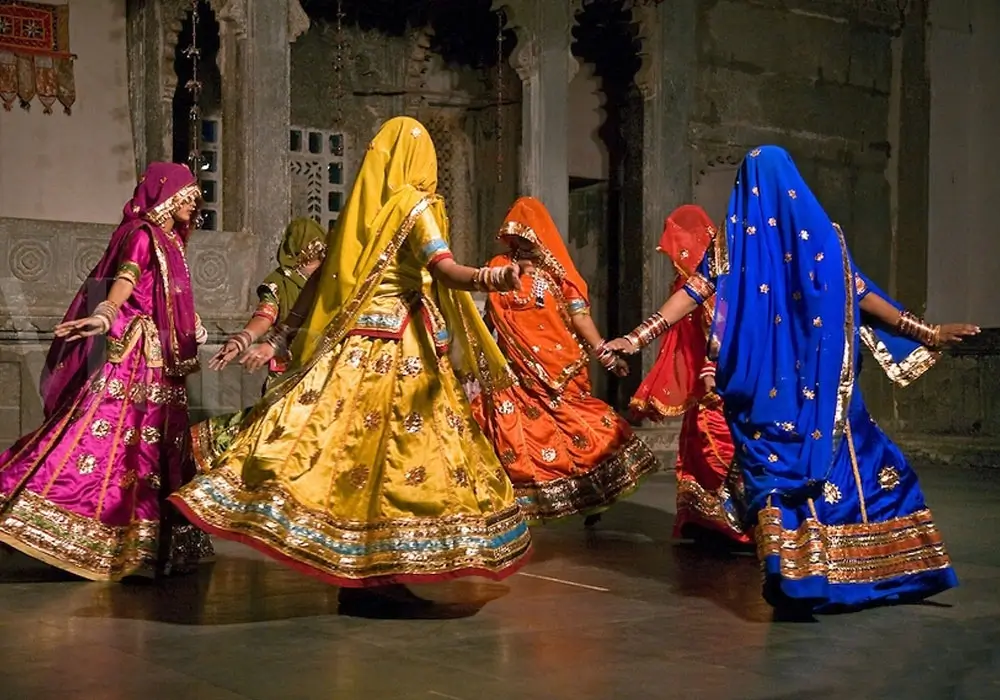
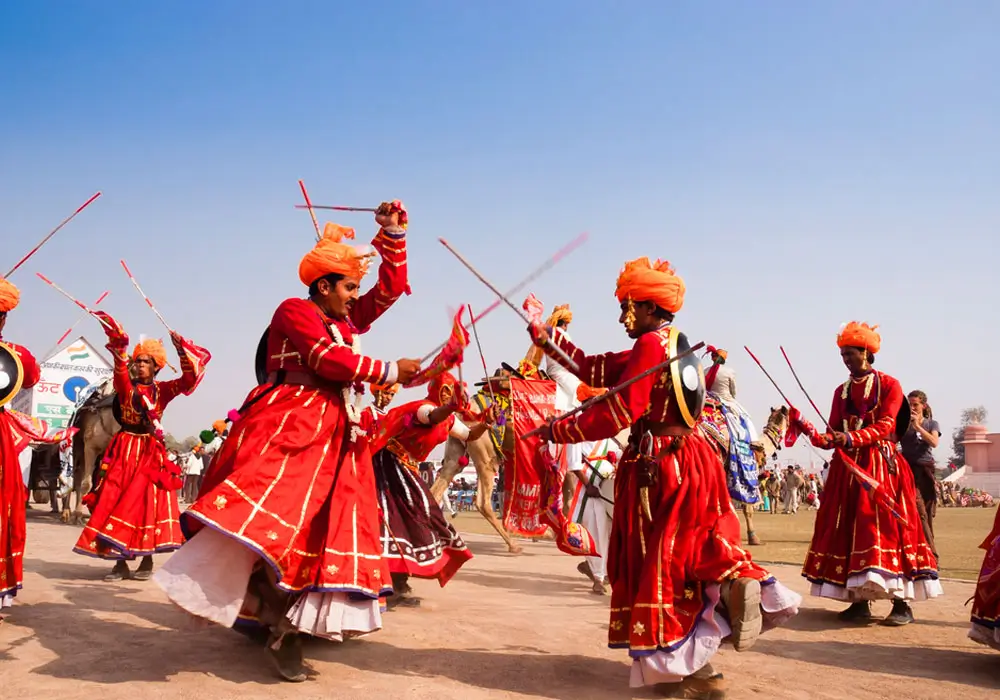
Rajasthan has always danced. Before cinema and television reached the villages, entertainment came from travelling performers: musicians who sang the ballads of local heroes, puppeteers who carried their stage on a camel, women who danced at weddings and festivals, and acrobatic dancers who balanced pots and swords while the crowd held its breath. Many of these traditions belong to specific communities, each with its own songs, costumes and steps, passed down within families. A Rajasthani folk dance show in Udaipur brings several of them together on one stage, in one evening.
The best-known show in the city takes place every evening at Bagore ki Haveli, an eighteenth-century mansion on the edge of Lake Pichola at Gangaur Ghat. The haveli was built by a prime minister of the Mewar court and is now run as a museum by day. In the evening its courtyard becomes an open-air stage, and the long-running performance, widely known as the Dharohar show, has been part of Udaipur’s evening life for many years. It is a public show with tickets sold at the door, not a private event, and we arrange the evening around it rather than claiming any special access.
For about an hour you sit around the courtyard as dancers, musicians and a puppeteer take turns. The programme usually includes ghoomar, the graceful whirling dance of Rajasthan; chari, where dancers carry brass pots with flames on their heads; bhavai, in which a single dancer balances a towering stack of pots; terah taali, a seated dance using thirteen small cymbals; kalbeliya, the snake-like dance of a nomadic community; and a kathputli puppet show that has children and adults laughing in equal measure.
It is one of the easiest and best-value evenings in Udaipur. It needs no fitness, suits every age and fits neatly after a sunset boat ride on Lake Pichola or before a food walk through the old city.
1. Pickup from your hotel
Your private driver collects you from your hotel in the early evening. Gangaur Ghat sits in the old city, where the lanes around the lake are narrow and busy, so the car drops you at the nearest practical point and you walk the last few minutes. If you are staying at a lakeside hotel in the old city, you may be close enough to walk the whole way.
2. A walk to Gangaur Ghat
The short walk takes you past small shops, cafés and temples down to the ghat, the stone steps leading into Lake Pichola. In the early evening the ghat is busy with families, people feeding pigeons, couples taking photographs and the arched footbridge of Chandpole lit up nearby. It is a pleasant place to pause before the show.
3. Tickets at the haveli
Tickets are sold at the haveli entrance before the show, and the counter usually opens a while before the performance begins. There is normally a separate charge if you want to use a camera. Our team or your guide can explain the current arrangements, but this is a public ticketed show, so the haveli sets its own prices and rules.
4. Choosing your seat
The courtyard has seating on low steps, benches and cushions arranged around the performance space. It fills up quickly in the busy season, so arriving early really matters. The best seats are in the front rows facing the centre of the courtyard, where you see the dancers’ faces and footwork clearly. The show usually begins around 7 pm, but timings can change around festivals, so we confirm on the day.
5. The music begins
The evening opens with the musicians settling in at the side of the courtyard. Expect the dholak, a two-headed hand drum, a harmonium, and singers whose voices carry across the courtyard without much need for amplification. Their songs set the scene before the first dancers appear.
6. The dances, one after another
Through the hour, the programme moves through a sequence of dances from different parts of Rajasthan. Each is short, colourful and very different from the last, so the energy never drops. Between items a presenter usually introduces the dance and the community it comes from, often in both Hindi and English.
7. The puppet show
At some point in the evening a puppeteer takes over with kathputli, the string puppets of Rajasthan. The puppets dance, fight, ride horses and play tricks on each other, and the squeaky voice of the puppeteer, made with a small reed held in the mouth, has the audience in fits of laughter.
8. The finale
The show traditionally builds to its most dramatic moments, with a bhavai dancer balancing a tall stack of pots while dancing on difficult surfaces. The applause at the end is genuine and loud.
9. Dinner or the walk back
After the show, the lanes around Gangaur Ghat are full of rooftop restaurants with lake views. Your driver can meet you at the agreed point and take you on to dinner or back to your hotel.
Ghoomar. The signature dance of Rajasthan. Women in long, heavy, gathered skirts called ghagras spin slowly in circles, so the hem flares out in a wide, swirling disc of colour. Faces are partly covered with a veil, and the movements of the hands and wrists are as important as the turns. Ghoomar is linked to the Bhil community and was later adopted by the Rajput royal courts, and it is still danced at weddings and festivals across the state, especially during Teej and Gangaur.
Chari. A dance associated with the area around Ajmer and Kishangarh and with the Gujjar community. Dancers balance brass pots, or charis, on their heads, and a small flame burns in each pot, often from oil-soaked cotton seeds. The dance celebrates the women who walked long distances to fetch water. With the lights dimmed, the moving flames make one of the most striking moments of the evening.
Bhavai. The highlight for many guests. A dancer balances a stack of earthen or brass pots on her head, sometimes seven or more, while dancing, turning and stepping onto difficult surfaces such as the rim of a brass plate, the edge of a sword or broken glass. The control involved is remarkable, and the audience usually falls completely silent as each pot is added.
Terah taali. Literally “thirteen cymbals”. The dancers, traditionally women of the Kamad community, sit on the floor with small metal cymbals, called manjiras, tied to their wrists, elbows, ankles and legs. They strike them in quick, complicated rhythms with another cymbal held in the hand, sometimes while holding a sword in the mouth or a pot on the head. It is a devotional dance traditionally performed in honour of the folk deity Baba Ramdev.
Kalbeliya. The dance of the Kalbeliya community, once snake charmers who travelled the desert. Women in black skirts embroidered with silver and coloured thread move with fast, flowing, snake-like twists and spins to the music of the been, a wind instrument. Kalbeliya songs and dances were added to UNESCO’s list of the Intangible Cultural Heritage of Humanity in 2010.
Gavri and other dances. The programme may also include short pieces drawn from the dance-dramas of the Bhil community of southern Rajasthan, or other folk forms. The exact line-up changes from night to night and season to season.
Kathputli puppets. Not a dance, but always a favourite. The puppets are carved from wood, dressed in bright fabric and worked with strings by a single puppeteer. Traditional stories include tales of the Rajput hero Amar Singh Rathore, but the evening show usually focuses on comic routines: dancing puppets, a juggler, a snake charmer and a horse rider.
The order and selection of dances varies, so take this as a guide to what is typical rather than a fixed programme.
These are community traditions. Most Rajasthani folk dances developed within particular communities, often tied to their work, their gods and their festivals. Terah taali is devotional, chari honours the hard labour of fetching water, kalbeliya grew from a nomadic way of life. Knowing this turns the show from a pretty spectacle into something with meaning.
Women lead much of the evening. Many of the dances are performed by women and were traditionally danced by women for women at weddings and festivals. The strength and balance needed for bhavai and chari are considerable.
Music carries the story. Many songs are in Rajasthani dialects rather than standard Hindi. They describe love and separation, the arrival of the monsoon, the bravery of local heroes and the work of village life. If your guide is with you, ask them to explain one or two.
Costume tells you where a dance comes from. The black and silver of kalbeliya, the heavy bright ghagras of ghoomar and the jewellery worn by the dancers all point to particular regions and communities. Look at the bangles, nose rings and anklets as well as the skirts.
The show runs every evening through most of the year, so you can usually choose any night of your stay.
October to March. The most comfortable and popular time to visit Udaipur. Evenings in the open courtyard are pleasant, and from December to February they can be cool enough for a light jacket. This is also when the show is busiest, so arrive well before the start.
April to June. Udaipur is hot during the day, but evenings in the courtyard are bearable and the crowds are thinner. Carry water and wear light cotton.
July to September. During the monsoon the lakes fill up and the hills around Udaipur turn green. Because the show is in an open courtyard, heavy rain can disrupt it, so we keep an eye on the forecast and suggest a backup evening if you have one.
Festivals. Around Gangaur in spring and Diwali in autumn, Udaipur is particularly lively, and timings can shift. We check the current schedule for your dates.
On the day. Aim to reach the haveli at least 30 to 45 minutes before the show starts in the busy season. In quieter months, a shorter margin is usually fine.
Udaipur. The haveli setting by Lake Pichola gives the show its atmosphere. You are in a real eighteenth-century courtyard, a few steps from the water, in the heart of the old city. For most travellers, this is the Rajasthani folk dance show to see.
Jaipur. In Jaipur, folk dance is usually seen at evening cultural programmes in heritage hotels, village-themed dinner venues on the edge of the city or at private performances we arrange with local troupes. These can include many of the same dances, often combined with a Rajasthani dinner. They suit travellers whose tour does not include Udaipur, or who want to see folk dance in a more relaxed dinner setting.
If your tour includes both cities, we usually suggest the Udaipur show and a different evening activity in Jaipur, such as a Jaipur night food walk or a royal dinner with a noble family.
Start with the lake at sunset. The perfect Udaipur evening begins with a Lake Pichola sunset boat ride, then a short walk or drive to Gangaur Ghat for the show. Time it carefully: sunset and show times shift through the year, and we plan the gap so you are not rushing.
Follow with food. Add an Udaipur food walk on another evening, or finish the show with dinner at one of the rooftop restaurants near the ghat.
Visit the haveli by day too. Bagore ki Haveli is also a museum, with restored rooms, painted walls and displays of costumes and puppets. Seeing it in daylight gives you a better sense of the building you sit in at night.
Two nights in Udaipur. With two nights, you can see the show on one evening and keep the other for a boat ride, a miniature painting class or a ropeway ride to Karni Mata hill.
Combine with a craft or village day. Seeing the dances first and then meeting rural communities on a Rajasthan village jeep safari helps you connect the performance with the life it comes from.
Bring and wear - Comfortable shoes for the old city lanes and ghat steps - A light jacket or shawl from December to February - Cash for tickets, the camera charge and small purchases - Phone or camera with the flash turned off - A small cushion or folded scarf if you prefer softer seating - Mosquito repellent near the lake
Leave behind - Tripods and large camera bags - Heels for the uneven lanes - Flash photography - A tight schedule, so you can arrive early
Tell us your Udaipur dates and we will plan the evening around the show, the lake at sunset and dinner by Gangaur Ghat.
Call & WhatsApp +91-9828085426 or email info@topindianholidays.net.
See more ideas on our Top Experiences in India page.
Tell us your travel dates and we will check availability and fit this experience into the right day of your itinerary. Reply within 12 hours.
Check Availability› Chat on WhatsApp› Send an Enquiry›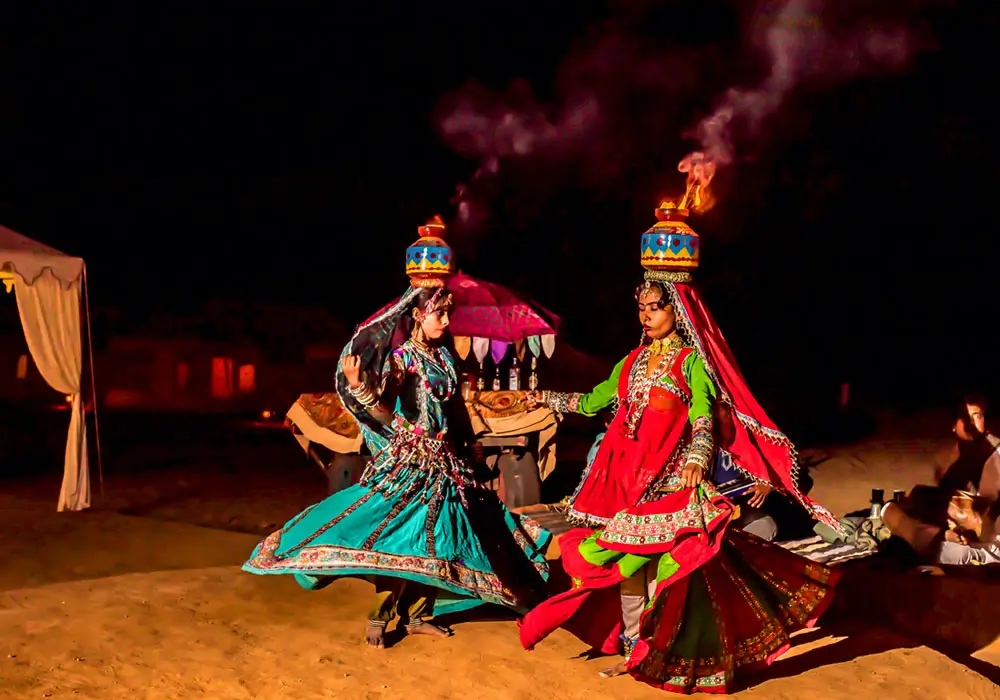



 🌙 12 Nights / 13 Days
Kolkata - Bhubaneswar - Puri... Kolkata - Bhubaneswar - Puri - Konark - Kolkata Show More
 🌙 14 Nights / 15 Days
Delwara - Narlai - Raipur... Delwara - Narlai - Raipur - Jodhpur - Nimaj - Jaipur - Delhi Show More
 🌙 05 Nights / 06 Days
⭐ Most Popular
Kolkata - Darjeeling - Kolkata Kolkata - Darjeeling - Kolkata Show More
 🌙 13 nights / 14 days
Delhi - Agra - Jaipur... Delhi - Agra - Jaipur - Jodhpur - Udaipur - Pushkar - Delhi Show More
Many older guests enjoy the show. The final approach is on foot through narrow lanes with some steps, and seating is on benches or low steps. Tell us about any mobility needs and we will plan the closest drop-off.
Comfortable shoes for the old city lanes and ghat steps, and light cotton clothes. From December to February, bring a light jacket or shawl, as evenings in the courtyard can be cool.
Yes, it is the classic Udaipur evening. Take a sunset boat ride first, then head to Gangaur Ghat for the show. We plan the timing around sunset and the show start so you are not rushed.
The show runs through most of the year, but it is held in an open courtyard, so heavy rain can disrupt it. If you visit in July to September, we suggest keeping a second evening free as a backup.
Yes. In Jaipur, folk dance is usually seen at heritage hotel programmes, village-style dinner venues or a private performance we arrange with local performers. It suits tours that do not include Udaipur.
Front rows facing the centre of the courtyard give the best view of the dancers’ footwork and faces. Seats fill quickly from October to March, so arrive 30 to 45 minutes early.
Photography is usually allowed if you pay the camera charge. Turn off your flash, especially during the balancing and fire dances, and stay in your seat while shooting.
Yes. Children usually love the puppet show and the pot-balancing dances. The show is short enough to hold their attention, and the evening timing works for most families.
For most travellers, yes. It brings several Rajasthani dance traditions together in one hour, in a real historic courtyard by the lake, and it is easy to combine with a sunset boat ride and dinner.
The programme usually includes ghoomar, chari with flaming pots, bhavai with stacked pots, terah taali with thirteen cymbals, kalbeliya and a kathputli puppet show. The exact line-up changes, so treat this as a guide.
Most visitors buy tickets at the haveli before the show. Seating is unreserved, so getting there early matters more than having a ticket in hand. We advise you on the current arrangements for your dates.
Tickets are sold at the haveli, which sets its own prices, and there is normally a separate camera charge. Prices can change, so we tell you the current rate when we plan your evening.
It takes place in the courtyard of Bagore ki Haveli at Gangaur Ghat, on the edge of Lake Pichola in the old city. Your driver drops you as close as possible and you walk the last few minutes.
The show at Bagore ki Haveli usually starts around 7 pm and runs for roughly an hour. Timings can shift around festivals, so we confirm on the day. Plan to arrive well before the start in the busy season.

Whether you're planning your first India trip or returning to explore deeper, get honest, expert advice from someone who knows every corner of this country. No pressure, no cost.