


 info@topindianholidays.net
 +91-8955000999

Hot Air Balloon Ride in Jaipur
Lift off as the sky turns orange and drift over villages, mustard fields and the Aravalli hills while Jaipur is still waking up.
View Experience ›As the bazaars light up and temple bells ring for evening aarti, follow your guide from one sizzling kadhai to the next through the old walled city.
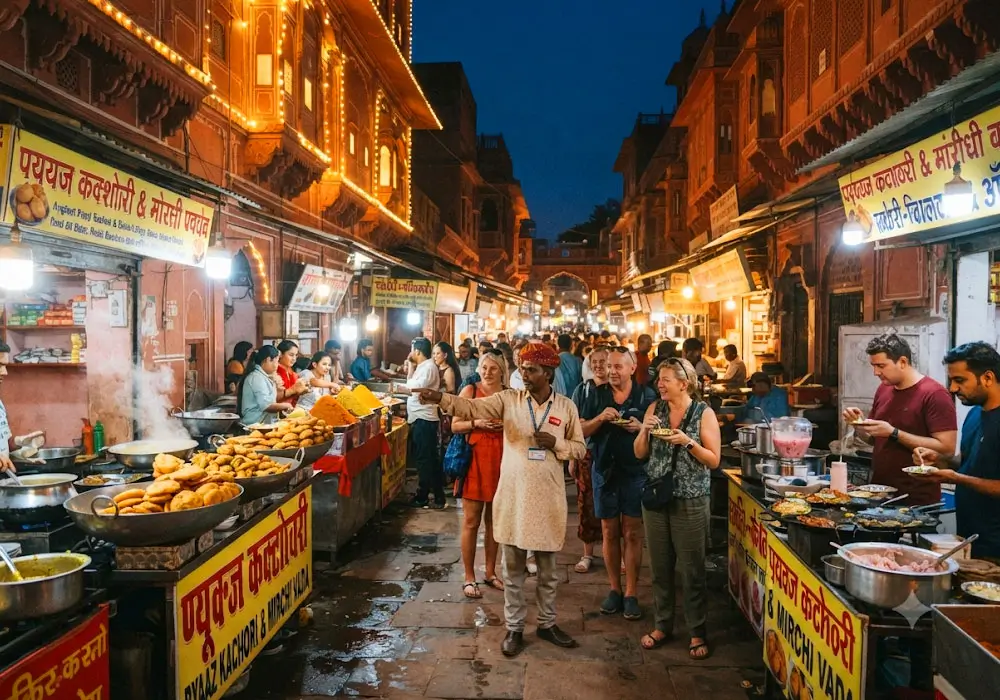
By day, Jaipur’s old city is about monuments: the Hawa Mahal’s honeycomb façade, the courtyards of the City Palace, the giant instruments of Jantar Mantar. As the sun drops, the same streets change character. Shop shutters stay up but the pace shifts, families come out after work, the arcades along the bazaars glow with strings of bulbs, and the smell of hot ghee and frying spices drifts across the road. This is when the city eats, and it is the best time to join it.
A Jaipur food walk after dark takes you into that evening routine. With a private guide who knows the lanes and the cooks, you move on foot through the bazaars of the walled city, stopping at the kind of counters where locals queue: a kachori fryer who has been at the same spot for decades, a sweet shop with trays of rabri thickening on the stove, a lassi counter where the curd is set in clay pots. Between bites, your guide explains what you are eating, how it is made and why Rajasthan cooks the way it does.
Rajasthan’s food was shaped by the desert. Fresh vegetables were scarce, so cooks relied on lentils, gram flour, dried beans, ghee, milk and spice. The results are rich, filling and very often vegetarian. Jaipur is one of the easiest cities in India for vegetarian travellers, and many guests are surprised to find that they do not miss meat at all.
We are also honest about the obvious question: is street food safe? With the right choices, yes, for most people. This page explains how we choose stops, what we avoid, and how to pace yourself, along with the dishes you are likely to try and how to fit the walk into your days in Jaipur.
1. Pickup from your hotel
Your driver collects you from your hotel in the late afternoon or early evening, timed so that you reach the old city as the light softens. Most hotels in Jaipur are outside the walls, so the drive gives you a first view of the pink gates and the old city ramparts.
2. Meeting your guide at a city gate
You meet your guide near one of the old city gates or a central landmark. Your driver parks nearby and stays on call. From here you go on foot, because the lanes are narrow, parking is impossible and walking is the whole point. Before you start, your guide asks about allergies, spice tolerance, diet and anything you would rather avoid, and plans the route around your answers.
3. Something savoury to begin
The first stop is usually fried and freshly made: a pyaaz kachori straight out of the oil, or a mirchi vada, a long green chilli stuffed with spiced potato and coated in gram flour batter. These are the classic Jaipur snacks, and the best are eaten within a minute or two of leaving the kadhai. Your guide will order small portions and share plates so that you have room for later.
4. A walk through the lit bazaars
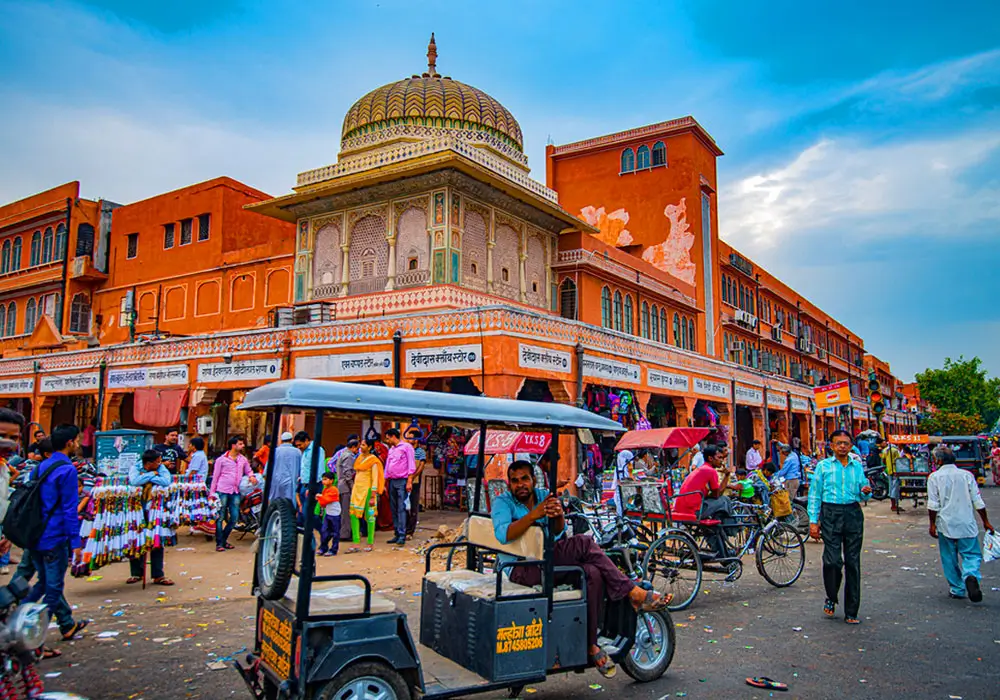
Between stops you walk. The main bazaars of the old city are laid out on a grid, with long arcaded streets specialising in different trades: textiles in one stretch, metal pots in another, bangles and silver in another. In the evening the arcades are lit, the traffic thins a little, and you can see into workshops and sweet shops that are often still busy. Your guide points out buildings, temples and old havelis as you go.
5. Evening aarti at a temple
Depending on your route and the time, you may pass a neighbourhood temple during evening aarti, when bells ring, lamps are waved before the deity and local families gather. Your guide will explain what is happening, and you can watch quietly from the side or the doorway. It is a moment of calm in the middle of the evening’s eating.
6. Chaat and something tangy
Chaat is a family of snacks built on contrasts: crisp, soft, sweet, sour and spicy all at once. Your guide may choose a stall serving aloo tikki, dahi bhalla or a plate of mixed chaat with tamarind and mint chutneys. We are careful here, because chaat often involves raw garnishes and water, and we choose stops accordingly.
7. Lassi, kulfi and rabri
Then come the cooling things. A thick sweet lassi topped with malai, served in a clay cup; kulfi, the dense Indian frozen dessert, sliced from a cone-shaped mould; and rabri, milk simmered slowly until it thickens and is layered with sweetened cream. Jaipur takes its milk sweets seriously, and this part of the walk is often the favourite.
8. A sit-down plate of dal baati churma
If you have room, the walk can end with a proper taste of Rajasthan’s signature dish at a simple restaurant: dal baati churma. Baati are hard wheat dumplings baked until crisp, broken open and drenched in ghee, eaten with spiced lentils and churma, a sweet crumble of wheat, ghee and sugar. It is heavy, so a shared plate is usually enough.
9. Back to your hotel
Your driver meets you near the last stop and brings you back to your hotel. Most guests are happily full and ready for bed.
The exact menu depends on the season, the day, what is fresh and what you like. These are the dishes you are most likely to meet.
Pyaaz kachori. Jaipur’s best-known snack. A flaky, deep-fried pastry filled with onions cooked down with spices, sometimes with a little potato. It is eaten hot, often with a tamarind or mint chutney, and locals eat it for breakfast as readily as in the evening.
Mirchi vada. A large, mild green chilli slit open, stuffed with spiced potato, dipped in gram flour batter and fried. Despite the name, it is usually not very hot, as the chillies used are mild. Ask your guide to choose a mild one if you are nervous.
Chaat. A catch-all for tangy street snacks. You may try aloo tikki (spiced potato patties), dahi bhalla (lentil dumplings soaked in yoghurt), or papdi chaat (crisp wafers with chickpeas, potato, yoghurt and chutneys). Each stall has its own balance of sweet and sour.
Lassi. A yoghurt drink churned with sugar, sometimes flavoured with saffron or cardamom and topped with a thick layer of cream. In Jaipur it is often served in a kulhad, a small unglazed clay cup that is thrown away after use.
Kulfi. Milk reduced for a long time, flavoured with cardamom, pistachio, saffron or mango, then frozen in moulds. It is denser and creamier than ice cream and melts slowly.
Rabri. Thickened sweetened milk with layers of skimmed cream, served cold in small bowls or with hot jalebi. One of the richest things you will eat in Rajasthan.
Ghewar. A disc-shaped sweet made from batter poured into hot ghee, forming a lacy honeycomb, then soaked in syrup and often topped with rabri and nuts. Ghewar is seasonal: it is made mainly around the monsoon festivals of Teej and Raksha Bandhan, roughly July and August. If you visit at that time, sweet shops are piled high with it. In the cooler months you may not find it, and we would rather tell you that than promise it.
Dal baati churma. The dish that most Rajasthanis would name first. Hard baked dumplings, ghee, spiced dal and a sweet crumble on the side. You break the baati with your fingers, pour dal over it and mix in the churma as you go.
Other possibilities. Depending on the night: samosas, kalmi vada (a crisp lentil fritter), moong dal halwa in winter, fresh jalebi fried in spirals, masala chai, or a paan to finish for the brave.
Jaipur is one of the easiest cities in India to eat well as a vegetarian. Much of Rajasthan’s traditional cooking is meat-free, and a large part of the city’s population is vegetarian, including many shopkeepers and sweet makers in the old city. Most of the stops on a typical food walk are entirely vegetarian, and many are run by families who would not cook meat on the premises.
Vegans need a little more care, because milk, ghee, curd and cream appear in a great many dishes. Tell us in advance and your guide will steer the route towards fried snacks, chaat without yoghurt and other options cooked in oil rather than ghee. We will also tell you honestly where it is difficult, such as with sweets.
If you would like to try Rajasthani meat dishes, such as laal maas, a fiery mutton curry, your guide can suggest a restaurant for another night. The street food walk itself stays mainly vegetarian, which reflects how the old city actually eats.
For those with allergies, tell us before the walk. Peanuts, cashews, gluten and dairy are common in Rajasthani cooking, and stall cooks may not always know every ingredient. We will be honest if we cannot guarantee that a dish is safe for you.
Many travellers want to eat street food in India and are also nervous about getting ill. Both feelings are reasonable. Here is how we approach it.
We choose busy, high-turnover stalls. A counter with a steady queue of locals is turning over its food quickly, which means fresh batches and less time sitting out.
Hot and freshly cooked comes first. Most of the savoury stops are fried or cooked in front of you at high temperatures, which is the safest kind of street food.
We are careful with water and raw garnishes. Pani puri, where crisp shells are filled with flavoured water, is the snack most likely to upset a visitor’s stomach. We generally skip it or suggest it only where we are confident of the water. We also ask for chaat without raw onion or coriander if you prefer.
Dairy from trusted shops. Lassi, kulfi and rabri come from established sweet shops with high turnover, not from carts where we do not know how the milk has been stored.
Portions stay small. The commonest problem on a food walk is not bad food but too much rich food in one evening. Small shared plates help.
Bottled water and hand sanitiser. Your guide carries both, and you can wash your hands where facilities exist.
Even with care, nobody can promise that a sensitive stomach will never react to new spices or ghee. If you have a medical condition, are pregnant or are simply anxious, tell us and we can shape the evening around cooked dishes and sit-down stops, or suggest a cooking class in Jaipur, where you see every ingredient go into the pot.
Part of the pleasure of this walk is simply being in the walled city after dark. Jaipur’s old city was planned in the eighteenth century on a grid, with wide main bazaars crossed by smaller lanes, and the evening shows it at its most lived-in.
Lights in the arcades. The covered walkways along the main bazaars are lit with bulbs and tube lights, and in festival seasons such as Diwali the whole city is hung with lights and the markets are crowded until late.
Temple bells and aarti. Small temples are tucked into the bazaars, some on rooftops above the shops. At dusk you hear bells and the sound of devotional songs, and see lamps being lit.
Sweet shops at work. Big iron pans of milk simmer on the stove, cooks pour jalebi batter in spirals, and trays of sweets are stacked in glass cabinets under bright lights.
Rooftops and gates. The pink-washed gates of the city look especially fine lit up at night, and your guide may suggest a spot where you can stand back and see one properly.
Daily life. Men playing cards on a step, children doing homework in a shop doorway, cows wandering past, motorbikes weaving through. You are walking through people’s neighbourhood, not a theme park, which is exactly why it is worth seeing.
October to March. The best season. Evenings are cool and comfortable for walking, and in December and January they can be genuinely cold, which makes hot kachori and chai even better. Winter is also the season for gajar halwa, moong dal halwa and other warming sweets.
April to June. Evenings stay hot, often very hot. A food walk is still possible after sunset, but we shorten it and include more sit-down stops in fans or air conditioning.
July to September. The monsoon brings humidity and occasional heavy showers. It is also ghewar season, around Teej and Raksha Bandhan, when the sweet shops are at their busiest. Carry an umbrella and expect some puddles.
Festivals. Diwali, usually in October or November, is the brightest time to be in the bazaars, though also the most crowded. Holi in spring and Teej in the monsoon bring their own festival foods. Tell us your dates and we will mention anything special happening.
Day of the week. Most stalls work every evening, though some shops close on a particular weekday. Your guide plans the route around the evening you choose.
Ask before you photograph people. Cooks, shopkeepers and customers are going about their evening. Most are happy to be photographed if asked, especially when you have just bought something from them, but always ask, and accept a no with a smile.
Eat with your right hand. If you eat with your fingers, use your right hand. Your guide will show you how to break a kachori or baati properly.
Temples. If you step into a temple, remove your shoes, dress modestly and keep your voice low. Watching aarti from the doorway is fine and welcome; just do not use flash or stand in front of worshippers.
Bargaining. Prices at food stalls are fixed and low, so there is no bargaining. Your guide usually pays as you go and the cost is part of the walk.
Leftovers and waste. Clay cups and leaf plates are used once. Your guide will show you where to dispose of them.
Cows and dogs. You will meet both. Give them space and do not feed them.
Make it your first or second evening. A food walk is a good introduction to Jaipur, and you can then return to places you liked on your own.
Pair it with a heritage walk by day. A morning Jaipur heritage walk through the same old city shows you the architecture and history in daylight. Returning to the same bazaars at night for the food walk feels completely different.
Keep dinner light or skip it. The walk replaces dinner. Plan a light lunch on the day.
Balance it with a cooking class. If you enjoy the flavours, a cooking class with a Jaipur family on another day teaches you to make some of the same dishes at home.
Add a tuk tuk ride. Some guests like to start the evening with a tuk tuk tour of Jaipur and then continue on foot for the food.
On a Golden Triangle tour. The walk fits into any Jaipur stay of two nights or more. If you are continuing to Udaipur, the Udaipur food walk makes a good comparison, showing the gentler Mewari side of Rajasthani food.
Bring and wear - Comfortable closed shoes for walking on uneven streets - Light layers, and a warm jacket from December to February - Modest clothing that covers shoulders and knees, for temple stops - Hand sanitiser and tissues - Any medication you normally carry for your stomach - An umbrella in the monsoon months - A small cross-body bag for your phone and camera
Leave behind - A big lunch on the same day - Valuables and large amounts of cash - High heels or flimsy sandals - Any expectation of a quiet street, because the bazaars are lively
Tell us your Jaipur dates, diet and how adventurous your group feels, and we will plan an evening food walk to suit you.
Call & WhatsApp +91-9828085426 or email info@topindianholidays.net.
See more ideas on our Top Experiences in India page.
Tell us your travel dates and we will check availability and fit this experience into the right day of your itinerary. Reply within 12 hours.
Check Availability› Chat on WhatsApp› Send an Enquiry›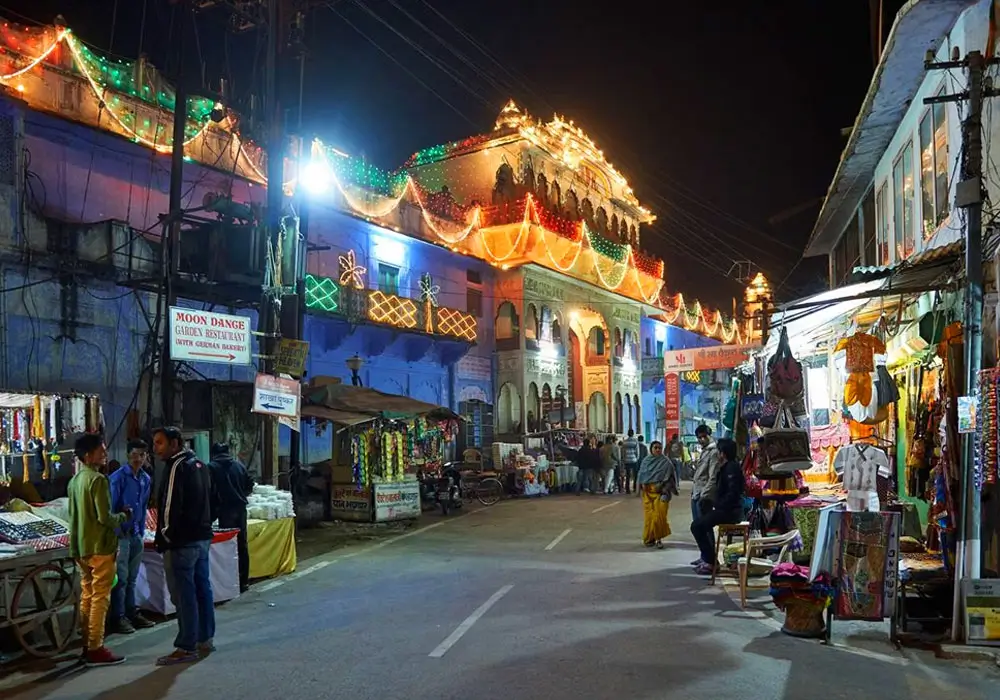



 🌙 01 Day
⭐ Most Popular
 🌙 01 Day
 🌙 05 Nights / 06 Days
Jaipur - Agra - Delhi Jaipur - Agra - Delhi Show More
 🌙 01 Day
The price depends on your group size and what you would like included. We quote a price covering your guide, the food on the route and transport from your hotel. Send us your dates and we will reply with the current price.
They complement each other. The food walk shows you how the city eats on the street, while a cooking class shows you how dishes are made at home. If you have the time, do both on different days.
October to March is the most comfortable, with cool evenings. Summer evenings are hot, and the monsoon is humid but brings ghewar season. Diwali is the most festive time, though also the busiest.
The main bazaars are busy and well lit in the evening, with families out shopping and eating. With your guide alongside and your driver waiting nearby, it is a comfortable walk. Keep valuables to a minimum, as you would in any crowded market.
Often, if the route and timing allow. Evening aarti at a neighbourhood temple, with bells and lamps, is a lovely pause between stops. You can watch quietly from the doorway, with shoes removed if you go inside.
Tell us in advance. Nuts, dairy and gluten appear in a lot of Rajasthani food, and street cooks may not always know every ingredient. We will be honest if we cannot guarantee a dish is safe for you.
Yes, many families enjoy it. Children usually love the sweets, the lights and the bustle. We keep portions small and avoid very spicy dishes for younger ones.
Ghewar is a seasonal sweet made mainly around Teej and Raksha Bandhan in the monsoon, roughly July and August. If you visit then, it is easy to find. In the cooler months it is less common, and your guide will suggest other sweets instead.
It usually starts in the early evening, around sunset, when the bazaars come alive and the temperature drops. We confirm the pickup time based on the season and your hotel.
Some dishes are, but many are milder than visitors expect. Your guide asks about your spice tolerance at the start and orders accordingly. The sweets and lassi are always there to cool things down.
Yes, very. Most of the food on a typical walk is vegetarian, and Jaipur is one of the easiest cities in India for vegetarian travellers. Vegans should tell us in advance, as many dishes use ghee, milk or yoghurt.
It runs through the evening, starting around dusk. The exact length depends on your appetite, your pace and how many stops you want. Plan it as your dinner for the night.
With careful choices, most travellers eat street food in Jaipur without any trouble. We pick busy stalls, favour hot freshly cooked food, and take care with water and raw garnishes. Nobody can promise a sensitive stomach will never react, so small portions and a sensible pace help.
Pyaaz kachori and mirchi vada are the city’s signature snacks, and the milk sweets, especially rabri, lassi and kulfi, are excellent. Dal baati churma is the best-known Rajasthani meal. On a food walk you taste a selection of these in one evening.

Whether you're planning your first India trip or returning to explore deeper, get honest, expert advice from someone who knows every corner of this country. No pressure, no cost.