


 info@topindianholidays.net
 +91-8955000999

Hot Air Balloon Ride in Jaipur
Lift off as the sky turns orange and drift over villages, mustard fields and the Aravalli hills while Jaipur is still waking up.
View Experience ›Lift off as the sky turns orange and drift over villages, mustard fields and the Aravalli hills while Jaipur is still waking up.
Most visitors see Jaipur from the ground: from the ramparts of Amber, a rooftop café in the old city, or the back seat of a car waiting behind a camel cart. From a balloon basket at dawn, the same landscape makes sense in a way it never does at street level. You see why the forts were built where they are, strung along the Aravalli ridge to watch the plains. You see how the city spills out of its old walls, and how quickly the suburbs give way to small farms, village ponds and dusty tracks lined with neem trees.
A hot air balloon ride in Jaipur is also one of the few quiet things you will do in Rajasthan. Between bursts of the burner there is almost no sound except what drifts up from below: dogs barking, a tractor starting, a temple bell, children shouting “balloon!” and running across the fields to follow you. For an hour or so, India moves at walking pace.
It works best as the opening act of a Jaipur day. You are back at your hotel in time for breakfast, and the rest of the day is still free for sightseeing.
1. Pickup in the dark
Your driver collects you from your hotel well before sunrise. Balloons cannot launch inside the city, so the take-off field is on the outskirts, chosen by the operator each morning depending on the wind. The roads are empty at this hour, which makes the drive quick and oddly peaceful.
2. Tea and the safety briefing
At the launch field the crew is already unloading the basket and envelope. The pilot gathers everyone for a briefing: where to stand, what to hold, how to keep hands inside the basket, and how to take the landing position. It is short but important, because a field landing can be bumpy and the landing position is what keeps it comfortable.
3. Watching the balloon come to life
This part surprises most people. The envelope is spread across the ground like an enormous sheet, then a large fan pushes cold air into it until it billows up. When the pilot fires the burner, the flame lights up the fabric from inside, glowing orange against the dark sky, and the balloon slowly rises upright. Have your camera ready.
4. Take-off
You climb into the basket, and with a few long blasts of the burner the balloon lifts off. There is no jolt and no sense of speed. The ground simply drops away, and within a minute you are looking down on the roofs of farmhouses.
5. The flight
The pilot controls height but not direction. To steer, they climb or descend to find layers of air moving in different directions, so you may skim low over a mustard field and then rise high enough to see the whole valley. The route is different every morning.
6. Landing in a farm field
As the flight ends, the pilot looks for a clear patch of open ground. A recovery vehicle has been following below the whole time. Once you take the landing position, the basket touches down, sometimes gently, sometimes with a small bump and a short slide. Almost always, villagers arrive within minutes, and the children are usually first.
7. Back to your hotel
While the crew packs the balloon away, your driver meets you at the landing spot and brings you back to your hotel for breakfast.
The flight is the headline, but the half hour after touchdown is often the part guests talk about at dinner. Balloons land wherever the wind and the pilot allow, which usually means a farmer’s field on the edge of a village that has no idea it is about to have visitors.
Getting out of the basket. Stay in the basket until the pilot tells you to climb out. The envelope is still partly inflated for a minute or two after landing, and the crew needs the weight inside to keep the basket steady while they take control of it. Once the pilot gives the word, you climb out the same way you climbed in, with crew members on hand to help.
Packing the balloon away. The crew lets the air out of the envelope, which slowly sinks across the field, then squeezes it along its length and rolls it into a large bag. It is hard work, done quickly, and many guests enjoy watching how much fabric goes into a bag that small. If the crew invites you to help hold or walk with part of the envelope, it makes a good photograph, but follow their lead rather than stepping in uninvited.
Meeting the villagers. Children usually arrive first, followed by curious parents and older men from the nearest houses. Smiles and a “namaste” go a long way. Ask before photographing anyone, especially women, and accept a polite shake of the head without fuss. Please do not hand out sweets, pens or money; it encourages children to chase vehicles and can cause friction in the village. Operators and farmers have their own arrangements for using the land, so there is nothing you need to settle yourself.
Respecting the field. You are standing on someone’s crop or grazing land. Walk along the edges of planted rows where you can, and keep to the track the recovery vehicle uses.
The drive back. The landing spot may be some distance from the take-off field, along narrow rural lanes. Your driver keeps in touch with the crew and finds you there, so you are not left waiting for a shared bus. Most guests are back at the hotel while breakfast is still being served.
People who are nervous about heights are often fine in a balloon, and there is a simple reason for it. Because the balloon moves with the wind rather than through it, you feel no breeze at all once you are airborne. The basket does not sway like a ride at a fair, and with no fixed edge below you to judge distance, the height feels less dizzying than standing on a tall building.
The one thing you will notice is heat. Each time the pilot fires the burner, a wave of warmth comes down on your head and shoulders. On a cold January morning this is welcome; it also explains why a cap is a good idea.
The basket walls come up to roughly waist height, and it is divided into sections so the weight stays balanced. You stand for the whole flight, though there is space to turn and look in every direction.
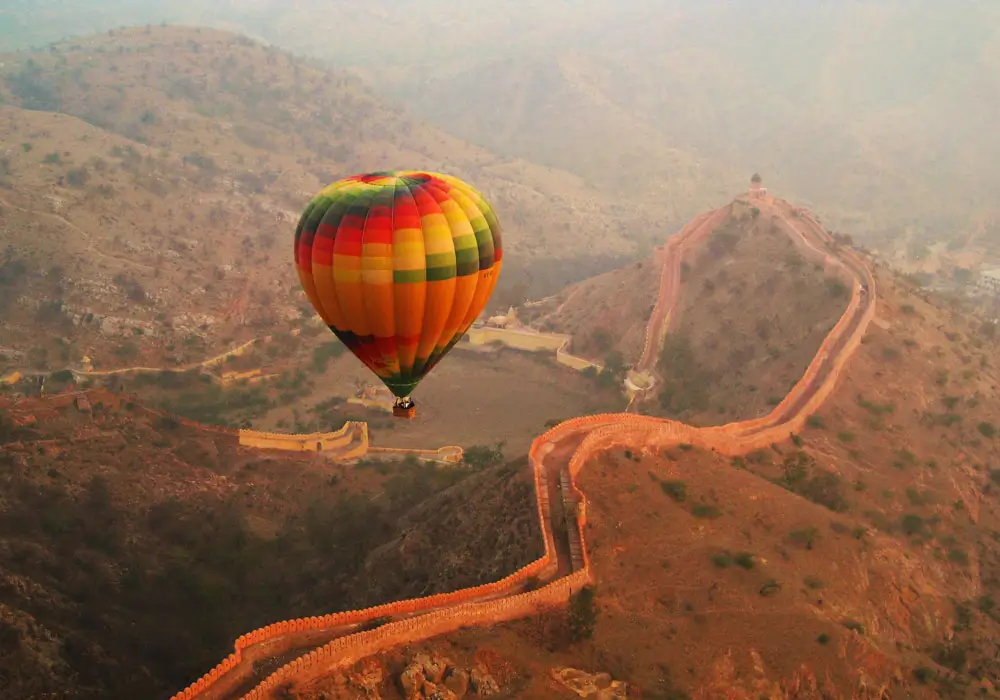
The forts on the ridge. Amber, Jaigarh and Nahargarh sit along the Aravalli hills north of the city. When the wind carries the balloon in their direction, you see the long walls snaking along the hilltops, something that is hard to take in from the ground.
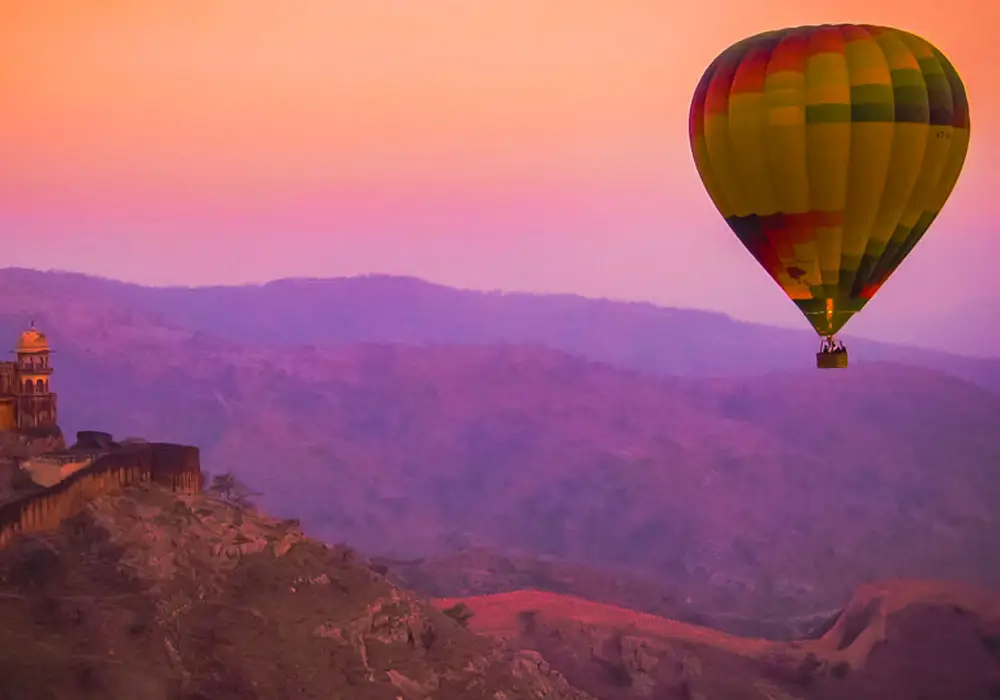
The Aravalli hills at first light. These are among the oldest mountain ranges in the world, worn down to low, rocky ridges. At sunrise they turn from grey to pink to gold.
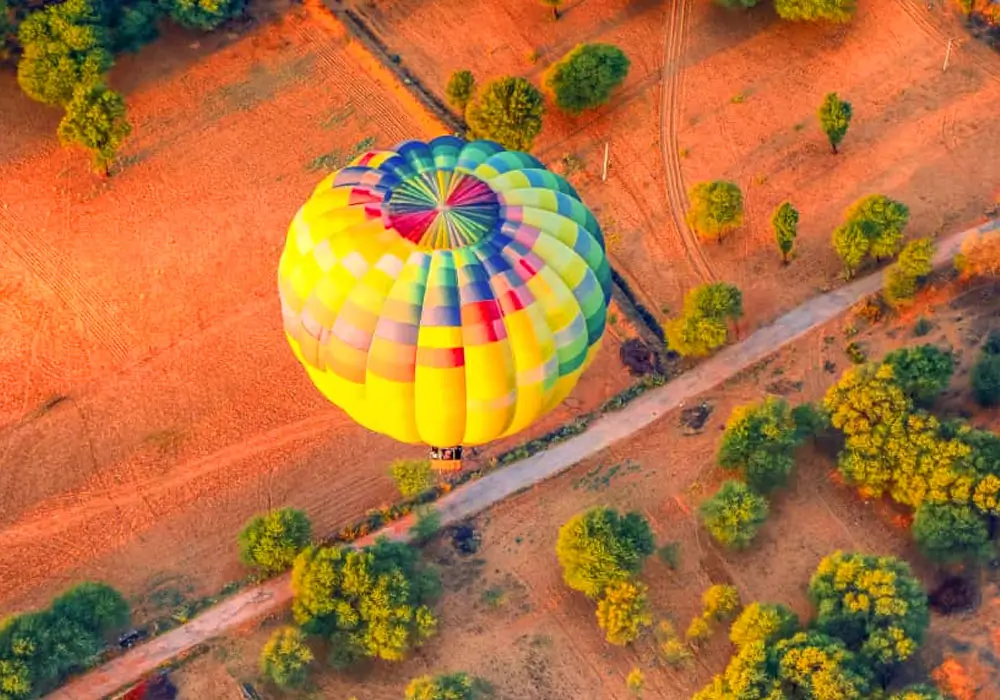
Farmland and mustard. In winter, fields of mustard flower bright yellow, broken up by wheat, vegetable plots and lines of trees. From above, the patchwork is very clear.
Village life starting up. Smoke from cooking fires, women carrying water pots, buffalo being led out, boys on bicycles on their way to school. This is the part many guests remember most.
Water and wells. Look for village ponds, step-wells and irrigation channels, which show how carefully water is managed in this dry state.
Because the balloon follows the wind, no two flights see exactly the same thing. We would rather tell you that honestly than promise a fort fly-past the weather may not allow.
Shared basket. This is the standard option. You fly with other guests, usually a mix of couples, families and friends from different countries. The atmosphere is relaxed and friendly, and it is the more affordable choice.
Private basket. A smaller basket reserved for just your group. It suits honeymooners, couples marking an anniversary, a proposal, or families who want the morning to themselves. It costs more and depends on availability, so it is worth asking early, especially for December and the Christmas and New Year weeks.
How to choose. If the view is what matters and you enjoy meeting other travellers, a shared basket is perfectly good, and the flight itself is the same. If you are celebrating something, travelling with young children who may need extra attention, or simply prefer not to share the moment, the private option is worth the extra cost.
A sunrise flight over the Aravalli hills is a popular way to mark something important, and with a little planning it can be done well.
Proposals. A private basket is the sensible choice, because you will not want an audience of strangers. Tell us in advance so we can let the operator know, and the pilot can pick a calm moment in the flight, usually once the sun is up and the light is good. Keep the ring in a zipped inside pocket rather than in a box in your hand. Remember the warning about anything dropped over the side.
Honeymoons and anniversaries. Many couples fly on their first morning in Jaipur and spend the rest of the day slowly, perhaps with a late breakfast on the hotel terrace and an afternoon at the City Palace. If you would like a small celebration after landing, ask us when you book and we will check what the operator can arrange on the day.
Birthdays and family milestones. A family flight works well for a significant birthday, especially when grandparents, parents and grown-up children are travelling together. Check the health notes in Good to Know first, so nobody is left on the ground at the last minute.
A word of honesty. The weather decides whether you fly. If a proposal or anniversary is tied to one particular morning, build in a backup plan, such as a sunset moment at Nahargarh Fort overlooking the city, in case the balloon cannot launch.
Balloons fly in Jaipur during the cooler months, roughly from October to March, when the early morning air is calm and stable. In the heat of summer and during the monsoon there are no flights.
October and November. The air is clear after the rains, the countryside is still green, and mornings are pleasant without being cold.
December to February. The peak season. Mornings are often crisp and clear, the mustard is in flower, and the light is soft. It is also the coldest time to fly, with dawn temperatures low enough that you will want a warm layer. Fog sometimes delays or cancels flights, particularly in late December and January.
March. Mornings are warming up and the fields are being harvested. Early March is still a good time to fly.
Every flight depends on the weather that morning. The pilot decides at the launch field, and a flight can be called off for wind even when the sky looks perfectly clear to you.
Pushkar flights. Balloons also fly in Pushkar, mainly around the season of the Pushkar Fair. You drift over the holy lake, the white temples and the sand dunes where the camel fair is held. If your tour is in Pushkar at that time, ask us whether a flight there suits your plans better.
Older children and teenagers usually love the balloon, and the early start rarely bothers them once they see the envelope glowing in the dark. A few points help the morning go smoothly.
Age and height. Operators set their own minimum age and height, mainly so that a child can see over the basket wall and safely take the landing position. Send us each child’s age and approximate height when you enquire, and we check with the operator before anything is booked.
Explain the landing beforehand. Children cope best when they know what to expect. Tell them the basket may bump and slide a little, that they will crouch and hold the handles, and that it is normal.
Plan for the cold and the early hour. Dress children in layers they can peel off, and pack a snack for the car, as breakfast will be later than usual. A short nap in the afternoon makes the rest of the day easier.
Keep the rest of the day light. After a balloon flight, younger travellers often enjoy something hands-on rather than another monument, such as a visit to an ethical elephant sanctuary where the animals are watched from a respectful distance, or a short horse riding outing for confident riders.
Book your first full morning in Jaipur. If the flight is cancelled because of the weather, you still have the next morning as a backup.
Stay at least two nights. With only one night in Jaipur, a cancelled flight means no flight at all.
Keep the rest of the day gentle. After an early start, a late breakfast followed by the City Palace and Jantar Mantar works well, as both are in the old city and close together. You could save Amber Fort for the following morning, so you see it from the air first and then walk its courtyards the next day.
Balance it with something slow. A cooking class with a local family in the evening, or a tuk tuk ride through the Pink City in the afternoon, makes a good contrast with the early start.
On a Golden Triangle tour. The flight fits easily into a Delhi, Agra and Jaipur itinerary as long as Jaipur has two nights. We place it on the best morning when we build your plan.
Bring and wear - Warm layers from December to February - Flat, closed shoes for walking in a farm field - A cap to protect your head from the burner’s heat - Phone or camera with a wrist strap - Sunglasses for when the sun is up
Leave behind - Loose hats and scarves that can blow away - Large bags, as there is very little space in the basket - Drones - Heels or sandals
Tell us your Jaipur dates and we will place the balloon flight on the best morning of your tour.
Call & WhatsApp +91-9828085426 or email info@topindianholidays.net.
See more ideas on our Top Experiences in India page.
Tell us your travel dates and we will check availability and fit this experience into the right day of your itinerary. Reply within 12 hours.
Check Availability› Chat on WhatsApp› Send an Enquiry›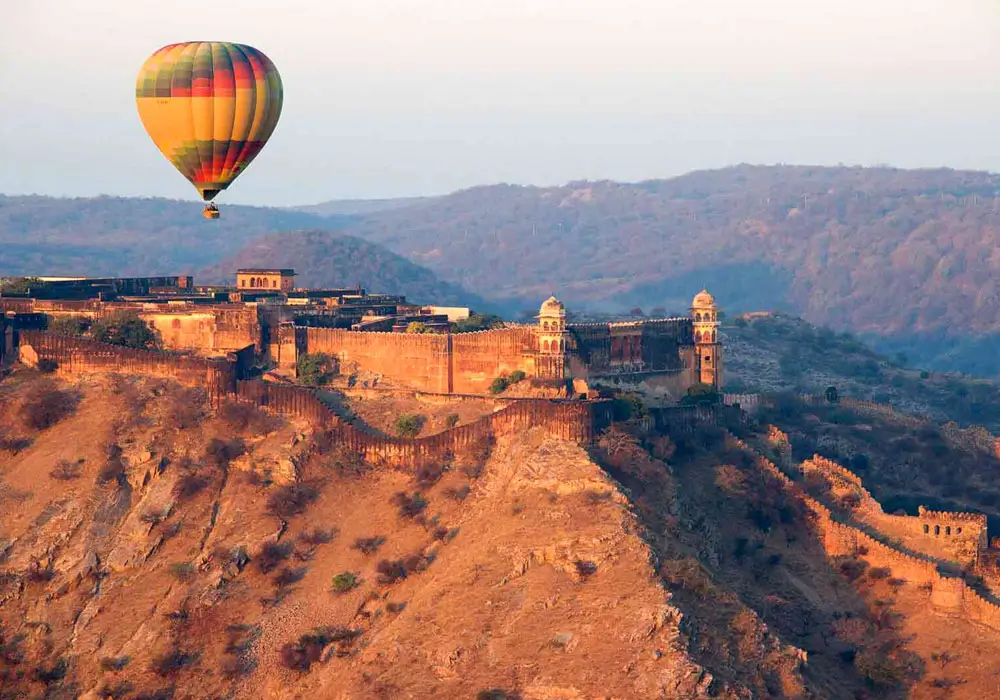



 🌙 15 Nights / 16 Days
Luxury
Delhi - Agra - Ranthambhore... Delhi - Agra - Ranthambhore - Jaipur - Jaisalmer - Jodhpur - Ranakpur - Udaipur Show More
 🌙 07 Night / 08 Days
⭐ Most Popular
Delhi - Agra - Jaipur... Delhi - Agra - Jaipur - Udaipur Show More
 🌙 05 Nights / 06 Days
Luxury
Delhi - Agra - Jaipur Delhi - Agra - Jaipur Show More
 🌙 11 Nights / 12 Days
Luxury
Jaipur - Ranthambore - Jodhpur... Jaipur - Ranthambore - Jodhpur - Jaisalmer - Udaipur Show More
Yes. Spend at least two nights in Jaipur and we will put the flight on your first full morning there, keeping the second morning as a backup.
Many older guests fly happily. You need to climb into a waist-high basket, stand during the flight and take the landing position. It is not suitable during pregnancy or for anyone with serious back, heart or mobility problems.
Jaipur gives you forts, hills and countryside, with a longer flying season. Pushkar flights run mainly around the Pushkar Fair, with views of the holy lake, the town and the camel ground. If you are in Pushkar during fair season, it is a strong choice.
Most people are surprised by how calm it feels. You move with the wind, so there is no breeze, and the basket does not swing. Many guests who dislike heights enjoy it.
Layers. Winter dawns can be very cold on the ground, while the burner warms the basket in the air. Wear flat closed shoes, because you land in a farm field, and a cap to shield your head from the burner.
The pilot decides on the morning. If the flight is cancelled, we try to move you to the next morning, which is why we suggest two nights in Jaipur. We explain the operator’s cancellation terms clearly before you book.
Yes. A private basket for a couple or family can be requested. It costs more than a shared flight and depends on availability, so ask early, especially for December.
Operators set a minimum age and height for safety. Tell us your children’s ages when you enquire and we will check before booking.
Possibly, but nobody can promise it. A balloon goes where the wind takes it. On many mornings you see the forts along the ridge from a distance, and on some you pass closer. Every flight gives wide views of the hills and villages.
We book only with licensed operators and experienced pilots. The pilot checks the weather at the launch field and will not fly if conditions are unsafe. Follow the briefing, especially the landing position, and the ride is very calm.
Time in the air varies with the wind and where the pilot finds a safe landing spot. Including pickup, briefing, inflation, landing and the drive back, plan to give up your whole early morning.
December to February usually gives the clearest, calmest mornings and the yellow mustard fields. October, November and early March are also good and less cold.
Flights leave around sunrise, so your hotel pickup is before dawn. The pickup time changes through the season as sunrise moves, and we confirm it the evening before your flight.
The price depends on the season, the operator and whether you choose a shared or private basket. Rates change from year to year, so we quote the current price for your exact dates. Send us a WhatsApp message with your dates and group size.

Whether you're planning your first India trip or returning to explore deeper, get honest, expert advice from someone who knows every corner of this country. No pressure, no cost.