📅 Last Updated On: 23 Nov 2026
⏱ 11 Min Read
Rambagh Palace vs The Oberoi Rajvilas vs The Leela Palace Jaipur: Which to Book?
N
Nand Singh Rathore
Travel & Tourism Expert specializing in India
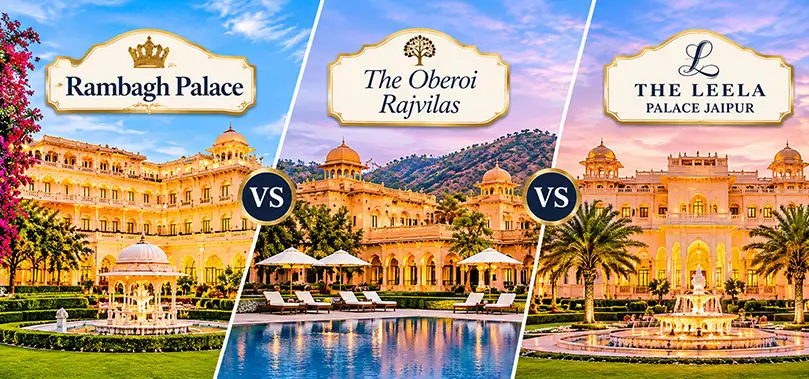
Compare Jaipur’s Finest Luxury Palace Hotels Before You Book
The email usually arrives a few weeks after a guest has fixed the dates of a Rajasthan holiday. Delhi is booked, Agra is settled at The Oberoi Amarvilas, and then the Jaipur nights stall. They have three tabs open on their laptop, one for Rambagh Palace, one for The Oberoi Rajvilas and one for The Leela Palace Jaipur, and every photograph looks like the most beautiful hotel in India. Each has peacocks or palace domes, each promises butlers and candlelit dinners, and the price differences are large enough to matter but not large enough to settle the question on their own.
The truth is that these are three very different hotels that happen to share a city and a five-star rating. One is a genuine royal residence in the middle of town, one is a low, walled retreat built in the style of a rural fort among gardens on the eastern edge of the city, and one is a grand new palace in the Aravalli hills on the road towards Amber Fort. Choosing between them depends on what you want from your two or three nights in the Pink City: history you can touch, privacy behind your own garden wall, or space and polish near the hills. Below, we set the three side by side on setting, rooms, peak season rates, dining, spa, distances and atmosphere, exactly as we weigh them when booking luxury Jaipur hotels for our own guests.
Three Palaces, Three Very Different Settings
Start with where each hotel stands and what it was before it became a hotel, because that shapes almost everything else. Rambagh Palace began life in the early nineteenth century as a modest garden house for a favoured lady of the royal household, grew into a hunting lodge and royal guesthouse, and was later expanded into the principal residence of the Jaipur royal family. They lived here until the middle of the last century, when the palace was turned into one of the first palace hotels in India, and the Taj group has run it for around five decades. The building sits in roughly 47 acres of lawns and Mughal-style gardens just south of the walled old city, so you are inside Jaipur rather than outside it.
The Oberoi Rajvilas has no royal past, and it does not pretend to. It was built by the Oberoi group in the late twentieth century on about 32 acres of farmland along Goner Road, on the eastern fringe of the city. Its architects took the language of a small Rajasthani fort, with high pink walls, domed pavilions, reflecting pools and courtyards, and arranged the rooms in low clusters among orchards, fountains and lily ponds. Inside the estate stands a genuine Shiva temple of around 280 years and a restored eighteenth-century mansion that now houses the spa. The effect is of a private rural estate rather than a city palace.
The Leela Palace Jaipur is the newest of the three, opened under the Leela name only a few seasons ago on roughly eight acres at Kukas, on the Delhi highway north of the city. Its backdrop is the Aravalli hills, and its design is deliberate, modern palace architecture, with arches, mirror work, painted walls in the Shekhawati style and long colonnades. It has no centuries of history, but it does have scale, newness and a location that faces the hills rather than the city traffic.
These three settings already divide guests. If you want to sleep in rooms where the rulers of Jaipur once received viceroys, polo players and film stars, only Rambagh Palace offers that. If you want silence, birdsong and the feeling of a walled garden kingdom, Rajvilas is the natural choice. If you want a contemporary grand hotel with the hills in view and a short run to Amber, The Leela fits well.The setting also affects the mood of your arrival. At Rambagh, the car turns off a busy road through tall gates into a long drive, and the city disappears behind the trees. At Rajvilas, the gates open onto a quieter lane, and the walls feel almost monastic. At the Leela, the arrival is broad and ceremonial, with fountains and a sweeping forecourt. All three are beautiful, but they speak in very different voices, and the right one is the voice that matches the rest of your Rajasthan luxury tour.
Plan Your Luxury Jaipur Stay
Get expert recommendations and a personalised hotel booking plan for your Jaipur getaway.
Rooms, Tents, Villas and Suites Compared
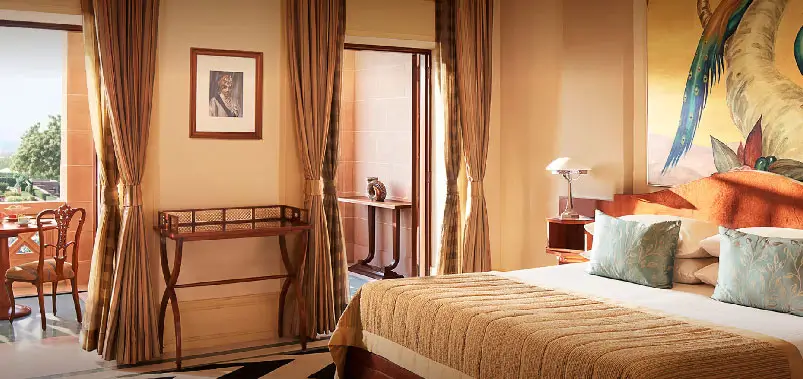
Room categories differ more between these three hotels than most guests expect, and this is often where the decision is really made. Rambagh Palace has around 78 rooms and suites, all inside or attached to the historic building. The entry level is the Palace Room, with high ceilings, period furniture and views over the gardens or courtyards. Historical Rooms sit in the older wings and carry more original character. Above them are Luxury Suites, and then the Grand Royal Suites, which include the former private chambers of the royal family, with painted ceilings, marble bathrooms, private terraces and dining rooms. Rooms vary widely in shape and outlook, because this is a real palace, not a hotel built to a standard layout, so asking for a specific wing or view matters.
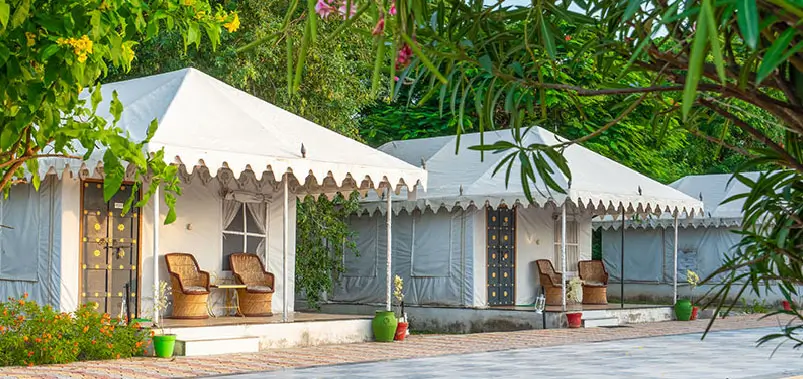
The Oberoi Rajvilas has about 71 keys across its estate, and they come in three very different forms. The Premier Rooms, of roughly 45 to 50 square metres, are grouped in small clusters around shared courtyards and have four-poster beds and sunken marble baths. The Luxury Tents are the hotel's signature, with canvas walls lined with fine fabrics, teak floors, a claw-foot bathtub and a private walled garden, all fully air-conditioned. The Royal Tent adds a separate living tent. At the top sit private villas with their own pools, including the Kohinoor Villa, which has a long heated private pool, a second bedroom and dedicated butler service. Many returning guests at Rajvilas refuse to stay anywhere but the tents.
The Leela Palace Jaipur is the largest of the three, with around 200 rooms, suites and villas. The Palace Rooms in the main building are generous and modern, with marble bathrooms and views over gardens or hills. The real strength, however, is the villa inventory. The Grand Villas sit in low wings among the gardens, the Royal Villas come either with a private courtyard or with a private plunge pool, and the largest units run to well over 1,000 square feet. At the top are grand suites with chandeliers, dining rooms and butler service.
What this means in practice is simple. For a couple who want a sense of heritage in their own room, Rambagh's suites are hard to beat, though the entry rooms can feel modest for the price. For privacy and a feeling of having your own garden, the Rajvilas tents and villas are unique in Jaipur. For space per rupee, especially for families who want connecting rooms or a private plunge pool villa, the Leela usually gives more square footage at a lower rate.
One small practical point is worth noting. At Rambagh, the best suites number only a handful and sell out first in the October to March season. At Rajvilas, the villas with private pools are few. At the Leela, the larger inventory means more availability, which is useful for late bookings and for groups of friends or extended families who want rooms close together.
What You Will Really Pay in Peak Season
Rates at all three hotels move sharply with the calendar, so it helps to think in peak-season terms, from roughly mid-October to early April, with the highest prices over Christmas, New Year, Diwali and the wedding season. The figures below are typical of what our guests see for those dates, before taxes, usually with breakfast included.
At Rambagh Palace, Palace Rooms generally run from roughly ₹55,000 to ₹95,000 per night in peak season, and Historical Rooms a little more. Luxury Suites often sit between ₹1,20,000 and ₹2,00,000, while the Grand Royal Suites can go from around ₹3,00,000 to well above ₹6,00,000 a night. Over the festive weeks, minimum stays of two or three nights are common.
At The Oberoi Rajvilas, Premier Rooms typically range from about ₹50,000 to ₹85,000 per night in high season. The Luxury Tents usually fall between ₹70,000 and ₹1,20,000, which is why they are the sweet spot for most couples. Villas with private pools are priced in a very different band, often ₹2,50,000 to ₹4,00,000, and the Kohinoor Villa can exceed ₹7,00,000 per night at the busiest dates.
At The Leela Palace Jaipur, Palace Rooms usually start from around ₹30,000 to ₹55,000 per night in peak season. Grand Villas and Royal Villas with courtyards tend to sit between ₹45,000 and ₹75,000, and the Royal Villas with plunge pools from about ₹60,000 to ₹1,00,000. Large suites run from roughly ₹1,50,000 upwards. It is, by a clear margin, the best value of the three for space.
Remember that Indian hotel tax at this level is currently 18 percent on rooms priced above ₹7,500, which is not trivial on a suite. For two nights in a Rajvilas Luxury Tent, for example, you might expect around ₹1,70,000 to ₹2,80,000 including tax, or roughly US$2,000 to US$3,300. Two nights in a Rambagh Luxury Suite might reach ₹2,80,000 to ₹4,70,000, around US$3,300 to US$5,600. Two nights in a Leela plunge pool villa could come in at around ₹1,40,000 to ₹2,40,000.
Meals and extras then push the bill upwards. Dinner for two at the signature restaurants of any of these hotels, with a good bottle of wine, typically costs between ₹18,000 and ₹35,000. A spa treatment for two often runs ₹20,000 to ₹40,000. Private dining set-ups in a courtyard, on a lawn or beside a pool can cost ₹40,000 to well over ₹1,00,000 depending on the menu and decoration.
Rates do drop in the hot months of May and June and during the monsoon, sometimes by 40 to 50 percent, and Rajvilas in the rain, with its gardens washed green, has its own charm. For most international guests, however, the cool, dry months are the only sensible time for a luxury Jaipur stay, and the prices above are the ones to budget for.
Dining Compared: Ballrooms, Courtyards and Hillside Terraces
Food is a serious part of any decision here, because many guests take at least one dinner in their hotel each night they stay. Each of the three handles dining in a very different way.
Rambagh Palace has the most theatrical setting. Suvarna Mahal, the former palace banquet hall, is one of the most beautiful dining rooms in India, with gilded walls, frescoed ceilings and heavy chandeliers, and it serves refined regional Indian cuisine from across the country. The Rajput Room is the relaxed all-day restaurant, overlooking the lawns, where breakfast is served. The Verandah is the place for afternoon tea, with peacocks wandering the grass beyond. The Polo Bar, decorated with trophies and photographs from the royal family's polo years, is one of the great hotel bars of the country. For something lighter, Steam, set in and around a restored steam locomotive, serves pizza and Mediterranean dishes. The range is wide, and the room itself is part of the meal.
The Oberoi Rajvilas keeps its dining smaller and more intimate. Surya Mahal is the main restaurant, serving Indian and international dishes in a domed room and courtyard, often with traditional music in the evening. Rajmahal is the Indian fine-dining room, known for carefully prepared Rajasthani and North Indian dishes. The Rajwada Library Bar, panelled and quiet, is ideal for a drink before dinner. Where Rajvilas excels, though, is private dining. Dinners can be set up beside the reflecting pools, in the old temple courtyard or on the terrace of your own villa, lit by lanterns and candles, and the service is famously calm and discreet.
The Leela Palace Jaipur has the most contemporary dining offer. Mohan Mahal is the signature Indian restaurant, serving rich royal-style cooking by candlelight. Preet Mahal, beside the pool, serves Italian food, and an all-day dining room handles breakfast and casual meals. The Jharokha bar overlooks the hills and is especially pleasant at sunset. Because the hotel is larger, it also has space for big private dinners, family celebrations and outdoor events on the lawns.
How should this affect your choice? Guests who want one grand, memorable dinner room usually prefer Rambagh, because nothing in Jaipur quite matches Suvarna Mahal. Guests who want slow, private evenings without other diners around them are happiest at Rajvilas. Families who need flexible menus, early dinners for children and a casual pool lunch often find the Leela easiest.
It is also worth remembering that you need not eat every meal where you sleep. Our guests at the Leela often book one dinner at Rambagh for the atmosphere. Guests at Rambagh sometimes book a private dinner at a fort or rooftop in the old city. A good Jaipur luxury itinerary mixes the best hotel restaurant with one or two outside experiences, rather than staying inside the gates every night.
Spa, Pools and Wellness
After a morning climbing the ramparts of Amber Fort and an afternoon in the City Palace, a good spa matters more than many guests expect. The three hotels take quite different approaches.
Rambagh Palace has the Jiva Grande Spa, the Taj group's flagship Indian wellness brand. Treatments draw on traditional Indian therapies, from foot rituals to full-body oil massages, with saunas and soaking baths alongside. The palace also has an indoor pool set under a vaulted ceiling, a reminder of the royal family's taste for comfort, and an outdoor pool in the gardens, along with a whirlpool and fitness centre. The spa is excellent but sits within a busy hotel, so book treatments early in peak season.
The Oberoi Rajvilas has what many regard as the most atmospheric spa in Jaipur. The Oberoi Spa occupies a restored eighteenth-century mansion within the estate, with treatment rooms around a courtyard and a peaceful pool nearby. Therapists are among the best trained in India, and couples' suites allow treatments side by side. Because the hotel has only around 71 keys, the spa rarely feels crowded. Add the villas with private pools, and Rajvilas is the most complete wellness retreat of the three.
The Leela Palace Jaipur has its own spa, offering a long menu of Indian and international treatments, plus a generous outdoor pool with views of the hills, a separate children's pool and a modern gym. The Royal Villas with plunge pools allow a private swim without leaving your room, which is rare at this price level in Jaipur. Yoga sessions can be arranged in the gardens with the hills behind, which suits guests who want a gentle start before sightseeing.
Prices are broadly similar across all three. A 60-minute massage typically costs between ₹9,000 and ₹15,000 per person before tax, and 90-minute signature rituals between ₹13,000 and ₹22,000. Couples' packages often run between ₹25,000 and ₹45,000. These are higher-side figures, and festive weeks bring premium pricing.
There are a few practical points to bear in mind. Early-morning yoga or a pre-dinner treatment is easy at all three, but afternoon slots fill first, because most guests return from sightseeing between three and five. At Rambagh and the Leela, which both host large weddings in season, the spa can become very busy on wedding weekends, while Rajvilas, with fewer rooms and fewer events, stays quieter.
For guests who think of their Jaipur stay mainly as rest between longer travel days, the answer is clear. If you are coming off a long drive from Agra or a tiring train journey, and you want two days of massages, slow mornings and a private pool, Rajvilas is the strongest choice. If you want a spa as one part of a busy, social palace stay, Rambagh is perfect. If you want a big pool for children and a quiet plunge pool for yourself, the Leela delivers both at a lower price.
Distances to Amber Fort, the Old City and the Airport
Location is where these three hotels differ most in day-to-day practice, and it should play a bigger part in your decision than most brochures suggest.
Rambagh Palace is the most central. It sits roughly 4 to 5 kilometres south of the walled old city, so the City Palace, Jantar Mantar and Hawa Mahal are about 15 to 25 minutes away by car, depending on traffic. Amber Fort is around 15 kilometres to the north, usually 35 to 50 minutes, because you have to pass through or around the old city. The airport is about 10 to 12 kilometres away, roughly 25 to 30 minutes. For guests who want to dash back for lunch, return to rest between sights or head out to dinner in the city, this central position is a real advantage.
The Oberoi Rajvilas is about 8 kilometres east of the city centre on Goner Road. The old city monuments are roughly 25 to 35 minutes away, and Amber Fort around 20 to 25 kilometres, which usually takes 45 minutes to an hour. The airport is about 14 to 16 kilometres, roughly 30 to 35 minutes. The position is quieter and greener, and the drive back to the estate each evening feels like leaving the city behind. The Jhalana leopard reserve, a small forest park on the south-eastern edge of the city, is within easy reach of both Rajvilas and Rambagh for an early-morning jeep drive.
The Leela Palace Jaipur has the opposite profile. It sits on the Delhi highway at Kukas, only about 12 kilometres from Amber Fort, so the drive to the fort can take as little as 20 minutes in the morning. However, the old city monuments are around 22 to 25 kilometres away, often 40 to 55 minutes, and the airport is about 35 kilometres, often an hour. Arriving from Delhi by road, the Leela is reached well before the city traffic, which is a pleasant bonus at the end of a long drive.
Amber Fort is open every day from about 8:00 in the morning to 5:30 in the evening, and the foreign visitor ticket is currently around ₹500 per person, with a composite ticket for several Jaipur monuments at about ₹1,000. The City Palace charges foreigners roughly ₹700 to ₹1,000 depending on the level of access. Our advice is always to reach Amber early, before the coach groups arrive at around ten, and the Leela makes this easiest.A private car and chauffeur for the day typically costs ₹4,500 to ₹6,000 in a Toyota Innova Crysta and ₹18,000 to ₹25,000 in a Mercedes-Benz or similar luxury sedan. A licensed private guide adds roughly ₹3,000 to ₹5,000 for a half day. These costs are the same at all three hotels, but the time spent in the car differs. Over a busy two-day Jaipur programme, guests at the Leela or Rajvilas can spend an extra hour or more on the road compared with guests at Rambagh, so if your time in the city is short and full, the central palace has a clear practical edge.
Find Your Perfect Palace Stay
Choose between Rambagh Palace, The Oberoi Rajvilas, and The Leela Palace Jaipur to discover the luxury experience that suits your travel style and budget.
Style and Atmosphere: Royal Heritage, Walled Retreat or Grand New Palace
Beyond rooms, rates and distances, each hotel has a distinct personality, and guests tend to fall in love with one atmosphere rather than another. It is worth being honest about which you are buying.
Rambagh Palace feels like a living royal home. There are long corridors lined with portraits and hunting trophies, marble verandahs, polished brass, peacocks crying on the lawns at dusk and staff whose families have worked here for generations. The hotel is formal in the best sense, with uniformed attendants, a piper or musicians on the terrace and tea served as it might have been for visiting dignitaries. It is also social. You will see wedding parties, business travellers, couples and well-dressed local families taking tea. For guests who want a sense of occasion, and who want to feel part of the history of Jaipur, the atmosphere is hard to match.
The Oberoi Rajvilas is quieter and more private. It feels less like a palace and more like a very refined country estate. Mornings start with birdsong and the sound of water in the fountains. There are few public spaces, and those there are stay calm. Service is discreet and anticipatory, with staff appearing just before you need them. Many guests describe Rajvilas as a place to recover rather than a place to perform. It is especially loved by repeat visitors to India, by couples on anniversaries and by guests who simply want a beautiful room, a private garden and silence.
The Leela Palace Jaipur is grand, polished and contemporary. Public spaces are large and lavish, with mirror work, chandeliers and painted walls, and the overall effect is closer to a modern luxury resort built in palace style. It is more spacious, more child-friendly and more flexible than the other two, and it handles large groups and events with ease. What it cannot offer is age. The building is new, and while the craftsmanship is fine, it does not carry the patina of two centuries.
Guests sometimes ask which hotel is the most luxurious. That is the wrong question, because all three operate at the very top of Indian hospitality. A better question is which kind of luxury you value most. Rambagh offers the luxury of history and ceremony. Rajvilas offers the luxury of privacy and calm. The Leela offers the luxury of space, newness and value.
Dress and pace also differ. At Rambagh, guests tend to dress for dinner, and there is a pleasant sense of occasion in the evening. At Rajvilas, the mood is relaxed elegance, and dinner in your own villa is common. At the Leela, the atmosphere is more casual, especially around the pool. None of this is enforced, but it shapes the evening. For a luxury honeymoon in Rajasthan, a big family celebration or a first trip to India, the atmosphere you choose will colour every memory of the city, so it is worth matching it carefully to your own travelling style.
Matching the Hotel to the Guest: Couples, Families and Celebrations
After years of booking all three, we have found that guests fit fairly naturally into one hotel or another once their priorities are clear. Here is how we usually match them.
Honeymooners and anniversary couples who want romance, privacy and calm almost always settle on The Oberoi Rajvilas, and usually on a Luxury Tent or a villa with a private pool. The walled garden, the candlelit private dinners and the quiet spa make it ideal for two or three slow nights, especially if the rest of the trip is busy. Couples who want romance with more spectacle, a grand dinner in Suvarna Mahal and drinks in the Polo Bar, choose Rambagh Palace, ideally in a suite rather than an entry room.
First-time visitors to India with only two nights in Jaipur, and a full sightseeing programme, are usually best served by Rambagh. Its central position saves time, and the hotel itself becomes part of the history lesson. If your time is short, sleeping in the former home of the royal family is a highlight in its own right.
Families with children, or groups of friends travelling together, often prefer The Leela Palace Jaipur. The larger inventory makes it easier to secure several rooms close together, villas give space for children, the pools and lawns keep younger guests happy and rates are kinder for multiple rooms. The short drive to Amber Fort is also helpful when children need an early start and an early return. Rambagh welcomes families too, but rooms are smaller for the price, and Rajvilas, with its quiet atmosphere and clustered rooms, is better suited to adults or families with older children.
Guests celebrating a milestone birthday, a vow renewal or a family wedding should think in terms of venue as much as rooms. Rambagh offers the most famous lawns and halls in the city, the Leela offers the most space and Rajvilas offers intimacy for a small, private gathering.
Booking lead times also matter. For the peak weeks from late November to early January, we recommend confirming any of the three around six to nine months ahead, and Rambagh suites or Rajvilas pool villas as early as possible, because they sell out first. For other months in the season, three to four months is usually enough. Wedding season can close whole hotels for private events at short notice, so always ask your India tour operator to check event calendars before confirming.
Finally, consider splitting your stay. Some of our guests spend one night at Rambagh for the history and two nights at Rajvilas for rest, or start at the Leela near Amber and finish centrally. Whichever you choose, three nights in Jaipur is the comfortable minimum for a private Rajasthan tour at this level, and the right hotel will make those nights the most memorable part of the journey.
Related Guides



 info@topindianholidays.net
 +91-8955000999