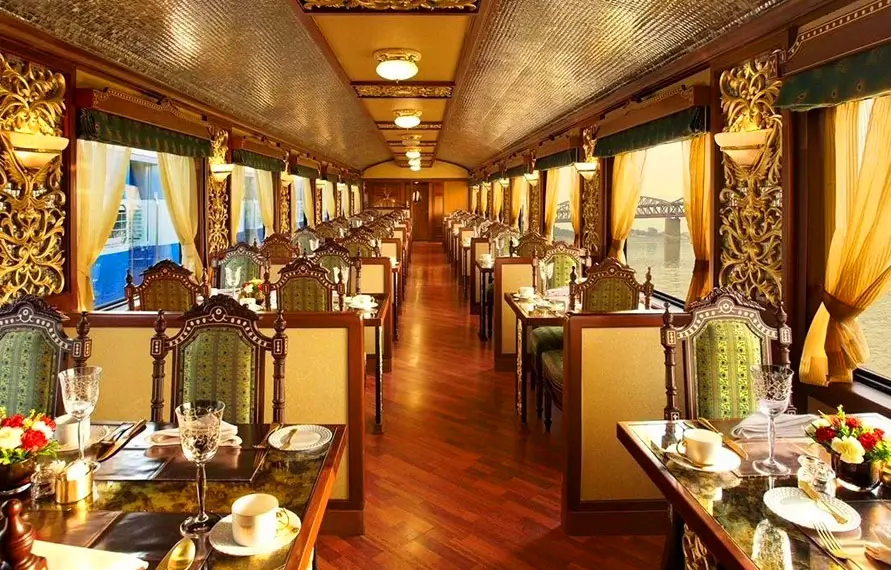
06 Nights / 07 Days Fully Guided Tours Private Car
Agra - Jaipur - Bikaner - Jodhpur - Udaipur - Mumbai
Delhi and Mumbai sit roughly 1,400 kilometers apart, and the Maharajas Express Indian Splendour Tour turns that distance into a slow, princely crossing of north and west India. Leaving Safdarjung station on a Sunday morning and pulling into Chhatrapati Shivaji Maharaj Terminus the following Saturday afternoon, the train links the Mughal capital of Agra, the tiger country of Ranthambore and four great cities of Rajasthan. You sleep in the same cabin all week while the landscape outside changes from wheat fields to scrub forest, desert sand and green Aravalli hills.
The route has a clear shape. It opens with the monuments of the Mughal emperors, pauses for a game drive in one of India's best-known tiger reserves, and then turns west into the desert kingdoms: pink Jaipur, sandstone Bikaner, blue Jodhpur and lake-ringed Udaipur. Evenings are part of the story, with a royal dinner at Rambagh Palace, a camel cart procession to a sunset party in the Bikaner dunes and lunch in a palace hall overlooking Lake Pichola. Because it ends in Mumbai rather than circling back to Delhi, this one-way Delhi to Mumbai luxury train also makes it easy to continue to Goa, Kerala or an onward flight home.
Run by IRCTC, the Maharajas' Express has collected the top luxury rail title at the World Travel Awards more than once. Its four cabin categories run from Deluxe Cabins to the Presidential Suite, which fills an entire carriage with a living room, two bedrooms and two bathrooms. Every cabin has a private bathroom, wide picture windows and a butler on call. Our Jaipur office at Top Indian Holidays, a private travel company holding Ministry of Tourism recognition and running tours for more than a quarter of a century, looks after the reservation, hotel stays, station pickups in Delhi and Mumbai, and any extra private days you would like. Departures for the 2026-27 season leave Delhi on 11 October, 8 November, 6 December, 3 January, 31 January, 28 February and 28 March.
The week begins at Delhi Safdarjung, a small station in the south of the capital that handles special departures like this one. Our chauffeur meets you in the lobby of your Delhi hotel at about 06:15, which leaves plenty of margin for morning traffic before check-in at around 07:00. On the platform you are greeted with garlands, a welcome drink and live music, and the guest relations staff verify your passport and booking. Porters take your suitcases directly to your cabin, so all you need to carry onto the Maharajas Express Indian Splendour is a small day bag with your camera.
Brunch is served in the restaurant car as the train runs south through the farmland of Haryana and Uttar Pradesh. This is the moment to meet your butler, who will ask how you take your coffee, whether you have any allergies and what time you would like to be woken on safari morning. A short briefing in the lounge covers the week ahead, the dress code for formal dinners and the optional activities on offer in each city. Pack light layers for the day trips: north Indian mornings can be cool from November to February, while afternoons are usually warm and sunny.
The train reaches Agra in the afternoon, and your guide escorts you to the Taj Mahal. Afternoon light gives the marble a warm, honey-colored glow, and the crowds usually thin a little as the day goes on. Your guide walks you through the garden layout, the symmetry of the four minarets and the precious stone inlay on the cenotaph chamber walls. In the evening you can choose between a spa session at a five-star Agra hotel or a theatrical dance performance about the love story behind the monument, before dinner on board while the train stays overnight in the city.
After an early breakfast you leave the train for Agra Fort, the massive red sandstone citadel on a bend of the Yamuna River that served as the main residence of the Mughal emperors for several generations. Its walls run for more than two kilometers, and inside them sit white marble pavilions, audience halls and private apartments. The most touching corner is the octagonal tower where the emperor Shah Jahan spent his final years confined by his son, gazing across the river at the tomb he had built for his wife. On a clear morning the Taj Mahal is plainly visible from the terrace.
Back on board, the train leaves Agra and heads west into Rajasthan. Breakfast and lunch are served as you cross the Chambal region, a land of ravines and small farming villages that few tourists ever see. If you prefer to rest after the morning's sightseeing, your cabin is the ideal place for a short nap, and the bar car is open for a quiet drink. Change into comfortable clothes in neutral colors for the afternoon, and keep a warm jacket handy, because temperatures can drop quickly once the sun sinks behind the hills in the park.
After lunch the carriages halt at Sawai Madhopur, where open-top jeeps wait to carry you into Ranthambore National Park for the afternoon safari. During the cooler winter weeks of November, December and January, park gates admit vehicles at roughly 14:00 and close at about 17:30, while in October, February and March the window moves later, to around 14:30 until 18:00. Your naturalist will scan the lakeshores and dry riverbeds for tigers, leopards, sloth bears and the big blue-gray antelope of the Indian plains, and point out crocodiles basking near the water. Sightings are never guaranteed, but the scenery of ruined walls and banyan trees is memorable in its own right. Dinner follows on board as the train continues to Jaipur.
You wake in Jaipur, the capital of Rajasthan, and set off after breakfast for Amber Fort, about 11 kilometers north of the city. Jeeps carry you up the winding ramp to the main courtyard, saving a stiff climb in the sun. The fort was the seat of the Kachwaha rulers until the early eighteenth century, when they moved their court down to the newly laid-out city on the plain. Look out for the mighty Sun Gate, the Hall of Public Audience with its double columns and the views over Maota Lake, where the reflection of the walls is clearest early in the day.
The guide then leads you into the private quarters. The Hall of Victory and the Mirror Palace are covered with tiny convex mirrors and colored glass set into white plaster, a technique that made a single candle seem to fill the room with stars. Return to the train for lunch, and then the afternoon is yours. Options include a spa visit at a luxury hotel, a guided visit to the City Palace and the Jantar Mantar observatory with its giant stone sundials, or a relaxed drive through the old city to see the honeycomb facade of the Hawa Mahal.
Jaipur is also a fine place to shop. Ask your guide about reputable outlets for block-printed cotton, cut gemstones, silver jewelry and hand-knotted rugs, as the city has been a center for these crafts for more than two centuries. In the evening the whole group is driven to Rambagh Palace, once the residence of the Maharaja of Jaipur and now a hotel run by Taj, for dinner in its grand dining rooms. Smart attire suits the occasion. Afterward you return to the station, and the train heads north-west overnight toward the Thar Desert and Bikaner.
Bikaner sits on the edge of the Thar Desert, and the air here feels drier and clearer than in Jaipur. The train arrives in the late morning, so the early hours are slow: breakfast on board, a book in the lounge or an optional short tour of the city. Bikaner was founded in the late fifteenth century by Rao Bika, a son of the founder of Jodhpur, and it grew rich as a stop on the caravan routes that carried goods across the desert. The town is also famous across India for its crunchy spiced snacks, which make a fun souvenir.
After lunch on board you visit Junagarh Fort, built in the late sixteenth century by Raja Rai Singh, a general in the service of the emperor Akbar. Unusually for Rajasthan, it stands on flat ground rather than a hilltop, protected instead by a moat and massive walls. The interiors are the real surprise. The Anup Mahal is covered with lacquer and gold leaf, the Phool Mahal is decorated with painted flowers and mirrors, and a small museum displays royal costumes, jewelry, weapons and even a First World War biplane.
Late in the afternoon a procession of camel carts, led by local musicians, carries the group out of town toward the dunes. The pace is gentle and the views of desert villages and grazing herds are lovely in the low sun. At the dunes a sundowner party is waiting, with cocktails, a barbecue and performances of desert folk music and dance around a fire. In December and January the desert can drop below 10 degrees Celsius after dark, so bring a warm layer. You return to the train late in the evening for the overnight run to Jodhpur.
Morning brings you to Jodhpur, the second city of Rajasthan and the old capital of the Rathore kingdom of Marwar. Breakfast is served on board, and the morning is free. Optional excursions usually include a visit to a Bishnoi village, where the community is known for its devotion to protecting trees and wildlife, or a tour of the Umaid Bhawan Palace museum and the white marble memorial of Jaswant Thada. If you would rather stay on the train, a quiet morning in the cabin is a welcome pause on the fifth day of the journey.
After lunch on board you head to Mehrangarh Fort, which rises on a sheer rock ridge high above the city. It was founded by Rao Jodha in the mid fifteenth century, and its walls are so high that they seem to grow out of the cliff itself. Inside, the museum holds royal palanquins, elephant saddles, miniature paintings and a remarkable collection of arms. From the ramparts you look down on the old town, where many houses are painted in shades of blue, giving Jodhpur its nickname of the Blue City.
From the fort you descend to the Clock Tower and the lively Sardar Market at its foot. A short walk and a ride in an open three-wheeler take you through lanes stacked with spices, dyed textiles, silver and lacquered bangles. Keep small notes handy and leave room in your suitcase. In the evening the group gathers for a cocktail dinner at an exclusive venue in the city, with Marwari dishes and live music. Return to the train afterward, and the journey continues south through the Aravalli Hills toward Udaipur while you sleep.
The train arrives in Udaipur after breakfast, and the change of scenery is striking. After the desert, here are lakes, green hills and white palaces reflected in the water. Your morning starts with a boat ride on Lake Pichola, passing the bathing steps of the old city, the marble Lake Palace that seems to float on the water and the island pavilion of Jag Mandir. Morning is the most pleasant time to be on the lake, with gentle light, calm water and the City Palace towering above the eastern shore.
From the jetty you walk up into the City Palace, the largest palace complex in Rajasthan, built and extended by successive rulers of the Mewar dynasty over several centuries. Its courtyards, mosaic peacocks and painted chambers make it one of the richest royal interiors in India. Next door, the Crystal Gallery at Fateh Prakash Palace displays a collection of crystal furniture, chandeliers and tableware ordered from England in the late nineteenth century. Remarkably, it lay unpacked in boxes for over a hundred years, as the ruler who ordered it died before it arrived.
Lunch is served in Satkar Hall at Fateh Prakash Palace, a royal dining room with chandeliers and views across the lake. It is a fitting final excursion for the week. In the afternoon you return to the station, and the train leaves Rajasthan and heads south through Gujarat toward the Arabian Sea coast. The farewell evening on board is relaxed and warm: a last dinner in the restaurant car, a toast in the bar and plenty of conversation with fellow guests about the highlights of the past six days.
Your final morning on the Maharajas Express Indian Splendour is unhurried. Breakfast and lunch are served on board as the train runs down through Gujarat and into Maharashtra, and the landscape becomes greener, with coconut palms appearing near the coast. Use this time to settle any extras with guest relations, pack your bags and say goodbye to your butler and the restaurant team. Many guests find this slower day a pleasant way to reflect on a week that has covered such a wide range of history and scenery.
The train is scheduled to reach Chhatrapati Shivaji Maharaj Terminus at about 16:35. The station is a UNESCO World Heritage Site and one of the finest Victorian Gothic buildings in Asia, so take a moment to look up at its domes, turrets and carved stone details as you step out. Our representative meets you on arrival and helps with your luggage to your car. Mumbai traffic is heavy in the early evening, so allow 45 to 90 minutes to reach hotels in Bandra or Juhu, or the international airport.
If your flight home leaves the same night, we suggest a departure after 23:00, with a day room available on request. Most guests, however, stay on for a night or two. Our travel desk can set up a guided Mumbai day covering the Gateway of India, the Elephanta Caves and the art deco seafront, or an onward flight to Goa for beach days, Kerala for its backwaters or Udaipur for a return visit at a slower pace. Because Top Indian Holidays works independently of the rail operators, we book the hotels, private cars and guides ourselves, so the days after the train flow just as easily.
Fill out this form with all the required information. Within 12 hours, we will provide you with a tailor-made itinerary at the best price.
Read the reviews of our esteemed client's, go through the experiences they had with Top Indian Holidays.

Whether you're planning your first India trip or returning to explore deeper — get honest, expert advice from someone who knows every corner of this country. No pressure, no cost.



 info@topindianholidays.net
 +91-8955000999