11 Nights / 12 Days Fully Guided Tours Private Car
Delhi - Agra - Ranthambore - Jaipur - Bikaner - Jodhpur - Udaipur - Mumbai - Goa
The Maharajas' Express leaves Delhi on a Sunday morning and, six nights later, pulls into the Victorian Gothic splendor of Mumbai's Chhatrapati Shivaji Maharaj Terminus. In between lies the most Rajasthani of all its routes: Agra, Ranthambore, Jaipur, the desert city of Bikaner, blue-walled Jodhpur and lakeside Udaipur. The Maharajas Express Indian Splendour with Goa adds a night in Delhi before boarding, one night in Mumbai after the train arrives and three unhurried nights on the coast of Goa, so a week of forts and palaces ends with warm sea, seafood and long lazy afternoons.
The train portion is a one-way journey, which is its great advantage. Rather than looping back to the capital, you travel steadily south-west from the Mughal heartland through the Thar Desert toward the Arabian Sea, so that every overnight run brings you closer to the beach. Highlights along the way include the Taj Mahal in the afternoon light, a game drive in Ranthambore, a camel cart procession to a sunset gathering on the dunes outside Bikaner, cocktails within sight of Umaid Bhawan Palace in Jodhpur and a boat ride on Lake Pichola in Udaipur.
Goa then supplies the contrast. Its beaches face west, its old churches recall four and a half centuries of Portuguese rule, and its kitchens turn out spicy prawn stews and slow-cooked pork dishes found nowhere else in India. IRCTC operates the train, while Top Indian Holidays, a Jaipur company recognized by the Ministry of Tourism and working entirely on its own account, reserves your cabin, greets you in Delhi and Mumbai, books the short flight to Goa and picks a beachfront luxury resort to suit your taste. Departures run on selected Sundays from October to March, the dry and sunny season for both Rajasthan and the coast.
Your representative from our team will be waiting at the arrivals exit of Indira Gandhi International Airport with a name board, regardless of the hour your flight lands. A private air-conditioned car takes you to a luxury hotel in Delhi, normally within 30 to 45 minutes. We pre-register your details with the hotel so check-in is quick, and early access to the room can be arranged when flights arrive overnight. A short welcome briefing covers the week ahead, the train's luggage guidance and the pickup time for the following morning.
The rest of the day is unscheduled. Guests who arrive early and feel energetic often take a relaxed afternoon drive with our guide to Qutub Minar, a soaring tower of fluted red sandstone built by the first Sultans of Delhi, or to the Lodhi Garden, where locals jog and picnic among fifteenth-century tombs. Others prefer to sleep, swim and adjust to the time difference. Delhi in October and March is warm and sunny, while December and January bring cool mornings around 8 degrees Celsius and frequent haze.
Pack for the week on the train in one medium suitable bag. The cabins have wardrobes and drawers, but space is finite and a large suitcase can be stored in the luggage car. Bring lightweight clothing for the day, a warm layer for early starts and evenings in the desert, a scarf or shawl for covering shoulders and something smart for the palace dinners. Swimwear and beach clothes for Goa can stay at the bottom of your case until the last part of the trip. Early dinner and bed are wise.
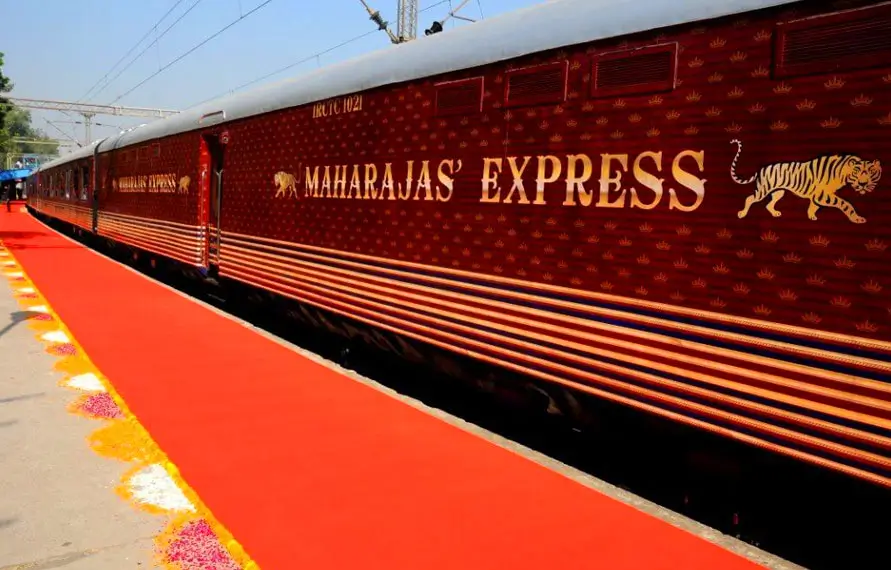
The hotel car collects you at about 06:15 so that you arrive at Delhi Safdarjung station in time for check-in at around 07:00. The platform is dressed for the occasion with a red carpet, flower garlands and a band, and the train's staff take care of passports, luggage and cabin assignments. The Maharajas Express Indian Splendour departs soon afterward, and brunch is served as the train heads south through the outskirts of the capital and into the farmland of Haryana and Uttar Pradesh, where mustard fields glow yellow in winter.
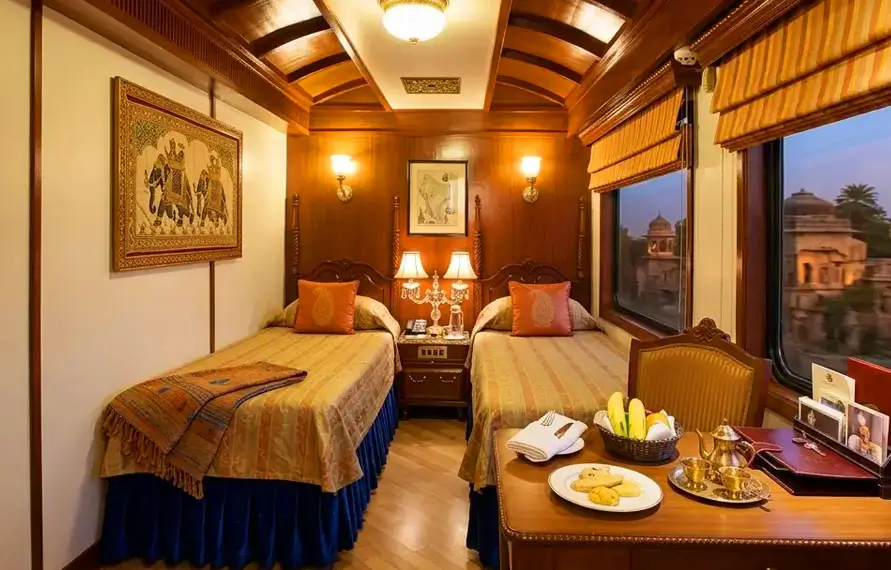
During the run to Agra, the train manager gives a briefing in the lounge car covering each day's schedule, the optional activities on offer and the dress code for dinners. Your butler shows you around the cabin, explains the controls for lights, heating and air-conditioning, and asks when you like your morning tea. This is also the moment to mention any dietary needs; the kitchen can manage vegetarian, vegan, gluten-free and many other requirements without fuss. The journey to Agra takes a few hours, which passes quickly over coffee and conversation.
In the afternoon you leave the train with your guide for the Taj Mahal. The softening light of late afternoon gives the marble a warm cream glow, very different from its sunrise appearance, and the gardens are lively with families and school groups. The guide points out how the inlaid flowers seem to change color as you move, and how the calligraphy grows larger toward the top of the gateway to appear uniform from the ground. Remember that the Taj Mahal is closed on Fridays. Back on board, dinner is served while the train rests in Agra.
The day opens with a short coach ride to Agra Fort, the massive red sandstone citadel where several Mughal rulers kept their household until the court shifted its seat to Delhi. Arriving early means the courtyards are still cool and peaceful. Inside, the white marble pavilions built by Shah Jahan contrast sharply with the older red stone buildings of Akbar's era. From the Musamman Burj, an octagonal tower, there is a beautiful view along the Yamuna to the Taj Mahal, which was where the emperor spent his last years.
Back on board, a late breakfast waits, and a midday meal follows as the train travels west into Rajasthan toward Sawai Madhopur. The landscape changes noticeably: the flat farms of the Yamuna plain give way to scrub-covered hills, small villages of stone houses and the first camels and goats grazing by the tracks. The train manager will remind everyone to bring a jacket, sunglasses, a hat and a scarf for the dust, and binoculars or a long camera lens if you have them, plus a small bottle of water.
Later, a naturalist rides with you in an open jeep for a wildlife drive through Ranthambore National Park. Through the cold months the afternoon permit covers roughly 14:00 until 17:30, moving about half an hour later, to around 14:30 until 18:00, in the shoulder months of October, February and March. As the heat drops, animals become more active and gather near water. Tigers are seen on many drives, though never guaranteed, and the park also shelters leopards, sloth bears, crocodiles and over three hundred bird species. You return to the train at dusk for dinner as it moves on to Jaipur overnight.
With the train standing at Jaipur station, the morning meal is laid out in the dining car, and a traditional welcome waits on the platform. The coach then drives you out to Amber Fort, the hilltop palace of the Kachwaha rulers that guards a narrow pass to the north of the city. Jeeps take guests up the steep cobbled road, and the guide leads the way through the ceremonial gateway into the courtyards. Sunlight on the yellow and pink sandstone makes the morning visit especially photogenic, so keep your camera ready.
Inside, the guide shows you the Hall of Public Audience, the Hall of Victory and the private apartments, culminating in the famous mirrored chamber where countless pieces of glass catch any light. Look up at the intricate painted ceilings and the screened windows from which royal women watched the courtyards below without being seen. The visit takes about two hours, and there are good views from the walls across Maota Lake and the hills. You return to the train for lunch and a relaxed afternoon.
The afternoon is yours to use as you wish. Some guests visit the City Palace and Jantar Mantar, the open-air astronomical observatory with instruments the size of buildings, while others book a spa treatment or a city tour with our team. In the evening, dinner is served at Rambagh Palace, once the residence of the royal family and now a celebrated luxury hotel. The setting is magnificent, with lantern-lit lawns, peacocks and grand dining rooms. You return to the train later in the evening for the overnight journey north-west into the desert.
The train reaches Bikaner in the late morning after a leisurely breakfast. This desert city on an old caravan route lies deep in the Thar, and it receives far fewer visitors than Jaipur or Jodhpur, which adds to its appeal. The morning is free to rest on board, use the onboard spa or take one of the optional city tours. Lunch is served in the restaurant car before the afternoon's main sightseeing begins. Wear sunglasses and a hat, as the midday sun is strong even in winter.
After lunch your guide leads you through Junagarh Fort, a rare fort in Rajasthan built on flat ground rather than a hilltop, and never conquered in battle. Behind its massive walls the palaces are decorated with gold leaf, painted ceilings, carved red sandstone and colored glass. The museum displays royal costumes, jewelry, palanquins and even a First World War biplane presented to the ruler of Bikaner. Watch for the room covered with painted blue clouds and lightning bolts, designed for a desert ruler who longed for rain.
In the late afternoon, decorated camel carts carry you in a procession to the sand dunes outside the city, accompanied by drummers and musicians. A sundowner is laid out on the sand, with drinks served as the sky turns orange and pink over the desert. After dark, an open-air barbecue dinner with folk musicians and dancers follows under the stars. Desert evenings can be chilly in winter, so bring a warm jacket. It is late when the coaches bring you back on board, and the train sets off overnight for Jodhpur.
Breakfast is served as the train arrives in Jodhpur, the Blue City, whose old town is painted in shades of indigo below an enormous fort. The morning is relaxed, with optional activities offered by the train. Many guests pick an outing to a Bishnoi settlement, home to a community long known for guarding wildlife, which shelters blackbuck antelope and trees, or a tour of the museum at Umaid Bhawan Palace, the vast Art Deco palace still partly home to the royal family. You can also simply rest on board.
After lunch you drive up to Mehrangarh Fort, which rises sheer from a rocky ridge about 120 meters above the city. A lift saves the climb to the upper levels. Inside, the palaces display a superb collection of royal cradles, elephant saddles, paintings and weapons, and the views over the blue houses below are extraordinary. Afterward you descend to the old Clock Tower market, where the guide leads you through the lanes past spice sellers, textile shops and silversmiths. Some guests ride part of the way in a local motorized three-wheeler.
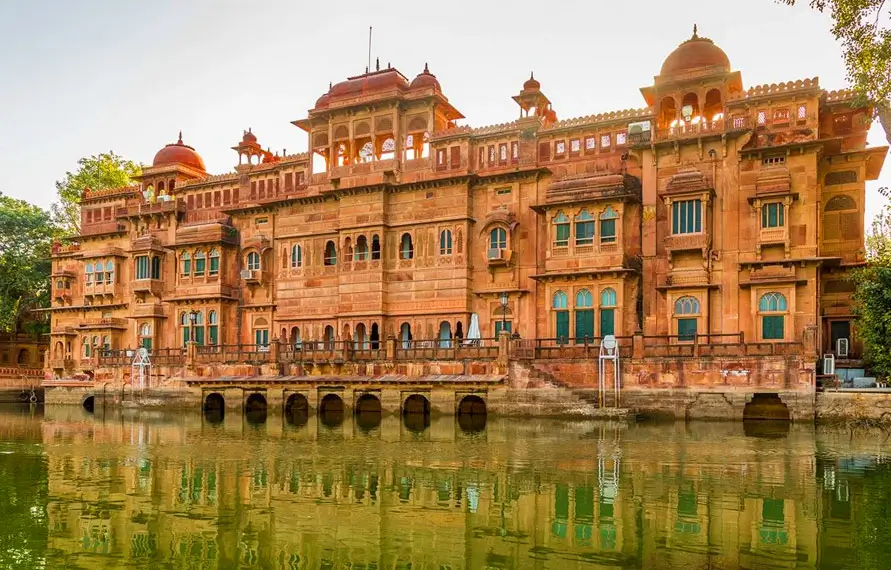
In the evening, you are hosted for cocktails and dinner at an exclusive palace venue such as Khaas Bagh, where tables are set beneath the trees and dinner features Marwari dishes, the regional cuisine of Jodhpur. Typical dishes include slow-cooked lamb in a fiery red chili sauce and lentil dumplings in yogurt gravy. Folk musicians often perform during the meal. Return to the train afterward for the journey to Udaipur through the hills of southern Rajasthan. This is one of the most memorable evenings of the entire trip.
You wake to green, hilly countryside, a sharp change from the desert of the previous days. After breakfast you arrive in Udaipur, the city of lakes, and drive to the shore of Lake Pichola for a boat ride. Out on the lake you glide past the gleaming Lake Palace and the island pavilions of Jag Mandir, where a Mughal prince is said to have found inspiration for the Taj Mahal. Morning is the best time for photographs of the City Palace rising along the eastern shore.
After the boat ride, your guide leads you into the City Palace of Udaipur, a labyrinth of courtyards, balconies and towers built and expanded by the Mewar rulers over several centuries. Highlights include the Peacock Courtyard with its glass mosaics, and the Crystal Gallery, which houses an extraordinary collection of crystal furniture commissioned in England in the nineteenth century, including a crystal bed. Note that no photography is permitted in the gallery, and a separate audio guide is usually offered. Allow about two hours for the full palace visit.
Lunch is served in the Satkar Hall of Fateh Prakash Palace, overlooking the lake. The terrace views are beautiful, and many guests consider this one of the finest lunches of the week. By mid-afternoon everyone is back aboard, and the train pulls out of Udaipur for the long journey south to Mumbai. Dinner is served on board, followed by a nightcap in the bar. This last evening is also a good time to settle your account with the guest relations team for drinks and optional activities, to avoid queues the next day.
The final day on board is relaxed. Breakfast and lunch are served as the train crosses the plains of Gujarat and descends toward the coast. Fields of cotton and sugarcane give way to banana plantations, and by the afternoon you see palm trees and the first signs of the sprawling city. This is a good time to sit in the observation lounge with a book, to take a spa treatment, or simply to say farewell to the friends you have made on board and swap addresses.
The train arrives at Chhatrapati Shivaji Maharaj Terminus in Mumbai at around 16:35. Completed in the late nineteenth century and now inscribed by UNESCO, this enormous terminus ranks among the grandest Victorian Gothic buildings anywhere beyond Europe, with domes, turrets, stained glass and stone carvings of animals and plants. A driver from our team waits beside your carriage to take charge of the bags. Pause for a few photographs of the facade from the street outside before getting into the car, ideally from the traffic island across the road.
The drive to your luxury hotel in South Mumbai takes around 20 to 30 minutes, depending on traffic. If time permits, a short evening walk along Marine Drive, the curving seafront promenade nicknamed the Queen's Necklace for its string of lights, is a lovely way to end the day. The Gateway of India and the Colaba neighborhood are also nearby. Mumbai's restaurant scene is one of the best in Asia, and we are happy to recommend options for dinner, from fine dining to coastal seafood.
After breakfast at your hotel, our driver collects you for the transfer to the domestic terminal of Mumbai's airport, a drive that can take 45 to 90 minutes depending on traffic. If your flight is in the afternoon, there is time for a short morning drive past the Gateway of India, built to mark a royal visit in the early twentieth century, and the cool marble halls of the Prince of Wales Museum, now known as Chhatrapati Shivaji Maharaj Vastu Sangrahalaya. Our team will advise based on your flight time.
The flight to Goa takes just over an hour. As you descend, the coastline unfolds below in a ribbon of beaches, river estuaries, coconut palms and red laterite cliffs. Goa has two airports, the older Dabolim in the south and the new Mopa airport in the north, and we select the most convenient flight for your resort. Our driver meets you at arrivals for the transfer, which takes between 30 minutes and an hour and a half depending on the location of your hotel and the time of day.
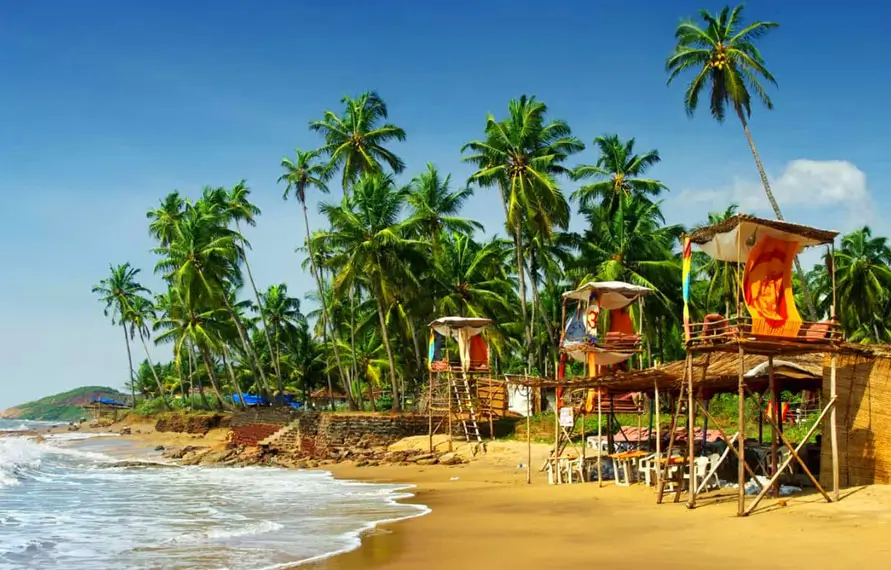
Your resort for the next three nights is a beachfront luxury property with gardens running down to the sand, a spa and several restaurants. South Goa's resorts tend to be quieter, with long empty beaches, while the north is livelier, with cafes, clubs and markets. After checking in, the evening is free. Sunsets on the Arabian Sea are spectacular from November to March, when the sky is clear. Enjoy dinner by the beach, perhaps grilled kingfish or tiger prawns cooked with Goan spices, served at a table set on the sand.
After a relaxed breakfast, our private guide meets you for a half-day tour of the old capital. Old Goa was once one of the richest cities in Asia, and its grand churches, built by the Portuguese in the sixteenth and seventeenth centuries, are listed by UNESCO. The Basilica of Bom Jesus holds the remains of St Francis Xavier in a silver casket, and the vast Se Cathedral across the lawn houses one of the largest church bells in Asia. Modest clothing covering shoulders and knees is required.
Next you drive about 20 minutes to Panaji, the state capital, and walk through Fontainhas, the old Latin quarter. Its narrow streets are lined with brightly painted houses in yellow, blue and ochre, with tiled roofs, wooden balconies and decorative tiles. Small art galleries, bakeries and cafes occupy many of the old buildings. Stop at the white Church of Our Lady of the Immaculate Conception, which sits at the top of a zigzag staircase overlooking the city center. The tour finishes in time for a late lunch.
For lunch, our guide can recommend a traditional Goan restaurant serving dishes such as fish in a tangy coconut sauce with rice, pickled prawns, chicken in a spiced coconut stew and a famous layered coconut cake. The cuisine blends Portuguese and Indian influences, with plenty of coconut, vinegar and chili. Return to your resort in the afternoon for a swim and a rest. In the evening, you might take a sunset cruise on the Mandovi River, where boats offer music and dancing, or dine at one of the resort's restaurants, many of which host live music on weekends.
This day is entirely yours. After so many early starts, most guests are happy to spend it at the resort, alternating between the pool, the beach and the spa. Goa's beaches are wide and sandy, and the sea is generally calm and warm from November to March, with water temperatures around 27 to 28 degrees Celsius. Lifeguards patrol the main beaches during the day. Look for the red flags that warn of strong currents, and avoid swimming after dark. Sunscreen is essential, as the coastal sun is stronger than it feels.
If you want some activity, our team can arrange a dolphin-watching boat trip in the morning, when the sea is calmest, or a visit to a spice plantation inland, where guides explain how pepper, cardamom, vanilla and nutmeg are grown and a lunch is served on banana leaves. Birdwatchers enjoy the Salim Ali Bird Sanctuary on Chorao Island, reached by a short ferry crossing and seen by canoe through the mangroves. Water sports such as kayaking and paddle boarding are available at many resorts, usually best before 11:00.
In the evening, enjoy a final dinner in India. Many resorts can set up a private table on the beach, lit by lanterns, with a menu of fresh seafood. Alternatively, visit one of Goa's well-known restaurants in Assagao or near Candolim, which combine coastal ingredients with modern techniques. Pack your bags before bed and keep your passport and travel documents close at hand. Our team will have messaged you with confirmation of your pickup time for the airport transfer the following day, with timings set around your flight.
Enjoy a final breakfast overlooking the sea and, if your flight leaves later in the day, take one last swim or walk along the beach. Most resorts allow check-out at around 11:00 or 12:00, and late check-out can be requested if the hotel has availability. Our driver collects you at the agreed time for the transfer to the airport, allowing extra time for traffic around the market towns and the bridges over Goa's rivers. For international connections, we suggest arriving at the airport at least three hours before departure to clear check-in and security comfortably.
Goa's airports have direct flights to Delhi, Mumbai and Bengaluru, from where you can connect to international flights, and a few direct international routes to the Gulf. If you are flying home from Mumbai or Delhi, we can book the connecting domestic flight for you and arrange a hotel room for a few hours if there is a long layover. Keep in mind that domestic baggage allowances can be smaller than international ones, so check your ticket conditions and keep valuables, medicines and chargers in your cabin bag during the transfer.
Over twelve days you will have traveled from the Mughal monuments of Agra across the Rajasthan desert to the beaches of the Arabian Sea. Top Indian Holidays, the Jaipur agency that has been arranging private journeys since the late nineties, stays on call throughout your departure and welcomes your feedback after you return home. Many guests come back to see South India, the Himalayas or the tiger reserves of central India, and we are always happy to help shape a second journey around your interests, timing it for the best season in each region.
Fill out this form with all the required information. Within 12 hours, we will provide you with a tailor-made itinerary at the best price.
Read the reviews of our esteemed client's, go through the experiences they had with Top Indian Holidays.

Whether you're planning your first India trip or returning to explore deeper — get honest, expert advice from someone who knows every corner of this country. No pressure, no cost.



 info@topindianholidays.net
 +91-8955000999