12 Nights / 13 Days Fully Guided Tours Private Car
Delhi - Jaipur - Ranthambore - Orchha - Khajuraho - Varanasi - Delhi - Kochi - Alleppey - Kumarakom - Kochi
Rajasthan's desert-edged forts and Kerala's green waterways sit roughly 2,500 kilometers apart, and very few holidays manage to join them gracefully. The Maharajas Express Indian Panorama with Kerala Backwaters does it by letting a train handle the north and a short flight handle the rest. You spend one night in Delhi, six nights in a private cabin rolling between Jaipur, Ranthambore, Agra, Orchha, Khajuraho and Varanasi, and then five slow nights in the far south, where coconut palms replace sandstone and the loudest sound at dusk is a kingfisher diving into the water.
The rhythm of the trip changes deliberately halfway through. The rail week is full and well organized, with guides waiting at each platform and early starts for the Taj Mahal and a tiger safari. Kerala is the reward for all that activity. Two nights in Fort Kochi give you colonial churches, spice warehouses and an evening of classical dance theater. A private Alleppey houseboat then carries you along narrow canals past rice fields and village jetties, with a cook on board preparing fresh fish and slow-cooked coconut stews. Two final nights at a lakeside resort in Kumarakom leave time for Ayurvedic massage, early birdwatching and doing very little at all.
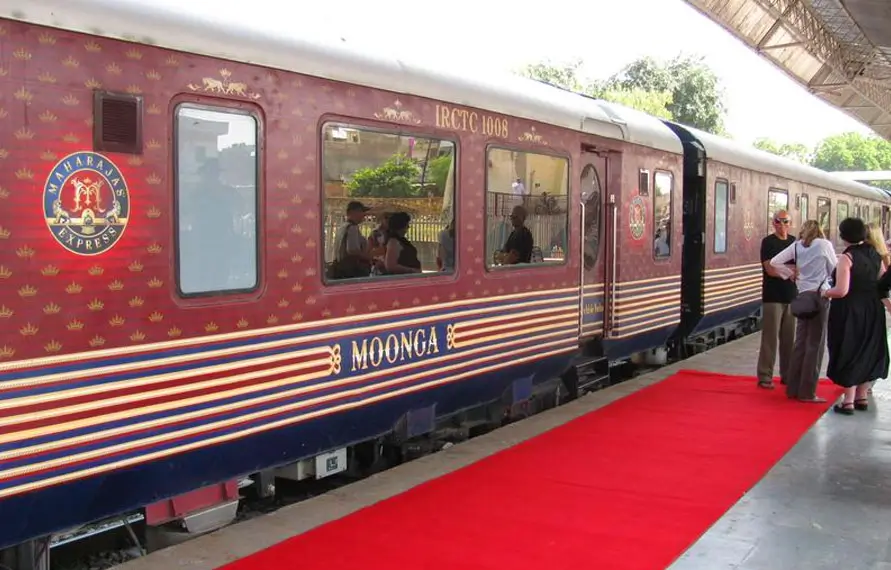
Indian Railways' catering and tourism arm, IRCTC, operates the Maharajas' Express, and the train has collected the World Travel Awards title for top luxury train more than once. Top Indian Holidays sits outside that arrangement: we are a privately owned Jaipur firm, recognized by the Ministry of Tourism with more than two decades of private touring behind us, and we take care of your train booking, the Delhi to Kochi flight connection on the day the train returns, every transfer, the houseboat and your Kerala hotels. The best window for this combination runs from October to March, when Rajasthan is dry and sunny and Kerala's monsoon has passed, leaving the backwaters full, the air warm and the sea calm.
Most international flights land at Indira Gandhi International Airport late at night or in the early hours, so the first day is kept intentionally light. A Top Indian Holidays representative waits in the arrivals hall holding a name board, and a private air-conditioned car takes you to your luxury hotel in central or south Delhi, a drive of roughly 30 to 45 minutes outside rush hour. Early check-in can be requested in advance if your flight lands before dawn, so you can sleep properly instead of waiting in the lobby for the afternoon room release.
If you feel rested by midday, a gentle half-day outing works well. The gardens and red sandstone dome of Humayun's Tomb are calm in the afternoon, and the wide avenues of New Delhi, with India Gate and the government buildings on Raisina Hill, make for an easy drive. Alternatively, many guests stay in, swim and eat lightly. The hotel concierge can help with a local SIM card or currency exchange, both useful before a week on the move. October and March afternoons in Delhi are warm, around 30 degrees Celsius, while December and January are mild and often hazy.
In the evening our team calls to confirm your pickup for the following morning, which will be at around 06:45. Pack the clothes you need for the next week in a soft suitcase that fits easily into the cabin, and keep warm layers handy for the safari and early starts. Heavier luggage meant for Kerala can be stored at the hotel and sent on to Kochi separately if you prefer, which keeps the cabin tidy. A smart outfit for the Rambagh Palace dinner on the first evening is worth placing near the top of your bag.
The quiet platform at Delhi Safdarjung feels more like a private reception than a railway station on departure morning. Guests gather from about 07:30, musicians play, and staff in turbans place a marigold garland around your neck while your bags disappear toward the carriages. The Maharajas Express Indian Panorama leaves at about 08:30, and the first hours are spent learning the train: two restaurant cars, a bar, an observation lounge and a long corridor of polished wood. Your butler introduces himself and notes how you like your coffee and when you want to be woken.
Lunch is served in one of the restaurants as the flat farmland of Haryana gives way to the low, rocky hills of eastern Rajasthan. The menu alternates between Indian regional cooking and continental dishes, and the chefs adjust spice levels on request. After lunch the train manager runs through the week ahead: where to be and when, what to wear at the temple sites, and which afternoons are free. It is a good moment to ask about optional activities, since some, such as spa slots in Jaipur hotels, fill up early.
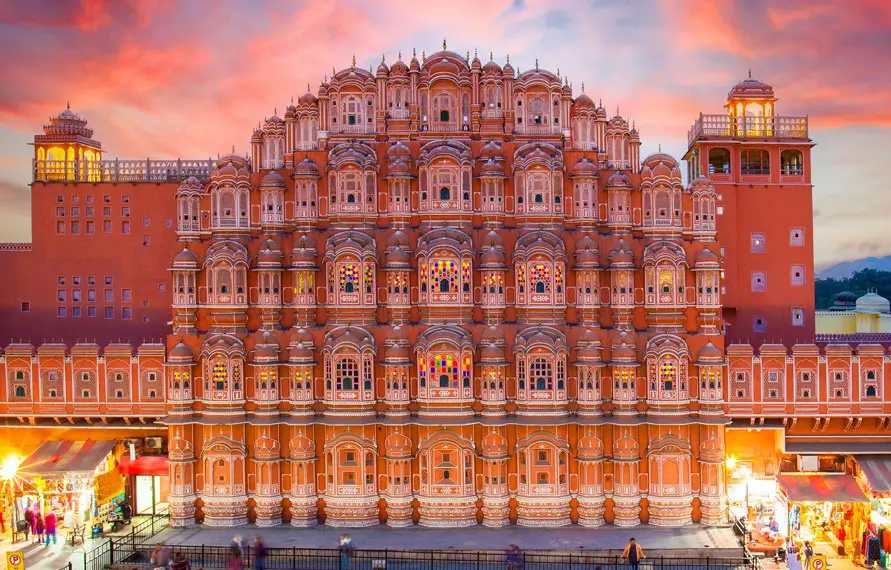
At around 15:00 you arrive in Jaipur for a guided afternoon at the City Palace, still partly occupied by the former ruling family. The Peacock Gate in the inner courtyard, with its painted plaster birds in blue and green, is the favorite photograph of most visitors. The museum displays royal robes, palanquins and an armory of jeweled daggers. Toward evening the coach takes you to Rambagh Palace, once a royal hunting lodge and later a residence, where dinner is served in a hall lit by chandeliers. You are back in your cabin by about 20:30.
After breakfast on board, the guides gather everyone at around 08:30 for the drive to Amber Fort, about 11 kilometers north of the city. The road runs past Jal Mahal, a summer palace that seems to float in the middle of Man Sagar Lake, and then climbs toward the honey-colored walls that cover the hillside. Jeeps carry you to the upper gate. The morning air is still cool in winter, often around 12 to 15 degrees Celsius, and comfortable shoes are needed because the courtyards are paved with uneven stone and connected by ramps.
The guide walks you from the public courtyards into the private wing built for the ruling family and their women. Look for the marble panels carved with flowers and butterflies near the Mirror Palace, and the narrow passageways that once allowed royal women to move unseen between rooms. Views from the upper terraces stretch over Maota Lake and the saffron garden laid out in the water below. The visit lasts about two and a half hours, after which the coach returns you to the train for lunch.
The afternoon is yours. A popular choice is a private visit to a textile workshop where artisans stamp patterns onto cotton with carved wooden blocks, a craft for which the region around Jaipur is famous. Others spend an hour at Jantar Mantar, the eighteenth-century open-air observatory with its giant stone sundial, or simply rest on board. Our team can arrange a car and guide for any of these if you let us know in advance. The train leaves Jaipur in the evening, and dinner is served as it heads toward Sawai Madhopur.
Your butler knocks with tea and biscuits while it is still dark, and by sunrise you are seated in an open safari vehicle at the gates of Ranthambore National Park. Safari slots depend on the month: roughly 06:30 to 10:00 in October, February and March, and 07:00 to 10:30 from November to January. The first half hour can be properly cold in winter, sometimes 6 to 9 degrees Celsius, so a hat, gloves and a windproof jacket will make the drive much more enjoyable. Blankets are usually provided in the vehicle, but layers are better.
Each vehicle is assigned a zone, and your naturalist and driver work it slowly, pausing often to catch the sharp warning cries that deer and monkeys give when a big cat is on the move. Sightings are never guaranteed, though Ranthambore has a strong record. Even without a tiger the morning is rich: crocodiles on the banks of the lakes, large brown deer wading for water plants, peacocks displaying on the tracks and painted storks in the shallows. Ancient fortifications and a ruined pavilion beside the water add a sense of history that most wildlife parks lack.
Breakfast is waiting on board, and the train travels east through the afternoon. At about 15:30 it reaches Fatehpur Sikri, the city Akbar built in the late sixteenth century and left within a generation. The guide explains how the emperor held religious debates in the Diwan-i-Khas, seated on a carved central pillar while scholars argued below. The courtyard of the great mosque, entered through the towering Buland Darwaza, is busy with pilgrims visiting the white marble tomb of a Sufi saint. Back on board, the evening has a themed dinner with music.
Agra greets you before the sun does. Coaches leave the station early so that you join the first entry at the Taj Mahal, which opens at sunrise every day except Friday. Passing through the red sandstone gateway, you see the tomb framed perfectly by the arch, its white marble still pale blue in the early light. Your guide explains how the symmetry works, why the four minarets lean very slightly outward and how the inlaid flowers were cut from carnelian, jade and lapis lazuli. Bags should be small, since food, tripods and large backpacks are not allowed.
As the sky brightens, the marble turns soft gold and then a brilliant white. Walk to the riverside terrace behind the tomb for a different view, across the Yamuna toward the Mehtab Bagh garden, where swallows and parakeets dart along the water. After about two hours you are driven to breakfast with a view of the monument, a relaxed meal that gives the early start a sense of occasion. Morning temperatures in winter are cool but pleasant, and the haze often lifts by around 09:00.
Lunch follows back on the train, and the afternoon is unscheduled. Guests interested in craft can visit a marble inlay workshop, where descendants of the families who worked on the Taj still set tiny chips of stone into white marble by hand. Agra Fort is the other popular option, especially the white marble pavilion from which Shah Jahan looked downriver at his wife's tomb during his final years. In the evening the train leaves Agra for the long overnight run into Bundelkhand, the rocky heartland of central India.
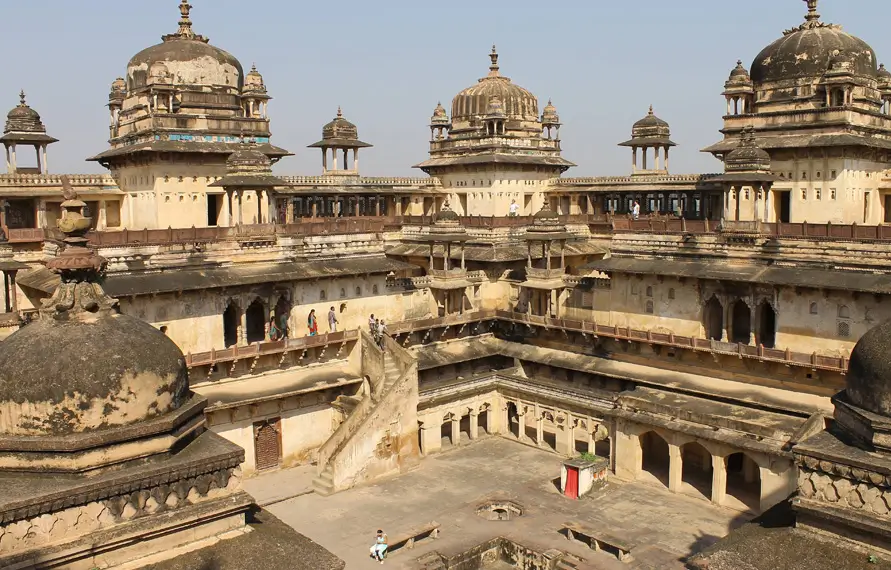
The train halts near Orchha at about 07:00, while mist still lies over the Betwa River. This small town has a sleepy, rural feel, yet its skyline is full of domes and towers from the time of the Bundela kings. The guide leads you through the Jahangir Mahal, a square palace with corner turrets and a central courtyard, then into the older Raja Mahal, where faded murals of gods, hunting scenes and court life still cover the ceilings. Early morning is the coolest and quietest time to see both buildings.
Before returning to the train you ride through the village and along the river, where a long line of royal cenotaphs stands on the bank. Their domed roofs are home to Egyptian vultures and the endangered long-billed vulture, so keep binoculars at hand. The town also has an unusual temple in which the god Rama is worshipped as a king, with an armed guard of honor each day. Breakfast is served on board, and the train continues south through a landscape of fields and low wooded hills.
Once lunch is over, a guide takes you around the Western Group of the Khajuraho temples, raised a thousand years ago by the Chandela dynasty and listed by UNESCO. The sculptors left almost no surface uncovered: dancers adjusting their anklets, warriors on horseback, elephants in procession, scenes of love and devotion side by side. A guide helps you read the panels in order around each temple's platform. The late afternoon light is ideal for photographs. In the evening you can attend a classical dance performance or the sound and light show before dinner on board.
By breakfast the train is crossing the wide plain of the Ganges, and in the late morning it reaches Varanasi. Lunch is served at the Taj Ganges hotel, a calm green compound in the city's cantonment area. Afterward the coach drives about 10 kilometers north to Sarnath, where the Buddha preached his first sermon. The ruins of monasteries stand among lawns, and the solid brick Dhamek Stupa rises over the site. The museum holds the lion capital of the emperor Ashoka, which became the national emblem of India.
Back in the city, you call at a family workshop where weavers produce silk brocade on hand looms. Watching a pattern of gold thread appear line by line explains why the best pieces take weeks to finish. Varanasi is also an easy place to buy fine silk scarves, and the workshop can ship larger items abroad. Wear light layers and comfortable closed shoes for this part of the day, because the lanes leading toward the river are narrow, uneven and busy with pilgrims, cows and motorbikes.
In the early evening you board a rowing boat on the Ganges in Varanasi. As the light fades the river steps fill with people, and the evening fire ceremony begins at about 18:00 in winter. Young priests in silk robes swing heavy brass lamps, blow conch shells and ring bells in perfect unison, and the smoke drifts across the water. Small boats sell leaf cups holding a marigold and a candle, which you can set afloat on the current. The farewell dinner is served on the train as it begins the overnight return to Delhi.
A late breakfast is served as the train crosses the plains toward the capital, and there is time to settle your account for drinks and extras with the guest relations team. The train arrives at Delhi Safdarjung at around 12:00. Our driver meets you on the platform, collects your luggage and drives you straight to Indira Gandhi International Airport, about 30 to 45 minutes away, for an afternoon domestic flight to Kochi. If you stored luggage at your Delhi hotel, we will have already collected it and loaded it into the car.
The nonstop flight to Kochi takes about three hours and crosses almost the full length of India, from the dry northern plains to the coconut-fringed coast of Kerala. As you step out of the aircraft the change is immediate: warm, humid air, the smell of rain on leaves and temperatures of around 30 degrees Celsius even in winter. Our Kerala driver meets you in arrivals for the drive of roughly one to one and a half hours to Fort Kochi, the historic quarter at the tip of a peninsula.
Your hotel for the next two nights is a boutique heritage property in Fort Kochi, typically a restored colonial mansion or warehouse with high ceilings, wooden shutters and a courtyard pool. After a long but rewarding day, a light seafood dinner in the hotel garden is the ideal way to unwind. Kochi's cooking leans on coconut, fragrant local leaves, black pepper and tamarind, and the kitchen will happily make dishes milder if you ask. Take an early night, since the next morning starts at the waterfront.
Early morning is the best time to see the Chinese fishing nets on the Fort Kochi waterfront at work. These huge cantilevered frames of teak and bamboo were probably introduced by traders from the court of Kublai Khan, and teams of fishermen still lower and raise them with ropes and stone counterweights. From there your private guide strolls with you to St Francis Church, which has the longest history of any European-built church in the country and held the body of the Portuguese navigator Vasco da Gama before his remains were shipped home, and to the Santa Cruz Basilica with its painted ceilings.
After breakfast you drive a few minutes to Mattancherry, where the Dutch Palace displays some of the finest temple murals in Kerala, including scenes from the Ramayana painted in rich earth colors. Nearby, Jew Town keeps the Paradesi Synagogue, with its hand-painted blue and white Chinese floor tiles and Belgian glass lamps. The palace is closed on Fridays and the synagogue on Fridays, Saturdays and Jewish holidays, so we arrange the order of visits around your dates. Old ginger and pepper warehouses line the street, many now home to antique shops and cafes.
The afternoon is free for a rest or a short walk through Princess Street. At about 17:00 you head to a small theater for a performance of Kerala's classical dance drama. Arriving early lets you watch the performers apply their elaborate makeup, painting faces green, red and white with natural pigments, which takes more than an hour. The show itself starts around 18:00 and lasts about an hour, with the story explained in English beforehand. Dinner is at a waterfront restaurant known for grilled catch of the day.
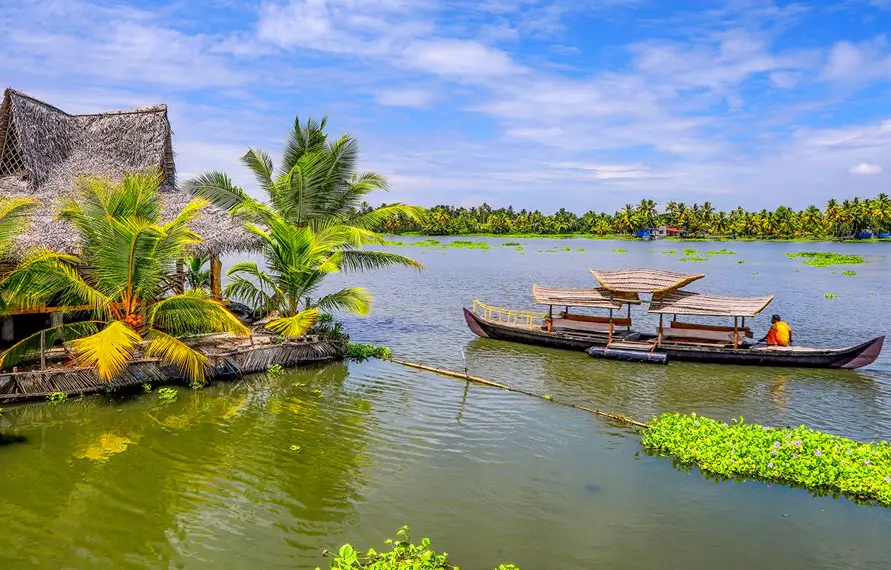
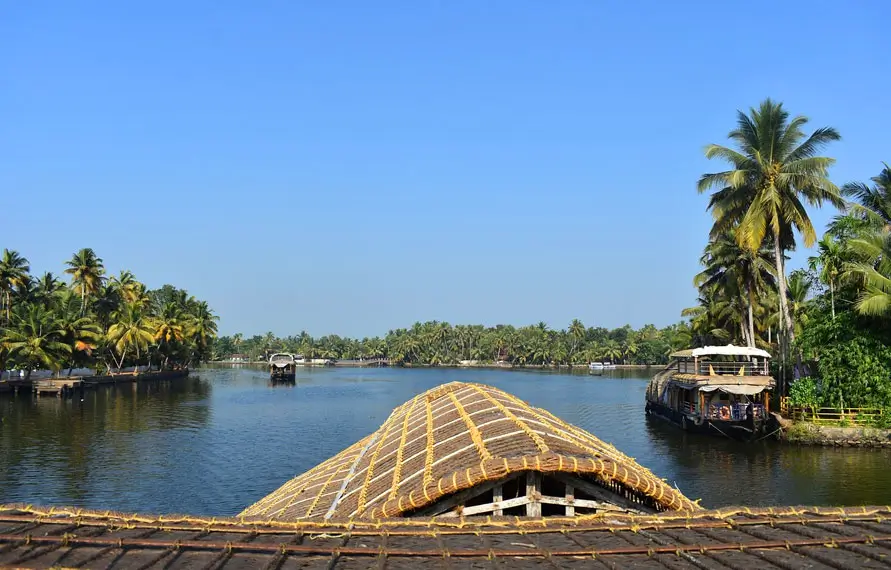
After a leisurely breakfast you leave Fort Kochi for Alleppey, about 60 kilometers south, a drive of around one and a half to two hours along the coastal highway. Alleppey sits at the heart of the Kerala backwaters, a network of lakes, rivers and canals that runs parallel to the Arabian Sea. You board your private houseboat at around 12:00. These boats are built in the style of traditional rice barges, with curved hulls and woven palm roofs, and are fitted with air-conditioned bedrooms, private bathrooms and an open deck furnished with cushioned loungers and a dining table in the shade.
Your crew normally includes a captain, a cook and a helper. Lunch is served as the boat slides into quieter channels: rice, fish in a spiced sauce soured with tart Kerala tamarind, vegetables cooked with grated coconut and crisp lentil wafers, finished with ripe bananas fried in coconut oil. The afternoon passes slowly, watching life along the banks, where women wash clothes on stone steps, ducks are herded along the water and narrow canoes carry children home from school. Green rice paddies, some lying below the water level, stretch away beyond the dikes.
Local rules require houseboats to stop cruising at around 17:30, and the crew moors in a quiet spot for the night. This is the time for tea on the deck, a short walk through a village with one of the crew, or simply watching the sunset turn the water copper. Dinner is cooked fresh on board, and you can ask for anything from lobster in a spiced coconut sauce to a simple grilled fish. Mosquito repellent is useful at dusk. Bedrooms are air-conditioned at night, and the quiet is remarkable after the city.
The morning on the water is often the most magical part of the houseboat stay. Mist hangs over the canals, kingfishers and cormorants work the shallows, and the first passenger ferries chug past with commuters. Breakfast is served on deck, typically with fruit, eggs and Kerala rice pancakes. The boat docks again at around 09:00, and our driver collects you for the short transfer to Kumarakom on the eastern shore of Vembanad Lake, about an hour by road, with the car following a quiet route lined with paddy fields and small churches.
Kumarakom has a cluster of luxury resorts set in coconut groves right on the lake, many with cottages built in the style of old Kerala homes and private plunge pools. Check in, relax and take a swim before lunch. In the afternoon the resort's Ayurveda center is the natural destination. A traditional full-body massage with warm herbal oils lasts about an hour, and longer therapies can be booked for the following day. Licensed doctors at the better resorts can advise on the right treatment after a short consultation about your health and energy levels.
Late afternoon is ideal for a sunset cruise on Vembanad, India's longest lake, in a small motorboat or a traditional canoe. The light turns the palms into silhouettes and fishing boats return home across the water. Back at the resort, dinner can be taken by the lake, perhaps with pearl spot fish, a local favorite cooked in banana leaf. Evenings in Kumarakom are warm, typically around 25 degrees Celsius in winter, and pleasantly free of the noise and traffic of the cities you visited earlier.
Birdwatchers should set the alarm for about 06:00 for a guided walk in the Kumarakom Bird Sanctuary, a 14-acre patch of mangrove and woodland next to the lake. Between November and February, migratory birds arrive from northern India and beyond, joining resident darters, egrets, night herons and kingfishers. A naturalist from the resort usually leads the walk, which takes about two hours, and returns you in time for a late breakfast. Wear light clothing with long sleeves and closed shoes, since the paths can be damp.
The rest of the day is designed for rest. You might book a second Ayurvedic therapy, join a cooking demonstration of Kerala dishes, or cycle through the nearby village to see coconut fiber being spun into rope and palm wine tappers climbing the trees. Some resorts organize a short canoe trip through the narrow canals that big boats cannot reach. All of these can be set up through the resort or by calling our team, and none require more than a couple of hours, which leaves long stretches of the day free for the pool or a book.
In the evening the resort often hosts a cultural performance, perhaps a Kerala martial arts demonstration or traditional drumming. Your last dinner in India is a good moment to try the local rice pancakes with a mild coconut stew, or to ask the chef for a spread of Kerala seafood. Pack before bed, keeping your passport and boarding documents easy to reach. Our team will have confirmed your departure time and pickup by message during the day, so there is nothing to arrange in the morning.
Breakfast is served by the lake, and depending on your flight time you may have the morning to enjoy the pool or take a last walk along the water. Late checkout can be requested, though it depends on the resort's occupancy. Our driver collects you for the transfer to Cochin International Airport, which takes about two hours, so for an international flight we usually suggest leaving Kumarakom at least five hours before departure. The road is good but slows near Kottayam and Ernakulam during the morning rush, and the extra time removes any stress from the final journey.
Cochin International Airport has direct flights to the Gulf states and Southeast Asia, with onward connections to Europe, North America and Australia. Some guests instead fly back to Delhi or Mumbai for a long-haul departure, which we can book as part of your arrangements. If you have time to spare, a short stop at a spice shop near the airport is an easy way to take home Kerala's famous black pepper, cardamom and cloves in airtight packs suitable for travel. Customs rules in most countries allow dried whole spices, though fresh produce and seeds for planting are usually restricted.
Over thirteen days you will have crossed India from the deserts of Rajasthan to the backwaters of the south, mostly without having to repack. Top Indian Holidays, the Ministry of Tourism approved Jaipur team that organized your trip independently of the train, stays reachable by phone and messaging throughout your final transfer, and we welcome feedback after you return home. If you would like to come back to India, many travelers combine a second visit with the tiger reserves of central India or the tea-covered hill country of Munnar, or a second luxury train such as the Palace on Wheels.
Fill out this form with all the required information. Within 12 hours, we will provide you with a tailor-made itinerary at the best price.
Read the reviews of our esteemed client's, go through the experiences they had with Top Indian Holidays.

Whether you're planning your first India trip or returning to explore deeper — get honest, expert advice from someone who knows every corner of this country. No pressure, no cost.



 info@topindianholidays.net
 +91-8955000999