07 Nights / 08 Days Fully Guided Tours Private Car
Mumbai - Vadodara - Udaipur - Jodhpur - Agra - Ranthambore - Jaipur - Delhi
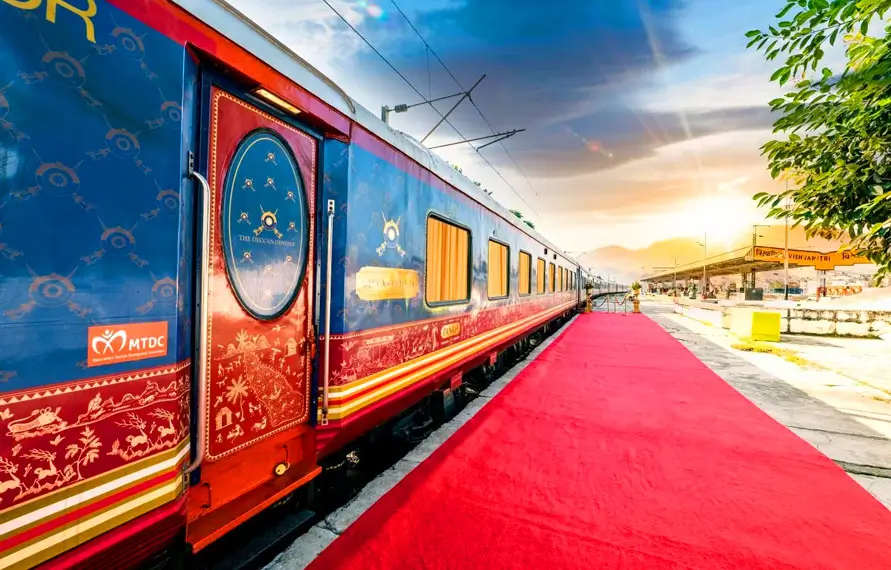
Mumbai's grand Victorian terminus is the starting line for the Deccan Odyssey Indian Sojourn Tour, a seven-night journey that travels north from the Arabian Sea to the capital. The train leaves on a Saturday afternoon and reaches Delhi early the following Saturday, passing through Gujarat, the lake country of southern Rajasthan, the edge of the Thar Desert, the Mughal heartland and a tiger reserve before ending in the Pink City and finally Delhi. It suits travelers who fly into Mumbai and want to see the classic sights of the north without backtracking.
The order of the route shapes the experience. You begin gently in Vadodara, a former princely capital where few foreign visitors go, then move into Rajasthan through Udaipur and its lakes. Jodhpur brings the drama of Mehrangarh Fort and an evening meal on its ramparts, and the second half delivers the Taj Mahal, a game drive in Ranthambore and a final day among the forts and palaces of Jaipur. Each stage builds on the last, and the busiest sights come once you have found your rhythm on board. Departures for 2026-27 are 3 October, 24 October, 14 November, 19 December, 23 January, 20 February and 3 April.
Maharashtra Tourism runs the Deccan Odyssey jointly with Indian Railways. Every Deluxe Cabin and Presidential Suite comes with its own bathroom, and the shared carriages hold two dining cars, a lounge with a bar, a compact fitness room and an Ayurvedic treatment area. As a Jaipur team with more than two decades of experience and Ministry of Tourism approval, Top Indian Holidays acts independently of the train and handles the reservation, your Mumbai and Delhi hotels, private transfers and any extra days you would like to add.
Arriving in Mumbai a day early gives you time to recover from the flight, and we suggest at least one night at a hotel near the Gateway of India before the Indian Sojourn begins. On the day of departure the morning is free. A stroll along the waterfront, a coffee at one of the old Irani cafes in the Fort district or a swim at the hotel pool are all easy ways to pass the hours. Keep lunch light, as the first dinner on board is generous.
At about 15:30 guests gather at Chhatrapati Shivaji Maharaj Terminus, the busy Victorian station that is also a UNESCO World Heritage Site. Our driver drops you at the entrance, and the train's staff take over from there with a traditional welcome, a cool drink and swift registration. Bags go straight to your cabin. Take a moment on the platform to look at the long line of carriages, each named after a place in Maharashtra, before you climb on board for the week ahead, camera in hand.
The train leaves Mumbai and runs north along the coastal plain toward Gujarat. Your cabin attendant explains the controls, the safe and the call button, and asks about any dietary needs. The first evening meal arrives in one of the dining cars, where the kitchen team cooks regional Indian plates alongside continental options from fresh ingredients. Evenings are smart casual. The bar lounge stays open after dinner, and it is a comfortable place to meet the other guests and look over the program for the week.
You wake at Vishwamitri station in Vadodara, the former capital of the Gaekwad rulers of Baroda, one of the wealthiest princely states of British India. After breakfast you drive about an hour into the countryside to Champaner-Pavagadh Archaeological Park, a UNESCO World Heritage Site. This was a royal city of the Gujarat Sultanate around the turn of the sixteenth century, abandoned after it was captured by the Mughal emperor Humayun. Its walls, gates, wells and mosques now stand among fields and scrub forest, rarely crowded.
The Jami Masjid is the masterpiece here: a broad courtyard, two tall minarets and a hall of carved stone pillars that mixes the styles of Hindu temple builders with Islamic design. Look up at the carved stone window screens and the domes of the upper gallery. The site is quiet compared to the famous monuments of the north, and your guide has time to talk about the history of Gujarat's sultans and the hill shrine of Pavagadh above. You return to Vadodara for lunch on board the train.
The afternoon begins at the Maharaja Fateh Singh Museum, a palace building that once served as a school for the royal children and now displays paintings by Raja Ravi Varma, who brought European oil techniques to Indian subjects. At about 17:30 you are welcomed at the Laxmi Vilas Palace, still the home of the former royal family, for tea and snacks from the palace kitchen. Some departures also include a folk performance. You return to the train for dinner as it heads north into Rajasthan.
The train climbs into the Aravalli hills overnight, and breakfast is served with views of rocky slopes and small farms. In mid-morning you arrive in Udaipur, a city founded by the rulers of Mewar, who claimed descent from the sun and were famous for refusing to bow to the Mughals. The guide begins with the City Palace, a cluster of palaces stacked along a ridge above Lake Pichola, and walks you through its courtyards, painted rooms and balconies with sweeping views over the water and the hills beyond.
The Crystal Gallery inside the palace is an unusual sight: crystal seats, tables, a bed and even a fountain ordered from England by a nineteenth-century ruler, who died before the shipment arrived. Afterward you board a boat for a cruise on Lake Pichola. From the water you see the Lake Palace floating in the middle of the lake, the white bathing steps of the old city, the temples on the shore and the low hills beyond. Morning cruises are cooler and the light is clear, so have your camera ready.
Lunch is served in the city, and in the afternoon you join a walking tour of the old city and its markets. The narrow lanes around the Jagdish Temple are lined with shops selling miniature paintings, wooden puppets, hand-block printed fabrics and silver jewelry. Watch an artist at work on a miniature for a few minutes and you will see why the best pieces take weeks. Bargaining is normal in the smaller shops but should stay friendly. You return to the train at about 18:00, and it departs for Jodhpur at about 20:00.
The landscape turns drier as the train approaches Jodhpur, on the eastern edge of the Thar Desert. After breakfast you leave for Mehrangarh Fort at about 10:00. The fort rises straight out of a sandstone ridge more than one hundred meters above the city, and its walls seem to grow out of the rock itself. The founder of Jodhpur, Rao Jodha, started building here in the fifteenth century, and later rulers added the delicate palaces inside, with their latticed stone screens and colored glass windows.
The museum inside Mehrangarh is one of the best run in India. Galleries display ornate elephant seats, royal palanquins, painted miniatures, turbans, textiles and arms, and an audio guide is available in several languages if you would like to linger. From the ramparts, the old city below is a sea of blue-washed houses, a color once linked to the priestly caste and now simply part of the city's identity. You return to the train for lunch at about 13:30 and a short rest during the hottest hours.
In the afternoon an open three-wheel motor taxi carries you down into the old city to the Clock Tower and its market, an energetic maze of stalls selling spices, textiles, bangles and dried chilies. Your guide leads you past old merchants' mansions with carved sandstone fronts. On many departures the evening ends back up at Mehrangarh with a barbecue dinner in a royal courtyard of the fort, the lights of the city spread out below. The train then departs for Agra, traveling east through the night.
The train stops at Tundla, east of Agra, and at about 08:30 you set off on the forty-minute drive into the city. Your first visit is the Taj Mahal. Rather than repeating what every postcard shows, your guide focuses on the details that reward a close look: the way the minarets lean very slightly outward, the calligraphy that grows larger toward the top of the arch so it looks even from the ground, and the flower inlays that glow when a torch is held against the translucent stone. Allow time to sit in the garden.
Lunch is served at a city hotel. In the afternoon you visit Agra Fort, the Mughal citadel whose double walls run for more than two kilometers along the Yamuna River. Its palaces trace the changing taste of three emperors, from the red sandstone of Akbar to the white marble of Shah Jahan. Then you cross the river to Itmad-ud-Daulah, a small and exquisite tomb built by the empress Nur Jahan for her father, which many travelers end up liking almost as much as the Taj Mahal.
The day ends at a workshop of marble inlay craftsmen, the descendants of families who have done this work for generations. You can watch artisans shape tiny pieces of colored stone on a hand-driven wheel and set them into marble with natural resin. If you buy, ask for a certificate and arrange shipping through the workshop. Back on board for dinner at about 19:00, the train leaves Agra at around 20:00 for Sawai Madhopur. The Taj Mahal is closed on Fridays, so this Wednesday visit fits neatly.
The train pulls into Sawai Madhopur soon after dawn, and an open-sided safari jeep waits to carry you into Ranthambore National Park. Safari timing is set by the forest department and confirmed on board, and depending on the departure you head out either in the morning or the afternoon. Morning drives usually go out between about 06:30 and 10:00 in October and from February to April, shifting to roughly 07:00 until 10:30 in the three coldest months. Expect temperatures of 6 to 9 degrees Celsius at the gate in winter, so pack a warm layer, a hat and gloves.
Ranthambore is famous for its tigers, which have become unusually used to vehicles over the years, and the park's ruined pavilions and lakes make a spectacular background for photographs. A sighting is never guaranteed, but the dry season gives good odds as animals gather at water. Your naturalist also points out large brown deer, spotted deer, gray monkeys, crocodiles, leopards on rare occasions, and some of the three hundred or so bird species recorded here. Keep still and quiet when the vehicle stops at a waterhole.
Between drives and lunch on board, you take a guided walk through a village near the park, meeting farming families who live alongside the forest and seeing how crops are grown and stored. High tea is served at the Sawai Madhopur Lodge, a former hunting retreat of the ruling princes of Jaipur, now run as a Taj hotel, with lawns and colonnades from the age of royal shooting parties. You return to the train in the early evening, and it sets off north toward Jaipur with dinner served on board.
Arrival in Jaipur is around 08:30, and a welcome at the station leads straight into your last full day of sightseeing. The morning is spent at Amber Fort, the honey-colored hilltop fortress that was the seat of power before Jaipur was built. This time your guide focuses on daily life inside: where the royal women lived, how water was raised from the lake below, and how the walls were kept cool in summer. Notice the Maota Lake garden below the fort, laid out in the shape of a formal Mughal garden.
After lunch at a city hotel, the afternoon takes you into the old city, which Sawai Jai Singh II laid out as a new capital during the early eighteenth century, using a grid inspired by ancient texts on architecture. You visit the City Palace, where the museum displays royal costumes, weapons and a pair of enormous silver urns, and you pass the five-story facade of Hawa Mahal. The Jantar Mantar observatory, with its giant stone sundial, is included on many departures, and your guide explains how it measured time to within seconds.
If time allows, the late afternoon is free for shopping or a treatment at a palace hotel spa. Jaipur is one of the world's major centers for cutting colored gemstones, and it is also known for block-printed cottons and hand-knotted rugs. Buy only from trusted shops, which your guide can recommend. You return to the Deccan Odyssey in the early evening for the farewell dinner, a chance to thank the crew and say goodbye to fellow guests before the short overnight run to Delhi and the end of the line.
Breakfast is served early as the train enters the outskirts of the capital, and the journey ends at a Delhi station in the early morning. Our driver meets you on the platform with a sign bearing your name, helps with your luggage and takes you to your hotel or the airport. Delhi's international airport is usually 30 to 50 minutes from the main railway stations, though rush-hour traffic can stretch that, so allow a generous margin if you have a morning flight. We track the train's arrival time for you.
With a day or two in Delhi, there is plenty to see. Humayun's Tomb, a garden tomb that inspired the Taj Mahal, is calm in the early afternoon, and the Qutub Minar, a soaring stone tower from the early Delhi Sultanate, is close to the airport. A guided walk through the lanes of Old Delhi and a visit to the Jama Masjid give a vivid contrast to the quiet of the train. We can arrange a day room if you are flying out late in the evening.
If you are not ready to fly home, Top Indian Holidays can extend your trip with a few nights in Varanasi on the Ganges, a retreat in the Himalayan foothills or a stay in Kerala. We arrange private cars, English-speaking guides, flights and carefully chosen hotels, and our team is on call around the clock until you leave the country. Many of our guests return for a second journey, often on a different route of the same train, and we are always happy to suggest one.
Fill out this form with all the required information. Within 12 hours, we will provide you with a tailor-made itinerary at the best price.
Read the reviews of our esteemed client's, go through the experiences they had with Top Indian Holidays.

Whether you're planning your first India trip or returning to explore deeper — get honest, expert advice from someone who knows every corner of this country. No pressure, no cost.



 info@topindianholidays.net
 +91-8955000999