09 Nights/ 10 Days Fully Guided Tours Private Car
Delhi - Agra - Ranthambore - Jaipur - Delhi - Udaipur - Jodhpur - Delhi
Rajasthan was once a patchwork of more than twenty princely states, each with its own ruling family, capital and style of palace, and the Maharajas Express Treasures of India with Udaipur & Jodhpur lets you see several of them in one elegant sweep. The trip opens with a night in Delhi, followed by three nights on India's most celebrated luxury train through Agra, Ranthambore and Jaipur. You then fly west to the lake city of Udaipur, drive through the Aravalli Hills to the marble temple of Ranakpur and finish in Jodhpur beneath the walls of one of the mightiest forts in Asia.
The appeal of this combination lies in its balance. The train portion is busy and social, with a guided program every day, shared dinners and a butler at your door. The second half slows right down. In Udaipur you have two nights by Lake Pichola, with time for a sunset boat ride, a long lunch on a terrace and unhurried wandering in the old city. In Jodhpur you stay two nights in a palace or heritage hotel, close enough to the blue old town to walk its lanes in the cool of the morning. The road day between the two, past farming villages and through forested hills, is one of the most scenic drives in Rajasthan.
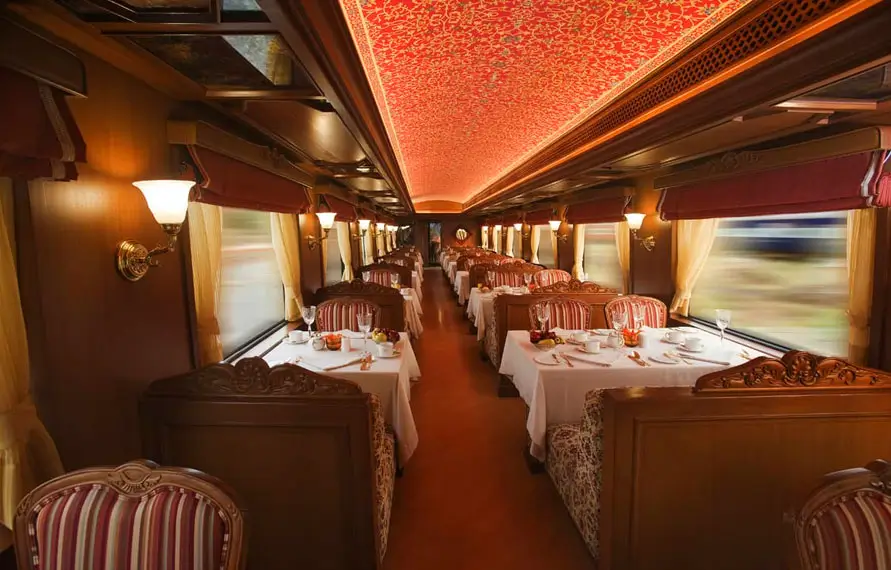
IRCTC runs the Maharajas' Express, a train that the World Travel Awards have more than once voted the top luxury train on the planet. Its cabins, from Deluxe to the carriage-length Presidential Suite, all have private bathrooms, broad windows and butler service. We at Top Indian Holidays, a Ministry of Tourism approved company that has run private tours from Jaipur since the late nineties, are not part of the train's management; we simply reserve your cabin and organize everything around it: hotels with daily breakfast, domestic flights, a private car with driver and expert local guides. The train portion follows the 2026-27 Treasures of India dates, which we match to your arrival in Delhi.
International flights tend to land in Delhi late at night or in the early hours, so your first day is all about rest. Our representative meets you in the arrivals hall of Indira Gandhi International Airport holding a name board, helps with your luggage and walks you to your private air-conditioned car. The drive to your luxury hotel in central Delhi takes 30 to 50 minutes depending on traffic. Check-in is arranged in advance, and if you arrive in the morning, we can request early access to your room so you can sleep off the flight.
The rest of the day is free. If you feel up to a short outing, your driver can take you to the gardens of Humayun's Tomb, a red sandstone Mughal mausoleum surrounded by lawns and water channels, which served as an inspiration for the Taj Mahal. Lodhi Garden, a popular park dotted with fifteenth-century tombs, is another gentle option for a walk in the late afternoon. Both are close to many of the city's best hotels and make an easy introduction to India without the crowds of the old city.
In the evening a member of the Top Indian Holidays team meets you at the hotel to hand over your travel documents, train tickets and contact numbers, and to go through the schedule for the next morning. This is the right time to ask questions about clothing, tipping or local customs. Delhi has a superb restaurant scene, and we are happy to recommend a table for your first Indian dinner. Have an early night, because the transfer to Safdarjung station leaves early the following morning.
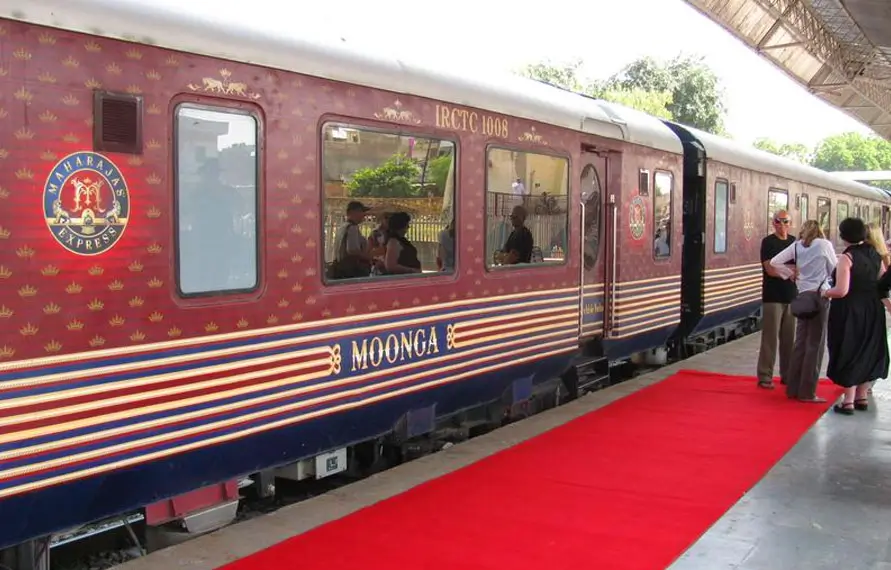
After an early breakfast your driver takes you to Delhi Safdarjung station, where the Maharajas Express waits on the platform in its deep red and gold livery. The welcome is pure theater, with garlands, music and a welcome drink, and staff take your luggage directly to your cabin. If you have bags you will not need on the train, our driver can store them for you until you return to Delhi, which keeps your cabin uncluttered for the three nights on board and saves the porters a great deal of lifting.
As the train leaves the city behind, brunch is served in the restaurant car. Your butler introduces himself and goes through the details of the cabin, and a short briefing in the lounge sets out the schedule for each day. The first stop is Agra, the Mughal capital for much of the sixteenth and seventeenth centuries. The guided visits here cover the Taj Mahal and Agra Fort, with the exact order set by the train's program for your departure, and you have the whole of the first afternoon and the following morning in the city.
At the Taj Mahal, the guide points out details that turn a famous postcard into a building you understand: the way the minarets lean slightly outward so they would fall away from the tomb in an earthquake, the shift of the marble color through the day and the semi-precious stones set into the walls in floral patterns. Evening options include a massage or other treatment at one of Agra's five-star hotels, or a stage show that retells in dance the love story of Shah Jahan and Mumtaz Mahal, followed by dinner on board.
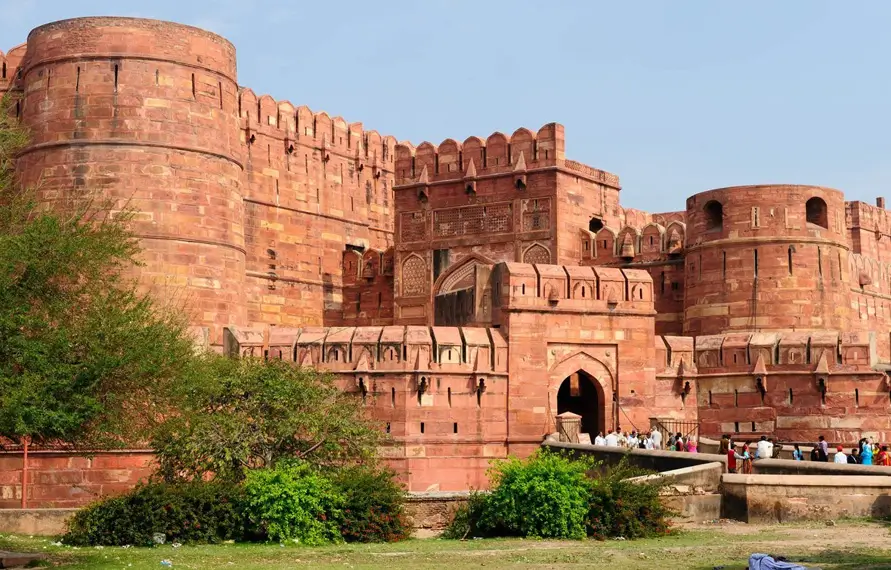
Morning in Agra completes the Mughal chapter of the trip. At Agra Fort, a sprawling citadel of red sandstone on the Yamuna River, your guide traces three generations of emperors in its architecture, from Akbar's robust walls to the delicate marble halls of Shah Jahan. The Hall of Private Audience, the Pearl Mosque seen from a distance and the octagonal tower where Shah Jahan lived out his final years are all part of the tour. The light in the early morning is soft and cool, ideal for photographs across the river.
The train leaves Agra before lunch and crosses into Rajasthan, the land of the princely states that the rest of this trip celebrates. Over lunch you can look out over ravines, mustard fields and villages where women in bright clothing carry water pots on their heads. Use the time to prepare for the afternoon: comfortable trousers, closed shoes, a hat, sunscreen and a fleece for the drive back as the light fades. Colors such as khaki, olive and brown are better than white or bright shades on safari.
In the afternoon you set off from Sawai Madhopur by open vehicle into Ranthambore National Park. The afternoon safari runs from about 14:00 to 17:30 in winter and from about 14:30 to 18:00 in October, February and March. Your naturalist reads the forest closely, tuning in to the warning cries of startled deer and monkeys and checking the dust for fresh tracks to judge where a tiger may be. Beyond the big cats, the ruined walls of Ranthambore Fort, the lakes and the huge banyan trees create a magical setting. An Indian evening with music and regional dishes follows on board.
The train spends the night traveling to Jaipur, and breakfast is served on board as the morning light falls on the Pink City. The day is a lesson in how the Kachwaha rulers lived, starting at Amber Fort, their stronghold before Jaipur was founded. Jeeps take you up the steep road to the main courtyard, and from there your guide leads you through the public halls into the private apartments. The Mirror Palace, with its walls of tiny reflective glass, is the highlight, but do not miss the views of the old defensive walls snaking across the hills.
Back in the city, you visit the City Palace, where the royal family still lives in one wing, and the Jantar Mantar observatory beside it. The observatory is a collection of nineteen giant stone instruments built in the early eighteenth century to measure time, track stars and predict eclipses. Standing beneath the largest sundial, which casts a shadow that moves visibly every few seconds, gives you a real sense of the scientific ambition of the ruler who built it. Lunch is served on board afterward.
The afternoon is free for optional activities, such as a spa visit, a round of golf, a shopping trip with a guide or simply resting on the train. Jaipur is famous for gemstones, block-printed textiles, blue pottery and silver jewelry, and your guide can steer you toward reputable workshops. In the evening a performance of Kalbelia dance, a fast and graceful folk style from the desert, entertains guests before dinner. The train then departs for Delhi on its final overnight run of this luxury train section of your trip.
Breakfast is served on board as the train approaches Delhi, and after farewells to your butler and fellow guests you step off at Safdarjung station. Our driver is waiting on the platform with any luggage you left in his care and drives you straight to the domestic terminal for your flight to Udaipur. The flight takes about 1 hour and 20 minutes, and the approach over the Aravalli Hills, with lakes glinting between the ridges, gives a beautiful first view of southern Rajasthan. A window seat is well worth requesting at check-in.
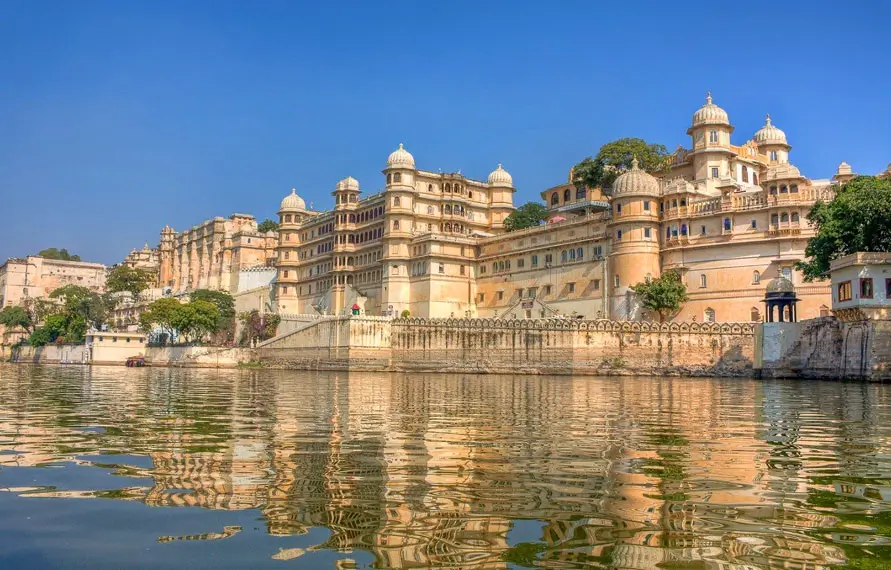
At Udaipur airport our local representative meets you and drives you to your lake-view hotel, about 30 to 40 minutes away. Udaipur is often called the City of Lakes, and it is one of the most romantic cities in India. Udai Singh II, a sixteenth-century ruler of the Mewar dynasty, chose this valley for a new capital, and the city spread around Lake Pichola with palaces, temples and mansions built right to the water's edge. After the busy rhythm of the train, the slower pace here is very welcome, and the hotel staff will happily arrange anything you need.
Late in the afternoon you head to the jetty for a sunset boat ride on Lake Pichola. The boat circles the island of Jag Mandir, a seventeenth-century pleasure palace, and passes the white marble Lake Palace, which seems to float on the water. As the sun sets behind the hills, the City Palace glows gold on the eastern shore, and lights begin to sparkle on the bathing steps of the old city. Dinner is at leisure, and we recommend a rooftop restaurant with a view of the illuminated palace.
After a leisurely breakfast your guide collects you for a walk through the City Palace of Udaipur, which no other royal residence in the state surpasses in size. Successive rulers of Mewar added wings, courtyards and towers over four centuries, creating a maze of rooms decorated with mirror work, colored glass, frescoes and inlay. The Peacock Courtyard, with its glass mosaic birds, is the most photographed corner, and the views over the lake from the upper terraces are superb. Allow about two to three hours here, and wear comfortable shoes for the many stairs.
Next you visit Saheliyon Ki Bari, the Garden of the Maidens, built in the eighteenth century for the ladies of the royal court. Its lotus pools, marble elephants and fountains, fed by the lake through underground channels, make it a cool and peaceful spot in the middle of the day. Then stroll through the old city lanes near the Jagdish Temple, a large carved temple dedicated to Vishnu, where artists sell miniature paintings and craftsmen make silver jewelry in small workshops. It is a pleasant area to browse without any pressure to buy.
The afternoon is free. You might take a cooking class with a local family, book a spa treatment at your hotel or visit the Bagore mansion museum, a restored eighteenth-century residence on the lakefront with an evening show of folk dances and puppetry. Another option is a drive up to the Monsoon Palace on a hilltop outside the city, where sunset views over the lakes and hills are wide and spectacular. In the evening dinner is at leisure, perhaps at a lakeside restaurant with views of the City Palace lit up.
Today you leave Udaipur after breakfast and head north-west on one of the loveliest drives in Rajasthan. The road climbs through the Aravalli Hills, passing farming villages, small reservoirs and herds of goats grazing on the slopes. Our driver will stop wherever you wish for photographs. After about two and a half to three hours you reach Ranakpur, set in a quiet wooded valley. Non-Jain visitors are admitted to the main temple from about 12:00 to 17:00, so the timing works perfectly for an early afternoon visit.
The Ranakpur Jain temple, built in the fifteenth century and dedicated to Adinath, the first Jain spiritual teacher, is a masterpiece of white marble carving. Its interior is a forest of 1,444 pillars, each carved differently, and the light shifts across them as the sun moves. Leather items such as belts and bags must be left outside, and shoulders and knees must be covered. An audio guide is available at the entrance. Many visitors find the silence and craftsmanship here more moving than the busier monuments elsewhere.
After lunch at a nearby resort, the drive continues to Jodhpur, which takes about three hours. The landscape grows drier and flatter as you approach the edge of the Thar Desert. You reach your palace or heritage hotel in the late afternoon, with time to relax by the pool or watch Mehrangarh Fort catch the evening light from the terrace. Dinner is at leisure. Jodhpur's hotels and rooftop restaurants offer some of the finest views in Rajasthan, so ask for a table with a view of the illuminated fort.
Start the day early with a guided walk through the old town of Jodhpur, before the heat builds and the lanes fill with traffic. Many houses here are painted in shades of indigo and sky blue, and the narrow streets around the Navchokiya area are full of small temples, carved doorways and families going about their morning routines. Your guide explains the theories behind the blue paint, from cooling the houses to marking the homes of priests, and introduces you to local life at a gentle pace.
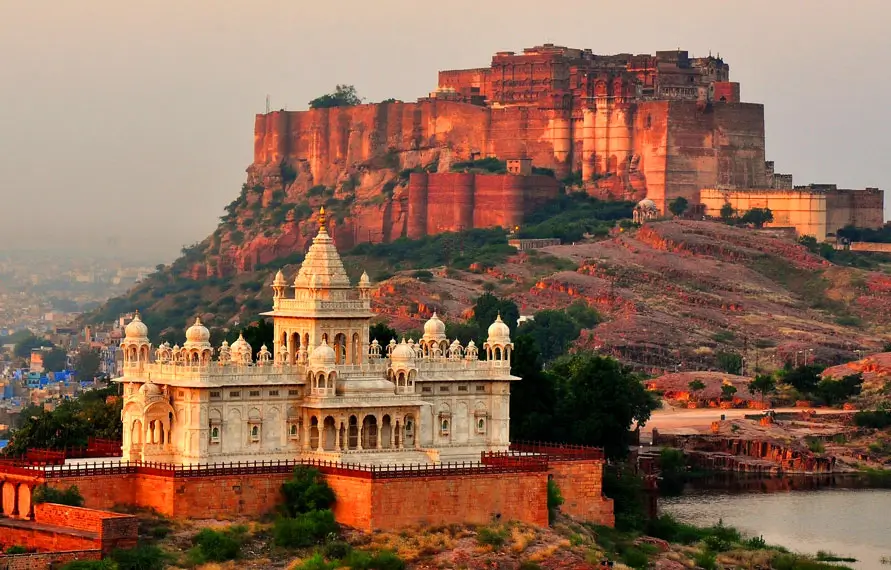
Mid-morning you climb to Mehrangarh Fort, founded by Rao Jodha in the fifteenth century on a rocky outcrop high above the city. The fort's museum is one of the best in India, with royal palanquins, elephant seats, paintings, textiles and a fine arms collection. The palace rooms, such as the Pearl Palace and the Flower Palace, are richly decorated with gold leaf and colored glass. Afterward you visit Jaswant Thada, the white marble cenotaph of Jaswant Singh II, a ruler of Marwar, whose wafer-thin panels turn a warm, translucent gold whenever sunlight falls on them.
In the afternoon you can visit the Umaid Bhawan Palace museum, part of a grand art deco palace completed in the early twentieth century and still home to the former royal family. Alternatively, browse the spice stalls and textile shops around the Clock Tower and Sardar Market, or simply rest at your hotel. In the evening you could book a dinner on the ramparts of the fort or at a rooftop restaurant, a lovely way to spend your last evening in Rajasthan while the fort glows above the city.
After a relaxed breakfast, there is time for a final stroll or a swim before your driver takes you to Jodhpur airport, about 15 to 20 minutes from most hotels. The flight to Delhi takes about 1 hour and 20 minutes. Our representative meets you on arrival and drives you to your hotel. Depending on your flight time, the afternoon may be free for a short tour of New Delhi, taking in India Gate, the government buildings designed by Edwin Lutyens and the peaceful gardens of Humayun's Tomb.
If you prefer the energy of the old city, a guided tour of Old Delhi includes the Red Fort, the great Jama Masjid mosque and a ride through the crowded lanes of Chandni Chowk. The contrast between the wide avenues of New Delhi and the dense medieval streets of the old city is a fitting end to a trip that has covered so much of north India's history. Your guide can also take you to a good spice market or a crafts emporium for last-minute gifts.
In the evening, enjoy a farewell dinner at one of Delhi's leading restaurants, many of which serve refined versions of regional Indian cooking. Our team can make a reservation for you. This is also the time to pack and to check your flight details for the next day. If you have any questions about the airport transfer or your luggage allowance, the Top Indian Holidays team is available around the clock to help, as it has been throughout the trip, from your first arrival to this final evening in the capital.
On your final day, enjoy breakfast at your hotel and make the most of the morning before your departure. Most hotels allow check-out at about 12:00, and if your flight leaves later in the evening, we can arrange a late check-out or a day room so that you have a place to rest and freshen up before the journey home. Delhi traffic can be unpredictable, especially in the late afternoon and early evening, so we time the transfer with a comfortable margin. If you have a few spare hours, a final visit to a museum, a crafts shop or a garden close to your hotel is easy to arrange with your driver.
Our driver takes you to Indira Gandhi International Airport, about 30 to 50 minutes from central Delhi, and helps with your luggage at the terminal. For international flights, we recommend arriving at the airport three hours before departure. Keep your passport, e-Visa printout and flight details easily accessible, as you will need to show them at the terminal entrance as well as at check-in. Check-in is efficient, and Terminal 3 has good shops, lounges and restaurants for the wait, including stores selling Indian tea, spices and textiles if you need a final gift.
We hope the journey on the Maharajas Express with Udaipur and Jodhpur has given you a rich picture of royal India, from the Mughal monuments of Agra to the lakes of Udaipur and the desert fort of Jodhpur. Top Indian Holidays, working on your behalf as a privately run Jaipur agency, has handled every transfer, hotel and guide along the way, and our team will be glad to help with your next trip, whether to the south, the Himalayas or another luxury train route. Thank you for traveling with us, and we wish you a safe and comfortable flight home.
Fill out this form with all the required information. Within 12 hours, we will provide you with a tailor-made itinerary at the best price.
Read the reviews of our esteemed client's, go through the experiences they had with Top Indian Holidays.

Whether you're planning your first India trip or returning to explore deeper — get honest, expert advice from someone who knows every corner of this country. No pressure, no cost.



 info@topindianholidays.net
 +91-8955000999