07 Nights / 08 Days Fully Guided Tours Private Car
Delhi - Jaipur - Ranthambore - Udaipur - Jaisalmer - Jodhpur - Bharatpur - Agra - Delhi
India's first luxury train left Delhi in the early 1980s, and the route it pioneered still ranks as one of the finest ways to see Rajasthan in a single week. The Palace on Wheels Rajasthan Tour follows that original circuit over seven nights, starting and ending at Delhi Safdarjung station. Between those two platforms lie pink Jaipur, the tiger country of Ranthambore, the hilltop ramparts of Chittorgarh, the lakes of Udaipur, the golden fort of Jaisalmer, the blue city of Jodhpur, the wetlands of Bharatpur and, as a final flourish, the Taj Mahal in Agra.
The appeal is the rhythm. The train covers most of its distance at night, so you go to sleep in one landscape and wake in another, with breakfast served before a guide meets you on the platform. Days are full but well paced, and the evenings bring dinners on board, a desert meal in Jaisalmer and a sound and light show at Chittorgarh Fort. For travelers who want the grand sweep of royal Rajasthan by train without daily packing, hotel check-ins or long road transfers, the format is hard to beat.
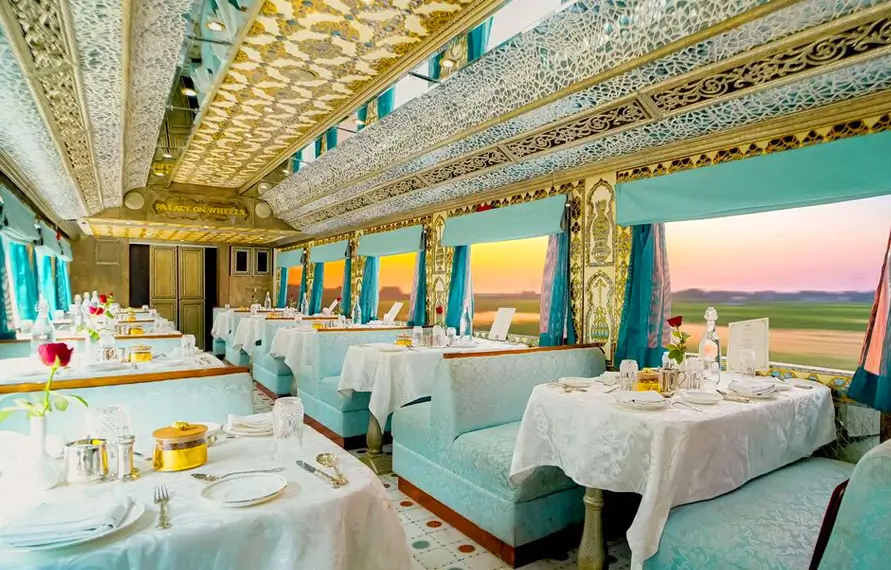
The Palace on Wheels is run by Rajasthan Tourism in association with Indian Railways, and each of its carriages carries the name of a former princely state, such as Udaipur, Jodhpur or Bikaner, with interiors to match. Cabins have private bathrooms and attentive carriage staff, and there are restaurant cars and a lounge bar for long evenings. The season runs from September to April, when days are warm and dry and nights in the desert are cool. We at Top Indian Holidays have been arranging Rajasthan travel from our Jaipur base for more than two decades as a government-recognized private operator, and we look after the train reservation, the Delhi drives and any extra hotel nights or chauffeured sightseeing you want on either side of the week.
The afternoon begins with a short drive across Delhi. Our driver picks you up from your hotel with enough margin for the city's unpredictable traffic, aiming to reach Delhi Safdarjung station for the 16:00 reporting time. Safdarjung is a quiet station used for special trains, so there is none of the chaos of the main Delhi terminals. Staff in traditional uniforms greet guests with garlands and a welcome drink, check passports and booking papers and take your bags to the cabin, where they will stay untouched for the next seven nights.
Before departure there is time to look around the train. The Palace on Wheels has carriages named after former princely states of Rajasthan, each finished in colors and motifs that reflect that region, so the decor changes as you walk from one end of the train to the other. Your cabin attendant introduces himself, explains the controls and the safe, and asks how you like your morning tea. Pack a small daypack now with sunscreen, a hat, a light scarf and comfortable shoes, since most sightseeing days begin shortly after breakfast.
At 18:30 the train pulls away from the platform and slides past the lit-up suburbs of south Delhi toward Rajasthan. Dinner is served on board, usually a mix of Indian regional dishes and continental options, and the first evening is a relaxed affair as guests settle in and meet their fellow travelers in the lounge bar. The rail line runs south-west through the night, and by the time you wake the train will be standing in Jaipur, the capital of Rajasthan and the first stop on this royal Rajasthan by train journey.
Jaipur is one of the earliest arrivals of the week, and after breakfast on board you set off by coach with a local guide. The morning usually starts at the Albert Hall Museum, an Indo-Saracenic building set in Ram Niwas Garden that houses carpets, metalwork, miniature paintings and an Egyptian mummy. From there the route enters the walled old city, where a photo stop in front of the Hawa Mahal shows off its honeycomb facade of nearly a thousand small windows, built so that royal women could watch street processions without being seen.
Next comes Jantar Mantar, the open-air observatory built by Maharaja Sawai Jai Singh II in the early eighteenth century, now a UNESCO World Heritage Site. Its giant stone instruments still measure time and track the stars, and the great sundial can tell the local time to within a couple of seconds. Right next door, the City Palace remains partly the home of the former royal family, and its museum galleries display royal costumes, weapons and the famous gateways of the Peacock Courtyard, each painted for a different season.
The afternoon moves out of town to Amber Fort, about 11 kilometers north, where honey-colored walls climb a ridge above Maota Lake. Inside, the Mirror Palace glitters with inlaid glass, and the rooftop terraces give wide views over the old defensive walls snaking across the hills. Late afternoon is set aside for the markets of the old city, known for gemstones, block-printed cotton and blue pottery. Remember that bargaining is normal in smaller shops. Back on board, dinner is served and the train leaves Jaipur at 20:00 for Sawai Madhopur.
The train reaches Sawai Madhopur at about 04:45, and a wake-up call comes early so you can dress warmly before stepping into an open safari vehicle. Ranthambore National Park lies just a short drive from the station. Morning drives run from about 06:30 to 10:00 in October, February and March, and from about 07:00 to 10:30 between November and January, when temperatures at the start can be 6 to 9 degrees Celsius. A fleece, gloves and a warm hat make a huge difference in an open vehicle.
Ranthambore is famous for tigers that are relatively relaxed around vehicles, but sightings depend on luck and the zone you are allotted. Even without a tiger, the park is a pleasure: lakes edged by ruined pavilions, banyan trees draped with aerial roots, crocodiles basking on the banks, and large brown deer and spotted deer grazing in the clearings. The fort that gives the park its name crowns a hill in the middle of the reserve. You return to the train for a late breakfast and a rest while it heads south-west toward Chittorgarh.
The train arrives at Chittorgarh in the middle of the afternoon. Chittorgarh Fort is the largest fort in India by area, stretching for several kilometers along the top of a high plateau, and it is part of the UNESCO-listed Hill Forts of Rajasthan. Your guide leads you to the nine-storied Tower of Victory, the palace associated with Queen Padmini and the ruined palace of Rana Kumbha, retelling the stories of the three great sieges that shaped Rajput history. As darkness falls, you watch the sound and light show inside the fort before returning to the train for dinner.
Udaipur is reached at about 07:00, and the change of scenery is immediate: after the dry plains, here are green hills, lakes and white palaces. The first stop is Saheliyon Ki Bari, the Garden of the Maidens, a pleasant spread of lawns, lotus pools, marble elephants and fountains laid out by an eighteenth-century ruler for the ladies of the court. The fountains are fed by gravity from the lake above, and early morning is the nicest time to walk through, before the day's crowds gather.
From the garden you drive to the City Palace of Udaipur, the largest palace complex in Rajasthan, built over several centuries by successive rulers of the Mewar dynasty. Its museum rooms are rich in mirror work, colored glass windows and painted walls, and the upper courtyards look out over Lake Pichola to the white Lake Palace hotel floating in the middle. The Crystal Gallery in the Durbar Hall holds a remarkable collection of cut-crystal furniture ordered from England in the nineteenth century and only put on display many decades later.
Late morning is the time for a boat ride on Lake Pichola, which gives the classic view of the City Palace rising straight from the water, with bathing steps, small temples and the island of Jag Mandir along the way. The light is soft and the water usually calm. After returning to the train for lunch, the journey continues at 16:00, crossing the Aravalli Hills and heading north-west across the Thar Desert toward Jaisalmer, with dinner served on board and a long overnight run ahead.
The train reaches Jaisalmer at about 08:30, and the town rises out of the desert like a sandcastle. The morning begins at Gadisar Lake, a reservoir built in the fourteenth century to supply water to the city, lined with small shrines and carved gateways. Early in the day the water reflects the sandstone pavilions perfectly and birds gather along the edges. It is a quiet introduction to a city that grew rich on the camel caravans that once carried spices and silk between India and Central Asia.
Next comes Jaisalmer Fort, one of the few living forts in the world, with homes, shops, guesthouses and temples still inside its walls. Your guide leads you through narrow lanes to the royal palace and the beautifully carved Jain temples. Below the fort lie the merchant mansions, and two of the finest are Patwon Ki Haveli, a cluster of five houses built by a wealthy trading family, and Nathmal Ji Ki Haveli, whose two halves were carved by two brothers working side by side. The stone lattice work looks almost like lace.
In the afternoon you drive out to the dunes on the edge of the Thar Desert for a camel ride as the sun goes down and the sand turns from gold to deep orange. Wear closed shoes and bring a light jacket, because desert evenings cool quickly. Dinner tonight is served at a five-star hotel in Jaisalmer, a relaxed meal off the train, often accompanied by desert folk musicians playing string and percussion instruments. You return to the station late, and the train departs at about 23:00 for Jodhpur.
The train arrives at Mandore station on the edge of Jodhpur at about 07:00. After breakfast you drive up to Mehrangarh Fort, which sits on a sheer rocky hill about 120 meters above the city. It is one of the most impressive forts in India, and its museum is among the best run in the country, with collections of royal palanquins, canopied elephant seats, paintings, arms and textiles. The audio guide is excellent, and the views from the ramparts over the blue-painted houses of the old city are a favorite with photographers, especially in the soft light of mid-morning.
A short drive from the fort brings you to Jaswant Thada, a white marble memorial built in the late nineteenth century for Maharaja Jaswant Singh II. The marble is so thin in places that it glows when the sun shines through it, and the small garden and lake around it offer a peaceful break from the bustle of the city. Many guests find this one of the most calming stops of the whole tour, and it gives a wide view back to the walls of the fort.
Finally you visit the museum wing of the Umaid Bhawan Palace, completed in the twentieth century and one of the largest private residences in the world. Part of it is still home to the former royal family, part is a luxury hotel and part is a museum displaying clocks, vintage cars and family photographs. The Art Deco interiors are a striking contrast to the older forts you have seen. The train leaves Jodhpur at 16:30 and travels east overnight toward Bharatpur, with dinner served on board.
The train arrives in Bharatpur at about 05:00, and after an early tea you head into Keoladeo National Park, a UNESCO World Heritage Site and one of the most important bird reserves in Asia. In winter the wetlands fill with migratory species such as ducks, geese and pelicans, while painted storks, cormorants and herons nest in the trees. Visitors move through the park on foot, by bicycle or in pedal-powered carts with naturalist guides, so the only sounds are birdsong and the creak of wheels.
The train continues to Agra, arriving at about 11:00. Your first stop is Agra Fort, a huge red sandstone fortress on the banks of the Yamuna River built by the Mughal emperor Akbar and later expanded by his grandson Shah Jahan. Inside are white marble halls, mosques and the octagonal tower where Shah Jahan is said to have spent his last years gazing at the tomb of his wife. Lunch is served at a hotel in the city, giving you a chance to rest before the afternoon visit.
In the afternoon you reach the Taj Mahal, the white marble tomb that Shah Jahan built for Mumtaz Mahal in the seventeenth century. The guide explains the inlay work of precious stones, the perfect symmetry of the gardens and the subtle tricks of the calligraphy. Late afternoon light gives the marble a warm golden tone. Remember the monument is closed on Fridays, which is why the train schedule always brings guests here on another day of the week. You return to the train for the farewell dinner, and it departs at 20:45 on the final stretch back to Delhi.
The train pulls into Delhi Safdarjung at about 02:30, but there is no need to get up in the middle of the night. Guests stay in their cabins and sleep until morning, and breakfast is served on board at a comfortable hour. This last meal is a good time to swap photographs and contact details with travelers you have shared the week with, and to thank the carriage attendant and restaurant staff who have looked after you since Delhi. If you have any extras to settle, such as drinks or laundry, the guest relations desk handles them before you step off.
Cabins must be vacated by 07:30, and you will find our chauffeur waiting beside the carriage door, ready to take charge of your suitcases. If you have an international flight later in the day, we can arrange a hotel room for rest before the drive to Indira Gandhi International Airport, which usually takes 30 to 50 minutes from Safdarjung. For guests staying longer in the capital, a half-day private tour of Old Delhi, Humayun's Tomb or the Qutub Minar is a pleasant way to use the extra time, and our team can set it up at short notice with a private car and an English-speaking guide.
Many travelers use the end of the Palace on Wheels Rajasthan Tour as a launch point for a second chapter in India. Popular choices include a flight to Varanasi for the river ceremonies, a few days on the Kerala backwaters, or a leopard safari in Jawai. Working as an independent agency, Top Indian Holidays can organize every element of such add-ons, from flights and luxury hotels to private cars, local guides and 24-hour support, so your Rajasthan journey flows straight into the next part of your holiday.
Fill out this form with all the required information. Within 12 hours, we will provide you with a tailor-made itinerary at the best price.
Read the reviews of our esteemed client's, go through the experiences they had with Top Indian Holidays.

Whether you're planning your first India trip or returning to explore deeper — get honest, expert advice from someone who knows every corner of this country. No pressure, no cost.



 info@topindianholidays.net
 +91-8955000999