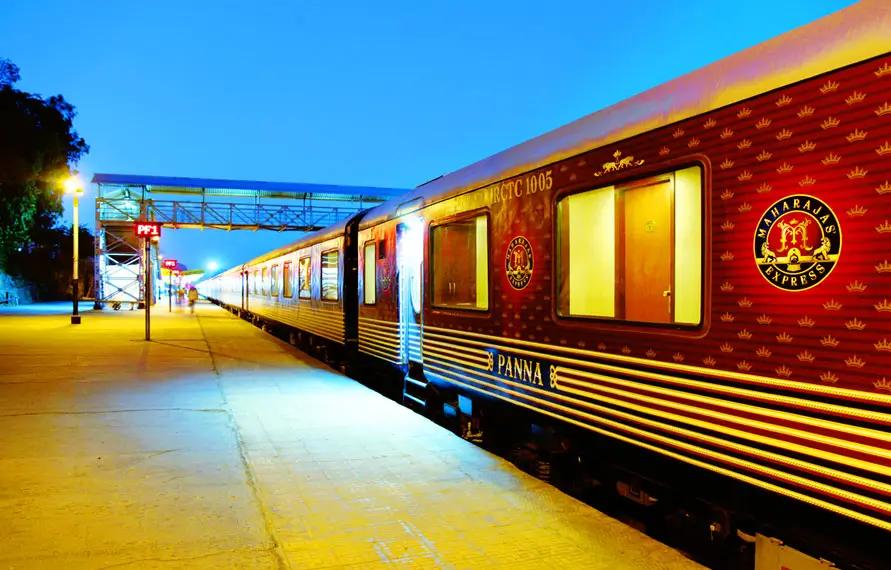
06 Nights / 07 Days Fully Guided Tours Private Car
Mumbai - Udaipur - Jodhpur - Bikaner - Jaipur - Ranthambore - Agra - Delhi
A brass band on the platform of a Victorian Gothic station, a glass of something cold in your hand and the Arabian Sea a short drive behind you: the Maharajas Express Heritage of India Tour begins in the grandest possible style at Chhatrapati Shivaji Maharaj Terminus in Mumbai. Over the next six nights the train climbs north through Gujarat into Rajasthan, calling at Udaipur, Jodhpur, Bikaner and Jaipur, then turns east for a tiger safari in Ranthambore and a dawn visit to the Taj Mahal before it reaches Delhi on the seventh day.
Travelers who know the train's Delhi to Mumbai route will recognize the cities, but the experience in this direction has its own logic. The week builds slowly, from the soft lakes of Udaipur and the desert forts of Jodhpur and Bikaner to the busier streets of Jaipur, and it saves the greatest monument of all for the very last morning. Seeing the Taj Mahal at sunrise as the closing act, after a week of Rajput palaces, gives it a weight it rarely has on a hurried day trip. The Mumbai start also suits guests flying in from Europe, the Gulf or Australia, and anyone who wants a few beach or city days in western India first.
IRCTC runs the Maharajas' Express, a train that judges at the World Travel Awards have ranked first among luxury trains worldwide on more than one occasion. Guests choose between Deluxe Cabins, Junior Suites, Suites and the Presidential Suite, a full carriage with two bedrooms, two bathrooms and a private living room. Butlers, two restaurant cars, a bar and a lounge complete the picture. Top Indian Holidays has run private tours out of Jaipur for over twenty-five years, holds recognition from India's tourism ministry and works independently, handling your reservation, car transfers and any hotel nights before or after the rail week. Departures in the 2026-27 season leave Mumbai on 18 October, 15 November, 13 December, 10 January, 7 February, 7 March and 4 April.
Your first morning in Mumbai is spent at a heritage hotel near the Gateway of India, where the train's team holds registration and a short briefing for the week. Our driver brings you from your own hotel in good time, usually by late morning, and the hosts will check passports, confirm dietary preferences and answer questions about the dress code. Smart casual wear is fine for most days, with one or two dinners where guests like to dress up. This is also a good time to meet your fellow travelers over a coffee before the formal welcome.
In the afternoon you are taken a short distance to Chhatrapati Shivaji Maharaj Terminus, the great domed railway station that ranks among the finest Victorian Gothic buildings in the world and is listed by UNESCO. A local band plays on the platform, a welcome drink is pressed into your hand and the train stands waiting in its distinctive livery. Porters have already taken your luggage on board, so you can simply walk to your carriage, where your butler waits at the door to show you to your cabin.
The train pulls out and heads north through the suburbs of Mumbai and into the coastal plains of Gujarat. Spend the first hours unpacking into the wardrobes, testing the controls for the lights and air conditioning and finding your way to the bar car, which tends to become the social center of the train. The first dinner is a relaxed affair in one of the two restaurants, with a mix of Indian regional cooking and continental dishes. Overnight the train crosses into Rajasthan on its way to Udaipur.
The train rolls into Udaipur around sunrise, and after breakfast on board you head to the shore of Lake Pichola. Udaipur was founded in the sixteenth century by Udai Singh II, ruler of the Mewar dynasty, one of the oldest ruling families in the world, after earlier capitals were lost to attack. The Aravalli Hills circle the city, and the lakes were enlarged by its rulers to secure water through the dry months. A short boat trip takes you past the white walls of the Lake Palace and the island garden of Jag Mandir.
Back on land, your guide leads you through the City Palace of Udaipur, a cluster of palaces built by successive rulers that stretches for hundreds of meters along the lakeshore. Highlights include the peacock mosaics in the Mor Chowk courtyard, the miniature paintings and the views from the upper balconies. The Darbar Hall, once used for state receptions, is hung with enormous chandeliers. In the adjoining Crystal Gallery, a nineteenth-century order of English crystal furniture, including beds and seats, sits on display after spending a century unopened in its boxes.
Lunch is served at Satkar Hall in Fateh Prakash Palace, a royal dining room looking out over the water. In the afternoon you return to the train to rest, and many guests enjoy simply watching the countryside slide past as the train moves on toward Jodhpur. The weather in Udaipur is pleasant through most of the season, with warm days in the mid twenties Celsius in winter and cooler evenings. If you have spare energy, ask the guest relations team in advance about an optional private evening in the city before departure.
Breakfast arrives as the train pulls into Jodhpur, where the morning is free for rest or optional activities. Popular choices include a visit to a Bishnoi village, where a small community has protected desert trees and blackbuck antelope for centuries, or a tour of the art deco Umaid Bhawan Palace museum. The palace is still partly occupied by the former royal family and partly run as a hotel. Lunch follows on board, and it is wise to take a hat and sunscreen for the afternoon, as the desert sun is strong even in winter.
The afternoon is devoted to Mehrangarh Fort, perched on a cliff some 120 meters above the city. A lift carries less mobile guests up to the main palace area, while others walk the cobbled ramp through a series of fortified gates, some still marked with cannonball scars and the handprints of royal widows. The fort museum is one of the best run in India, with galleries of canopied elephant seats, palanquins, textiles and paintings. From the battlements the old town below is a sea of blue-washed houses.
Afterward you descend to the old town for a walk and a short open three-wheeler ride around the Clock Tower and its busy market, where spice sellers, cloth merchants and silversmiths trade side by side. In the evening the group is hosted at Khaas Bagh for cocktails and a Marwari meal served under the stars, with local musicians setting the mood. Marwari cooking leans on desert ingredients such as dried beans, millet and dried berries, along with slow-cooked meat dishes. You return to the train after dinner for the overnight run north to Bikaner.
Bikaner is a town of sandstone and camels on the northern edge of the Thar Desert, and the morning is yours to relax or join an optional outing. Bikaner's camels are famous across India, and the region has long bred them for both trade and the army. The quieter pace of this morning is welcome after three busy days, and many guests use it for a session in the train's lounge, a stroll on the platform or simply catching up on photographs and notes. Lunch is served on board before the afternoon tour.
After lunch you visit Junagarh Fort, one of the few great forts of Rajasthan never taken by force. It was built in the late sixteenth century and expanded by later rulers, and inside its plain walls lies a remarkable sequence of decorated rooms. The Hall of Private Audience, the Flower Palace and the Anup Mahal, with its red and gold lacquer work, are among the most richly ornamented interiors in the region. Your guide also points out the collection of royal costumes and the vintage biplane kept in one of the halls.
As the heat fades, a procession of decorated camel carts takes the group out to the sand dunes, accompanied by drummers and singers. The ride is slow and bumpy in a pleasant way, passing village homes and herds of goats. At the dunes a sunset celebration awaits, with cocktails, a barbecue and performances by desert musicians and dancers whose songs have been passed down through families for generations. Wear closed shoes for the sand and bring a light jacket. The train departs late at night for the long run to Jaipur.
You arrive in Jaipur in the morning to a traditional welcome on the platform. After breakfast, a short drive brings you to Amber Fort, where jeeps take you up the hillside to the main gate. The fort was the seat of the Kachwaha rulers before the city of Jaipur was laid out on the plain in the early eighteenth century, and its honey-colored walls follow the ridges for miles. Your guide explains the layered structure of the fort, with public halls at the front and increasingly private quarters toward the back.
The private rooms include the Hall of Victory and the Sheesh Mahal, where every surface glitters with mirror mosaics. The craftsmen designed the room so that a few candles would reflect thousands of times, filling the hall with soft light after dark. Morning is cooler than afternoon here, and the fort is less crowded before the midday rush. Afterward you are driven to Rambagh Palace, the former residence of the Maharaja of Jaipur, for an exclusive lunch in elegant surroundings, with time to walk through its Mughal-style gardens.
The afternoon is free. You can return to the train for a rest or join an optional activity, such as a guided return to the royal palace complex and the giant stone instruments of the old astronomical park, a tour of a block printing workshop or a spa treatment at a luxury hotel. Jaipur is also an excellent place to buy gemstones, silver, textiles and blue pottery, and your guide can recommend trusted outlets. In the evening dinner is served on board as the train sets off for Sawai Madhopur, the station for Ranthambore. Ask your butler for an early wake-up call.
The day starts in darkness with tea or coffee delivered to your cabin. You then board an open safari vehicle for a morning game drive in Ranthambore National Park. In October, February and March the morning slot runs from about 06:30 to 10:00, and from November to January from about 07:00 to 10:30. Winter mornings can be very cold, between 6 and 9 degrees Celsius at the start, so bring a hat, gloves and a thick fleece. Blankets are often provided in the vehicles, but extra layers make a real difference.
Ranthambore is known for tigers that are relatively relaxed around vehicles, and the park's lakes, ruined pavilions and old banyan trees make a beautiful setting. Even when the big cat stays hidden, you are likely to see spotted deer, large brown deer, wild boar, mongooses, crocodiles and a wide range of birds, from kingfishers to crested serpent eagles and painted storks. Back in your carriage, the stewards bring out breakfast and later lunch while the rails carry you eastward out of Rajasthan and into Uttar Pradesh. A rest in your cabin after the early start is recommended.
In the afternoon you visit Fatehpur Sikri, the city founded by the Mughal emperor Akbar in the late sixteenth century as his new capital and left largely empty within a few decades. Its red sandstone courtyards, palaces and audience halls remain almost complete, and inside the courtyard of the great mosque stands the gleaming marble shrine of Salim Chishti, the Sufi mystic whose blessing Akbar believed brought him an heir. That evening the train hosts an Indian evening with music and regional dishes, the last big celebration on board before Agra.
Your last morning on the Maharajas Express Heritage of India journey begins before sunrise. You leave the train for the Taj Mahal, arriving as the gates open. This is the best time to visit: the air is cool, the gardens are quiet and the marble shifts slowly from gray to soft pink and then white as the light grows over the Yamuna River. Your guide shares the story of Shah Jahan and Mumtaz Mahal and points out the craftsmanship of the inlay work, the calligraphy and the perfect symmetry of the complex.
You return to the train for breakfast and lunch as it travels north to the capital. There is time to settle any outstanding bills, exchange contact details with new friends and thank the butlers and the crew, who will have looked after you closely for the past six days. Many guests find this final stretch a good moment to look through their photographs and reflect on how much ground the journey has covered, from the Arabian Sea coast to the plains of the Ganges basin.
The train arrives at Delhi Safdarjung in the afternoon, where our driver meets you and takes you to your hotel or the airport, a drive of about 30 to 50 minutes. If you are flying home the same day, we recommend booking a late evening departure. Top Indian Holidays, as an independent tour operator, can also extend your trip with a guided day in Old and New Delhi, a few days in Varanasi, a stay in the Himalayan foothills or a beach break, with private cars, guides and selected hotels arranged throughout.
Fill out this form with all the required information. Within 12 hours, we will provide you with a tailor-made itinerary at the best price.
Read the reviews of our esteemed client's, go through the experiences they had with Top Indian Holidays.

Whether you're planning your first India trip or returning to explore deeper — get honest, expert advice from someone who knows every corner of this country. No pressure, no cost.



 info@topindianholidays.net
 +91-8955000999