


 info@topindianholidays.net
 +91-8955000999

Hot Air Balloon Ride in Jaipur
Lift off as the sky turns orange and drift over villages, mustard fields and the Aravalli hills while Jaipur is still waking up.
View Experience ›Leave the forts behind for a day and join a farming family outside Jaipur as they work the fields, milk the buffalo and cook lunch over a wood fire.
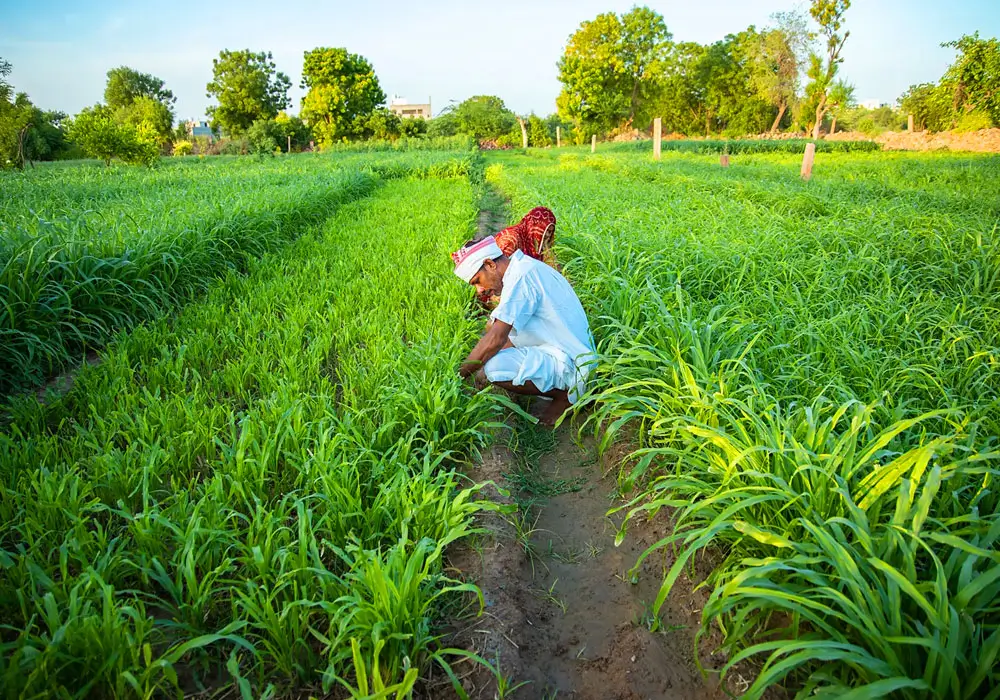
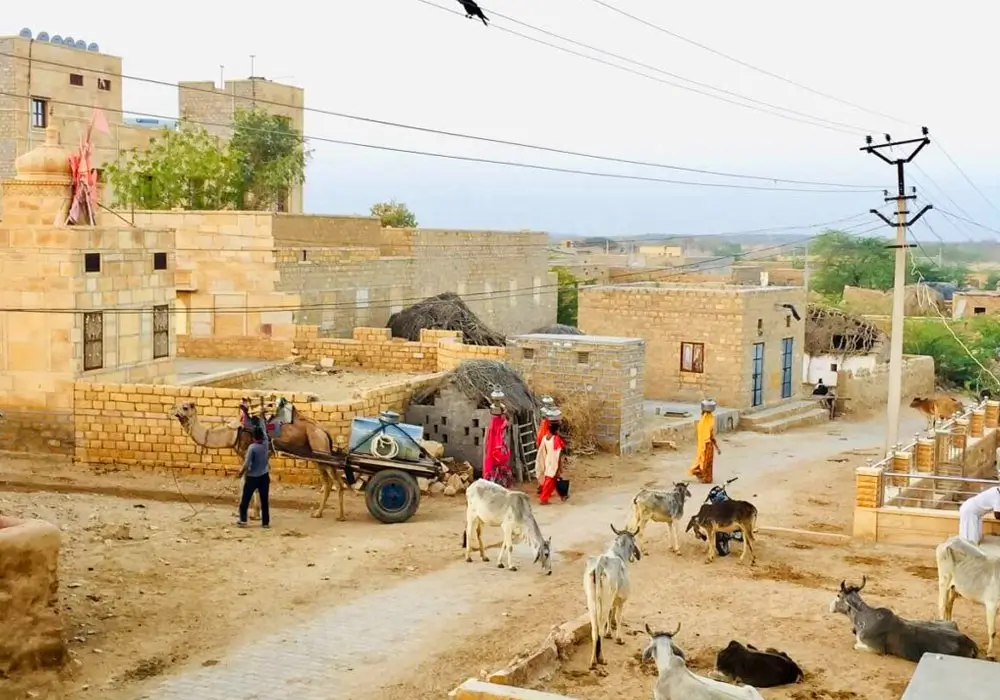
Drive half an hour or so out of Jaipur in almost any direction and the city loosens its grip quickly. The flyovers and showrooms give way to brick kilns, then to small fields edged with thorny khejri trees, cattle sheds made of mud and thatch, and farmhouses painted in pale blue or ochre. This is where most of Rajasthan actually lives. A farm visit near Jaipur takes you into that world for a day, not as a spectator on a bus, but as a guest of a family who grow their own wheat, keep their own buffalo and still cook much of their food on a clay stove.
The day is unhurried by design. You walk the fields with the farmer and hear what has been sown and why. You try your hand at whatever the season demands, whether that is cutting mustard stalks, pulling chickpea plants or helping to channel well water into a thirsty row of cauliflowers. You sit in the courtyard while the women of the house churn butter, and you learn to pat out a roti that holds together long enough to reach the fire. Then everyone sits down to eat what came, in large part, from the land around you.
It is one of the most rewarding things to do with children in Rajasthan. Kids who have grown restless in museums come alive when there is a calf to meet, a tractor to climb on with permission, and a field to run across. Adults tend to get just as much from it, often more than they expected, because the conversations that happen over lunch are the ones that make sense of everything else you see in India.
Our farm days are arranged with working families we know, chosen because they farm in a traditional way and are happy to share their home and their routine. Your visit pays them directly for their time and their food, and it never interrupts the work that has to be done.
1. Drive out of Jaipur
Your private driver collects you from your hotel after breakfast. The drive takes you past the city limits into farming country, and your guide uses the time to explain what you will see: the crops of the season, how families divide the work, and a few words of the local Dhundhari or Hindi greeting that will make the family smile when you arrive.
2. Welcome at the farmhouse
You are met in the courtyard, usually with a glass of water and then chai made with milk from the family’s own animals. Grandparents, parents and children are often all at home, because rural families in Rajasthan tend to live together. Your guide introduces everyone and translates. Take a few minutes here simply to sit, look around and settle in. Nothing is rushed.
3. A walk through the fields
The farmer leads you out to the fields. Depending on the month, you may walk between rows of wheat turning gold, through mustard in yellow flower, past chickpea plants that come up to your knee, or across bare ploughed soil waiting for the rains. Your guide explains what each crop is for: some sold at the market, some kept for the family, some grown as fodder for the animals.
4. Hands in the soil
This is where you join in. The task depends on the season and the family’s real work that day. It might be sowing seed by hand along a furrow, harvesting with a curved sickle, weeding a vegetable patch, picking peas or tomatoes, or helping to guide water from the well along small earth channels. You do as much or as little as you like. Children often take to it with surprising enthusiasm.
5. Milking and the dairy corner
Most farms keep a few buffalo or cows, sometimes goats. You watch how the animals are milked, and if the animal is calm and the family is comfortable, you may try it yourself under guidance. Back in the courtyard, the women show how fresh milk becomes curd, how curd is churned into butter with a wooden churner pulled by a rope, and how butter is slowly heated into ghee.
6. Cooking on the chulha
The chulha is a low clay stove fed with wood or dried cow dung cakes, and it is still used in many village kitchens. You learn to knead dough, roll or pat it into rounds and cook rotis on an iron griddle over the fire. Your first attempts will probably be lopsided. Everyone will tell you they are excellent anyway.
7. Lunch with the family
Lunch is served on the floor or on low stools, often on steel plates. Expect rotis or bajra flatbread, a seasonal vegetable curry, dal, fresh curd or buttermilk, and a spoon of the ghee you saw being made. Eating with your right hand is normal, and cutlery is always offered if you prefer it.
8. A short cart ride
After lunch there is often a short ride around the village lanes on a bullock or camel cart, a gentle pace through the fields and past neighbouring houses. The ride is kept brief, the animals are working animals cared for by the family, and they are never loaded heavily or driven hard. You can skip it if you would rather walk.
9. Back to Jaipur
You say your goodbyes in the mid-afternoon and your driver brings you back to Jaipur, leaving time to rest at your hotel or head out for an evening in the city.
Farming in Rajasthan follows two main seasons, and the farm you visit will look very different depending on when you come.
Rabi season, roughly October to March. These are the winter crops, sown after the monsoon and harvested in spring. Around Jaipur, the main rabi crops are wheat, mustard and chickpea, often with barley and a patch of vegetables. In December and January the mustard fields flower bright yellow, which is the classic image of rural Rajasthan in winter. From late February into March, the wheat ripens and the harvest begins, with whole families out in the fields from early morning.
Kharif season, roughly June to September. These are the monsoon crops, sown when the first rains arrive. Bajra, the pearl millet that has fed this dry region for centuries, is the most important. Guar, a hardy bean grown both as a vegetable and for its seeds, is another. You may also see moong and other pulses. During the rains the countryside turns surprisingly green, and you will see sowing, weeding and the constant watching of the sky.
Vegetables all year. Most families keep a vegetable patch near the house or near the well. Depending on the month you may see cauliflower, carrots, radish, spinach, fenugreek, tomatoes, aubergine, okra, gourds and chillies. These are often what end up on your lunch plate.
The quiet months. April and May are hot and dry. The rabi harvest is in, the fields are bare and much of the work moves indoors: storing grain, repairing tools, tending animals. A farm visit is still possible, but we keep it to the cooler morning hours.
Because the tasks follow the real farm calendar, we cannot promise exactly what you will do on any given day. What we can tell you is what is typical.
October and November. Sowing the rabi crops. You may help scatter or drop seed along furrows, see fields being ploughed and levelled, and watch the first irrigation of the season.
December and January. Watering and weeding. The mustard is in flower and the wheat is green. Vegetable picking is at its best, with cauliflower, carrots, peas and leafy greens.
February and March. The harvest begins. You may try cutting wheat or mustard with a sickle, tying sheaves, or pulling up chickpea plants and picking the green pods to eat raw, which children usually love.
July to September. Monsoon sowing and weeding of bajra and guar. Fields can be muddy, and some days the rain decides the programme.
All year. Milking, feeding the animals, making butter and ghee, and cooking on the chulha happen every day, whatever the season.
Rajasthan is one of the driest states in India, and on a farm you see very quickly how much of life is organised around water. Many farms near Jaipur rely on wells and borewells, with water pumped up and sent along narrow earth channels to each section of the field in turn. The farmer opens one channel with a few strokes of a spade, closes another, and the water moves exactly where it is needed. It is simple, clever and slow, and it is one of the tasks guests most enjoy helping with.
Ask about how the water situation has changed over the years. Many farmers will tell you that wells need to be dug deeper than they were in their parents’ time, and that they have shifted crops or methods to cope. You may see drip lines on a vegetable patch, a small farm pond that holds rainwater, or a tank on the roof. These conversations give real context to the stepwells and lakes you will see later in your tour.
Many small farms in this region still work in ways that are close to organic, partly by tradition and partly because chemical inputs are expensive. Cow and buffalo dung is composted and spread on the fields. Neem leaves are used as a natural pest deterrent, and crops are rotated between seasons to keep the soil healthy. Dried dung cakes are stacked neatly against the walls to use as cooking fuel.
We do not claim every farm we work with is certified organic, and you should be wary of anyone in India who makes that claim casually. What you will see is a way of farming that uses very little from outside, wastes almost nothing and has kept families fed on poor soil for generations. If organic and natural farming are of particular interest to you, tell us in advance and we will choose a family whose practices match.
Lunch is home cooking from a Rajasthani farming household, not a restaurant menu. It is usually vegetarian, simple and very good.
Rotis and bajra bread. Wheat rotis cooked on the chulha are the staple. In winter, families often make thick bajra rotis from millet flour, eaten with butter and jaggery.
Seasonal vegetables. Whatever is ready in the field: cauliflower and potato, spinach, fenugreek, gourds, carrots or a dry curry of guar beans.
Dal. Lentils or chickpea dal, cooked slowly and finished with a spoon of ghee and a tempering of spices.
Dairy. Fresh curd, chaas (buttermilk spiced with cumin and salt), and sometimes white butter straight from the churn.
Something sweet. Perhaps a piece of jaggery, a simple halwa or kheer made with the farm’s own milk.
Tell us in advance about any allergies or dietary needs, including vegan, gluten-free or dislike of spice. The family is happy to adjust. Drinking water is bottled, provided by us, and fruit and vegetables served to you are cooked.
Animals are part of the family on a Rajasthani farm, and they are looked after carefully because the household depends on them. Buffalo and cows provide milk, dung for fuel and fertiliser, and in some families the bullocks still pull carts. A camel may be kept for transport on farms closer to the desert, especially around Pushkar.
Milking. You only try milking if the animal is used to people and the family is happy. Your guide shows you how to approach slowly, and you stop the moment the animal seems unsettled.
Cart rides. We arrange cart rides only with families who treat their animals well. The ride is short, at walking pace, on village tracks, with a light load and the animal’s owner always in control. If an animal looks tired, unwell or overloaded, the ride does not happen. You are always free to say no.
What we do not do. There is no riding of wild animals, no feeding of wildlife and no animal show of any kind. If you would like to spend time with elephants in an ethical setting, see our elephant sanctuary in Jaipur page.
This is one of the best family days you can plan in Rajasthan, and the reasons are practical.
Bring a change of clothes for younger children, hand wipes and sun cream. Keep an eye on them near wells, water tanks and the cooking fire, and around large animals. Your guide and the family will help, but parents are always responsible for their own children.
You are a guest in a family home, and a few simple habits make the day comfortable for everyone.
The family is paid fairly for hosting you, and you do not need to tip during the visit. If you wish to leave something extra as thanks, your guide can tell you what is appropriate.
Near Jaipur. The easiest choice for most itineraries. Farms here grow wheat, mustard, chickpea, bajra and vegetables, and the drive from your hotel is reasonable. It slots into a Jaipur stay as a full or half day.
Near Pushkar. The land is sandier and closer to the desert, and you are more likely to see camels on the farm. The area around Pushkar is also known for rose cultivation. A farm day here pairs well with an overnight in Pushkar between Jaipur and Jodhpur or Udaipur.
Both give you the same core day: fieldwork, dairy, cooking and lunch with the family. We suggest the one that fits your route.
Give it a full day in Jaipur. Most guests spend the morning and early afternoon on the farm and keep the evening light. With at least three nights in Jaipur, a farm day sits easily between the forts and the old city.
Use it as a reset. If you are a week into a busy Golden Triangle tour, a slow day in the countryside is a welcome change from monuments and traffic.
Pair it with village life. Families who enjoy the farm often add a village homestay in Rajasthan, an open jeep village safari or a village cricket match with locals.
Cook again in the city. If you loved the chulha, a cooking class with a Jaipur family in the evening lets you learn the spicier, richer dishes of an urban home.
Add crafts on the way. Some farm areas lie close to the block printing villages of Bagru and Sanganer, so a block printing workshop can sometimes be combined on the drive back.
Bring a camera, but use it lightly. Mustard in flower looks best in soft morning light, and the details tell the story well: hands shaping dough, a brass milk pot, dung cakes drying on a wall, water running down a channel. Dust gets everywhere in the dry months, so a cloth bag for your camera helps. And the best parts of the day often happen over lunch, when nobody is taking pictures.
Bring and wear - Loose cotton clothing that covers shoulders and knees - Closed shoes you do not mind getting dusty or muddy - A hat, sunglasses and sun cream - A light layer for cool winter mornings - Hand sanitiser and wet wipes - A change of clothes for young children - A small gift for the household, such as fruit or something from your home country, if you wish
Leave behind - White or delicate clothes - Expensive jewellery - Sweets or pens to hand out to village children - Strong perfume, which can unsettle animals
Tell us when you will be in Jaipur and who is travelling, and we will match you with a farming family and a day that suits the season.
Call & WhatsApp +91-9828085426 or email info@topindianholidays.net.
See more ideas on our Top Experiences in India page.
Tell us your travel dates and we will check availability and fit this experience into the right day of your itinerary. Reply within 12 hours.
Check Availability› Chat on WhatsApp› Send an Enquiry›



 🌙 16 Nights / 17 Days
⭐ Most Popular
Delhi - Agra - Jaipur... Delhi - Agra - Jaipur - Pushkar - Udaipur - Ranakpur - Jodhpur - Jaisalmer - Bikaner - Mandawa - Gurugram - Delhi Show More
 🌙 13 Nights / 14 Days
Delhi - Agra - Jaipur... Delhi - Agra - Jaipur - Udaipur - Mumbai - Kochi - Kumarakom - Kochi Show More
 🌙 13 Nights / 14 Days
⭐ Most Popular
Delhi - Agra - Ranthambhore... Delhi - Agra - Ranthambhore - Jaipur - Jodhpur - Narlai - Udaipur Show More
 🌙 07 Nights / 08 Days
Luxury
Jodhpur - Rohet - Jaisalmer... Jodhpur - Rohet - Jaisalmer - Osian Show More
Yes. With at least three nights in Jaipur, a farm day fits well between sightseeing days. Tell us your dates and we will plan it on the day that suits the season and your route.
Yes. Farms around Pushkar are sandier and closer to the desert, and you are more likely to see camels. It suits guests staying in Pushkar between Jaipur and Jodhpur or Udaipur.
Some guests like to extend the day into a night in the countryside. Our village homestay with a local family is the best way to do that, and we can plan it alongside or instead of a day visit.
Facilities are basic and may be a simple squat toilet. Your guide can advise, and there are usually better options along the drive. Bring tissues and hand sanitiser.
October to March is the most comfortable, with sowing in autumn, mustard flowers in winter and the wheat harvest in late February and March. The monsoon is green and interesting but can be muddy. Summer visits are best kept to the early morning.
Many small farms here use traditional methods close to organic, such as dung compost, neem and crop rotation. We do not claim certification unless it is real. If organic farming matters to you, tell us and we will choose a suitable family.
Lunch is a home-cooked vegetarian meal: rotis from the chulha, a seasonal vegetable, dal, curd or buttermilk and fresh ghee. It is usually mildly spiced, and the family can adjust it for allergies or diets if you tell us beforehand.
We only arrange short rides at walking pace with families who look after their animals well. The load is light and the owner is in control. If an animal looks tired or unwell, the ride does not happen, and it is always optional.
Often, yes, if the animal is calm and the family is comfortable. You will be shown how, and you stop if the animal seems unsettled. Watching is just as interesting if you prefer.
Yes. You join whatever the family is doing that day, such as sowing, weeding, harvesting with a sickle, picking vegetables or guiding well water along the channels. You do as much or as little as you like.
In winter you will usually see wheat, mustard and chickpea, with mustard flowering yellow around December and January. In the monsoon the fields are planted with bajra (pearl millet) and guar. Vegetables are grown near the house most of the year.
Yes, it is one of the best family days in Rajasthan. Children can pick vegetables, meet calves, make rotis and play in open space. Parents should stay close near wells, the fire and large animals.
The price depends on your group size, the length of the day and whether you combine it with other stops. We quote the current price for your exact dates, including the private car, guide, the family’s hosting and lunch.
The farms we use are in the countryside outside the city, and the drive time depends on the farm, your hotel and the traffic that day. We tell you the expected drive when we confirm the family for your dates.

Whether you're planning your first India trip or returning to explore deeper, get honest, expert advice from someone who knows every corner of this country. No pressure, no cost.