

 info@topindianholidays.net
 +91-8955000999
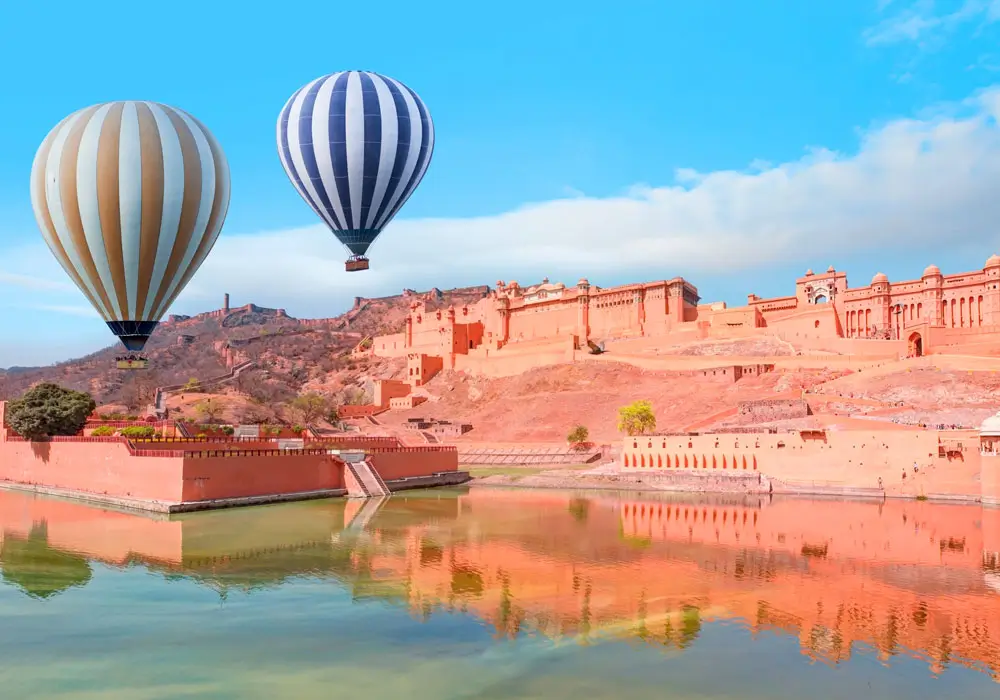
Hot Air Balloon Ride in Jaipur
Lift off as the sky turns orange and drift over villages, mustard fields and the Aravalli hills while Jaipur is still waking up.
View Experience ›Ride out in an open jeep to the villages south of Jodhpur, where the Bishnoi people have protected trees and wild antelope for more than five hundred years.
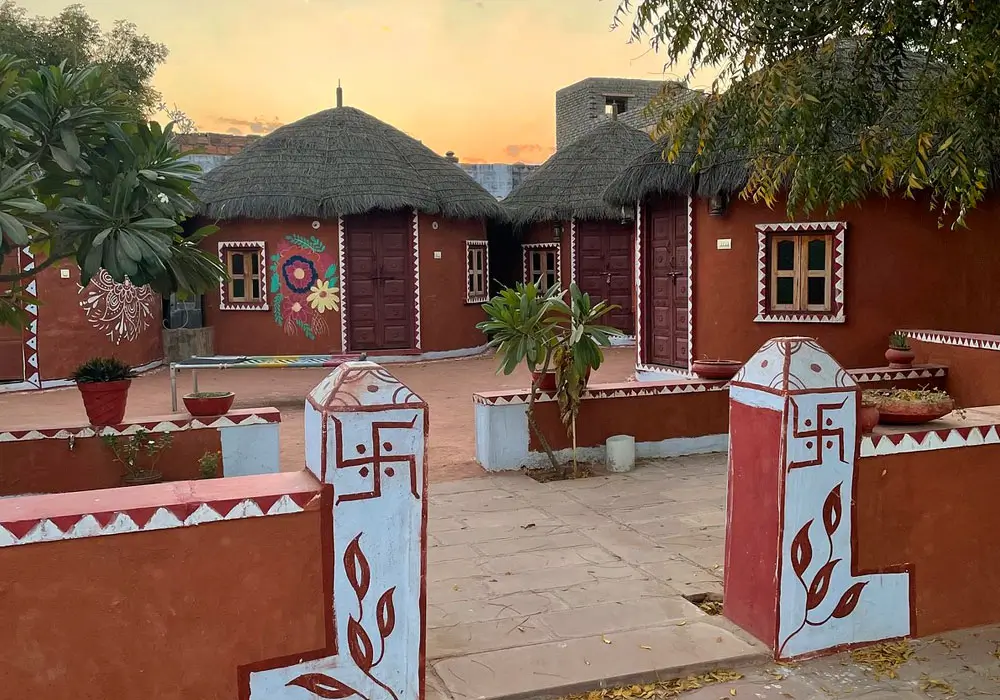
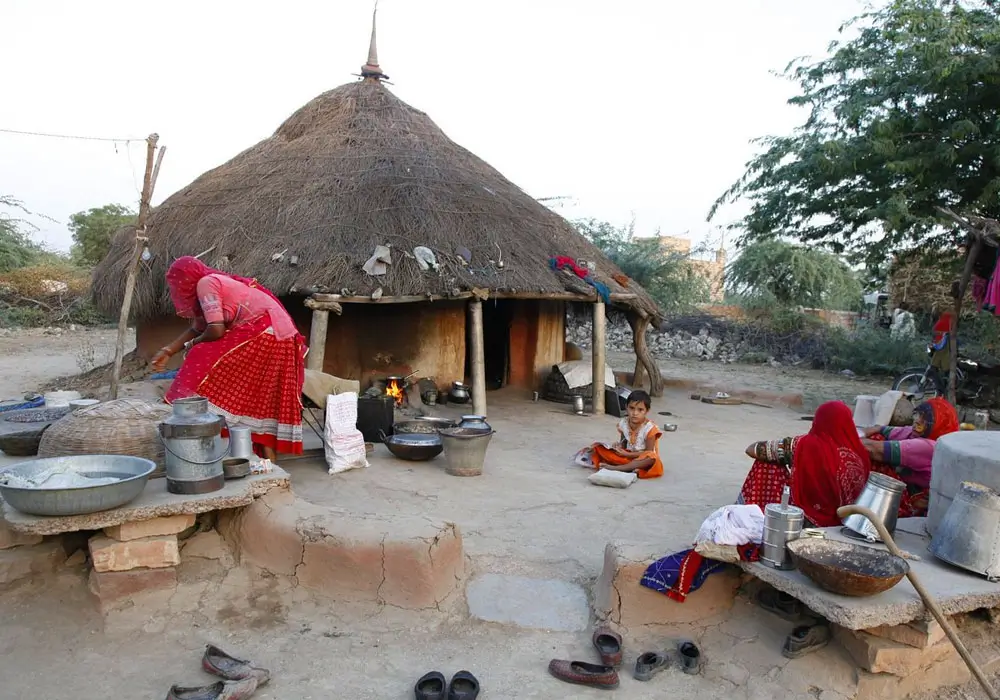
Drive south out of Jodhpur and within half an hour the city has gone. The road runs through flat, sandy scrubland dotted with thorny khejri trees, low thorn fences and the occasional round mud hut with a thatched roof. Then, quite suddenly, you notice something you would not expect in a dry, crowded farming region: wild antelope. Blackbuck graze in open fields within sight of houses. Chinkara, the small and delicate Indian gazelle, stand watching from the edge of the scrub. They are not fenced in and nobody is guarding them with guns. They are here because the people who live here will not let them be harmed.
These are the Bishnoi, a community of western Rajasthan whose faith is built on protecting living things. Their way of life comes from twenty-nine principles laid down by their founder, Guru Jambheshwar, at the end of the fifteenth century, and several of those principles are about trees and animals. Bishnoi families do not cut green trees, do not kill animals and, in many villages, put out water and grain for wildlife. Their story is one of the earliest examples of environmental protection anywhere in the world, and they still live by it.
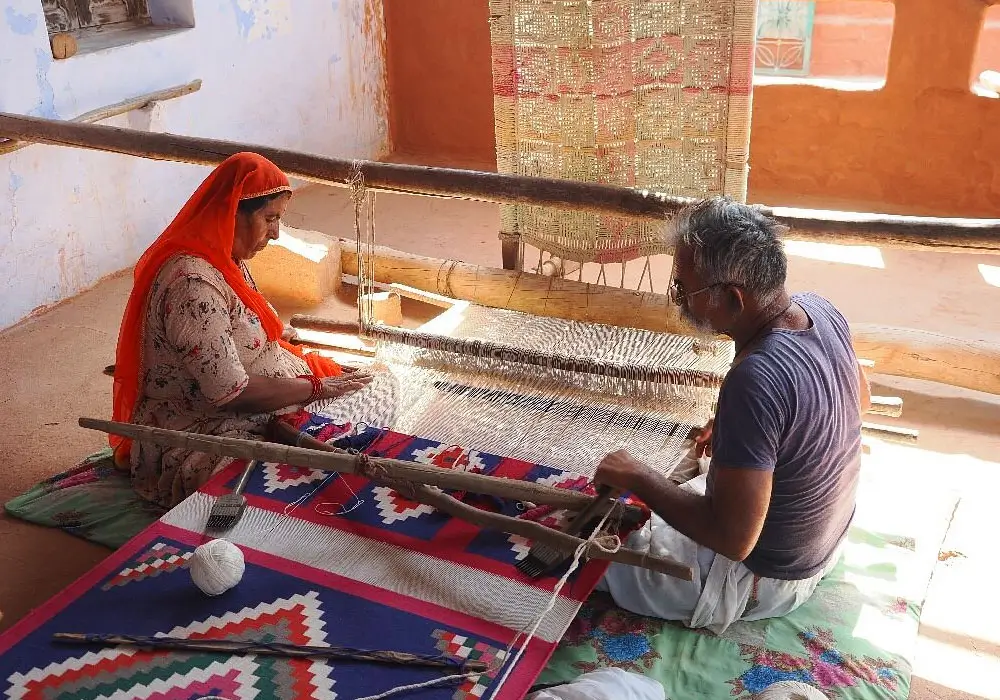
A Bishnoi village safari takes you into this landscape by open jeep, with a guide who knows the families and can explain what you are seeing. You visit a Bishnoi home, look for blackbuck and chinkara in the fields around the villages, and stop with craft families nearby: a potter turning clay on a wheel and dhurrie weavers working flat-woven cotton rugs on a pit loom. It is a gentle, conversational morning rather than a show, and it gives a very different picture of Rajasthan from the forts and palaces.
If you would like a broader look at rural life around Jodhpur without the focus on the Bishnoi and wildlife, our open jeep village safari is a good alternative.
1. Pickup from your Jodhpur hotel
Your driver and guide meet you at your hotel in an open jeep, or in your car with a switch to the jeep outside the city, depending on how we plan your day. We usually start early, so you reach the villages while the air is cool and the animals are out grazing.
2. Into the countryside south of Jodhpur
The villages are spread across the countryside to the south and south-east of the city, along the roads towards Luni and beyond. Your guide explains how the land changes as you leave the city: from stone quarries and suburbs to dry farmland, grazing land and thorn scrub, with the occasional village pond.
3. Khejarli and the story of 1730
Many safaris stop at or pass near Khejarli, the village where, in 1730, members of the Bishnoi community gave their lives to stop the felling of khejri trees. Your guide tells the story at the memorial and temple there, which is a quiet place with trees planted in memory of those who died. It is the best possible introduction to the rest of the morning.
4. A visit to a Bishnoi home
In a Bishnoi village such as Guda Bishnoi, you are welcomed into a family home, usually a small compound of mud and stone houses around a swept courtyard. Your host may show you how the household runs, from grinding grain to storing water, and you are often offered tea or a glass of buttermilk. Your guide translates and helps the conversation along. This is a visit, not a performance, so take your lead from your hosts.
5. Looking for blackbuck and chinkara
Around the villages, your driver slows down along the tracks so you can scan the fields. Blackbuck usually move in herds, with the dark males easy to pick out by their black and white coats and spiralled horns. Chinkara are smaller, sandy brown and often alone or in pairs. You watch from the jeep at a respectful distance.
6. Guda Bishnoi lake and birds
Near Guda Bishnoi there is a lake that holds water for much of the year, and it attracts birds and animals coming to drink. In the cooler months you may see demoiselle cranes, which migrate here in winter, along with herons, storks and waders. It is a pleasant place to stop and look.
7. The potter’s home
Your next stop is with a potter’s family in one of the nearby villages. You watch the potter shape clay on a wheel, often a heavy stone wheel spun by hand, and see the water pots, lamps and storage jars the family makes for village use. If you want, you can have a try at the wheel yourself, which is harder than it looks and usually ends in laughter.
8. Dhurrie weavers in Salawas
Salawas is known for weaving dhurries, flat cotton or wool rugs made on pit looms set into the floor. You see the weavers at work, the pattern building up thread by thread, and learn how the designs and colours are chosen. Rugs are for sale if you want one, with no obligation to buy.
9. Back to Jodhpur
After the last stop, the jeep heads back to the city. Most guests are back at their hotel in time for lunch, with the afternoon free for the fort or the old city. On a late afternoon safari, you return around dusk.
The Bishnoi community traces its beginnings to Guru Jambheshwar, often called Jambhoji, who lived in western Rajasthan in the late fifteenth and early sixteenth centuries. The region was going through a terrible drought, and he saw how people were cutting down the last trees and killing animals in their struggle to survive. He gave his followers twenty-nine principles to live by. The name Bishnoi is commonly explained as coming from the local words for twenty and nine.
The principles cover daily life, personal conduct and faith. Some are about cleanliness, such as bathing every morning. Some are about behaviour, such as being truthful, forgiving and content, avoiding theft, gossip and anger. Some concern food and drink, such as avoiding alcohol and tobacco. And several are about the living world: do not cut green trees, be compassionate to all living beings, and do not kill animals. Many Bishnoi families also follow the practice of filtering water and firewood so that small creatures are not harmed.
For a community of farmers and herders living in a dry land, these were not abstract ideas. They meant protecting the trees that held the soil together and gave fodder for animals, and protecting the wildlife that shared the land. Today Bishnoi villages are among the best places in Rajasthan to see blackbuck and chinkara outside a protected reserve, precisely because the people here have defended them for so long.
You may notice that many Bishnoi men dress in white and that women often wear bright red or orange with heavy silver jewellery. Your guide can explain the meaning of clothing and customs, and your hosts are usually happy to answer questions asked with genuine interest.
In 1730, the ruler of Jodhpur needed wood for building work, and soldiers were sent to cut khejri trees in the Bishnoi village of Khejarli. A Bishnoi woman named Amrita Devi refused to let them. According to the story told in the community, she held on to a tree and said that a head cut off was a cheaper price than a tree cut down. She was killed, and so were her daughters who followed her.
Word spread to the surrounding villages, and Bishnoi men and women came to take their places, holding on to the trees one after another. The community remembers that hundreds of people died before the ruler learned what was happening and stopped the felling. He then issued an order protecting trees and animals in Bishnoi villages.
The event at Khejarli is often described as the first recorded act of this kind of tree protection, and it later inspired the Chipko movement in the Himalayas, in which villagers hugged trees to stop logging. At Khejarli today there is a temple and a memorial, with trees planted in memory of those who died. Every year, a fair is held there to remember them.
Standing at the memorial with your guide is one of the most moving parts of the morning. It changes how you look at every khejri tree you pass on the drive back.
Blackbuck. The most striking antelope in India. Adult males have glossy black and white coats and long spiralled horns, while females and young are light brown. They graze in open fields and can run very fast when startled. Seeing a herd within sight of a village is something you will not easily forget.
Chinkara. The Indian gazelle, small and slender with a sandy coat and short horns. They are shy and often stand still at the edge of the scrub, so they are easy to miss until your guide points them out.
Nilgai. The largest antelope in Asia, bluish grey in the males. They are sometimes seen in the fields and scrub around the villages.
Birds. Peacocks are common around the villages, along with partridges, larks, bee-eaters and birds of prey. In winter, look for demoiselle cranes around the lakes and fields.
Khejri trees. The tree at the heart of the Bishnoi story. Its leaves feed goats and camels, its pods are eaten as a vegetable, its roots fix the soil and it survives in very dry ground. You will see it everywhere, and now you will know why it matters.
Village life. Mud houses with neat thatched roofs, grain stores, women collecting water, children walking to school, camels pulling carts and goats moving out to graze. This is rural Marwar, much as it has been for generations, though with mobile phones and motorbikes added.
The animals are wild. Blackbuck and chinkara around Bishnoi villages are free-living animals, not pets. We watch from the jeep at a distance, we do not chase them, and we never feed or touch them. If an animal moves away, we let it go.
People are hosts, not an attraction. The families you meet are welcoming you into their homes and workplaces. Greet them, accept tea if you wish, and follow your guide’s lead. Your guide will help you talk with them rather than about them.
Ask before photos. Always ask before photographing people, and accept a no gracefully. Many people are happy to be photographed, especially once you have talked for a while, but some prefer not to be, particularly women in more traditional households.
The visit benefits families. We plan these visits so that the families you meet are paid for their time and hospitality, and craftspeople sell directly to you. Buying a pot, a small rug or a piece of block-printed cloth is the most direct way to support them, but it is never expected.
No alcohol, no smoking. The Bishnoi principles exclude alcohol and tobacco, so please do not smoke or bring alcohol into Bishnoi homes or villages.
Dress modestly. Shoulders and knees covered is a good rule in rural Rajasthan. Light, loose clothing is comfortable and respectful.
Give children your time, not sweets. Children often gather around visitors. Rather than handing out sweets, pens or money, which encourages begging, spend a few minutes talking or playing. If you would like to give something, ask your guide about supporting a local school instead.
Pottery. The potter families of the villages around Jodhpur make the clay water pots, called matkas, that keep water cool in the desert heat, as well as oil lamps, pots for cooking and decorative pieces. You see the clay being prepared, the wheel being spun and the shaped pots drying in the sun before firing. Small pieces are easy to pack if you want a souvenir.
Dhurrie weaving at Salawas. A dhurrie is a flat-woven rug, traditionally made of cotton and sometimes wool, used across India on floors and beds. In Salawas, weaving families work on pit looms, with the weaver sitting on the floor and the loom set into a pit in front of them. You can watch a pattern grow, see the cotton being dyed and ask about how long a rug takes. Rugs come in a wide range of sizes and colours, and many families can arrange shipping if you buy something too large to carry.
Block printing. Some safaris also pass villages where cloth is printed with carved wooden blocks. If you are interested in printing, ask us to add a stop, or plan a longer printing session in Jaipur on our block printing workshop.
October to March. The most comfortable months. Mornings are cool and fresh, afternoons warm and pleasant, and in winter migrating birds such as demoiselle cranes add to the wildlife. December and January mornings can be chilly in an open jeep, so bring a warm layer.
April to June. Hot, with strong sun and dry wind. If your tour falls at this time, start as early as possible and finish before the worst heat of the day. Animals are often easier to see near water.
July to September. The monsoon brings occasional rain and turns the land green for a short time. Tracks can be muddy, but the countryside looks very different and often beautiful.
Morning or late afternoon. The early morning is usually best for wildlife, as animals are grazing and the light is soft. A late afternoon safari also works well, with golden light and the animals coming out again as it cools. Avoid the middle of the day if you can.
Plan two nights in Jodhpur. Give one morning to Mehrangarh Fort and the old city, and the other to the Bishnoi villages. You might start the fort day with our Mehrangarh zipline for a different view of the walls.
On a travel day. The villages are south of Jodhpur, in the general direction of roads that lead towards Udaipur and Jawai. On some itineraries we can fit the safari into the morning you leave Jodhpur, before continuing south. Ask us whether it suits your route.
Combine with Jawai. If you are heading on to the granite hills of Jawai, our Jawai leopard safari is a natural next stop, with more wildlife and another community, the Rabari herders, who share the land with leopards.
Contrast with the desert. If you are going west to Jaisalmer, a night under the stars on our desert camping tour shows another side of the Thar.
Bring and wear - Light clothes covering shoulders and knees - A warm layer for winter mornings in the open jeep - Sunglasses, a hat and sunscreen - A scarf or buff against dust - Binoculars for blackbuck and birds - Small notes in rupees for buying crafts - Comfortable shoes that are easy to slip off at homes
Leave behind - Alcohol and cigarettes - Sweets or gifts for handing out to children - Drones - Revealing clothes
Tell us your Jodhpur dates and we will plan a Bishnoi village safari at the best time of day for wildlife and arrange the family and craft visits with care.
Call & WhatsApp +91-9828085426 or email info@topindianholidays.net.
See more ideas on our Top Experiences in India page.
Tell us your travel dates and we will check availability and fit this experience into the right day of your itinerary. Reply within 12 hours.
Check Availability› Chat on WhatsApp› Send an Enquiry›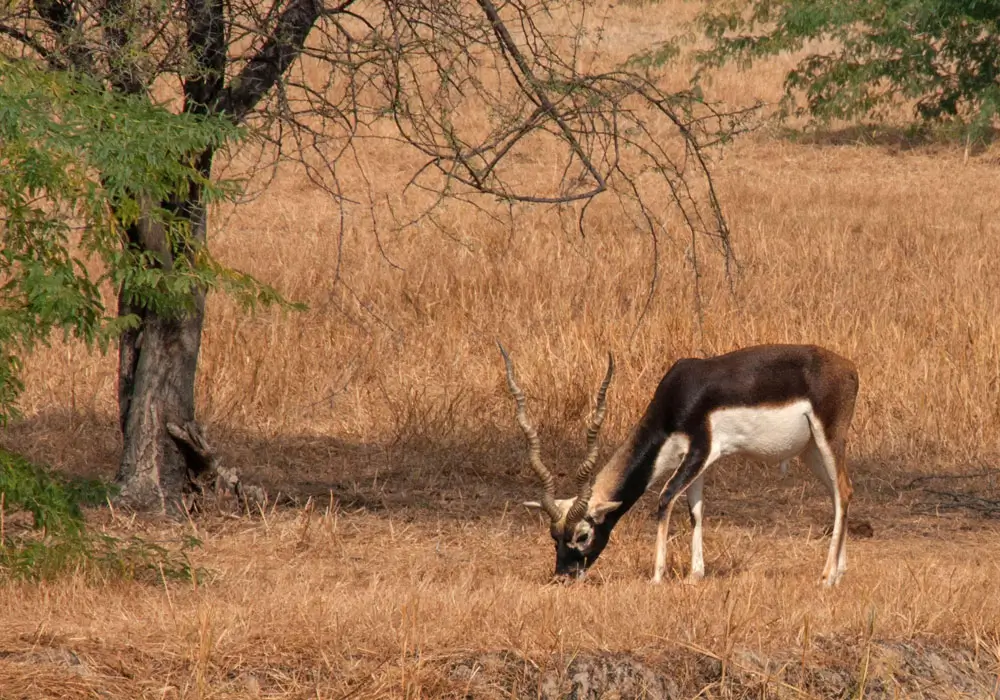
 🌙 08 Nights / 09 Days
Luxury
Delhi - Agra - Ranthambore... Delhi - Agra - Ranthambore - Jaipur - Udaipur Show More
 🌙 09 Nights / 10 Days
Luxury
Delhi - Agra - Jaipur... Delhi - Agra - Jaipur - Jodhpur - Udaipur - Delhi Show More
 🌙 12 Nights / 13 Days
Delhi - Mandawa - Bikaner... Delhi - Mandawa - Bikaner - Nagaur - Osian - Barmer - Jaisalmer - Jodhpur - Ranakpur - Udaipur Show More
 🌙 13 Nights / 14 Days
⭐ Most Popular
Delhi - Agra - Ranthambhore... Delhi - Agra - Ranthambhore - Jaipur - Jodhpur - Narlai - Udaipur Show More
Yes. With two nights in Jodhpur it fits easily on the second morning. On some routes we can also fit it in on the morning you leave Jodhpur for Jawai or Udaipur.
Yes. Potters and weavers sell directly to visitors, and many weaving families can ship larger rugs abroad. There is never any pressure to buy.
This safari focuses on the Bishnoi community, their conservation story and the wildlife around their villages. Our broader open jeep village safari is more of a general countryside drive through rural Rajasthan, with farms and village life as the main theme.
Light, loose clothing that covers shoulders and knees, a hat, sunglasses and a scarf for dust. Bring a warm layer for winter mornings in the open jeep, and shoes that slip off easily for entering homes.
Yes. Children usually love spotting the antelope, trying the potter’s wheel and watching the looms. The jeep ride is bumpy, so very young children may need a little extra care.
Salawas is a village south of Jodhpur known for dhurrie weaving, the flat-woven cotton and wool rugs made on pit looms. You can watch the weavers at work and buy directly from them if you wish.
October to March is most comfortable, with cool mornings and winter birds. Early morning is best for wildlife. In summer, start very early to avoid the heat.
Ask first, every time, and accept a polite refusal. Many people are happy to be photographed after you have spent some time together. Your guide can ask on your behalf.
We plan it to be. Wildlife is watched from a distance and never fed or chased. Families are paid for their time, craftspeople sell directly to you and photos are taken only with permission.
Blackbuck are often seen in the fields around Bishnoi villages, and chinkara too, but they are wild animals, so nobody can guarantee a sighting. Early morning and late afternoon give the best chances.
Soldiers were sent to cut khejri trees in the village of Khejarli. Amrita Devi and her daughters held on to the trees to protect them and were killed, and many more Bishnoi people followed their example before the felling was stopped. It is remembered as one of the earliest acts of tree protection.
They are a community of western Rajasthan who follow twenty-nine principles laid down by Guru Jambheshwar in the fifteenth century. These include not cutting green trees and showing compassion to all living beings, which is why wildlife thrives around their villages.
The villages are in the countryside to the south and south-east of the city, so the drive out is not long. Your driver collects you from your hotel and the jeep takes you between villages on local roads and tracks.
It is a guided trip by open jeep to the villages south of Jodhpur where the Bishnoi community live. You visit a Bishnoi home, learn about their principles and history, look for blackbuck and chinkara in the fields, and stop with potters and dhurrie weavers.
Whether you're planning your first India trip or returning to explore deeper, get honest, expert advice from someone who knows every corner of this country. No pressure, no cost.