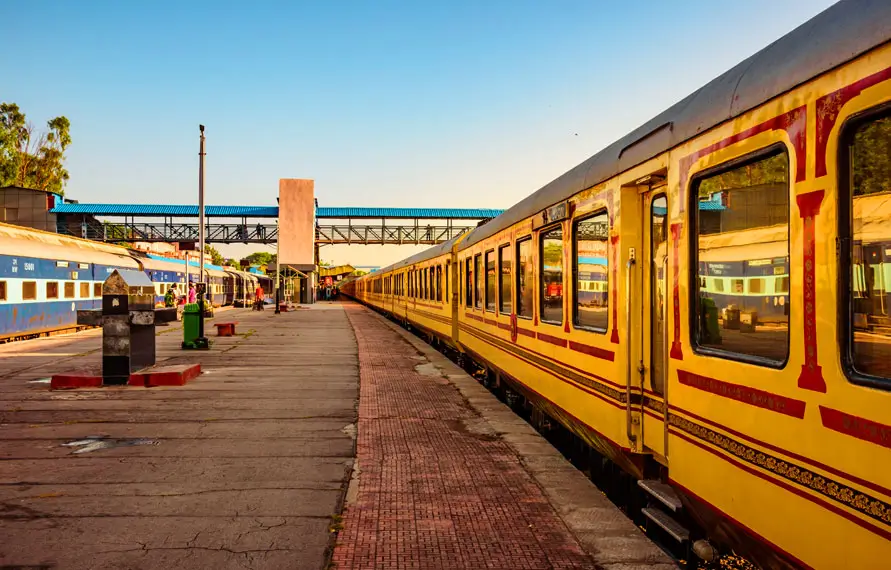
13 Nights / 14 Days Fully Guided Tours Private Car
Delhi - Jaipur - Ranthambore - Chittorgarh - Udaipur - Jaisalmer - Jodhpur - Agra - Delhi - Kochi - Alleppey - Kumarakom - Kochi
More than two thousand kilometers separate the sand dunes of Jaisalmer from the coconut-lined canals of Alleppey, and few holidays manage to hold both in a single, easy itinerary. The Palace on Wheels with Kerala Backwaters does exactly that over thirteen nights. You begin with a week of royal Rajasthan aboard India's original luxury train, then fly south to the tropical state of Kerala for spice-trade history in Kochi, a night afloat on a private houseboat and two slow days on the shores of Vembanad Lake at Kumarakom.
There is a thread running through this trip, and it is water. In Rajasthan, every great city depended on how its rulers caught and stored the little rain that fell: the lakes of Udaipur, the reservoir at Jaisalmer, the tanks on the plateau of Chittorgarh and the wetlands of Bharatpur all tell that story. Our guides bring it to the surface as the Palace on Wheels, run by Rajasthan Tourism with Indian Railways, carries you from Jaipur through Ranthambore, Udaipur, Jaisalmer and Jodhpur to Agra and the Taj Mahal. Then, in Kerala, you find the opposite: a landscape shaped by too much water, where rivers, lagoons and canals form the main roads.
The contrast makes the second week feel like a true reward. After seven nights of early starts and full sightseeing days, the backwaters slow everything down: lunch of fresh fish on the deck of your houseboat, a canoe ride through village canals at dawn, an Ayurvedic massage in a lakeside resort. Behind the scenes, Top Indian Holidays, a privately owned Jaipur firm recognized by the Ministry of Tourism and active since the late nineties, books the train, your flight to Kochi, the hotels, the houseboat and every private car and guide. The best months are October to March, when Rajasthan is dry and Kerala's monsoon has passed.
Your journey starts in the Indian capital, where our representative waits outside the arrivals hall at Indira Gandhi International Airport holding a board with your name. Whether your flight lands at midnight or mid-morning, a private air-conditioned car takes you directly to your luxury hotel, usually 30 to 45 minutes away depending on traffic. We request early check-in for flights arriving before dawn, so that you can sleep properly and recover from the long flight before the train journey begins tomorrow afternoon. Cash machines in the arrivals hall make it easy to collect local currency on the way out.
The rest of the day is yours. Many travelers simply stay at the hotel, sleep, swim and adjust to the time difference. If you would like to stretch your legs, a guided visit to Humayun's Tomb in the late afternoon is a good choice: the sixteenth-century garden tomb has fountains and water channels that divide the gardens into four parts, a layout that you will see again at the Taj Mahal at the end of the train journey. It is a good first lesson in how Mughal architects used water as decoration.
Later, one of our Delhi staff stops by the hotel with your travel papers and walks you through the fortnight ahead, including timings for the first few days. This is a good moment to sort your luggage. We suggest a soft bag for the train and leaving bulky items with the hotel in Delhi if you are passing back through, though on this itinerary you fly directly south from Delhi after the train. Pack warm layers for the desert and safari mornings, along with cotton clothing, sandals and swimwear for Kerala.
The morning is free for a late breakfast and a slow start. If you want a short outing, the Qutub Minar complex in south Delhi is close to Safdarjung station and takes about an hour to see. Among its ruins stands a seven-meter iron pillar that has barely rusted in more than a thousand years, still a subject of scientific study. After lunch, check out of the hotel, and our driver takes you to Delhi Safdarjung station, aiming to arrive in good time for the 16:00 reporting time.
The welcome on the platform is warm and colorful, with garlands, a refreshing drink and traditional music. Staff take your bags to the cabin while you complete registration with your passport. The Palace on Wheels has a series of carriages named after the former princely states of Rajasthan, each with its own color scheme and decor, and your cabin has a private bathroom and twin or double beds. Your carriage attendant introduces himself and will look after you all week, from morning tea to shoe polishing.
The train departs at 18:30, slowly gathering speed as it leaves the lights of Delhi behind. After freshening up, join other guests in the lounge bar for a drink, then move to the restaurant car for dinner, which mixes Rajasthani specialties with continental dishes. There is no need to stay up late. The night run toward Jaipur is smooth, and the morning will be a full one, so most guests retire early, lulled by the steady rhythm of the rails as the train crosses into Rajasthan under a sky full of stars.
Jaipur sits in a dry basin ringed by hills, and its founders in the early eighteenth century had to work hard to keep it supplied with water. After breakfast on board, your guide begins at the Albert Hall Museum in Ram Niwas Garden, whose galleries hold carpets, sculpture and a rare Egyptian mummy. Then you enter the old walled city, passing the Hawa Mahal, a five-story pink screen of windows designed to catch the breeze and keep the rooms behind it cool during the long summers.
At Jantar Mantar, the guide explains how Maharaja Sawai Jai Singh II used giant stone instruments to predict the movements of the sun and moon, information that mattered for setting dates of festivals and monsoon sowing. The City Palace of Jaipur next door still holds the two huge silver urns made to carry sacred Ganges water to England for a ruling prince who would drink nothing else on his voyage. The palace courtyards, with their painted gates and arcades, are one of the most photographed corners of the city.
In the afternoon you drive to Amber Fort, about 11 kilometers to the north. Its ramparts overlook Maota Lake, which once supplied the fort through a system of wheels and channels, and you can still see the terraced saffron garden in the middle of the water. Inside, the Mirror Palace sparkles with tiny pieces of glass. Later there is free time to walk in the markets of the old city, known for jewelry and textiles. Dinner is served on board, and the train departs at 20:00 for Sawai Madhopur.
The train arrives at Sawai Madhopur at about 04:45, and you head into Ranthambore National Park in an open vehicle for the morning safari, with the gates opening near 06:30 in the shoulder months of October, February and March, and half an hour later in midwinter, so expect to be out until about 10:00 or 10:30. Temperatures at dawn in winter can be 6 to 9 degrees Celsius, so dress in warm layers. The forest is dry for much of the year, which makes its three main lakes, Padam Talao, Rajbagh and Malik Talao, the magnet for almost all the wildlife.
Tigers often come to the lakes to drink and to cool off, and some of the most famous images of the park show them wading in the water near the old hunting pavilions. Sightings are never guaranteed, but the edges of the lakes are also full of large brown deer, wild boar, crocodiles and wading birds, from storks to herons. Your naturalist will stop to listen for alarm calls of deer and monkeys, which often mean a predator is moving. Breakfast is served when you return to the train.
By mid-afternoon the train reaches Chittorgarh. Chittorgarh Fort stands on a high plateau that once held dozens of water bodies, from stepped wells to huge tanks, enough to sustain a population through long sieges. Your guide shows you the Tower of Victory, the palace of Rana Kumbha and the pavilion of Queen Padmini, which stands in a pool, and tells the stories of the three great sieges. Once night settles, a narrated light show plays across the walls, after which you head back on board for dinner.
The train arrives in Udaipur at about 07:00, and here the theme of water becomes impossible to miss. The city was founded on the shores of Lake Pichola in the sixteenth century, and later rulers added more lakes, linked by channels, to create a reservoir system that still supplies the city. Your first visit is to Saheliyon Ki Bari, a royal garden whose fountains are fed by gravity from Fateh Sagar Lake above, with no pumps at all. On a quiet morning, the sound of falling water fills the garden.
Next comes the City Palace of Udaipur, a huge complex of courtyards, balconies and towers built over several centuries by the rulers of the Mewar dynasty. Inside, rooms decorated with colored glass, mosaics of peacocks and painted murals lead to terraces with wide views over the lake. The Crystal Gallery displays crystal furniture ordered from England in the nineteenth century, including seats, tables and a bed. Your guide will point out the Lake Palace and Jag Mandir, both built on islands in the middle of the water.
The highlight of the morning is a boat ride on Lake Pichola. From the water you see the full length of the City Palace rising above the shore, the bathing steps where local people wash clothes and the white marble pavilions of Jag Mandir. The light is soft and the lake usually calm at this time of day. Lunch is back on board, and at 16:00 the wheels start turning on a long night crossing of the desert to Jaisalmer, a journey that takes you from the greenest city in Rajasthan to the driest.
The train pulls into Jaisalmer at about 08:30, in the heart of the Thar Desert, where annual rainfall is among the lowest in India. The first stop is Gadisar Lake, a reservoir dug in the fourteenth century to collect every drop of rain, which once supplied the whole city. Small shrines and carved gateways stand around its edges, and in the morning the golden stone reflects in still water. Your guide explains how the city rationed and protected this lake for centuries, a lifeline for caravans crossing the desert.
Next you climb into Jaisalmer Fort, a living fort with homes, shops and temples still inside its walls. In the narrow lanes, you visit the royal palace and the Jain temples, with their finely carved pillars. Below the fort, you stop at two splendid merchant mansions: Patwon Ki Haveli, a cluster of five homes built for a wealthy trading family, and Nathmal Ji Ki Haveli, built by two brothers who each carved one half. The stone lattice work on both is remarkably fine, and the upper rooms of Patwon Ki Haveli hold a small museum of household objects.
In the late afternoon you drive out to the dunes for a camel ride across the sand as the sun sets, turning the landscape from gold to amber. Desert nights get cold quickly, so bring a warm layer and a scarf. The evening meal is laid on at a five-star hotel in town, frequently with desert singers performing. On the walk back to your carriage, glance upward, because without city glare the sky over the sand is crowded with stars. Around 23:00 the train leaves for Jodhpur.
Mandore, a small station at the northern edge of Jodhpur, is where you wake at roughly 07:00. Once breakfast is done, a coach climbs to Mehrangarh Fort, a vast stronghold among the biggest anywhere in the country, perched on a rocky hill above the blue-painted houses of the old city. Its museum holds royal palanquins, elephant seats, paintings, weapons and textiles, and the views from the ramparts are some of the best in Rajasthan. On a clear morning you can see far across the rocky plain to the edge of the desert.
Your guide will also tell you how Jodhpur survived in such a dry place. The old city was once fed by a network of lakes, tanks and stepwells, deep stone wells with stairs leading down to the water. Beside Jaswant Thada, a cenotaph raised for Maharaja Jaswant Singh II, a small lake mirrors the fort on its ridge. Its walls are cut from marble sheets fine enough to let sunlight pass, giving the stone a soft, lit-from-within look. It is a quiet and peaceful place after the busy fort.
The last visit is the Umaid Bhawan Palace museum. The palace was built in the twentieth century partly to provide work for local people during a long period of drought and famine, and it is one of the largest private residences in the world. Today it is a royal home, a luxury hotel and a museum showing clocks, photographs and vintage cars. By 16:30 you are rolling east out of Jodhpur on the night run to Bharatpur, with dinner in the restaurant car and one last full evening in the lounge bar.
At about 05:00 the train stops at Bharatpur, and an early tea prepares you for Keoladeo National Park. These wetlands were created in the nineteenth century by flooding a natural depression with water from a nearby canal, originally for royal duck shoots. UNESCO now lists the park, and it ranks among the finest places in Asia for birds, home to storks, herons, cormorants and ducks, with migrants arriving from Central Asia in winter. Naturalists take you along quiet embankments by cycle-cart, and binoculars are well worth packing.
By around 11:00 you are in Agra, where a guide leads you into Agra Fort, the huge red sandstone citadel on the banks of the Yamuna River, where Mughal emperors lived and ruled. Within its walls lie mosques, white marble audience halls and the eight-sided tower in which Shah Jahan lived out his captivity. A city hotel hosts lunch. Notice how the Yamuna, which flows past both the fort and the Taj Mahal, links the two monuments and was used as a highway for royal barges.
In the afternoon you visit the Taj Mahal, built by Shah Jahan for his wife Mumtaz Mahal. The gardens are divided by water channels into four parts, a symbol of paradise, and the long central pool holds the reflection of the tomb on a still day. Remember that the monument is closed every Friday. The afternoon light gives the marble a warm glow. A farewell dinner awaits on board, with speeches from the crew, and at 20:45 the carriages begin the last night's ride toward the capital.
Although the train reaches Safdarjung in the small hours, around 02:30, you sleep on undisturbed. After breakfast in the restaurant car you leave the cabin by 07:30, and a waiting driver collects your bags and heads for the domestic terminal at Delhi airport for your flight south to Kochi. The direct flight takes a little over three hours, and the change in climate is dramatic, and the temperature can be ten degrees warmer: you leave the dry, cool north and land in a warm, humid world of palms and water.
Our representative meets you at Kochi airport, and the drive to your hotel in Fort Kochi takes about an hour and a half. Fort Kochi is the old colonial quarter at the tip of a peninsula, and we choose a heritage hotel there, often a restored merchant house with a courtyard, wooden floors and a pool. After checking in, take the afternoon to rest and enjoy the change of pace, perhaps with a fresh coconut water by the pool after the long day of travel from Delhi.
In the late afternoon, stroll along the waterfront to see the famous Chinese fishing nets, giant cantilevered structures that fishermen raise and lower into the water using counterweights of stone. Sunset is the best time to see them working against the colorful sky. Small stalls nearby sell the day's catch, and some will cook your choice for you on the spot. Dinner is at your hotel or at one of the many seafood restaurants in Fort Kochi, where dishes cooked with coconut, fragrant local leaves and black pepper are local favorites.
After breakfast your guide takes you on a tour of Fort Kochi, a town shaped by more than five centuries of trade with Portuguese, Dutch and British merchants. You begin at St. Francis Church, among the oldest European churches in India, which held the grave of the seafarer Vasco da Gama for some years until his body was shipped home to Lisbon. Nearby, the Santa Cruz Basilica has a bright painted interior. Walking the quiet streets, you see old Dutch and Portuguese houses with tiled roofs and wide verandas.
Next you drive to Mattancherry, a short distance away. The Mattancherry Palace, often called the Dutch Palace, was built by the Portuguese and presented to the Raja of Kochi, and its walls are covered with beautiful murals of scenes from the Hindu epics. Close by is the Jewish quarter and the Paradesi Synagogue, famous for its blue and white hand-painted Chinese floor tiles. Keep in mind that Friday is a closing day for the palace, while the synagogue shuts on both Friday and Saturday. The surrounding streets are full of spice warehouses and antique shops.
Late in the day you take your seat at a small Fort Kochi theater for Kerala's classical dance drama, a stylized retelling of ancient epics. Arrive early, around 17:00, to watch the performers apply their elaborate makeup, made from natural pigments, which takes up to two hours. The performance itself starts around 18:00 and lasts about an hour and a half, with a short explanation of the hand gestures and facial expressions used to tell the story. Dinner is at leisure, perhaps at a waterfront restaurant serving fresh Kerala seafood.
After breakfast you check out and drive south to Alleppey, about one and a half hours from Fort Kochi. Here your private Alleppey houseboat is waiting. These boats are modeled on the old rice barges that once carried goods along the backwaters, built of wood and covered with a curved roof of woven palm leaves and bamboo. Today they have air-conditioned bedrooms with attached bathrooms, an open deck with sofas and a private crew, including a captain, a deckhand and a chef. Boarding is usually around midday.
The boat eases out into the backwaters, a maze of lagoons, rivers and man-made channels stretching for hundreds of kilometers just inland from the sea. Lunch is cooked on board, often with fish caught in these waters, red rice, vegetables in coconut and spicy pickles. As you glide along, you see daily life on the banks: children walking to school along the embankments, women washing clothes, ducks herded along the water, and green rice paddies in the Kuttanad region that lie below sea level, protected by earth dikes.
In the late afternoon the boat stops at a quiet spot, usually by about 17:30, as local rules require houseboats to anchor for the night so fishermen can lay their nets. This is a good time to take a walk along the embankments with a crew member, visit a small village shop or simply relax on deck as the sun sets over the palms. Dinner is served on board under the stars, and the night is peaceful, with only the sound of frogs and the lapping of water against the hull.
Wake up early to see the backwaters at their most magical, with mist on the water and birds calling from the palms. After breakfast on deck, the boat returns to the jetty, usually by around 09:00, and you say goodbye to the crew. Our driver then takes you to Kumarakom, about an hour away by road, a cluster of small islands on the eastern shore of Vembanad Lake, the largest lake in Kerala. Your lakeside resort has cottages and villas set among gardens, lawns and narrow canals.
After checking in, the rest of the day is free to relax. Most resorts in Kumarakom have a pool overlooking the lake, an Ayurvedic spa offering traditional treatments with warm herbal oils, and a restaurant serving Kerala cooking. A gentle massage after two busy weeks of travel is a treat many guests enjoy. Alternatively, ask the resort about a cooking demonstration, where the chef shows how to prepare a fish stew with tamarind or a vegetable stew with coconut milk, ingredients that you will find everywhere in Kerala.
In the late afternoon, take a sunset cruise on Vembanad Lake in a small motorboat or a traditional country boat. The lake is so wide that it feels almost like the sea, and fishermen in narrow canoes cast their nets as the light turns gold. Cormorants and kingfishers dive for fish along the shore. Back at the resort, dinner can be served by the water, with oil lamps flickering along the path and the croak of frogs rising from the canals as the night settles over the water.
Rise early for a visit to the Kumarakom Bird Sanctuary, a short walk or boat ride from most resorts. The best time to visit is just after sunrise, between about 06:00 and 08:00, when the birds are most active and the air is still cool and fresh. Walking along shaded paths through mangroves and coconut groves, a local guide helps you spot herons, egrets, cormorants, kingfishers and darters drying their wings, as well as the occasional monitor lizard sunning itself on the bank. Wear light, neutral clothing and carry insect repellent.
After breakfast, take a ride in a small wooden canoe through the narrow village canals, where larger boats cannot go. Paddled by a local boatman, you glide past homes, small churches, temples and coconut groves, often close enough to greet the families on the bank. Women wash pots on stone steps by the water, men repair fishing nets and children wave from the bank. This is a quieter, more intimate side of the backwaters than the houseboat trip, and many guests find it the most charming part of their time in Kerala.
The rest of the day is free to enjoy the resort. Read in a hammock, swim in the pool or book another Ayurvedic treatment. In the evening, you might take a short walk to watch the fishermen bring in their catch, or join a traditional lamp-lighting at the resort. This last full evening is a good time to reflect on the remarkable range of the trip, from the dunes and fortresses of the desert on the royal train to the calm green waters of Kerala.
After a final breakfast overlooking the lake, check out of the resort. Our driver takes you to Kochi International Airport for your onward flight, a drive of about one and a half to two hours depending on traffic. Evening departures leave room for a later check-out, or a detour to a spice market on the drive, which we are happy to set up. Kochi airport has direct international flights to the Gulf and to Southeast Asia, which connect easily with Europe, North America and Australia.
On the way to the airport, the road passes through small towns with colorful churches, temples and roadside stalls selling bananas, coconuts and tapioca chips. If time allows, ask your driver to stop at a spice shop where you can buy fresh black pepper, cardamom and cinnamon to take home. Kerala's spices were the reason European traders first sailed to India, and they make an excellent light gift for friends at home. Allow at least three hours at the airport for international departures, and keep spices in your checked bag.
Until your boarding pass is in hand, the Top Indian Holidays team, an independent outfit rather than an agent of any airline or railway, can be reached at any hour. We hope the Palace on Wheels with Kerala Backwaters has shown you two very different faces of India, from the desert forts and royal palaces of the north to the tranquil waters and green landscapes of the south. If you would like to return for more, perhaps the tea hills of Munnar or the wildlife of Periyar, we would be glad to arrange your next journey.
Fill out this form with all the required information. Within 12 hours, we will provide you with a tailor-made itinerary at the best price.
Read the reviews of our esteemed client's, go through the experiences they had with Top Indian Holidays.

Whether you're planning your first India trip or returning to explore deeper — get honest, expert advice from someone who knows every corner of this country. No pressure, no cost.



 info@topindianholidays.net
 +91-8955000999