6 Nights / 7 Days Fully Guided Tours Private Car
Delhi - Jaipur - Ranthambore - Fatehpur Sikri - Agra - Orchha - Varanasi - Delhi
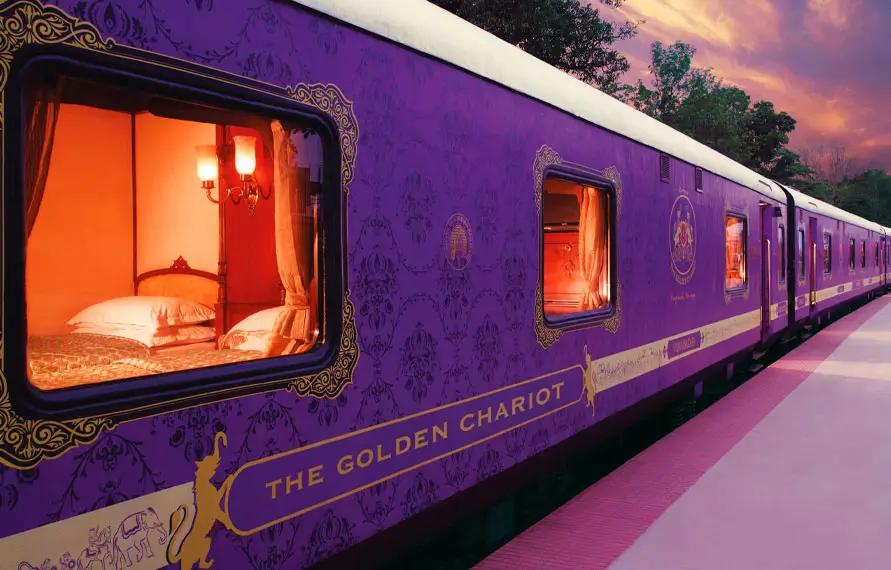
Seven mornings, eight destinations and one cabin that you never have to pack up: that is the simple promise of the Maharajas Express Indian Panorama Tour. This six-night circuit leaves Delhi on a Sunday and rolls back into the capital the following Saturday, carrying a small number of guests through royal Rajasthan, the tiger forests of Ranthambore, the Mughal heartland around Agra and the ancient river city of Varanasi. The train travels mostly after dark, so each day opens in a fresh place with a guide waiting on the platform and a full program of sightseeing already arranged.
What sets this luxury train journey in India apart from the other routes of the same train is its range. Within one week you move from the pink sandstone streets of Jaipur to a dawn game drive, from the marble perfection of the Taj Mahal to the quiet riverside palaces of Orchha, and from the carved stone temples of Khajuraho to the lamp-lit riverfront of Varanasi. Few itineraries anywhere in the country link so many contrasting faces of India without a single hotel change or domestic flight.
The Maharajas' Express, operated by IRCTC, has won the title of World's Leading Luxury Train at the World Travel Awards on several occasions. Cabins range from Deluxe Cabins to a carriage-length Presidential Suite, each with a private bathroom, wide windows and a personal butler. Top Indian Holidays, an independent tour operator approved by the Ministry of Tourism, arranges your booking, your transfers in Delhi and any private days you would like to add before or after the rail portion of the trip.
Your Maharajas Express Indian Panorama journey begins early on Sunday morning at Delhi Safdarjung railway station, a small station in the south of the city that is reserved for special departures. Our driver collects you from your Delhi hotel at around 06:45 so that you reach the platform comfortably by 07:30, when registration opens. A red carpet, a welcome drink and live instrumental music set the tone, and the guest relations team checks your passport and hands over a folder with the week's program. Your luggage is taken straight to your cabin by the train staff.
The train pulls out at about 08:30 and heads south-west across the plains toward Rajasthan. This first stretch is a good time to settle in. Your butler shows you how the cabin works, from the climate control to the safe, and asks about your preferences for morning tea, newspapers and dietary needs. Lunch is served in one of the two restaurant cars, and a short briefing follows in the lounge, where the team explains the timing of each excursion, the dress code for dinners and how to request optional activities during free afternoons.
The train reaches Jaipur in the afternoon, and at around 15:00 you step off for a guided visit to the City Palace of Jaipur, a sprawling complex of courtyards, gateways and galleries that remains partly home to the former royal family. The textile and arms collections are among the finest in Rajasthan, and two giant sterling silver urns on display are recognized by Guinness World Records as the largest silver vessels of their kind. In the evening you are driven to Rambagh Palace, a former royal residence now run by Taj, for a welcome dinner in grand surroundings, returning to the train by about 20:30.
Breakfast is served on board as the morning light reaches the rooftops of Jaipur. At around 08:30 you leave the train with your guide and drive out of the city to Amber Fort, the hilltop stronghold that served as the seat of the Kachwaha rulers before Jaipur was founded. Jeeps carry you up the steep approach road to the main gate, which saves a hot climb and drops you right at the first courtyard. From the ramparts you can see the old defensive walls running along the ridges of the surrounding hills like a smaller version of the Great Wall.
Inside the fort, the guide leads you through the Hall of Public Audience with its double rows of columns, then into the private quarters of the rulers. The highlight is the Mirror Palace, where the walls and ceiling are inlaid with thousands of tiny pieces of convex glass. When the guide holds up a single flame in the darkened room, the whole ceiling glitters like a night sky. Morning is the best time for this visit, before the midday sun bakes the stone courtyards and before the large day-tour coaches from Delhi arrive.
You return to the train for lunch, and the rest of the afternoon is free. Some guests choose a spa treatment at a city hotel, while others ask our team for a private car and guide to visit the Hawa Mahal facade, the old city markets and a gemstone workshop, since Jaipur is one of the world's leading centers for cut colored stones. Block-printed cotton, hand-knotted rugs and blue pottery are other good buys. In the evening the train departs for Sawai Madhopur, the gateway station for Ranthambore National Park, with dinner served as it travels south.
This is the earliest start of the week, and it is worth every minute. Wrapped in warm layers, you board an open safari vehicle for a morning drive in Ranthambore National Park. From November to January the morning slot runs from about 07:00 to 10:30, and in October and from February onward it moves earlier, to roughly 06:30 to 10:00. Winter mornings can be as cold as 6 to 9 degrees Celsius at the start of the drive, so a fleece, gloves and a scarf are strongly recommended, along with binoculars if you have them.
Ranthambore is one of the finest places in India to see a wild tiger, though no sighting can be promised on any single drive. The landscape is part of the appeal: dry forest, rocky ridges, lakes dotted with crocodiles and the walls of a thousand-year-old fort rising above the trees. Spotted deer, large brown deer, wild boar, gray monkeys and a long list of birds are seen on almost every drive. Your naturalist reads alarm calls and fresh paw prints in the sand to decide where to wait, which makes every drive a small piece of detective work.
You return to the train for breakfast, and lunch is served as it crosses into Uttar Pradesh. At about 15:30 you reach Fatehpur Sikri, the red sandstone capital built by the Mughal emperor Akbar in the sixteenth century and abandoned soon after, largely because of water shortages. Its palaces, audience halls and the white marble tomb of the Sufi saint Salim Chishti are remarkably well preserved, and the late afternoon light turns the stone a deep shade of orange. Back on board, the evening has a festive theme with music and regional dishes.
The train reaches Agra overnight, and you leave for the Taj Mahal before sunrise to see it at its most peaceful. Arriving early means smaller crowds at the security gates and softer light on the white marble, which shifts from pale grey to warm pink as the sun climbs over the Yamuna River. Your guide explains the story of the emperor Shah Jahan and his wife Mumtaz Mahal, and points out details that most visitors miss, such as the precious stone inlay work and the optical tricks in the calligraphy around the main arch.
After the visit you are taken to a property with a direct view of the monument for a leisurely breakfast. This is a lovely moment to sit back with a coffee and look at the Taj Mahal in full daylight, now with the morning crowds moving through its gardens. It is worth knowing that the monument is closed every Friday, which is one reason the train schedule always brings guests here midweek. Photography is allowed in the gardens and on the main platform, though not inside the tomb chamber itself.
Lunch is served back on the train, and the afternoon is free to use as you like. Many guests take up the option of visiting Agra Fort, a massive red sandstone fortress on the river where Shah Jahan spent his last years under house arrest, with a distant view of the tomb he built. Others prefer a spa session or a quiet afternoon in the cabin after the early start. In the evening the train leaves Agra and travels south into central India, with dinner served on board.
The train arrives at Orchha at about 07:00, and this short morning visit is often the surprise of the week. Orchha was the capital of the Bundela kings in the sixteenth and seventeenth centuries, and its palaces and temples stand on an island in the Betwa River, linked to the town by an old stone bridge. The grand palace built to welcome the Mughal emperor Jahangir has layer upon layer of terraces, domes and latticed balconies, and from its upper floors you look out across a landscape that has barely changed in centuries.
Before returning to the train you take a short ride through the village lanes and past the row of royal cenotaphs on the riverbank, where vultures still nest on the domes. Orchha sees only a fraction of the visitors that flock to Jaipur or Agra, and that sense of space and quiet is a welcome change of pace in the middle of a busy week. Breakfast is served once you are back on board, and the train continues south through farmland and small villages toward Khajuraho.
After lunch you visit the Western Group of the Khajuraho temples, a UNESCO World Heritage Site built by the Chandela rulers about a thousand years ago. Every surface of these sandstone temples is carved with figures of gods, celestial dancers, musicians, warriors, animals and scenes of daily life. The largest, Kandariya Mahadev, rises in a series of peaks meant to echo a mountain range. In the evening you can choose between a classical Indian dance performance, the sound and light show at the temples or a spa treatment, before dinner on the train.
Breakfast is served as the train crosses the Gangetic plain toward Varanasi, one of the oldest continuously inhabited cities in the world and the holiest city for Hindus. After arrival you are driven to the Taj Ganges hotel for lunch, and then out to Sarnath, about 10 kilometers from the center. It was here that the Buddha delivered his first sermon after his enlightenment, and the site holds the remains of ancient monasteries, a towering brick monument from the Gupta period and an excellent small museum.
In the late afternoon you stop at a silk weaving workshop, where artisans still produce the famous Varanasi brocades on hand looms. A single richly patterned piece can take several weeks to finish, and watching the weavers at work gives you a real sense of the skill involved. There is no pressure to buy, but the workshop is a good place to pick up a high-quality scarf or stole as a gift, and staff can arrange international shipping for larger pieces such as wall hangings or bedcovers, which arrive at your home a few weeks after the trip.
As dusk falls you board a wooden boat on the Ganges in Varanasi and drift along the riverfront as the city's evening fire ceremony begins, usually at around 18:00 in winter. Priests in matching robes raise large brass lamps in slow circles to the sound of bells and chanting, while thousands of pilgrims gather on the stone steps and small leaf boats carrying candles float past on the current. It is a moving and memorable scene, and many guests describe it as the emotional peak of the whole journey. You return to the train for a farewell dinner as it heads back toward Delhi.
Your final morning on the Maharajas Express begins with a relaxed breakfast as the train runs through the countryside of Uttar Pradesh and Haryana on its way back to the capital. There is time to settle any extras with the guest relations team, exchange contact details with fellow travelers and say thank you to your butler and the restaurant staff, who will have come to know your habits remarkably well over the course of the week. Many guests also use this quiet morning to sort their photographs and write a few notes about each stop while the details are still fresh.
The train arrives at Delhi Safdarjung station at around 12:00, where our driver meets you on the platform and helps with your luggage. If you are flying out the same day, we recommend an international flight departing after 21:00, and we can arrange a hotel room for the afternoon so that you can rest and freshen up before the drive to Indira Gandhi International Airport, which takes about 30 to 50 minutes from the station depending on traffic. Our team keeps an eye on your flight status during the afternoon and adjusts the pickup time if there is any change.
Many guests choose not to fly home straight away. A popular option is to continue to Udaipur for two or three nights at a lake palace hotel, or to fly south to Kerala for backwater cruises and beach resorts. Others return to Ranthambore for extra safaris to improve their chances of a tiger sighting. Our team arranges all of these extensions with private cars, guides and hand-picked hotels, so the end of the train journey becomes the start of a more relaxed chapter of your India trip.
Fill out this form with all the required information. Within 12 hours, we will provide you with a tailor-made itinerary at the best price.
Read the reviews of our esteemed client's, go through the experiences they had with Top Indian Holidays.

Whether you're planning your first India trip or returning to explore deeper — get honest, expert advice from someone who knows every corner of this country. No pressure, no cost.



 info@topindianholidays.net
 +91-8955000999