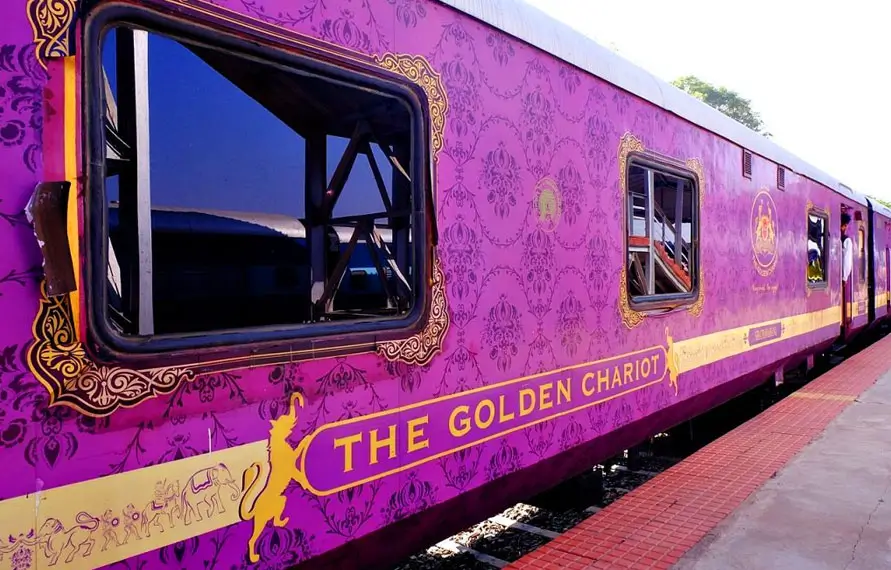
05 Nights / 06 Days Fully Guided Tours Private Car
Yeshwanthpur - Mysuru - Chikkamagaluru - Hampi - Goa - Bengaluru
Karnataka is larger than England, and within its borders you can move from elephant forest to coffee estate to a sixteenth-century imperial ruin to the edge of the Arabian Sea. The Golden Chariot Pride of Karnataka Tour is the one itinerary that strings all of these together in a single week. Over five nights the train runs a loop from Bengaluru through Bandipur, Mysuru, Halebidu, the coffee town of Chikkamagaluru, Hampi and Goa, before returning to the state capital on the sixth morning. You unpack once, and the long distances between stops pass overnight.
Where the shorter Glimpses of Karnataka circuit focuses on wildlife, palaces and Hampi, this longer route adds two quieter chapters that many travelers end up loving most. At Halebidu you stand in front of temple walls carved with more detail than seems humanly possible, and in the hills around Chikkamagaluru you walk between coffee bushes shaded by tall silver oak trees. The journey then crosses the coastal mountains of the Sahyadri range to the old Portuguese churches of Goa, a final day with a very different flavor. It is the most rounded luxury train tour in South India for travelers who want variety without long road transfers.
The Golden Chariot is operated by IRCTC and takes its name from the stone chariot in Hampi. For the 2026-27 season it has refreshed interiors, smart TVs, Wi-Fi and the Arogya spa with Ayurvedic treatments. Its 40 cabins carry up to 80 guests, and one cabin is designed for guests with limited mobility. Meals are served in two restaurants, Ruchi and Nalpaka, with a lounge bar for the evenings. Our role at Top Indian Holidays, a Jaipur travel house operating since the late nineties with Ministry of Tourism approval and no ties to the railway, is to lodge your reservation with IRCTC, drive you around Bengaluru and add any hotel nights or private sightseeing you choose.
A driver from Top Indian Holidays picks you up at your Bengaluru hotel and takes you across the city to Yeshwanthpur station, where registration for the Golden Chariot Pride of Karnataka journey opens at about 08:30. Bengaluru traffic is famously unpredictable, so we build in a generous margin. On the platform the crew welcomes you with flower garlands and a cool drink, staff take your luggage to the cabin and you are shown the lounge, the two restaurants and the spa carriage. Light cotton clothes suit the day, with a sweater for the air conditioning.
The train leaves at about 09:45, and high tea in the lounge is followed by a short talk on the week ahead. Look out of the window as the city thins into millet fields, mango orchards and villages with whitewashed temples. Lunch is a relaxed affair in Ruchi or Nalpaka, and the menus usually include a few regional specialties such as Mangalorean fish in a coconut and red chili sauce or a spiced rice and lentil dish from old Mysuru kitchens, alongside international choices. The train halts at Nanjangud at about 13:30, and a coach drives you roughly 50 kilometers south to the reserve.
The drive in Bandipur Tiger Reserve runs from about 16:30 to 18:30, the best part of the day for animals moving toward water. Bandipur was once the private hunting reserve of the Mysuru kings and now forms part of a vast protected forest that continues into Tamil Nadu and Kerala. Wild elephants are a frequent sight, along with Indian bison, large brown deer, spotted deer and many birds, including the crested serpent eagle. Tigers and leopards live here, though sightings are never certain. Back aboard by roughly a quarter past eight, you sit down to dinner while the train continues toward Mysuru.
Breakfast is served with the train standing at Mysuru station, and a short coach ride takes you to the palace of the Wodeyar kings. Mysuru Palace is one of the most visited buildings in India, and for good reason: its gilded columns, colored glass ceilings and carved rosewood and silver doors are dazzling. Your guide points out the paintings of the royal Dasara procession, with every elephant, soldier and musician drawn in careful detail, and explains how the family still performs certain ceremonies here every autumn. Visitors remove their shoes before entering, and photography is not allowed inside.
After the palace, the coach passes the Devaraja market area, where flower sellers pile jasmine, marigolds and roses in tall mounds and traders sell betel leaves, bananas and colored powders. If you have shopping in mind, Mysuru is the place for pure silk, sandalwood soap and oil, incense and inlaid woodwork, and the government emporiums give reliable quality and fixed labels, which takes the guesswork out of buying silk. You return to the train for lunch, and the early afternoon is a good moment to book a spa treatment before the optional outing.
In the afternoon you can join an optional trip to Srirangapatna, the river island that served as the capital of Hyder Ali and his son Tipu Sultan in the late eighteenth century. The highlight is Daria Daulat Bagh, the summer palace set in a formal garden, its interior walls painted from floor to ceiling with scenes of battles against the British. Nearby the Gumbaz, a white domed tomb with ivory-inlaid doors, holds the graves of father and son. The train expects you back by about 20:00, and dinner is served as it leaves for Banavar overnight.
An early breakfast is followed by a drive from Banavar station to Halebidu, which you reach at about 08:00 while the air is still cool. This small village was once Dorasamudra, the capital of the Hoysala kings, and its Hoysaleswara Temple, built in the twelfth century, stands on a star-shaped platform of soft gray soapstone. That stone allowed the sculptors to carve friezes of astonishing fineness: rows of elephants, lions, horsemen and scenes from the great epics run around the base, while above them gods and dancers wear jewelry so delicate that the beads look movable.
The Hoysala temples of Halebidu, Belur and Somanathapura are listed together as a UNESCO World Heritage Site, and your guide explains how to read the friezes, which tell stories from the Ramayana and Mahabharata from left to right. Two large stone bulls sit in pavilions facing the shrines. The visit takes about two and a half hours, with time for photographs in the soft morning light. You are back on the train by about 11:00, and lunch is served as it climbs west into greener country, reaching Chikkamagaluru in the early afternoon.
Chikkamagaluru is where coffee first took root in India. According to local tradition, a pilgrim named Baba Budan carried seven beans back from Arabia in the seventeenth century and planted them in the hills that now bear his name. In the afternoon you visit a working plantation, where the planter's team walks you between the coffee bushes under tall shade trees wrapped in pepper vines, explaining picking, drying and grading. Depending on the month you may see white blossom or red berries. A tasting of fresh filter coffee ends the visit, and the train departs for Hampi overnight.
Breakfast is taken on board as the train rolls into Hospet, and a short drive brings you to the edge of Hampi, a UNESCO World Heritage Site spread across a valley of granite hills beside the Tungabhadra River. Sixteenth-century visitors from Portugal and Persia described Vijayanagara as a city larger than Rome, with markets selling rubies and horses. After its defeat in battle and the sacking that followed, the capital was abandoned, and what remains today is a vast open-air museum of temples, gateways, water channels and royal buildings scattered among the boulders.
Your guided tour begins at Hemakuta Hill, a cluster of early shrines with a sweeping view over the Virupaksha Temple, whose tall white tower rises above the old market street. You then visit the temple itself, still a place of daily worship. In the royal enclosure you see the stepped tank, the great platform where the kings watched festivals, the Queen's Bath with its arched corridors and the long row of domed Elephant Stables. The small Hazara Rama Temple, covered with carved friezes of soldiers, horses and dancers, is a favorite with photographers.
A break for lunch is built into the day, and the afternoon is warm, so a wide-brimmed hat, light long sleeves and plenty of water make a real difference. Comfortable walking shoes that slip off easily are ideal, because shoes must be removed at active temples. Late in the day you return to the train, and after a shower and a drink in the lounge bar the Golden Chariot sets off west toward the coast. The overnight route descends through the forested Sahyadri range, and dinner is served as the train travels toward Goa.
You wake at Karmali station near the Mandovi River, and after breakfast you drive a short distance to Old Goa, the former capital of Portuguese India. In the sixteenth century this was one of the great cities of Asia, and its churches, now a UNESCO World Heritage Site, remain impressive. The Basilica of Bom Jesus holds the tomb of Saint Francis Xavier in a richly decorated chapel, while the vast Se Cathedral across the lawn is one of the largest churches in Asia. Dress modestly, with shoulders and knees covered, as these are active places of worship.
After the churches you visit a restored Portuguese-era home now used as a shop and cafe, a good chance to see the tall windows, tiled floors and wide verandas of Goan colonial houses and to buy cashews, local spices or hand-painted tiles. Lunch is served back on board as the train moves south to Madgaon. The afternoon is free for a rest, a spa therapy or simply a view of the paddy fields, coconut palms and red laterite soil that give South Goa its look.
In the evening you are driven to a hotel in South Goa for a gala dinner, often the most festive night of the week, with a buffet of seafood, Goan slow-cooked stews and desserts and sometimes live music. The sea breeze is pleasant after the heat of the Deccan, so a light jacket is plenty. Guests return to the train at about 21:45, and at about 22:30 it departs for Bengaluru on the long overnight run east across the Sahyadri range, which climbs through forested hills in the dark.
Your last morning begins with breakfast in the restaurant as the Golden Chariot crosses the Karnataka plateau, now a very different landscape from the coast you left the night before. Fields of millet and sugarcane slide past, with granite hills rising here and there. There is time to settle the bar and spa account, collect any items left with the guest relations desk and say goodbye to the cabin crew and chefs, who will have learned your tastes over five nights. Leave room in your bag for the coffee you bought in the hills.
The train ends its journey at Yeshwanthpur station in Bengaluru, where our driver waits on the platform to help with luggage and take you to your hotel or to Kempegowda International Airport, a drive of about 60 to 90 minutes. Arrival times on this long return leg can vary, so we recommend booking any onward flight for the evening rather than the early afternoon. If you have a late international departure, a day room at a hotel near the airport makes the wait far more comfortable.
Many travelers use the journey as the heart of a longer South India trip. Top Indian Holidays can follow it with a few nights in Coorg among the coffee estates and then a stay at a lodge on the Kabini River for more game drives, or with a flight to Kochi for the hills and backwaters of Kerala. We arrange every extension with a private air-conditioned car and driver, English-speaking guides on sightseeing days and carefully chosen hotels, so your trip continues at the same unhurried pace.
Fill out this form with all the required information. Within 12 hours, we will provide you with a tailor-made itinerary at the best price.
Read the reviews of our esteemed client's, go through the experiences they had with Top Indian Holidays.

Whether you're planning your first India trip or returning to explore deeper — get honest, expert advice from someone who knows every corner of this country. No pressure, no cost.



 info@topindianholidays.net
 +91-8955000999