09 Nights / 10 Days Fully Guided Tours Private Car
Delhi - Agra - Jaipur - Bengaluru - Bandipur - Mysuru - Hampi - Bengaluru
North India and South India feel like two different countries, and this ten-day trip lets you sample both without a rushed schedule. The Golden Triangle with Golden Chariot begins with five nights of private touring through Delhi, Agra and Jaipur, the classic Mughal and Rajput circuit, and then carries you south by air to Bengaluru, where a three-night rail journey through Karnataka takes over. You move from sandstone forts and marble tombs to teak forests, a royal palace lit by thousands of bulbs and the boulder-strewn ruins of a medieval empire.
The northern half is fully private: a chauffeur-driven car, your own English-speaking guide in each city and luxury or palace hotels chosen for comfort and location. You see the Taj Mahal at sunrise, walk through the empty courtyards of Fatehpur Sikri and spend a full day in Jaipur, with time left over for the craft workshops the Pink City is known for. The pace allows a slow breakfast most mornings and an afternoon pause in the hotel before dinner, which matters in a country where the days can be long and the sights are many.
The southern half is the Golden Chariot Glimpses of Karnataka itinerary, a short loop from Bengaluru that visits Bandipur National Park, Mysuru and Hampi. The train is operated by IRCTC and was refreshed for 2026-27 with new interiors, smart TVs, Wi-Fi and an Arogya spa offering Ayurvedic therapies. It carries no more than 80 guests in 40 cabins and serves meals in two restaurants, Ruchi and Nalpaka. The train booking, northern hotels and guides, the flight from Jaipur to Bengaluru and each transfer along the way are handled by Top Indian Holidays, a Jaipur team that has run private tours for more than twenty-five years and holds Ministry of Tourism recognition as an independent operator. Train departure dates are confirmed at the time of booking, and the northern days are built backward from your chosen departure.
Since overseas arrivals into Indira Gandhi International Airport tend to touch down close to midnight or before dawn, nothing is scheduled for this first day, giving you time to sleep off the flight. A representative holding a card with your name waits beyond customs, takes charge of the trolley and leads you out to a chauffeured, air-conditioned sedan. Reaching a hotel in central or south Delhi typically takes 40 to 60 minutes, traffic permitting, and early check-in can be requested in advance if you arrive in the morning.
Your hotel for two nights is a luxury property chosen for its quiet gardens and easy access to the monuments, which matters in a city of more than twenty million people. Once you are settled, the representative goes through a printed program for the whole trip, hands over local contact numbers and answers questions about money, mobile data and dress. A local SIM card or an eSIM can be arranged, and currency is easy to change at the hotel or withdraw from ATMs in the city.
If you land early enough and feel restless, a short evening walk through Lodhi Garden near the hotel district is a gentle introduction. The park is full of joggers, families and fifteenth century tombs of the Lodi and Sayyid rulers, and it stays open until dusk. Otherwise, rest and adjust to the time difference. Delhi in the winter months can be cool after dark, around 8 to 12 degrees Celsius in December and January, so a light sweater for the evening is useful. Dinner can be taken at the hotel, where most restaurants serve both Indian and international menus.
After breakfast your guide meets you in the lobby at about 09:00 for a full day in the capital. The morning goes to Old Delhi, the walled city built by Shah Jahan in the seventeenth century. You stop outside the Red Fort, whose massive sandstone walls run for more than two kilometers, and then climb the broad steps of Jama Masjid, one of the largest mosques in India. Shoes are left at the entrance, and women are offered a robe if needed. From the courtyard there is a fine view over the rooftops of the old city.
Next comes a ride through Chandni Chowk on a cycle carriage, the best way to move through lanes too narrow for a car. Spice merchants, silver dealers, wedding card printers and sweet shops line the route, and the guide points out the scale of the wholesale spice market off Khari Baoli, where sacks of chilies and turmeric are stacked to the ceiling. Wear closed shoes and keep a light scarf handy for the dust. Lunch can be at a restaurant in Connaught Place or back in the leafy part of the city.
The afternoon shifts to New Delhi, laid out by the British in the early twentieth century. You drive along Kartavya Path past India Gate and the government buildings on Raisina Hill, then spend unhurried time at Humayun's Tomb, the garden tomb of the second Mughal emperor and a clear forerunner of the Taj Mahal. Late afternoon light suits its red sandstone and white marble. If time allows, the guide adds Gurudwara Bangla Sahib, where volunteers run a free community kitchen that feeds thousands each day. You return to the hotel by early evening.
Check out after breakfast and set off for Agra at around 09:00. The Yamuna Expressway makes the 230 kilometer drive smooth, and the journey usually takes three and a half to four hours including a coffee stop. Your driver speaks English, knows the road well and keeps cold water in the car. Mustard fields, brick kilns and small farming towns slide past the window, and in winter the morning haze can be thick, which is one reason we avoid very early starts on this day.
You check in to a luxury hotel in Agra, several of which have rooms with a view toward the Taj Mahal, and rest over lunch. At about 14:30 your Agra guide takes you to Agra Fort, the red sandstone citadel where three generations of Mughal emperors held court. Behind the ramparts lie marble pavilions, audience halls and an eight-sided tower from which, according to tradition, the captive Shah Jahan gazed downstream at his wife's tomb during his final years of confinement. Allow about ninety minutes here, and look for the small mosque built for the ladies of the court.
For the last light of the day, the guide drives you across the river to Mehtab Bagh, a restored Mughal garden directly opposite the Taj Mahal. From here you see the monument from the back, reflected in the shallow water when the river level allows, with very few other visitors around. Sunset is around 17:30 in winter and later in spring. It is a calm, low-key way to see the Taj for the first time before tomorrow's early visit. Dinner is at your hotel, and an early night is wise.
Your guide meets you in the lobby about half an hour before sunrise, and an electric shuttle takes you the last stretch to the east gate. The Taj Mahal opens at sunrise and is closed every Friday, so the program is arranged to avoid that day. Early morning brings softer light, cooler air and shorter queues. Bags are scanned at security, so carry only a phone, camera, passport and water. Food, tripods and large bags are not allowed inside, and a locker at the gate can hold anything you forget to leave in the car.
As you pass under the red sandstone entrance, the arch holds the white dome like a picture frame, and the guide explains how the minarets lean slightly outward and how the calligraphy grows larger toward the top so that it looks even from the ground. Inside, the inlay of carnelian, lapis and jade glows under a flashlight. Spend as long as you like in the gardens before returning to the hotel for breakfast and checkout at around 10:00, with a long but scenic drive ahead of you through rural Uttar Pradesh and eastern Rajasthan.
The road west reaches Fatehpur Sikri in under an hour. Built by the emperor Akbar in the sixteenth century, the city served as his capital for only around fourteen years. Your guide leads you through the Diwan-i-Khas with its carved central pillar, the Panch Mahal and the courtyard of the great mosque, where the white marble tomb of the saint Salim Chishti is wrapped in delicate stone screens. From here the drive to Jaipur takes about four and a half hours, and you reach your palace or luxury hotel by early evening.
At roughly 08:30 you leave for Amber Fort, which crowns a ridge some 11 kilometers beyond the northern edge of Jaipur. Going early avoids both the heat and the large coach groups that arrive later. A jeep climbs the ramp to the main courtyard, and from there your guide shows you the pillared audience hall, the brightly frescoed Ganesh Gate and the glittering Mirror Palace. Heading back into town, pause briefly beside Man Sagar Lake to photograph Jal Mahal, whose pale walls appear to drift on the water.
Late morning is spent in the old walled city. The City Palace still houses the former royal family in one wing, while the rest holds courtyards, a textile gallery and a painted gateway for each season. Next door, Jantar Mantar is a UNESCO-listed collection of giant masonry instruments built in the early eighteenth century to track the sun, moon and stars. The largest sundial here measures time to within about two seconds, and the guide shows you how to read it on a sunny day.
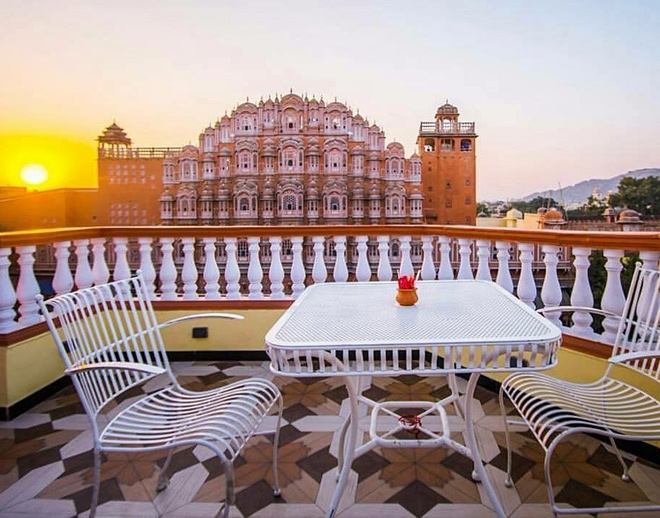
After lunch, stop outside the Hawa Mahal, whose pink honeycomb front of 953 little windows once let the ladies of the court follow parades below without being observed. The afternoon is yours: some guests visit a block-printing workshop, a gem-cutting studio or the shops of Johari Market, while others prefer the hotel pool. Jaipur in winter has warm, dry days around 23 to 26 degrees Celsius and cool evenings, so dinner on a rooftop terrace with a view of the lit-up Nahargarh Fort is often a pleasure. Tonight is your last night in the north.
After a relaxed breakfast, the driver takes you to Jaipur International Airport, about 30 minutes from most hotels, for a direct flight to Bengaluru. Non-stop flights take roughly two and a half to three hours, and the schedule is chosen when your booking is confirmed so you do not need an early alarm. Domestic airlines in India apply a checked baggage limit of about 15 kilograms in economy, so mention any heavy luggage in advance and we can suggest a higher cabin class or prepaid extra allowance.
Bengaluru sits on a plateau at about 900 meters above sea level, which gives it a mild climate all year, usually 15 to 28 degrees Celsius in the winter months. Our representative meets you at Kempegowda International Airport, north of the city, and the drive to your luxury hotel can take 60 to 90 minutes. You notice the change at once: green avenues, office towers, a different script on the road signs, coconut stalls at the junctions and a softer, more relaxed tempo than Delhi.
If you arrive by mid-afternoon, a short visit to Lalbagh Botanical Garden is a lovely way to stretch your legs. The garden was laid out in the eighteenth century under Hyder Ali and Tipu Sultan and is known for its glass house, modeled on London's Crystal Palace, and for very old trees. Otherwise, rest at the hotel and get ready for tomorrow's boarding. Pack a small day bag for the train with sunscreen, a hat and walking shoes, since Hampi involves a fair amount of walking on uneven stone.
The driver drops you at Yeshwantpur railway station by about 08:30, when registration for the Golden Chariot opens. Staff greet you with music and a welcome drink, check your passport and show you to your cabin, while your luggage follows separately. Cabins have twin or double beds, an en-suite bathroom, a smart TV and Wi-Fi, and one is set up for guests with limited mobility. The train pulls away at about 09:45, and a short briefing in the lounge explains timings, dress for each outing and how meals work in Ruchi and Nalpaka.
Lunch is served as the train runs south-west across farmland toward Nanjangud, a temple town on the Kapila River, which it reaches at about 13:30. From here a coach drives you about 50 kilometers to Bandipur National Park, a tiger reserve on the edge of the Nilgiri hills where Karnataka meets Kerala and Tamil Nadu. The road climbs gently into dry deciduous forest, and wildlife is often seen even before the safari begins: spotted deer grazing at the roadside or a herd of wild elephants crossing.
The evening safari runs from about 16:30 to 18:30 in forest department vehicles with a trained naturalist. Bandipur is best known for its Asian elephants and Indian bison, the massive wild cattle of South Indian forests, but tigers, leopards and wild dogs are present too, and a sighting is always a matter of luck. Wear muted colors, bring a jacket for the open vehicle as the light fades and keep cameras ready. You return to the train by about 20:15 for dinner as it moves on toward Mysuru.
You wake in Mysuru, the former royal capital of the Wadiyar dynasty, and breakfast is served on board. The morning is devoted to Mysuru Palace, also known as Amba Vilas. The present building was completed in the early twentieth century after a fire destroyed the older wooden palace, and it was designed by the British architect Henry Irwin in a mix of Hindu, Mughal, Rajput and Gothic styles. From the outside it looks like a fairy tale, with domes, arches and a tall central tower.
Inside, your guide leads you through the Kalyana Mantapa, the octagonal marriage hall with a stained glass ceiling shipped from Glasgow and a floor of polished tiles in geometric patterns. Painted panels along the walls show the great annual procession of the Dasara festival in remarkable detail, with every soldier and elephant drawn individually. The public Durbar Hall opens onto a long balcony with views toward Chamundi Hill. Cameras are limited indoors and footwear stays at the door, so a pair of socks helps on chilly marble floors.
You return to the train for lunch. In the afternoon, an optional excursion visits Srirangapatna, the island fortress of Tipu Sultan in the Kaveri River, with its painted summer palace, Daria Daulat Bagh. Guests who stay in the city often buy pure silk, sandalwood oil or incense, all long associated with Mysuru. The palace is lit with close to a hundred thousand bulbs on Sunday and holiday evenings, so ask the train staff whether your departure day allows a view. Dinner is served on board as the train travels north overnight toward Hospet.
Morning brings a very different landscape: giant granite boulders stacked in impossible piles, banana plantations and rice paddies along the Tungabhadra River. After breakfast at Hospet, a coach takes you to Hampi, once Vijayanagara, the capital of one of the richest empires in South Indian history until it was sacked in the sixteenth century. The ruins spread over more than 40 square kilometers, so your guide focuses on the most rewarding sites. Hats, sunscreen and water are essential, since midday can reach 30 degrees Celsius even in winter.
The highlight for most guests is the Vittala Temple, home to the stone chariot that gives this train its name and appears on Indian currency notes. Look closely at the carved wheels and at the pillared halls nearby, whose slender columns once produced musical notes when tapped. They are now protected and cannot be touched, but the guide explains how the musicians of the royal court are thought to have used them. The route usually includes the Royal Enclosure with its great stepped platform, the Queen's Bath and the long Elephant Stables with their alternating domes.
You return to the train for lunch and a rest during the hottest part of the day. Later, the program brings you to the bank of the Tungabhadra to watch the sun drop behind the boulder hills, one of the most memorable evening views in South India. An optional afternoon trip crosses to Anegundi, a village older than Hampi itself. Dinner on board this evening is the last of the journey, and the train leaves for Bengaluru overnight while you sleep, crossing the dry plains of the northern Deccan in darkness.
Breakfast is served as the train runs through the countryside of central Karnataka, and it reaches Yeshwantpur station in Bengaluru at about 11:00. Settle any onboard bar or spa bills before arrival, and leave the cabin after the staff confirm your luggage is ready. Saying goodbye to the crew is part of the ritual, and many guests find that three nights were just enough to learn names, favorite drinks and the quiet routines of the cabin stewards. Your bags are carried out to the platform where our driver waits.
From the station, the car takes you to Kempegowda International Airport for your onward or international flight. The drive takes about 45 minutes to an hour from Yeshwantpur, which sits on the northern side of the city closer to the airport. If your flight leaves late in the evening, a day room at an airport hotel or a short city tour can be arranged so that you are not waiting for hours in the terminal. Many international departures from Bengaluru leave around midnight, so a shower and a nap before the flight make a real difference.
As an independent, government-approved operator, Top Indian Holidays keeps its Jaipur team reachable around the clock until you check in for your flight home. Over ten days you have crossed from the Mughal plains to the Deccan plateau, from the marble of Agra to the granite of Hampi, by car, plane and private cabin. If you would like to add a beach extension in Goa or Kerala, or a few days in Coorg's coffee country, we can attach it to this trip with very little change to the dates.
Fill out this form with all the required information. Within 12 hours, we will provide you with a tailor-made itinerary at the best price.
Read the reviews of our esteemed client's, go through the experiences they had with Top Indian Holidays.

Whether you're planning your first India trip or returning to explore deeper — get honest, expert advice from someone who knows every corner of this country. No pressure, no cost.



 info@topindianholidays.net
 +91-8955000999