11 Nights / 12 Days Fully Guided Tours Private Car
Bengaluru - Mysuru - Kanchipuram - Mahabalipuram - Thanjavur - Kochi - Alleppey -Munnar - Thekkady - Periyar - Kochi
Tea bushes cut as neatly as hedges cover the hills above Munnar at around 1,600 meters, and on a clear morning the slopes look as if someone has draped green velvet over every ridge. That cool upland is where this trip ends, but it begins far below, on the hot plains of the south, aboard a luxury train. The Golden Chariot Jewels of South with Munnar & Thekkady pairs five nights of rail travel through Karnataka, Tamil Nadu and Kerala with five nights of private touring in the Sahyadri mountains of Kerala, finishing with a last evening in the port of Kochi.
The train portion carries you past the great temples and old trading towns of the south: Mysuru, the Pallava shore monuments of Mahabalipuram, the Chola temple at Thanjavur, the merchant mansions of Chettinad, the spice harbor of Kochi and a houseboat day on the backwaters. Once you step off in Bengaluru, a short flight returns you to Kerala, and the pace changes completely. In Munnar you walk through tea gardens and look for rare wild goats, and in Thekkady you cruise Periyar Lake at dawn, smell cardamom drying in a spice garden and sleep to the sound of the forest. The contrast between rail and hills is what makes this pairing work so well.
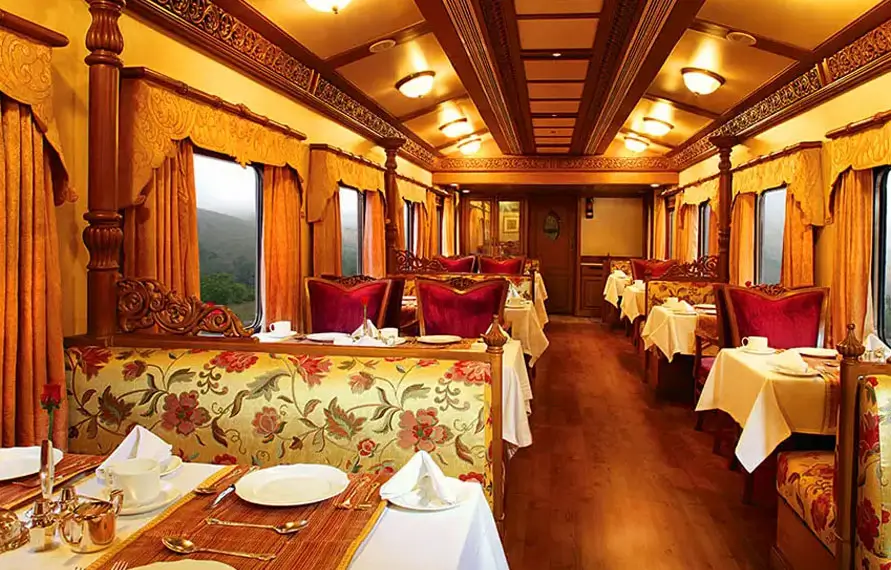
The Golden Chariot is operated by IRCTC and named after the stone chariot at Hampi. Upgraded for the 2026-27 season with new interiors, smart TVs, Wi-Fi and the Arogya spa for Ayurvedic therapies, it carries up to 80 guests in 40 cabins and serves meals in its Ruchi and Nalpaka restaurants. Booking is handled by Top Indian Holidays, a Jaipur-based private travel company recognized by the Ministry of Tourism, which submits your train reservation request and also secures your flights within India, hill resort stays, a private car with an experienced driver for all of Kerala and every transfer along the way.
Most long-haul flights land at Kempegowda International Airport in the early hours or late at night, and our representative waits in the arrivals hall holding a sign with your name. The drive into the city takes 60 to 90 minutes depending on traffic, along a fast raised highway and then through the busy northern suburbs. Your hotel in central Bengaluru, chosen from the city's luxury properties, holds your room so that you can sleep off the flight, and our team hands over a folder with your train documents, Kerala hotel details and contact numbers for the whole trip.
Bengaluru sits on a plateau at about 900 meters, which keeps its climate milder than most Indian cities, with daytime temperatures of around 26 to 30 degrees Celsius for much of the year. If you have energy in the afternoon, a gentle outing is a good idea. The Lalbagh botanical garden has century-old trees, a glasshouse modeled on London's Crystal Palace and a rocky outcrop with a small watchtower built by the city's founder, while Cubbon Park offers shaded walks between colonial red-brick buildings, including the High Court and the State Central Library.
The city is also known for its food and drink. Bengaluru was one of the first places in India to take craft beer seriously, and its older restaurants still serve South Indian breakfasts of crisp rice pancakes and steamed rice cakes with coconut relish that draw queues from early morning. Keep the evening simple, though: tomorrow begins with an early transfer to the station. Lay out light cotton clothes, a shawl for temples and comfortable shoes that slip off easily, and ask the hotel for a wake-up call around 06:30.
After an early breakfast, our driver brings you to Yeshwanthpur station for registration on the Golden Chariot at about 08:30. The crew greets you with garlands and a cold drink, your luggage disappears to the cabin, and a member of staff walks you through the carriages: the lounge bar, the two restaurants and the spa where Ayurvedic massages can be booked during the week. Cabins have their own bathrooms, wide windows and plenty of storage, so you can unpack completely and forget about suitcases until the following Sunday.
The train pulls out at about 09:45, and the guest relations team runs a short briefing over high tea about the stops, dress codes at temples and which outings are optional. Your first meal on board comes at midday in Ruchi or Nalpaka while the train rolls south-west over the Karnataka countryside, through fields of sugarcane and paddy and past small hills of bare granite. Many guests spend this first leg in the lounge, chatting with fellow travelers, since the group on board is small and the mood friendly. Others prefer the quiet of the cabin and the slowly changing view.
In the afternoon you leave the train at Mysuru for a guided tour of Mysuru Palace, the residence of the Wodeyar kings. Its exterior is grand, but the interior is the real surprise: a wedding hall with a peacock-patterned stained-glass ceiling, a royal court hall of carved pillars open to the hills and corridors of paintings that record the royal autumn festival in fine detail. Shoes stay outside and cameras are not allowed indoors. You return to the cabin for dinner as the train sets off on the long overnight run to Tamil Nadu.
The train arrives at Chengalpattu in the morning, and after breakfast an optional excursion takes you to Kanchipuram, about an hour's drive away. Known as the city of a thousand temples, it was the Pallava capital and remains a major pilgrimage center. The small Kailasanatha Temple, cut from sandstone in the eighth century, has rows of shrines and lion pillars, and the Ekambareswarar Temple has a huge tower and a mango tree said to be very old. Kanchipuram silk, with its heavy gold borders, is woven on hand looms in the side streets.
Lunch is served aboard before the drive to Mahabalipuram, where the Pallava kings carved shrines out of solid rock beside the sea. The Shore Temple, built in granite in the early eighth century, stands at the water's edge, its outlines blurred by salt wind. Inland you see the Five Rathas, each a temple cut from a single rock, and the enormous open-air relief of Arjuna's Penance, packed with gods, sages, animals and a procession of elephants. The whole group of monuments is a UNESCO World Heritage Site.
The late afternoon light here is lovely for photographs, especially near the round boulder perched on a slope that locals call Krishna's Butter Ball, which seems ready to roll at any moment. Stone carvers in town still work granite by hand, and you can watch them shape statues of gods and animals in roadside workshops. In the evening the group dines at a beachfront hotel, with the waves of the Bay of Bengal close by, before you return to the train for the run south to Thanjavur.
Breakfast is served as the train enters Thanjavur, and by about 09:00 you are walking through the gateway of the Brihadeeswarar Temple, built by the Chola king Rajaraja early in the eleventh century. Its pyramid-shaped tower rises around 66 meters, and its top is a single granite block whose transport to the summit is still debated by engineers. A great stone bull watches over the courtyard. Arriving in the morning matters: the stone paving grows hot by late morning, and visitors must walk barefoot inside the walls.
Your guide explains the Chola world: the bronze sculptures that made the dynasty famous, the inscriptions that list temple dancers and musicians by name, and the paintings hidden inside the walls of the inner corridor. If time permits, you may see artisans making gilded paintings or polishing bronzes in nearby workshops. Lunch is served once the train leaves Thanjavur and rolls south across the flat rice country of the Kaveri delta toward Karaikudi. The delta is the rice bowl of Tamil Nadu, and from the window you see bullock carts, water channels lined with palms and village shrines guarded by large clay horses painted in bright colors, offered to a local guardian deity.
The afternoon visit to Chettinad is one of the most unusual of the journey. The Chettiars were a banking community whose families grew rich through trade across South-East Asia, and they poured their wealth into vast homes with dozens of rooms arranged around open courtyards. You see a mansion with teak columns brought from Burma, imported floor tiles and stained glass, then a workshop at Athangudi where tiles are still made by hand in bright geometric patterns. The train leaves in the evening for Kochi, with dinner served on board.
The train reaches Kochi in the morning, and you drive to the Mattancherry Palace, gifted by the Portuguese to the local raja in the sixteenth century and later repaired by the Dutch. From the outside it is a simple whitewashed building, yet its upper rooms hold some of the most detailed mural paintings in India, in deep reds and greens, telling stories from the Ramayana. Nearby, spice warehouses still trade ginger and pepper, and the air in the narrow lanes carries their smell. Wear light clothing; the morning is already warm and humid.
A performance of Kerala's classical dance drama follows, in which performers wear painted faces, tall headdresses and wide skirts, and tell their stories entirely through hand gestures, eye movement and drumming. Back in your carriage for a midday meal, you then have a free afternoon for a nap or a session in the spa. Kochi is humid, so a short break in an air-conditioned cabin is welcome after a busy morning. If you prefer to stay active, the crew can suggest a short walk near the station, but most guests choose a slow lunch and a nap before the evening outing.
Later in the day, an optional trip takes you to the seafront of Fort Kochi, where the large cantilevered Chinese fishing nets rise and fall at the water's edge, worked by teams of fishermen. St. Francis Church, the oldest church built by Europeans in India, stands a few streets away, and Vasco da Gama was buried here for some years before his body was returned to Portugal. You will return to Kochi at the end of the trip, so this visit is a first taste. Dinner is on board as the train moves toward Chertala.
From Chertala station, a short drive takes you to a landing near Alleppey, the gateway to the Kerala backwaters. You board a traditional houseboat built of wooden planks tied together with coconut fiber rope, with a curved roof of woven palm and bamboo. These boats once carried rice and spices along the waterways; today they are comfortable floating lounges with cane seating on deck. The crew serves fresh coconut water as the boat pulls away from the jetty and into a wide lagoon, with cushioned deck seats facing the water.
The cruise follows narrow canals lined with coconut palms, past rice fields lying below water level and villages linked only by water. Small churches, temples and schools sit right on the banks, and life moves at the speed of the paddle. Lunch is cooked on board, typically fish in a red chili and coconut sauce, vegetable dishes and steamed rice. Look for egrets, kingfishers and cormorants drying their wings on posts, and carry a hat and sunscreen for the open deck. A light shower is possible in the wetter months.
In the late afternoon you return to the jetty and the train for a farewell dinner. Since you return to Kerala tomorrow, this evening is less of a goodbye than for other guests, but it is still a good moment to thank the crew and the guides who have looked after you since Bengaluru. Insect repellent is useful near the water at dusk. Overnight the Golden Chariot Jewels of South journey turns back toward Bengaluru, and the train climbs from the coast through the hills toward the Deccan plateau.
Breakfast is served on board as the train reaches Bengaluru, and after farewells at Yeshwanthpur station our driver takes you to Kempegowda International Airport for the short flight back to Kochi, about one hour in the air. Arrival times of the train can vary, so we choose a flight with a comfortable gap. At Kochi airport your Kerala driver meets you with a private air-conditioned car, and you set off east toward the mountains. Keep a fleece in your hand luggage, as the evening in the hills will be far cooler than the coast.
The road to Munnar is about 110 kilometers and usually takes three and a half to four hours. It begins through rubber plantations and small towns, then climbs through forested mountain roads with waterfalls tumbling beside the hairpin bends. As you gain height, the air cools and the hills fill with tea. Your driver is used to these roads and will stop for photographs at the viewpoints, or for fresh pineapple and tea at a roadside stall. Travelers prone to motion sickness should take precautions before the climb.
You will reach your Munnar resort in the evening, likely after dark if the train is late. Hill resorts here are set among tea gardens or forest, with wide views and fireplaces in some rooms. Nights can be chilly from December to February, falling to around 10 degrees Celsius, so have a sweater ready. After a long day of travel, dinner at the resort is the best choice, with Kerala dishes and international options. Tomorrow is a full day to enjoy the hills at a gentle pace.
Morning is the best time in Munnar, when mist lifts off the valleys and the tea pickers start work on the slopes. After breakfast you drive about 15 kilometers to Eravikulam National Park, home of the Nilgiri mountain goats, a sturdy wild species found only in the high hills of the Sahyadri range. Forest buses carry visitors up from the entrance, and the animals often graze near the road, quite used to people. The park usually closes for a few weeks between February and April for the calving season, and we confirm the dates before your visit.
Later, your guide or driver takes you to the tea museum run by a local plantation company, where an old rolling machine and a short film tell how tea came to these hills in the late nineteenth century, cleared by British planters from dense forest. A working factory shows the stages from withering green leaves to rolling, drying and grading, and a tasting session teaches the differences between grades. The afternoon includes a drive past the Mattupetty dam and lake and the high meadows around Echo Point.
Return to the resort in the late afternoon for a walk through the tea rows, if you wish, accompanied by a local guide who can explain how pickers select the top two leaves and a bud. Munnar's weather changes quickly, so a light rain jacket is worth carrying. Evenings in the hills are quiet, ideal for an early dinner and a long sleep after the busy train week. If you enjoy cooking, ask our team about a home-style Kerala cooking lesson at the resort, where you learn to temper spices in coconut oil.
After a leisurely breakfast, you leave Munnar for Thekkady, a drive of about 90 to 110 kilometers depending on the route, usually three to four hours. The road winds south through the Cardamom Hills, where tea gives way to forests of tall trees shading cardamom bushes, with pepper vines climbing their trunks. Along the way you pass small towns with churches and temples and roadside stalls selling spices, honey and homemade chocolate. The scenery is some of the finest in southern India, with views of folded green ridges stretching toward Tamil Nadu, and your driver will pull over at the best viewpoints for photographs.
You arrive at Thekkady around lunchtime and check in to your resort, typically set in landscaped gardens on the edge of the Periyar Tiger Reserve. The town of Kumily sits right on the Kerala and Tamil Nadu border, and its main road is lined with spice and handicraft shops. The climate is milder than the coast and warmer than Munnar, with pleasant evenings. Unpack and rest for a while before the afternoon activity. Resorts here often have pools, Ayurvedic spas and restaurants serving fresh food grown on the property, and giant squirrels and hornbills are sometimes seen in the gardens.
In the late afternoon you visit a spice garden with a guide who shows you cardamom pods growing at the base of the plant, nutmeg with its red mace, cinnamon bark, cloves, vanilla orchids and black pepper. You can taste and smell each one, and there is a small shop where spices are packed for travel. In the evening, many guests enjoy a performance of Kerala's traditional martial art at a local theater, full of acrobatic leaps and swordplay, followed by dinner at the resort.
Rise early for the first boat cruise on Periyar Lake, which departs around 07:30 from the boat landing inside the reserve. Arrive about 30 minutes ahead, as shuttle buses carry visitors from the parking area. The lake was created in the late nineteenth century when a dam was built on the Periyar River, and dead tree trunks still stand in the water where the old forest was flooded. Each cruise lasts about one and a half hours, and cormorants and darters perch on the submerged trees.
From the boat you may see wild elephants coming down to drink, Indian bison, large brown deer and wild boar on the shores, and occasionally otters. Tigers live in the reserve but are rarely seen. The forest department also runs guided nature walks through the reserve, led by trained local guides, many of whom were once forest poachers who now protect it. These walks need advance booking and an early start, and group sizes are kept small; wear long trousers and closed shoes, and guides provide leech socks in the wet season.
The rest of the day is free. You might take an Ayurvedic massage at the resort, browse the spice shops in Kumily, or visit a tea factory or a local village. For more adventure, the forest department offers bamboo rafting and longer treks, though these take most of a day and need to be booked in advance. Dinner at the resort is a good occasion to try local dishes such as lacy rice pancakes with a mild coconut stew, followed by a cup of local cardamom tea.
After breakfast you drive from Thekkady back to Kochi, about 160 kilometers and five hours on hill roads that drop gradually toward the coast through rubber and pineapple plantations. Your driver can stop at a roadside spot for lunch or a local tea break. You reach Kochi in the afternoon and check in to a hotel in Fort Kochi or on the waterfront, depending on your preference. Fort Kochi hotels are often restored colonial bungalows or old spice warehouses with high ceilings and courtyard pools, while waterfront hotels look out across the busy harbor.
In the late afternoon, take a stroll through Fort Kochi at your own pace or with a local guide. The streets are lined with old merchant houses, warehouses converted into galleries, and cafes under huge rain trees. If you missed the Paradesi Synagogue earlier, Jew Town is a short drive away, though the synagogue is closed on Fridays, Saturdays and Jewish holidays. Antique shops along the lanes sell carved doors, old brass lamps and spice boxes. The local art scene is lively too, and several galleries show contemporary Indian work.
At sunset, head to the seafront to watch the Chinese fishing nets lowered into the water against an orange sky, with ships passing at the harbor mouth. Fishermen sell their catch at small stalls, and nearby restaurants will cook it for you to order. For your last evening, our team can book a table at a waterfront restaurant serving Kerala seafood, a relaxed way to end the trip after the hills and backwaters. Ask for the catch of the day grilled with green pepper, a Kerala favorite.
Enjoy a relaxed breakfast and perhaps a final walk along the waterfront before you pack. Check-out is usually at noon, though for a later departure we will ask the hotel to keep your room longer or offer a day room, depending on how full it is. Kochi has several international flights each day to the Gulf, Singapore and beyond, making it an easy departure point for travelers heading home. Domestic flights to Delhi, Mumbai and Goa also leave throughout the day if you are continuing your travels in India.
Our driver will take you to Cochin International Airport, about 45 to 75 minutes from Fort Kochi depending on traffic. We suggest leaving at least three hours before an international flight. The airport is known as the first in the world to run entirely on solar power, and its terminals are clean and well organized. Our team stays in touch until you are checked in, so any last-minute questions are answered quickly. Keep spices and tea in your checked luggage, as liquids and powders can be questioned at security.
Top Indian Holidays has arranged trips like this one for many years, and we hope the combination of the Golden Chariot train and the Kerala hills has given you a full view of South India. If you would like to extend your stay, a few nights on the beach at Marari or Kovalam, or a stay in a Kumarakom lake resort, would round off the trip nicely. Our team can arrange any of these with private cars and comfortable hotels, so the holiday ends as gently as it began.
Fill out this form with all the required information. Within 12 hours, we will provide you with a tailor-made itinerary at the best price.
Read the reviews of our esteemed client's, go through the experiences they had with Top Indian Holidays.

Whether you're planning your first India trip or returning to explore deeper — get honest, expert advice from someone who knows every corner of this country. No pressure, no cost.



 info@topindianholidays.net
 +91-8955000999