


 info@topindianholidays.net
 +91-8955000999

Hot Air Balloon Ride in Jaipur
Lift off as the sky turns orange and drift over villages, mustard fields and the Aravalli hills while Jaipur is still waking up.
View Experience ›After seeing the flowers of the Taj Mahal set in stone, sit beside an inlay artisan and cut, grind and set a petal of your own.
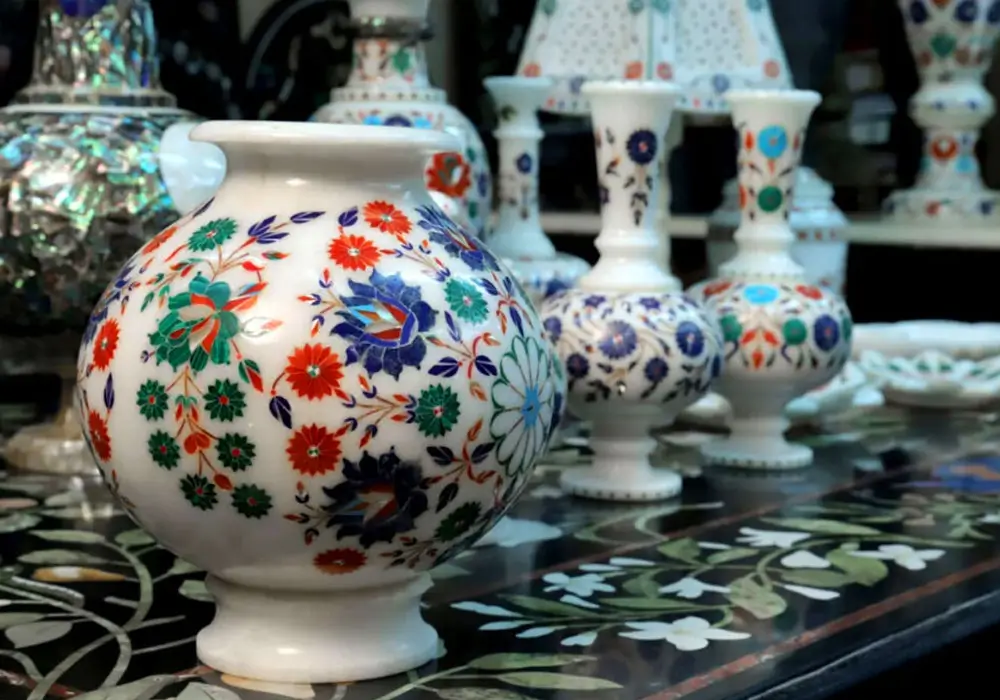
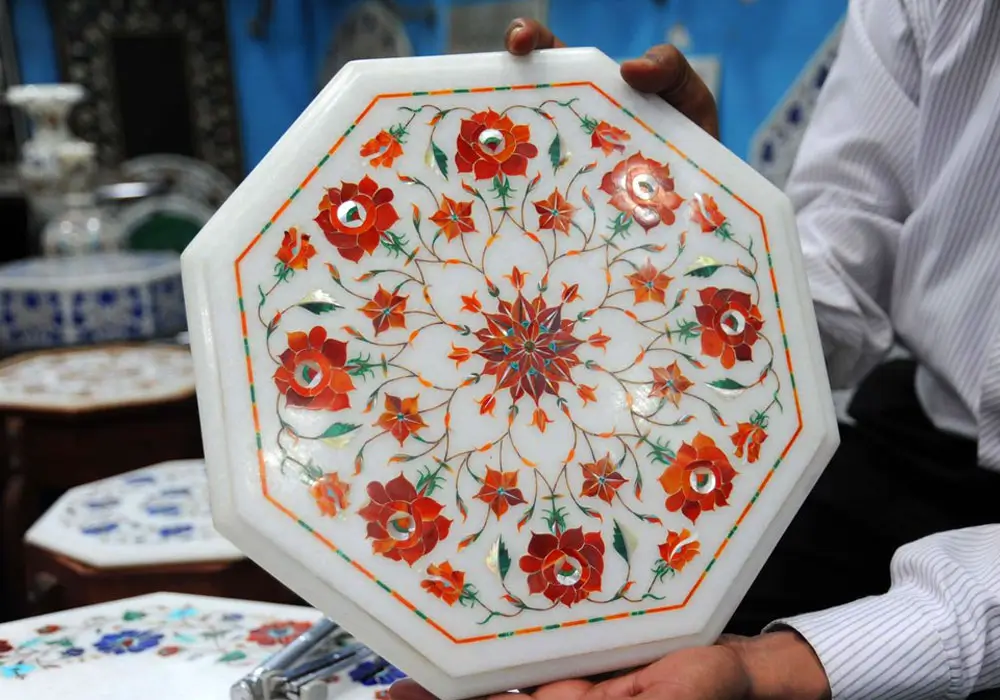
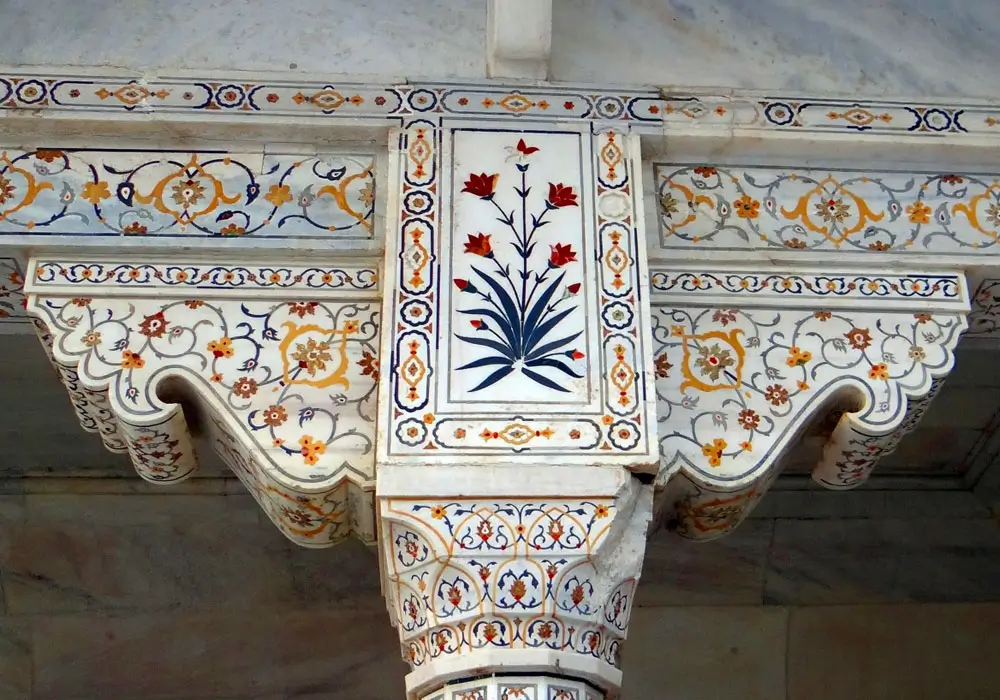
Stand close to the walls of the Taj Mahal and look at the flowers. They are not painted. Every leaf, stem and petal is a separate piece of coloured stone, cut to shape and fitted so tightly into the white marble that the joins are almost invisible. Some flowers are made of many tiny pieces, shaded from dark to light so that the petals seem to curl. This is pietra dura, known in India as parchin kari, and it is one of the reasons the monument looks so alive in changing light.
The craft did not end when the Taj was finished. In the lanes of Agra, families who have worked in this craft for generations still cut and set stone in the same basic way: a thin slice of lapis or carnelian held against a grinding wheel, a recess carved into marble with a fine chisel, a natural adhesive warmed and pressed in, and hours of polishing. A marble inlay workshop in Agra lets you watch each of these stages up close and then try one yourself.
We should be honest from the start. Agra has a great many “workshops” that are really showrooms, with one or two artisans at the door to demonstrate and a large shop behind. Guests are often brought there by guides who earn commission, and the visit turns into a sales pitch. We do this differently. We take you to places where the craft is actually practised, we tell the artisans that you are coming to learn, and there is no pressure to buy anything.
The best time to go is the same day as your Taj Mahal visit, ideally a few hours after sunrise, while the flowers on the tomb are still fresh in your mind.
1. From the Taj to the workshop
Most guests come after an early visit to the Taj Mahal and breakfast at their hotel. Your driver takes you to the workshop, which is a short drive within Agra. Your guide explains on the way what you are about to see, and links it back to the panels you have just looked at.
2. Meeting the artisans
You meet the craftsmen at their benches. Inlay is usually a team effort, with different people specialising in cutting stone, carving marble, setting and polishing. They work seated on the floor or at low benches, often in small groups, and you can watch for a while before anyone asks you to pick up a tool.
3. Choosing the stones
The artisan shows you the raw materials: blue lapis lazuli, green malachite, orange and red carnelian, green jade, black onyx, yellow and brown stones, and the shimmering mother of pearl. Each comes as a small block or slice. You learn which stones are hard and which are soft, and why some colours cost far more than others.
4. Slicing the stone
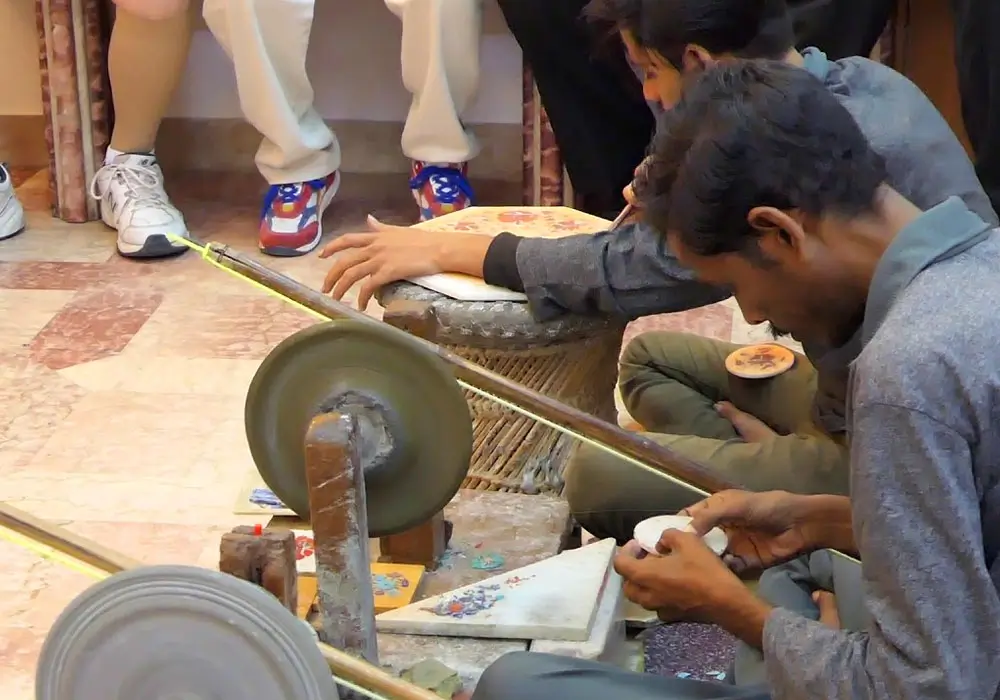
Stone is cut into thin slices, traditionally with a bow strung with wire and an abrasive paste. This is slow, patient work and a good way to understand why each flower takes so long. In many workshops today you will also see small powered tools used alongside the traditional ones.
5. Shaping on the wheel
The artisan holds a tiny slice against a turning grinding wheel, often worked by hand or with a simple belt, and shapes it into a petal or leaf. The skill is in the fingertips: the piece is so small that the craftsman judges it by feel as much as by eye. This is the step you will most likely try yourself, with a larger and easier shape.
6. Carving the marble
A separate artisan draws the design on the marble and then carves out a shallow recess for each piece with fine chisels. The recess must match the stone exactly, or the joint will show. You can try a few strokes on a practice piece and feel how hard and unforgiving marble is.
7. Setting the stone
The shaped pieces are fixed into the recess using a natural adhesive, which is warmed so that it flows and then sets hard as it cools. The artisan presses each piece in with care. Because the cut is so accurate, very little adhesive shows.
8. Polishing
Finally the surface is ground flat and polished so the stone and marble sit level and smooth. Done well, you can run a finger over a flower and feel no edge at all. You will see finished pieces and pieces at earlier stages, which shows how much the polish changes the look.
9. Questions, tea and a quiet look around
Tea is usually offered. Ask the artisans how long they trained, how a large tabletop is planned, and how they keep the old patterns alive. If there is a display room, you can look without obligation. Then your driver takes you on to Agra Fort, your hotel or onward to Jaipur or Delhi.
The Taj Mahal was built in the seventeenth century by the Mughal emperor Shah Jahan as a tomb for his wife Mumtaz Mahal. Its decoration combines carved marble relief, calligraphy inlaid in black stone and floral inlay in coloured semi-precious stones. The technique came to India in the Mughal period and was developed by Mughal craftsmen into something distinctive, with flowing plants and flowers that reflect the Mughal love of gardens.
What to look for at the Taj. Inside the main tomb, the screens and cenotaphs carry some of the finest inlay. Outside, look closely at the panels around the arches, where flowers and vines climb the walls. If you have a guide, ask them to point out a flower made of many tiny pieces, with the colour shading from petal to petal.
The tomb of Itimad-ud-Daulah. Often called the “Baby Taj”, this smaller tomb across the river was built before the Taj and is covered in inlay of geometric patterns, wine cups, cypress trees and flowers. It is quieter than the Taj and lets you study the inlay at close range.
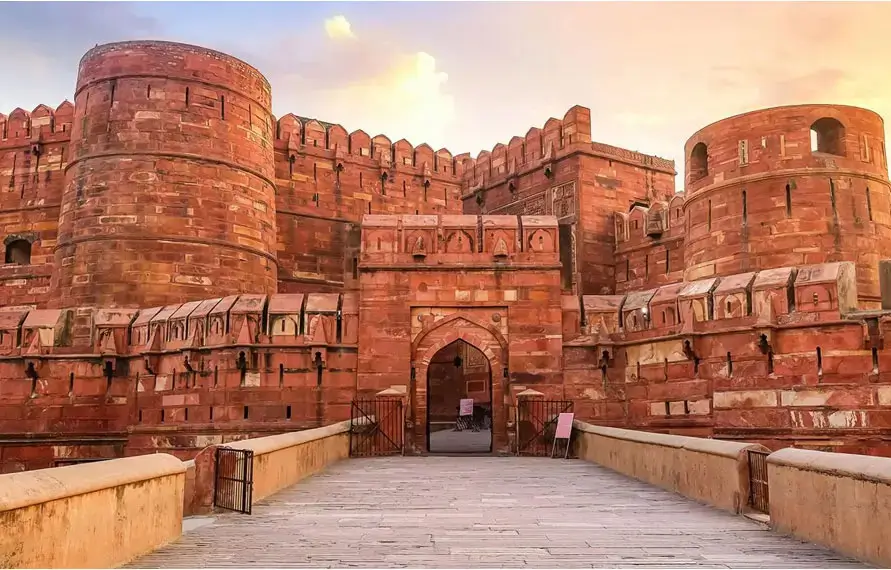
Agra Fort. The marble pavilions inside the fort also carry inlay work, and from parts of the fort you can see the Taj across the river.
When you then sit with an artisan and see a single petal take shape on the wheel, the scale of the work on the Taj becomes almost hard to believe.
Lapis lazuli. A deep blue stone with tiny gold flecks, traditionally imported and highly valued. It is used for blue flowers and borders.
Malachite. A banded green stone used for leaves and stems. It is relatively soft and needs careful handling.
Carnelian. An orange to red stone that glows when light passes through it. It is a classic choice for red petals.
Jade. Usually pale to deep green, very tough and hard to work. It gives a soft colour to leaves.
Mother of pearl. The inner layer of shell, used for its shimmer and pale colours. It catches the light and changes as you move.
Onyx and other stones. Black stone for outlines and lettering, and yellow and brown stones for shading and detail.
Makrana marble. The white marble of the Taj Mahal came from Makrana in Rajasthan, and good quality inlay work today is still often made on white marble from the region.
Your artisan will show you the stones they use. Some pieces combine expensive natural stones; others use more affordable materials. Both are honest if you are told clearly which is which.
This section matters because it is the part that disappoints so many visitors to Agra.
The common pattern. A guide or driver brings guests to a large air-conditioned shop. An artisan demonstrates for a few minutes at the entrance. Then guests are led into a sales room, offered tea and shown tabletops priced in the thousands. Prices are often inflated to cover commissions, and some items are not what they claim to be.
What we do. We choose workshops where the craft is actually practised every day, with artisans who are happy to teach and talk. We arrange the visit as an experience, not a shopping stop. We tell the workshop in advance that you are coming to learn, and that you may not buy anything. Your guide stays with you and will step in if you feel uncomfortable.
What you can do. Feel free to say “thank you, we are just looking” and leave a display room whenever you like. If you are interested in a piece, take your time, ask questions, and do not let anyone rush you.
If you do decide to buy, a few simple checks help.
The translucency test. Real marble is slightly translucent. Hold a small torch or your phone light against the edge or underside of the piece in a dim spot, and good marble glows softly as light passes into it. Many imitations, such as painted stone or resin, stay dark.
Feel the surface. On good inlay the stones sit perfectly level with the marble. Run your finger over the design; you should not feel ridges or gaps.
Look at the joins. Fine work has tight joints and petals made of several pieces with shaded colours. Very simple flowers with thick visible adhesive lines suggest cheaper work.
Ask what the stones are. A genuine artisan will name each stone. Be cautious of extravagant claims about rare gems.
Weight. Marble is heavy. A large tabletop that feels light may not be solid marble.
Price. Fine inlay takes days or weeks. A very low price for a large, detailed piece usually means shortcuts somewhere.
Small pieces. Coasters, small boxes, plates and tiles can travel in your luggage. Ask for them to be wrapped well in bubble wrap and a firm box. Keep them in hand luggage if they are delicate and within your airline’s limits.
Large pieces. Tabletops and large panels are heavy and fragile and usually need to be shipped. Ask the seller to put the shipping terms in writing: the total price including packing, insurance and delivery, the expected timeline, and what happens if the piece arrives damaged.
Customs and duties. Your home country may charge import duty or taxes on arrival. These are usually paid by you, not the seller, so it is worth checking your own country’s rules before buying something large.
Keep the paperwork. Keep a receipt that describes the piece, the stones used and the price paid. Photograph the piece before it is packed.
Pay sensibly. For large shipped items, use a payment method that offers some protection. Your guide can help you ask the right questions, but the purchase is between you and the seller.
Architecture and history lovers. If the Taj Mahal is the reason for your trip, this is the best way to understand how it was decorated.
Families with older children. Teenagers who like making things usually enjoy the wheel and the stones, and the hands-on part keeps them interested.
Travellers who want to shop wisely. Even if you never touch a tool, an hour with real artisans teaches you what good inlay looks like before you spend money on it.
Couples. A quiet, unhurried morning after a dawn visit to a monument built for love suits many honeymooners.
The workshop is indoors and works all year.
October to March. The main season for Agra. Mornings can be misty in December and January, which affects views at the Taj but not the workshop.
April to June. Agra is very hot. A workshop visit after an early Taj visit is a good way to spend the hottest part of the day indoors.
July to September. Monsoon season. Rain does not affect the workshop, and the Taj can look very fresh under monsoon skies.
Fridays. The Taj Mahal is closed to general visitors on Fridays. If you are in Agra on a Friday, the workshop, Agra Fort and the Baby Taj make a good alternative day.
After sunrise at the Taj. The most popular plan is the Taj Mahal at first light, breakfast at your hotel, then the workshop mid-morning while the inlay is fresh in your mind.
On a day trip from Delhi. On a Taj Mahal sunrise tour from Delhi by car, the workshop can be added before the drive back, though the day becomes long. An overnight in Agra makes it more relaxed.
On a Golden Triangle tour. Agra sits between Delhi and Jaipur, around a few hours’ drive from each. A night in Agra lets you see the Taj at sunrise, visit the workshop and Agra Fort, and continue to Jaipur the next day, perhaps via the stepwell at Abhaneri.
For full moon visitors. If you are visiting for the Taj Mahal under the full moon, the workshop fits neatly the following morning.
Build a craft theme. In Jaipur, try gemstone cutting and jewellery or block printing. Together they show how much of India’s decorative tradition rests on small, skilled hands.
Bring and wear - Comfortable clothes that can handle a little marble dust - Closed shoes, as floors may have stone chips - Reading glasses if you use them - A small torch or phone light for the translucency test - Your camera, after asking the artisans if photos are fine
Leave behind - Any feeling that you must buy something - Loose scarves or sleeves near the turning wheel - Rings on the hand you use to hold the stone
Tell us your Agra dates and we will place the workshop on the morning after your Taj Mahal visit, in a working workshop with no sales pressure.
Call & WhatsApp +91-9828085426 or email info@topindianholidays.net.
See more ideas on our Top Experiences in India page.
Tell us your travel dates and we will check availability and fit this experience into the right day of your itinerary. Reply within 12 hours.
Check Availability› Chat on WhatsApp› Send an Enquiry›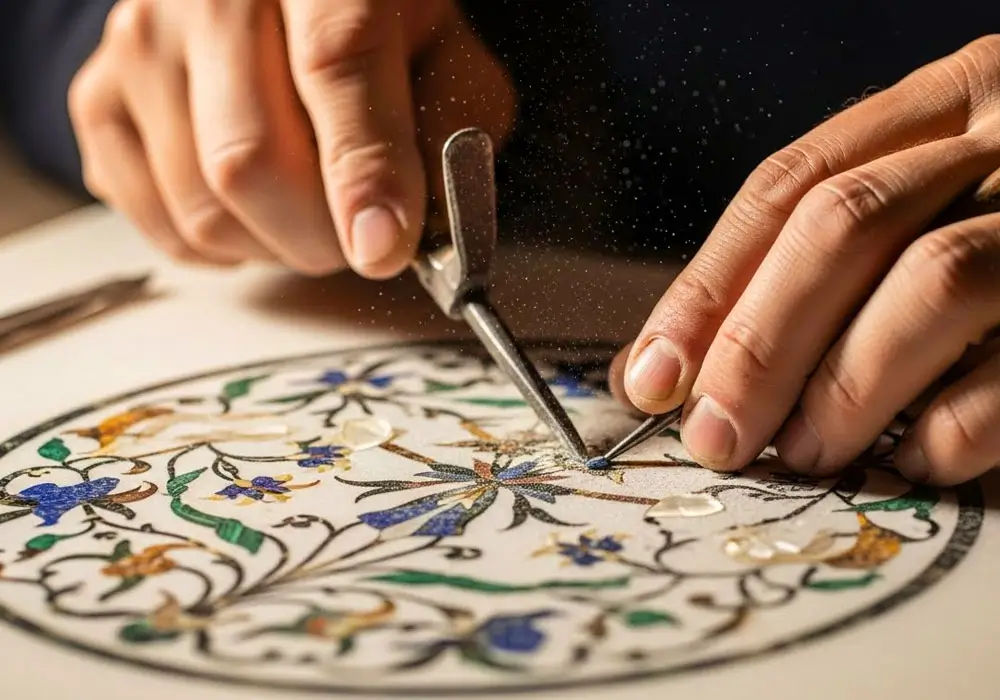



 🌙 01 Day
⭐ Most Popular
 🌙 07 Nights/08 Days
Delhi - Agra - Jaipur... Delhi - Agra - Jaipur - Delhi Show More
 🌙 05 Nights/06 Days
Delhi - Agra - Jaipur Delhi - Agra - Jaipur Show More
 🌙 04 Nights / 05 Days
A large, detailed tabletop can take a team many weeks or longer, depending on the design and number of stone pieces. Small coasters and boxes take much less time.
The tomb of Itimad-ud-Daulah, often called the Baby Taj, is covered in fine inlay and is quieter than the Taj. Agra Fort also has inlaid marble pavilions.
They come from families who have worked in this craft for generations in Agra. Many learned from parents and relatives, starting young and building skill over years.
Older children often enjoy watching and trying. The tools are sharp and the wheels turn, so close adult supervision is needed. Tell us their ages when you enquire.
Yes, but it makes a long day. An overnight in Agra lets you see the Taj at sunrise and visit the workshop at a relaxed pace.
Workshops usually work on Fridays, and the visit makes a good alternative while the Taj Mahal is closed to general visitors. We confirm the arrangements for your date.
Yes, many sellers ship worldwide. Get the shipping cost, insurance, timeline and damage terms in writing, and check your home country’s import duties before buying.
Common stones include lapis lazuli, malachite, carnelian, jade, onyx and mother of pearl, set into white marble. Your artisan will show you each one.
Shine a light at the edge in a dim spot; real marble glows slightly. Feel the surface for smooth, level joints, and ask the artisan to name each stone. Very cheap large pieces are a warning sign.
Yes. Under supervision you can try shaping a stone on the wheel and other simple steps. A finished piece takes far longer than one visit, so this is a taste of the craft rather than a full project.
Yes. The basic method of cutting, shaping, carving the recess, setting and polishing is the same craft you see on the Taj, though some modern tools are used alongside traditional ones.
No. We choose working workshops and tell them in advance that you are there to learn. You can browse if you wish, but there is no obligation to buy.
The price depends on the length of the visit and your group size. We quote the current price for your dates with transfers included. Send us your dates on WhatsApp.
It is the technique of cutting coloured stones into shapes and setting them into marble to form a picture or pattern. In India it is called parchin kari, and it is the inlay you see on the Taj Mahal.

Whether you're planning your first India trip or returning to explore deeper, get honest, expert advice from someone who knows every corner of this country. No pressure, no cost.