


 info@topindianholidays.net
 +91-8955000999

Hot Air Balloon Ride in Jaipur
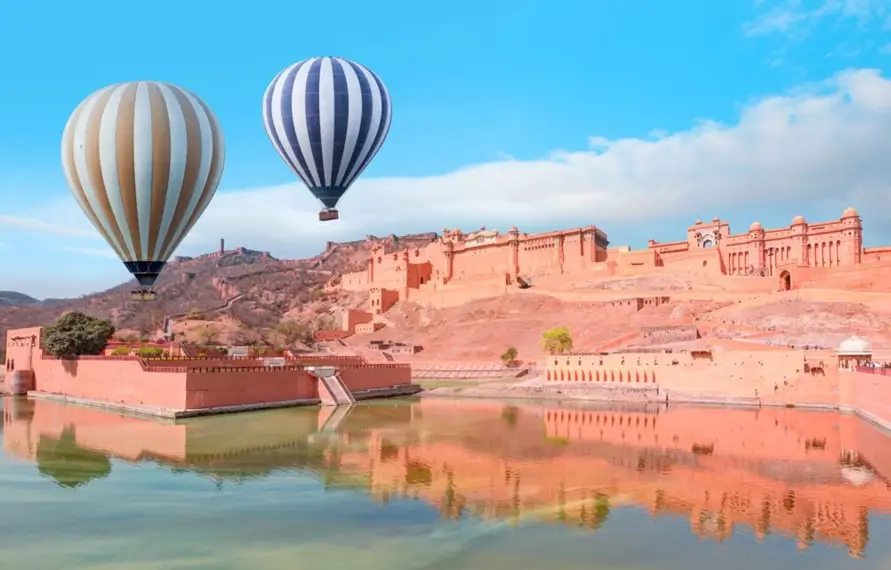
Lift off as the sky turns orange and drift over villages, mustard fields and the Aravalli hills while Jaipur is still waking up.
View Experience ›Dress as a Rajasthani bride and groom, ride in on a decorated horse with a band, exchange garlands and walk around the sacred fire in a lakeside or heritage setting.
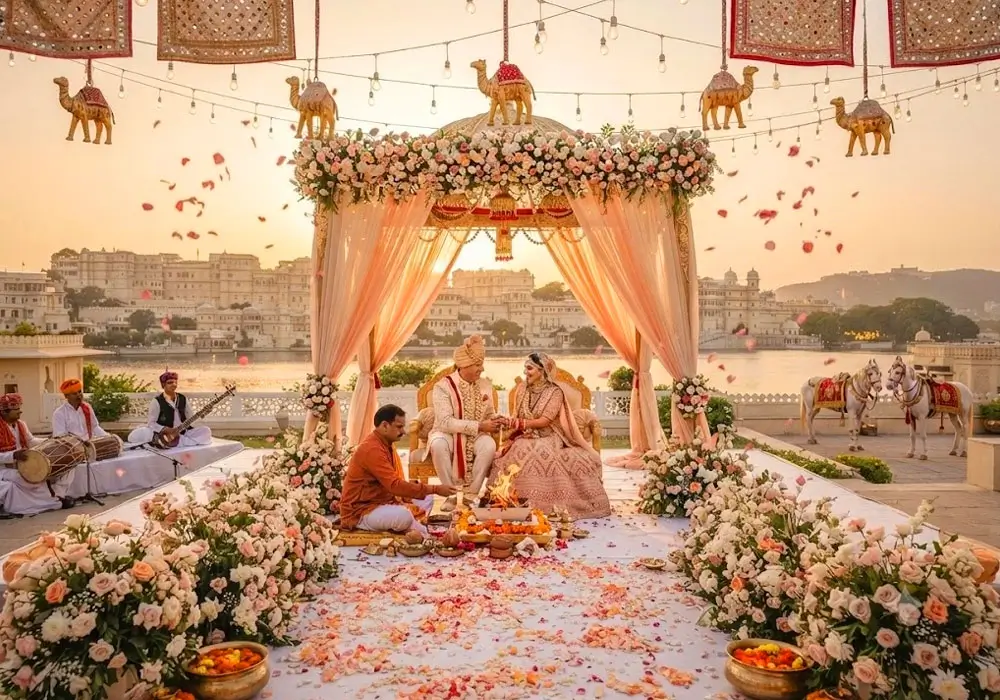
Indian weddings are famous for good reason. There is music before the groom even arrives, a bride whose hands are covered in fine henna patterns, garlands of marigold and rose, a priest chanting by a small fire, and families who make sure everyone eats far too much. Many travellers who see a wedding procession pass in the street of Udaipur or Jaipur wish, half seriously, that they could have one of their own. This experience makes that possible.
A Rajasthani wedding for couples is a symbolic Hindu-style ceremony arranged for you and your partner. It suits couples on honeymoon, couples marking a special anniversary, and those who simply want to renew their vows in a setting that feels very far from home. You dress in wedding clothes, the groom arrives with a small procession, you exchange garlands, and a priest leads you through the pheras, the circles around the sacred fire that sit at the heart of a Hindu wedding. Dinner and music follow.
One thing must be clear from the start. This is a ceremonial celebration. It is not a legally registered marriage in India. Most couples marry legally at home, before or after their trip, and celebrate here. We explain why further down this page, and why that usually makes far more sense than trying to register a marriage while travelling.
Udaipur, with its lakes, white palaces and hills, is the classic setting for a vow renewal in India. Jaipur offers grand heritage hotels and old havelis in and around the Pink City. Both give the evening a sense of place you could not create anywhere else.
1. Planning together before you travel
Every ceremony is arranged around you. Before your trip we talk through the setting you want, the size of the celebration, whether you want a horse or a vintage car for the groom’s arrival, the style of clothes and your budget. We also explain the rituals so nothing is a surprise on the day.
2. Mehendi in the afternoon
The bride’s hands, and often her feet, are decorated with henna by a mehendi artist. Traditional bridal designs are dense and detailed, often running up the forearms. The paste needs time to dry and darken, so this is a relaxed afternoon session with tea. Grooms can have a small design too if they wish. If you want a separate taste of the art on another day, a henna art session works well.
3. Dressing in wedding clothes
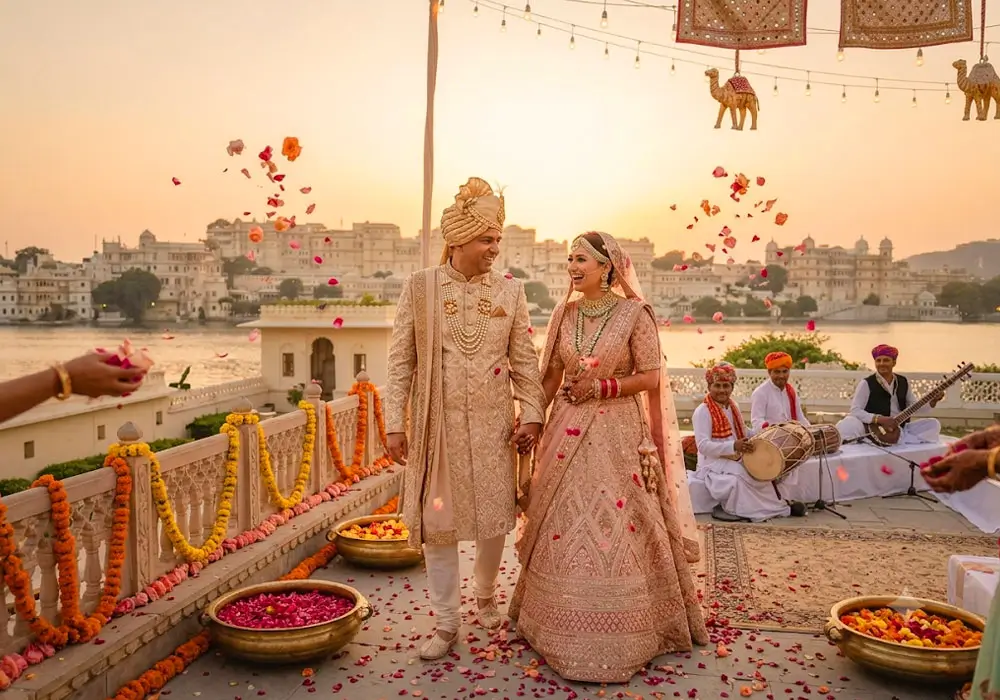
The bride is dressed in a saree or lehenga, often in red, pink or another rich colour, with bangles, jewellery and a light veil. The groom wears a sherwani, the long formal coat, with a safa, the tied Rajasthani turban, often in bright colours. Helpers dress you and tie the turban; a session of turban tying and saree draping earlier in your trip helps if you want to understand how it is done.
4. The baraat
The groom’s procession, the baraat, is the joyful arrival. Traditionally the groom rides a decorated horse, led by a small band with drums and brass, while friends dance alongside. A decorated vintage car is a calmer alternative. Even a short baraat around the courtyard of a heritage venue brings a burst of energy and noise.
5. Welcome and varmala
The bride’s side receives the groom with a welcome ritual, and then the couple exchange varmala, the garlands of flowers. In many families this is a playful moment, with friends lifting the bride or groom so the other cannot reach easily. Petals fall, the band plays, and photographs come thick and fast.
6. The pheras around the sacred fire
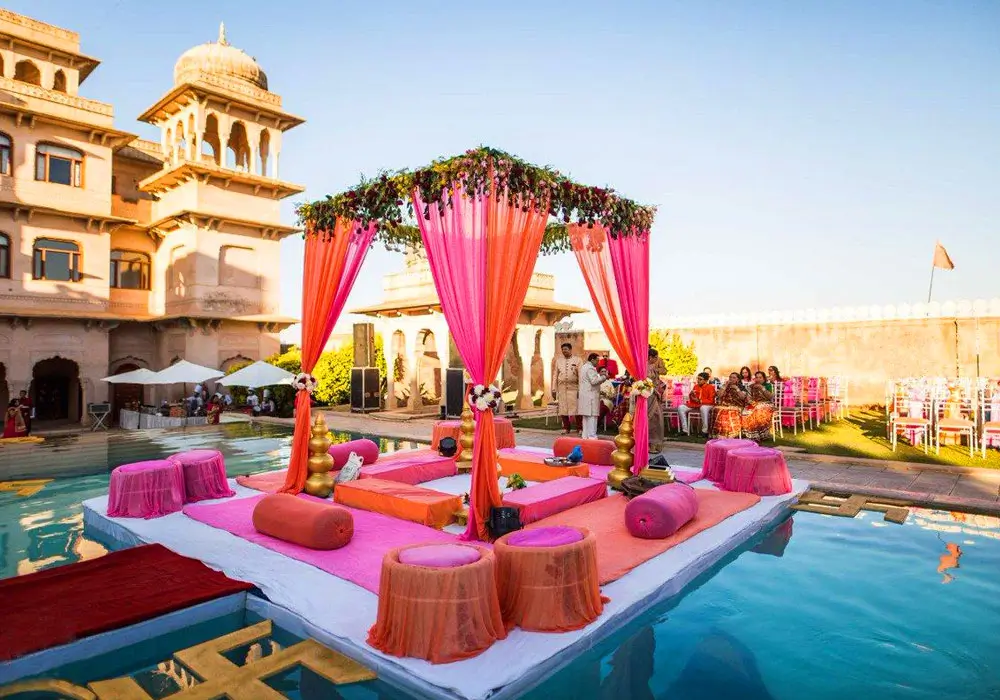
Under a decorated canopy, the mandap, a priest lights a small sacred fire and recites prayers in Sanskrit. The couple’s clothes are tied together, and they walk around the fire, traditionally seven times, as vows are spoken. The priest will explain the meaning of each step in English as far as possible, so you understand what you are promising.
7. Blessings and sindoor
After the pheras there may be further small rituals, such as the groom applying sindoor, red powder, in the bride’s hair parting, and blessings for the couple. The priest guides you; nothing is done without explanation.
8. Music and dinner
The evening ends with music, perhaps folk musicians or dancers, and a dinner of Rajasthani dishes. If you have travel companions or friends with you, they become your wedding guests and are welcome to dance.
Lakeside. Udaipur’s lakes give the most romantic backdrop: palace walls, ghats, hills and the evening light on the water. A lakeside terrace, courtyard or garden can be arranged depending on the season and availability. Many couples combine the ceremony with a Lake Pichola sunset boat ride on the same day or the day after.
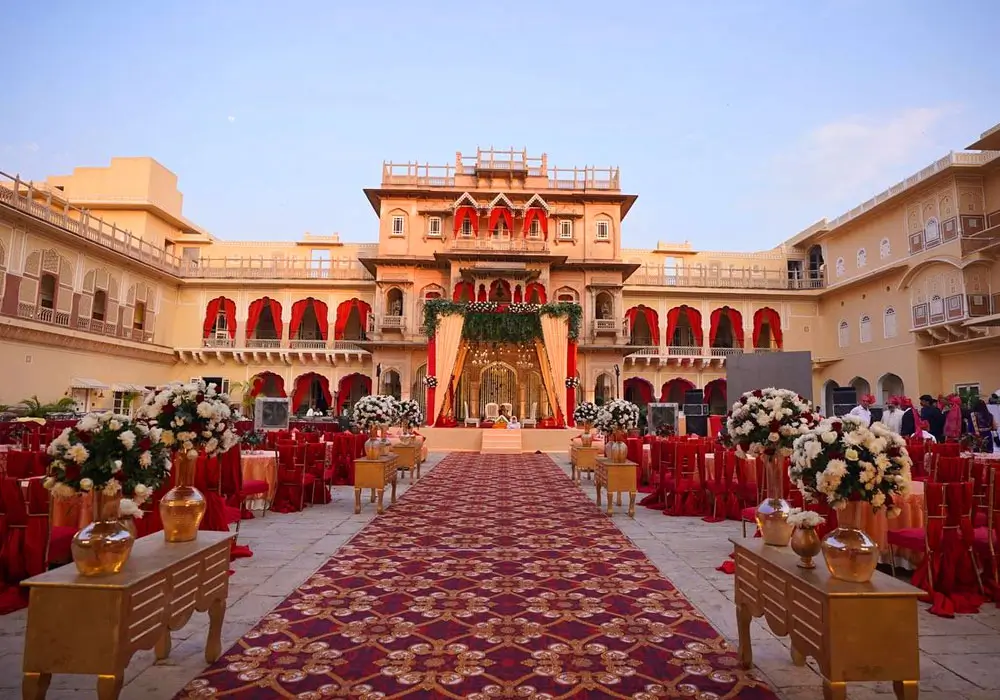
Heritage hotel. Both Udaipur and Jaipur have many palace and heritage hotels with courtyards, gardens and terraces. If you are staying at one, the ceremony can often be held there, which keeps logistics simple and lets you walk to your room afterwards.
Private haveli. An old merchant or noble house with carved balconies and an inner courtyard gives an intimate, family atmosphere. This suits couples who want something smaller and more personal.
Countryside or fort setting near Jaipur. Some venues outside the city offer open lawns, forts or desert-style settings with space for a full baraat on horseback.
We suggest settings to suit your style, the season and the number of guests, and we confirm availability for your dates before anything is booked.
We are often asked whether foreign couples can legally marry in India while on holiday. It is possible in principle, but it is rarely practical.
The Special Marriage Act. Couples who are not marrying under a personal religious law, which includes most foreign couples, generally marry in India under the Special Marriage Act. The process involves giving formal notice to the local Marriage Officer, and in practice at least one partner needs to have been living in that district for a period before the notice is given. Notice is then published for around 30 days to allow objections before the marriage can be solemnised. Embassies may also ask for documents such as certificates of no impediment.
What this means for travellers. Taken together, these steps usually mean a stay in one place of several weeks, with paperwork and appointments. That rarely fits a holiday. Rules and practice can vary and change, so anyone seriously considering a legal marriage in India should check with their own embassy and a local lawyer well in advance.
What most couples do. Most couples marry legally at home, either in a simple civil ceremony before travelling or after they return, and then celebrate their Rajasthani wedding here. Others are already married and see the ceremony as a vow renewal. Either way, the celebration in India carries the meaning you give it, without any legal complications.
We will never describe the ceremony as a legal marriage, and we ask you not to rely on it as one.
A Hindu wedding is a religious ceremony first and a celebration second. A few simple points help keep the day respectful.
Follow the priest. The priest leads the ritual and will tell you when to sit, stand, offer rice or ghee to the fire, or walk around it. Take your time and do not worry about mistakes; the priest guides everything.
Shoes off at the mandap. Footwear is removed before stepping up to the sacred fire.
Treat the fire with care. It is sacred, not a prop. Do not throw anything into it except offerings the priest gives you, and keep clothing clear of the flame.
Ask about anything you are unsure of. If a ritual does not feel right for you, for example for religious reasons, tell us in advance. Ceremonies can often be adapted or simplified with the priest’s agreement.
Alcohol and the ceremony. Keep any drinks for after the ritual is over, and follow the venue’s rules.
Dress fully. Wedding clothes are modest and covering. Keep shoulders covered during the ceremony itself.
For the bride. A lehenga is a long, full skirt with a fitted blouse and a long scarf, the dupatta, often heavily embroidered. A saree is a single long cloth draped around the body. Both come in rich colours. Red is traditional for brides in Rajasthan, but pink, maroon, orange and gold are also popular. Jewellery usually includes bangles, earrings, a necklace and a forehead ornament.
For the groom. A sherwani, the knee-length formal coat, worn over fitted trousers, with a safa turban and sometimes a stole. Embroidered shoes, called mojaris, complete the look.
Rent or buy. Outfits can be rented or bought. Buying gives you a lasting keepsake, and Jaipur and Udaipur both have good shops and tailors. If you want made-to-measure clothes, tell us early so there is time for fittings.
Make-up and hair. A make-up artist can be arranged for the bride, along with a simple hairstyle that works with the veil and jewellery.
October to March. The best season. Evenings are pleasant, the lakes in Udaipur are usually full after the monsoon, and outdoor venues work well. December and January evenings can be cool, so a light shawl helps.
November to February. This is also the main Indian wedding season, which brings a lively atmosphere but also busy venues, bands and priests on auspicious dates. Plan early.
April to June. Very hot. Ceremonies are still possible, but indoor or late-evening settings are better.
July to September. Monsoon season. Udaipur is green and lovely, but outdoor events need a rain plan.
Auspicious dates. Indian families choose wedding dates using the Hindu calendar. For a symbolic ceremony you can choose any date, but if a priest suggests an auspicious time for your evening, it adds a nice touch.
Make it the high point of Udaipur. Two or three nights in Udaipur gives time for the mehendi, the ceremony and a relaxed day afterwards for the City Palace, the lakes and the ropeway ride to Karni Mata Hill.
Or celebrate in Jaipur. Jaipur suits couples on a Golden Triangle route. Put the ceremony on your last evening there so the rest of your stay is spent sightseeing with the tuk tuk ride through the Pink City or a cooking class.
Give yourself a quiet day afterwards. The ceremony is long and emotional. A slow morning, a spa visit or an Ayurvedic massage helps.
See a real wedding too. If your dates fall in the wedding season, you might also attend an Indian wedding as a guest, which shows how families celebrate on a much larger scale.
Add a royal evening. A royal dinner hosted by a Thakur family or an evening of Rajasthani folk dance complements the wedding theme.
Honeymoon couples. Couples who married at home and come to India for their honeymoon often say this celebration felt like the wedding they never quite had time to enjoy. You are not hosting relatives; you are simply present for each other.
Milestone anniversaries. Couples marking ten, twenty-five or more years together often choose a vow renewal. Some bring their children or grandchildren as guests, who join the baraat dancing.
Small groups of friends. If friends travel with you, they can be part of the bride’s or groom’s side, wear Indian clothes, and dance in the procession. Tell us the numbers in advance so the setting and dinner fit.
Proposals. Some guests plan a proposal earlier in the trip and the ceremony later. We can help with a quiet spot for the question too.
Bring and wear - Your wedding rings if you are renewing vows and wish to wear or exchange them - Comfortable shoes for the day and flat sandals under wedding clothes - A light shawl for cool winter evenings - Any personal vows you want to read - Copies of your passports for the venue
Leave behind - Expectations of a legally registered marriage in India - Heavy jewellery that clashes with rented wedding pieces - Tight schedules on the day of the ceremony
Tell us your dates, your preferred city and how you picture the evening, and we will plan a Rajasthani wedding celebration around it.
Call & WhatsApp +91-9828085426 or email info@topindianholidays.net.
See more ideas on our Top Experiences in India page.
Tell us your travel dates and we will check availability and fit this experience into the right day of your itinerary. Reply within 12 hours.
Check Availability› Chat on WhatsApp› Send an Enquiry›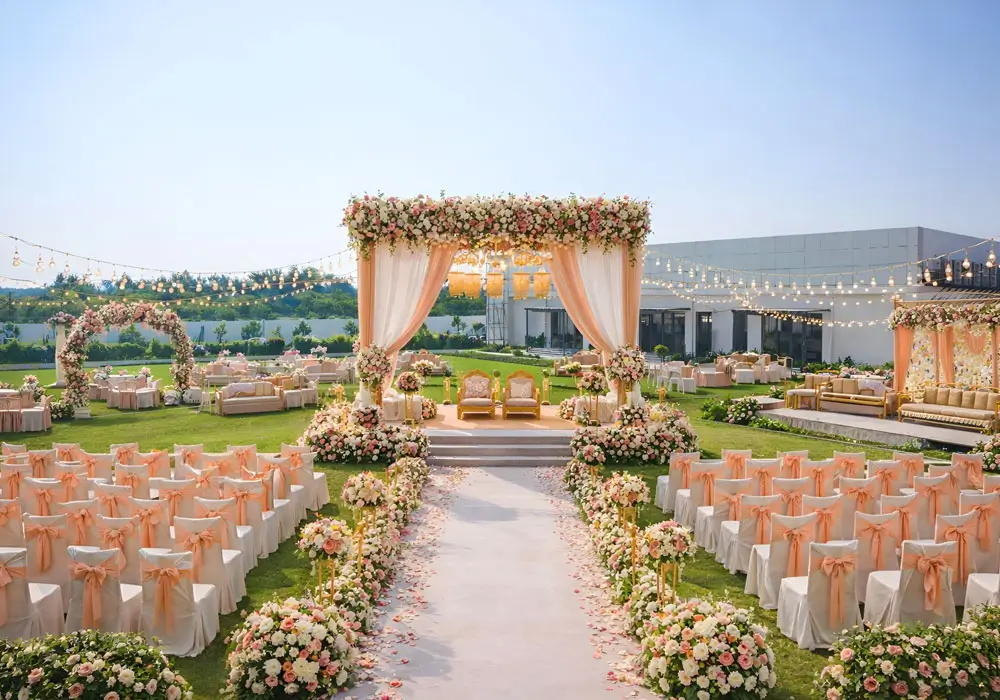



 🌙 01 Day
 🌙 05 Nights / 06 Days
Jaipur - Agra - Delhi Jaipur - Agra - Delhi Show More
 🌙 07 Nights/08 Days
Delhi - Agra - Jaipur... Delhi - Agra - Jaipur - Delhi Show More
 🌙 06 Nights/07 Days
Delhi - Agra - Jaipur Delhi - Agra - Jaipur Show More
If your dates fall in the wedding season, we may be able to arrange for you to attend an Indian wedding as guests. It is a wonderful contrast to your own private ceremony.
Yes, it is one of the most popular reasons couples choose it. Many marry legally at home and then celebrate a Rajasthani wedding together during their honeymoon.
October to March gives pleasant evenings. November to February is also the Indian wedding season, so venues, bands and priests book up and early planning helps.
Yes. Family and friends travelling with you can join as guests, wear Indian clothes and dance in the baraat. Tell us numbers early so the venue and dinner fit.
Udaipur offers lakes and a romantic, relaxed feel. Jaipur suits Golden Triangle routes and has grand heritage hotels and havelis. Both work beautifully.
Lakeside terraces, gardens and courtyards can be arranged depending on availability and season. We suggest settings and confirm them for your dates.
Traditionally, yes, with a band and dancing friends. A decorated vintage car is a calmer alternative. Both can be arranged depending on the venue.
The bride wears a saree or lehenga with jewellery and bangles. The groom wears a sherwani with a safa turban. Outfits can be rented or bought, and made-to-measure clothes need time for fittings.
No. The ceremony is symbolic and respectful, and the priest explains each step. If any ritual does not suit your beliefs, tell us in advance and we will ask about adapting it.
Key moments include mehendi, the groom’s baraat procession, exchange of varmala garlands, and the pheras, when the couple walk around the sacred fire while a priest recites prayers. Dinner and music follow.
The cost depends on the venue, decor, guests, music, clothes and season. We quote for your exact plan once we know what you have in mind.
It is possible in principle under the Special Marriage Act, but the process involves residence in the district, a notice period of around 30 days and paperwork. That rarely fits a holiday, so check with your embassy and a lawyer if you are serious.
No. This is a ceremonial celebration, not a legally registered marriage in India. Most couples marry legally at home and celebrate here.
Yes. A vow renewal in India is a symbolic ceremony, so couples of any nationality can take part. Udaipur and Jaipur are the most popular settings, with lakeside, heritage hotel and haveli venues.

Whether you're planning your first India trip or returning to explore deeper, get honest, expert advice from someone who knows every corner of this country. No pressure, no cost.