


 info@topindianholidays.net
 +91-8955000999

Hot Air Balloon Ride in Jaipur
Lift off as the sky turns orange and drift over villages, mustard fields and the Aravalli hills while Jaipur is still waking up.
View Experience ›Walk through the sets, studios and hillside locations where Hindi films and television serials are made, with a guide who explains how a Bollywood shoot really works.
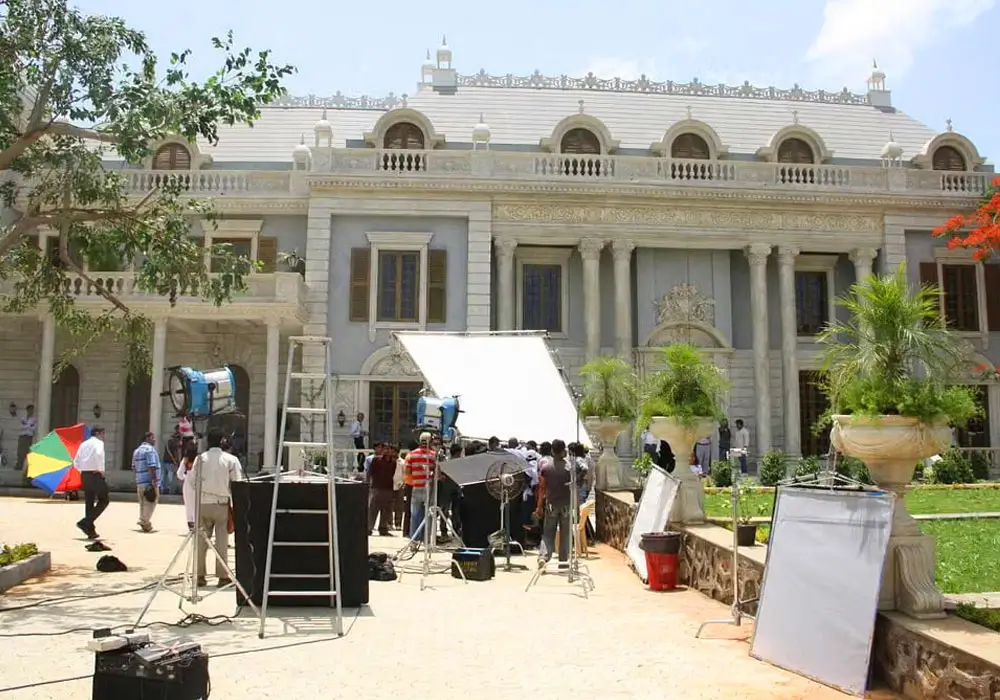
Mumbai makes more films than almost anywhere on earth, yet most visitors leave the city without seeing a single camera. The cinema is all around you: hand-painted posters, film songs blaring from taxis, crowds outside a star’s bungalow in Bandra on a Sunday. The place where much of it is actually made sits far from the Gateway of India, in the green northern suburb of Goregaon, at a sprawling state-run complex officially called Dadasaheb Phalke Chitranagari and known to everyone simply as Film City.
A Bollywood tour in Mumbai that takes you inside Film City is less about glamour and more about craft. You see how a village square, a hospital corridor, a police station and a temple courtyard can stand a few hundred metres apart, each built to be filmed from one angle and to look completely different from the other. You learn why so many Hindi film songs seem to share the same lake, the same wooded hillside and the same stone steps. And if the day’s schedule allows, you may catch a glimpse of a unit at work: lights, reflectors, a director shouting “action”, and two hundred people standing perfectly still for forty seconds.
This is not a theme park. Film City is a working production base, so the tour runs around the shooting schedule rather than the other way round. That is exactly what makes it interesting, and it is also why we are careful to explain what you will and will not see before you book.
It fits best as a half-day outing from a South Mumbai hotel, or as a stop on the way to or from the airport if you are staying in the northern suburbs. We plan the timing around Mumbai’s notorious traffic so you spend more time on the sets and less time on the Western Express Highway.
1. Pickup from your hotel
Your private driver collects you from your hotel at the agreed time. From Colaba, Fort or Marine Drive the drive north is long, so we usually suggest leaving mid-morning, once the worst of the inbound rush has passed, or using the Bandra-Worli Sea Link to cut part of the journey. From a hotel in Juhu, Andheri or near the airport, Film City is much closer.
2. Arrival at the Film City gate
Film City is a controlled site with security at the entrance. Casual visitors cannot simply walk in and wander, so visits are made through an organised guided tour. Your booking details are checked at the gate and you meet the tour team there. Keep your passport or a photo ID handy, as identity checks are normal.
3. Introduction to the complex
The guide begins with a short introduction: what Film City is, who runs it, how productions hire its studios and outdoor locations, and how the day’s shoots affect the route. This is a good moment to ask questions about anything you want to focus on, whether that is classic Hindi cinema, television serials or the technical side of film-making.
4. Touring the outdoor sets
Film City covers a very large hilly area on the edge of Sanjay Gandhi National Park, so much of the visit is by vehicle, with stops to get out and walk. Typical stops include standing sets such as a mock village, a temple, a court or police station front, a market street and garden locations. Sets change as productions build and strike them, so the exact list varies from one week to the next.
5. Song and scenery locations
Between the sets, the guide points out the natural locations that have appeared in countless films: the lake, the lawns, the wooded slopes and the waterfall area that comes alive in the monsoon. This is where you start recognising backdrops from songs you may have seen on television or streaming.
6. Studio floors and behind-the-scenes demonstrations
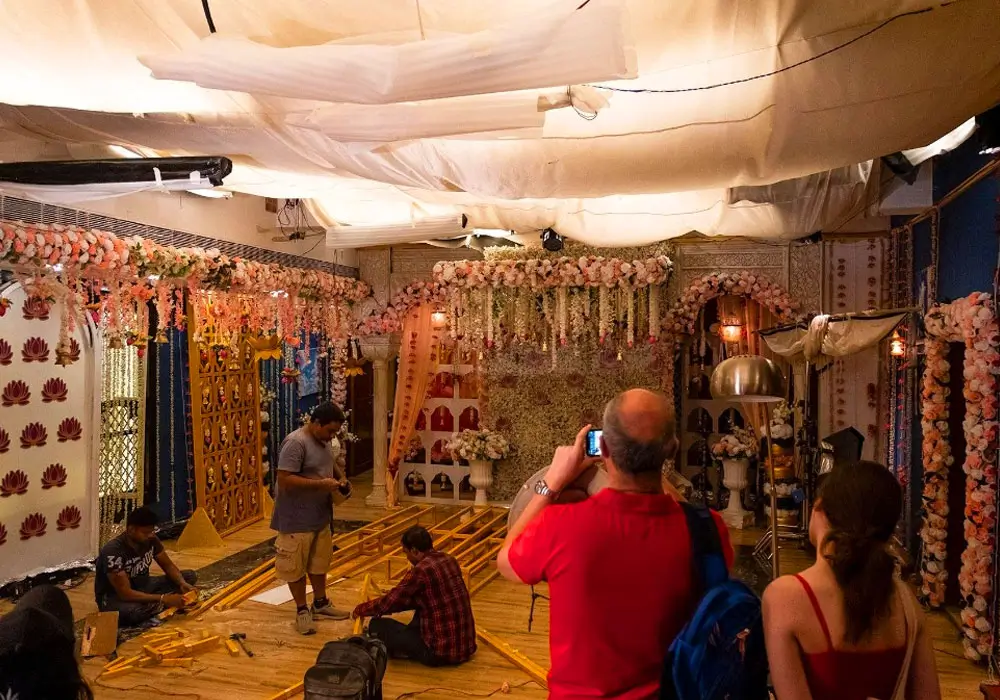
Depending on the tour format running at the time, you may see the outside of the large sound stages, a make-up or costume demonstration, a short explanation of lighting, green screen or dubbing, or a dance demonstration. Not every element runs every day, and access inside a studio floor depends on whether it is free.
7. A possible glimpse of a live shoot
If a production is filming outdoors on the route and the unit permits it, you may be able to watch from a respectful distance. This is never guaranteed. Some days are busy with shoots, some days the big productions are inside closed studios, and some units ask that no visitors come near.
8. Return to your hotel or onward plans
After the tour, your driver meets you at the gate. You can head back to South Mumbai, break for lunch in Juhu or Andheri, or carry on to the airport if you are flying out that evening.
Understanding a little of the story makes the visit far richer, and it is why the complex carries the name it does.
Dadasaheb Phalke and the first Indian feature. Dhundiraj Govind Phalke, remembered as Dadasaheb Phalke, is regarded as the father of Indian cinema. After watching a film about the life of Christ, he became determined to tell Indian stories on screen. He travelled to London to learn the craft and buy equipment, and in 1913 released Raja Harishchandra, a silent film based on the legend of a king who would not break his word. It is widely accepted as the first full-length Indian feature film. Because acting was not then considered respectable for women, the female role was played by a man. India’s highest film honour, the Dadasaheb Phalke Award, is named after him, as is Film City itself.
The arrival of sound. In 1931 Alam Ara became the first Indian talking picture, and with sound came songs. Music has been central to Hindi cinema ever since, which is why so many locations at Film City exist mainly as places to film a song.
The studio era and the golden age. Through the 1940s and 1950s, studios in Bombay, as the city was then called, employed their own actors, writers and musicians. Directors such as Raj Kapoor, Guru Dutt and Bimal Roy made films that are still studied today, and the playback singers of that era remain household names across South Asia.
The masala years. From the 1970s, big entertainers mixing action, romance, comedy, family drama and songs dominated the box office. This was also the decade in which the state government established Film City in Goregaon, offering producers a large, controlled space with ready-made locations close to the city.
Bollywood today. The word Bollywood, a blend of Bombay and Hollywood, is used loosely for the Hindi film industry based in Mumbai. India also has major film industries in Tamil, Telugu, Malayalam, Kannada, Bengali and other languages, and your guide may point out that Bollywood is only one part of a much larger national cinema. Film City now hosts film shoots, television serials, web series and advertisements, often all on the same day.
Standing sets. Some sets are built to last for years and are rented by many productions. A street front may be a police station in one serial and a lawyer’s office in another, with only the signboard changed. Walk round the back and you see the scaffolding, plywood and sandbags that hold it all up, which is often the most entertaining part.
Village and temple locations. Rural scenes remain a staple of Hindi films and television, so look for well-worn mock village houses, a temple platform and courtyards painted and repainted many times over.
Lake and garden backdrops. The open lawns and water edges have hosted song sequences for decades. Your guide will often name a film or two shot there, and older guests sometimes recognise a scene before the guide says a word.
Studio buildings. The sound stages look like large industrial sheds from outside. Inside, when you are able to see one, the scale is striking: a full house interior, a nightclub or a palace hall built under a roof full of lights.
The working crowd. Even without a live shoot, you notice the industry around you: vans of lighting equipment, catering trucks, junior artistes in costume waiting for their call, spot boys carrying tea, generators humming. This is the side of Bollywood that rarely makes it into magazines.
The forest edge. Film City borders Sanjay Gandhi National Park, and parts of the complex feel surprisingly wild, with thick trees, rocky slopes and birdsong. In the monsoon months the whole area turns deep green.
This is the question almost every guest asks, so here is an honest answer.
A live shoot is possible but not guaranteed. On many days several television serials and other productions are filming somewhere on the complex. Whether you can see one depends on where they are, whether they are indoors or outdoors, and whether the production allows visitors to watch. A watching opportunity, when it happens, is usually from a distance, for a short time and in silence.
Seeing a famous star is down to luck. Big names generally work inside closed studios with tight security, and their schedules are private. Some guests do spot a well-known television actor between takes; many do not. We would rather tell you this clearly than oversell the day.
What you will always get is a guided look at sets and locations, an explanation of how production works, and the experience of being inside one of the busiest film production bases in the country. Guests who go in curious about the process, rather than set on meeting a celebrity, enjoy it most.
If spotting stars is your main interest, a drive past the famous bungalows of Bandra and Juhu on a Sunday, when crowds sometimes gather hoping for a wave, is a fun addition. Ask your driver to include it on the way back.
Film City is a place of work, and the people you see are doing their jobs. A few simple rules keep the visit pleasant for everyone.
There is more than one way to get a feel for the Mumbai film industry, and the Film City visit can be combined with others.
The Film City guided visit. The most direct way to see sets and studios. Best for travellers interested in how films and television are made, and for families with children who enjoy seeing how a fake street is built.
A Bollywood dance class. If you want to do something rather than watch, a Bollywood dance class teaches you a short routine to a well-known film song with a choreographer. It is lively, very sociable and good for groups of friends or families. It pairs naturally with the studio visit: see where the songs are shot in the morning, learn the moves in the afternoon.
A film at a single-screen cinema. Watching a new Hindi release in a grand old Mumbai cinema, with the audience clapping and whistling at the hero’s entrance, is an experience in its own right. Even without subtitles, the story is usually easy to follow. We can suggest a cinema and show time near your hotel.
A drive past the film landmarks. Stars’ homes in Bandra and Juhu, the seafront at Bandstand, the old studio districts and the poster artists’ streets can be covered by car with your driver.
Mumbai traffic is the single biggest factor in how this day feels, so it is worth planning carefully.
Goregaon is far north. Most international visitors stay in South Mumbai, around Colaba, Fort, Nariman Point or Marine Drive. Film City is in Goregaon East, a long way up the western suburbs, and the journey can take around 1.5 hours on a good run and well over two hours at peak times.
Avoid the rush hours. Weekday mornings see heavy traffic heading south into the business districts, and evenings see the reverse. A mid-morning start and an early afternoon return usually work better than leaving at 8am or returning at 6pm.
Use the Sea Link. The Bandra-Worli Sea Link, a cable-stayed bridge across the bay, takes a slice off the journey and gives you a fine view of the skyline. Your driver will use it when it helps.
Consider staying north. If Film City, a dance class and a few days of business are on your list, a hotel in Juhu, Andheri or near the airport puts you much closer. You can then visit South Mumbai’s heritage sights on one dedicated day.
Combine it with the airport. Because Mumbai’s international airport is in the north of the city, a Film City visit can work well on your departure day, with luggage in the car and the airport not far away afterwards. We check flight times carefully before suggesting this.
Season by season. Weather changes the day as much as traffic does.
October to March. The most comfortable months for a Mumbai visit, with lower humidity and mostly dry days. Outdoor stops are more pleasant, and this is also the busiest season for travellers.
April and May. Hot and very humid. The tour still runs, but plan for heat on the outdoor stops and keep water with you.
June to September. The monsoon. Heavy rain can make outdoor stops wet and slow, and traffic is often worse. On the other hand, the hills and the forest edge turn a brilliant green and the waterfall area is at its most attractive. Some outdoor shoots move indoors when the rain is heavy.
Day of the week. Tour availability, shooting activity and traffic all vary by day. Tell us your dates and we will check what is running and suggest the best day in your Mumbai stay.
Give Mumbai at least two full days. One day for South Mumbai’s colonial architecture, the Gateway of India, Kala Ghoda and the markets, and one for the northern suburbs and Film City.
Pair it with Elephanta on another day. The Elephanta Caves by ferry leaves from the Gateway of India in the south, so it makes sense on your South Mumbai day rather than the same day as Film City.
Add a community perspective. If you want to understand the city beyond its film industry, our Dharavi community walk is a respectful, guided introduction to one of Mumbai’s most industrious neighbourhoods. It is located between South Mumbai and the suburbs and is best on a separate morning.
Continue to Goa, Kerala or Rajasthan. Mumbai is a natural gateway for a Konkan coast or Kerala trip, or for flights to Udaipur and Jaipur. You could follow the city with a few days of Kerala wellness or a classic Rajasthan circuit.
Bring and wear - Passport or photo ID - Comfortable, closed walking shoes - Light, breathable clothes and a hat for outdoor stops - Water and sunscreen, especially from March to May - A light rain jacket or umbrella from June to September - Phone or camera, set to silent
Leave behind - Drones - Large bags, which are awkward on and off the vehicle - Expectations of meeting a particular star - Valuables you do not need for the day
Tell us your Mumbai dates and where you are staying, and we will choose the best day and departure time for your Film City visit and build the rest of your stay around it.
Call & WhatsApp +91-9828085426 or email info@topindianholidays.net.
See more ideas on our Top Experiences in India page.
Tell us your travel dates and we will check availability and fit this experience into the right day of your itinerary. Reply within 12 hours.
Check Availability› Chat on WhatsApp› Send an Enquiry›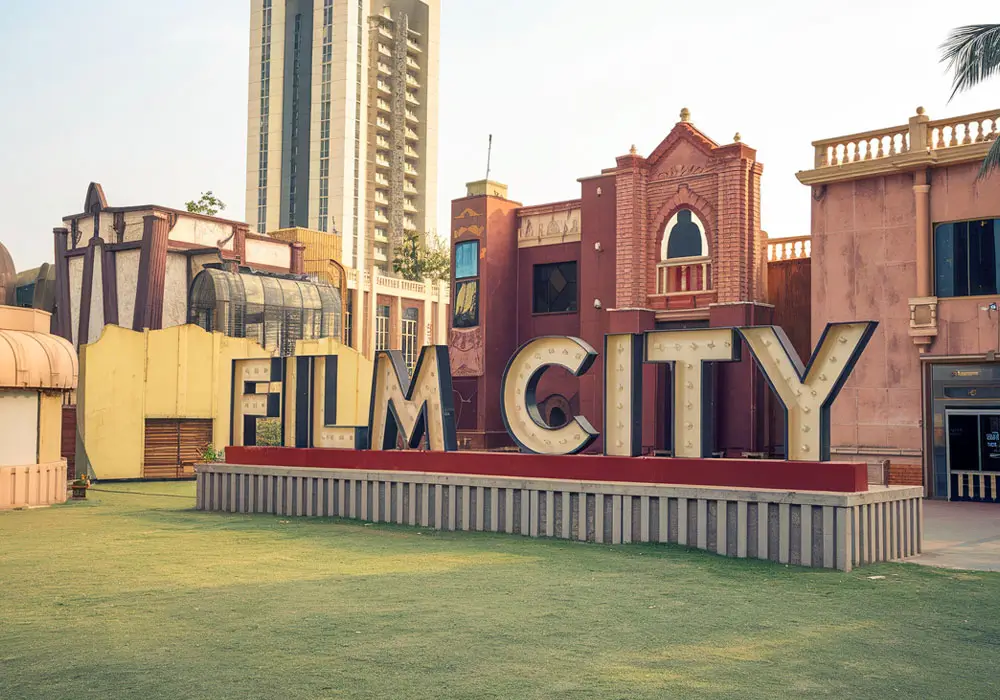



 🌙 01 Day
Mumbai → Delhi → Agra... Mumbai → Delhi → Agra → Delhi → Mumbai Show More
 🌙 06 Nights/07 Days
Mumbai - Delhi - Agra... Mumbai - Delhi - Agra - Jaipur - Mumbai Show More
 🌙 10 Nights / 11 Days
Delhi - Agra - Jaipur... Delhi - Agra - Jaipur - Mumbai - Goa Show More
 🌙 13 Nights / 14 Days
Delhi - Agra - Ranthambore... Delhi - Agra - Ranthambore - Jaipur - Jodhpur - Udaipur - Mumbai - Delhi Show More
Yes, guided visits for international travellers are run in English. If you would prefer another language, let us know when you enquire and we will check what is possible for your date.
Carry your passport or another photo ID. Identity checks at the Film City entrance are normal, and having it with you avoids delays at the gate.
Often, yes, because both are in the north of the city. We check your flight time, allow a comfortable margin for traffic and keep your luggage secure in the car while you are on the tour.
No. The studio tour shows you the sets and locations where films are made. A dance class teaches you a routine to a film song. Many guests do both on the same day, the tour in the morning and the class in the afternoon.
Dadasaheb Phalke is regarded as the father of Indian cinema. In 1913 he released Raja Harishchandra, widely accepted as the first full-length Indian feature film. Film City and India’s top film award are both named after him.
October to March is the most comfortable, with drier, less humid days. The monsoon from June to September makes the hills beautifully green but brings heavy rain and slower traffic.
Most children enjoy seeing how a fake street or temple is built and what lies behind it. The tour includes short walks on uneven ground and time in a vehicle. Tell us your children’s ages and we will check that the format suits them.
At most outdoor sets and scenic stops, yes. Photography is not allowed near active shoots, inside many studios, or wherever your guide or security staff say no. Never photograph an actor without asking first.
The guided visit itself fills a good part of a morning or afternoon, and the exact length depends on the format running and the day’s shooting schedule. Add the return drive from your hotel, and plan on giving up most of the day if you are staying in South Mumbai.
Film City is in Goregaon East in the northern suburbs. From Colaba or Marine Drive, the drive takes around 1.5 hours on a good run and can be much longer in peak traffic. From Juhu, Andheri or the airport area it is far closer.
It is down to luck. Major stars usually film inside closed studios with tight security. Some guests spot a familiar television actor between takes, but nobody can promise it, and we never sell the tour on that basis.
Possibly, but it is never guaranteed. Shoots happen on many days, but whether you can watch depends on where they are and whether the production permits visitors. When it happens, you watch quietly from a distance for a short time.
The price depends on the tour format, the season and your group size, and it includes your private car and driver for the day. Rates change, so we quote the current price for your exact date. Send us your dates and hotel on WhatsApp.
Yes. Film City in Goregaon, officially Dadasaheb Phalke Chitranagari, can be visited on an organised guided tour. You see outdoor sets, natural shooting locations and, depending on the day, studio areas and demonstrations. You cannot simply walk in on your own, so the visit is booked in advance.

Whether you're planning your first India trip or returning to explore deeper, get honest, expert advice from someone who knows every corner of this country. No pressure, no cost.