📅 Last Updated On: 15 Jun 2026
⏱ 10 Min Read
Govind Dev Ji Temple, Jaipur
T
Top Indian Holidays
Jaipur Travel Guide
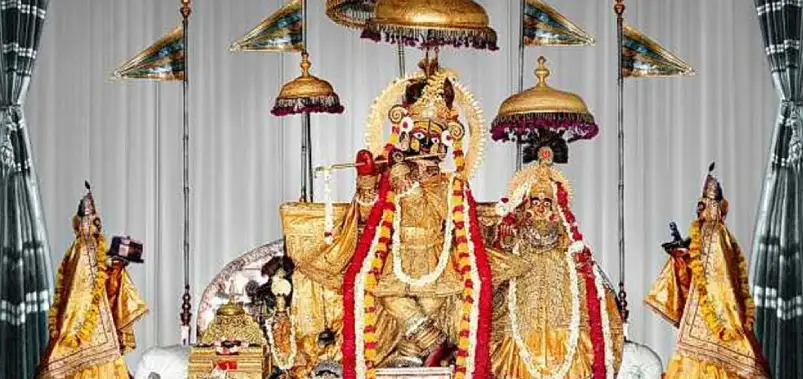
Govind Dev Ji Temple - Jaipur's Most Beloved Shrine
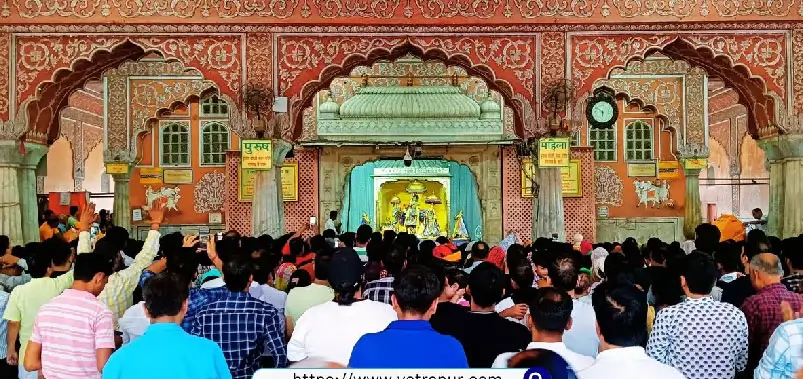
If you spend only one morning in Jaipur and want to feel the real pulse of this city - not the palaces, not the bazaars, but the living soul - go to Govind Dev Ji Temple at dawn. By 4:30 in the morning, thousands of devotees have already gathered in the open-air courtyard. When the curtain lifts for the first aarti, the sound of conch shells, bells, and prayer fills the air in a way that no amount of description can quite prepare you for.
Govind Dev Ji Temple is dedicated to Lord Govind Dev Ji - a form of Lord Krishna - and is considered one of the most powerful and sacred Krishna shrines in all of North India. The deity here is not a sculpted image but is believed by devotees to be a svayambhu murti - a self-manifested form - directly connected to the original idol worshipped in Vrindavan, the land of Krishna's childhood.
What makes Govind Dev Ji extraordinary in the context of Jaipur's history is the story of how this temple came to be situated where it is. Maharaja Sawai Jai Singh II - the founder of Jaipur, one of the great astronomers and city planners of his age - gave up the most prized rooms of his own royal palace, with their direct view of the stars, so that the deity of Lord Krishna might have that same open sky to look upon. There are few more personal acts of devotion recorded in Rajput history. That spirit of surrender is still felt here, three centuries later, in every morning aarti.
|
Detail
|
Information
|
Notes
|
| Location |
Jalebi Chowk, City Palace Complex, Jaipur, Rajasthan 302002 |
Heart of the old city |
| First Opens |
4:30 AM - Mangala Aarti |
Most auspicious darshan |
| Entry Fee |
Free - No ticket required for all visitors |
Open to all faiths |
| Photography |
Strictly prohibited inside the temple premises |
Keep camera in bag |
| Dress Code |
Shoulders and knees covered; head covering for women |
Scarves at gate |
| Best Season |
October to March - cool weather, winter temple decorations |
Avoid May–June heat |
Experience Govind Dev Ji Temple with a Local Expert
Witness the divine aarti at Govind Dev Ji Temple and explore Jaipur's most iconic attractions including City Palace, Hawa Mahal, Jantar Mantar, and Amber Fort with a private guide.
Who Is Govind Dev Ji - The Lord of Jaipur
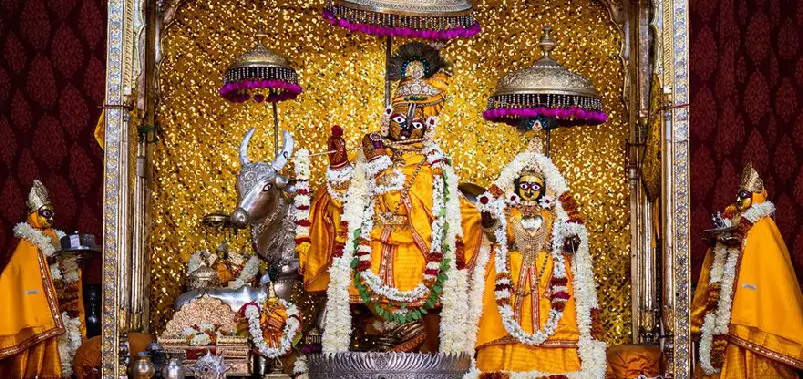
The story of the Govind Dev Ji idol is one of the most compelling narratives in Rajput devotional history. The original Govind Dev Ji deity was installed in Vrindavan by the great Vaishnava saint Rupa Goswami in the 16th century, under the instructions of the spiritual master Chaitanya Mahaprabhu. This idol - carved in black stone - was said to bear a striking likeness to Lord Krishna himself, as described by Vajranabha, Krishna's great-grandson who had personally seen the Lord.
When Mughal Emperor Aurangzeb launched his campaign of temple destruction in the late 17th century, the priests of Vrindavan feared for the deity's safety. The idol was moved through several locations for protection. Sawai Jai Singh II - a devoted Vaishnava king - eventually had the idol brought to Jaipur for safekeeping. It has resided here ever since, in the heart of the City Palace complex, under the royal family's patronage and protection.
The Jaipur royal family still considers Govind Dev Ji their kul devata - their family deity - and the Maharaja of Jaipur does not eat until the deity has been offered food first. This tradition of royal service to the deity continues unbroken to this day.
In the Vaishnava tradition, Govind Dev Ji is a form of Lord Krishna in his princely aspect - adorned with magnificent jewellery, royal garments, and a crown. The deity is dressed differently for each aarti throughout the day, with elaborate vastra seva (dressing ceremony) that changes with the season, the festival calendar, and even the time of day.
The name 'Govind' is itself one of Krishna's most beloved epithets - meaning the one who gives pleasure to the senses, the one who is found by the cows, the one who is the master of the earth. Dev Ji is a respectful suffix of address used in Rajasthani tradition. Together, Govind Dev Ji is the living lord of Jaipur - a title the people of this city take with complete seriousness.
All 7 Aarti Timings - Govind Dev Ji Temple (2026)
The Govind Dev Ji Temple follows the traditional shodashopachara puja system - sixteen forms of service to the deity - divided into seven major darshan timings throughout the day. Each darshan corresponds to a specific moment in the deity's daily routine, from waking to sleeping. The temple closes between each darshan so that the deity may rest, eat, or complete his daily activities undisturbed.
Important: Temple timings change slightly with seasons - summer (April–September) and winter (October–March) schedules differ by 30–60 minutes. Always confirm current timings at the temple gate or with your guide, especially during festival seasons.
|
Aarti / Darshan
|
Winter (Oct–Mar)
|
Summer (Apr–Sep)
|
What Happens
|
| 1. Mangala Aarti (Most Auspicious) |
4:30 AM – 5:00 AM |
4:30 AM – 5:00 AM |
The deity is awakened with conch shells, bells, and devotional singing. Considered the most auspicious darshan of the day – a small, quiet crowd in lamplight before sunrise. |
| 2. Dhoop Aarti (Morning) |
7:30 AM – 8:00 AM |
7:30 AM – 8:00 AM |
The deity has been bathed and dressed in fresh clothes. Incense (dhoop) is offered. The morning Bhog food offering is also performed around this time. |
| 3. Shringar Aarti (Mid-Morning) |
9:30 AM – 10:00 AM |
9:00 AM – 9:30 AM |
The deity is fully adorned in the day's royal garments and jewellery – the most visually spectacular presentation. Best darshan for seeing the deity in full ceremonial dress. |
| 4. Rajbhog Aarti (Midday) |
11:00 AM – 11:30 AM |
10:30 AM – 11:00 AM |
A grand midday bhog (food offering) is made. After this darshan, the temple closes for the deity's afternoon rest. Temple gates close for several hours. |
| 5. Gwala Aarti (Afternoon) |
5:45 PM – 6:15 PM |
5:30 PM – 6:00 PM |
Celebrating Krishna's return from the pastures with his cows. The temple reopens after afternoon closure. A relaxed darshan as the day begins to cool. |
| 6. Sandhya Aarti (Most Crowded) |
6:30 PM – 7:15 PM |
7:00 PM – 7:45 PM |
The most attended darshan of the day. Thousands of devotees gather for spectacular evening aarti with conch shells, cymbals, and collective chanting. Arrive 30–45 minutes early. |
| 7. Shayan Aarti (Final Darshan) |
8:00 PM – 8:30 PM |
8:30 PM – 9:00 PM |
The final darshan of the day – the deity is prepared for sleep. Quieter and more intimate than Sandhya aarti. After this the temple closes for the night. |
Best Aarti to Attend: For the most powerful spiritual experience, attend the Mangala Aarti (4:30 AM) for its quiet pre-dawn intimacy, or the Sandhya Aarti for the full spectacle. The Shringar Aarti around 9:30 AM gives the best view of the fully adorned deity without the evening rush.
HISTORY & HERITAGE
The Remarkable Story Behind This Temple
The history of Govind Dev Ji Temple is inseparable from the history of Jaipur itself - they were conceived almost simultaneously, and the relationship between the city's founder and his Lord defined the character of the entire kingdom.
16th Century - Rupa Goswami Installs the Original Idol in Vrindavan
The great saint Rupa Goswami, disciple of Chaitanya Mahaprabhu, establishes the Govind Dev Ji deity in Vrindavan following a divine vision. The idol is believed to be a near-perfect likeness of Lord Krishna himself, carved by sculptors working from the description given by Vajranabha - Krishna's great-grandson who had personally seen the Lord. The Vrindavan temple becomes one of the most important pilgrimage sites in North India.
Late 17th Century - The Idol is Hidden for Safety
As the Mughal Emperor Aurangzeb orders the demolition of temples across North India, the priests of the Vrindavan Govind Dev Ji temple face a crisis. Over a period of years, the deity is moved through several locations - including Kama and Bharatpur - keeping ahead of the threat. This nomadic period lasts for several decades before a permanent, safe home is found.
1728 - Sawai Jai Singh II Founds Jaipur & Plans the Temple
Maharaja Sawai Jai Singh II - astronomer, mathematician, city planner, and devoted Vaishnava - lays out the planned city of Jaipur on a grid system inspired by the Shilpa Shastra. In the centre of the royal complex, he designates a position for the deity of Govind Dev Ji. He arranges for the idol's transfer from its temporary refuge to his new capital.
1735 - Jai Singh Gives Up His Palace Rooms for the Lord
This is the event that defines the temple's extraordinary character. The Surya Mahal - the Sun Palace, the best positioned rooms within the City Palace complex, offering a direct and unobstructed view of the open sky - was Jai Singh's personal set of apartments. He vacated these rooms entirely so that Govind Dev Ji could be installed there instead. His reasoning: the deity should have the finest position in the city. This gesture of surrender is still spoken of as one of the greatest acts of bhakti (devotion) in Rajput history.
Today - 300,000+ Devotees on Festival Days
Govind Dev Ji Temple now draws some of the largest religious gatherings in Rajasthan. On Janmashtami (Krishna's birthday), estimates put the crowd at over three lakh (300,000) devotees in a single day. The temple operates entirely on donations and the royal family's patronage - there is no entry fee, and the tradition of free langar (communal food) is maintained on major festival days.
ARCHITECTURE & TEMPLE LAYOUT
What You Will See Inside the Temple Complex
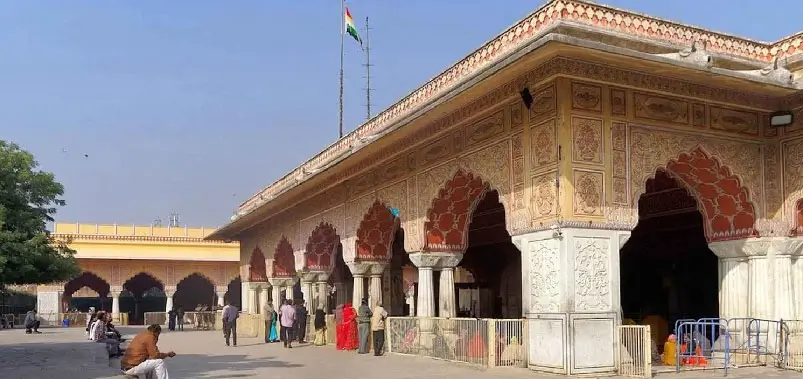
Unlike many North Indian temples built in the traditional Nagara shikhara style with towering spires, Govind Dev Ji Temple has a markedly different character - open, spacious, and designed for large congregational worship.
The Open-Air Mandap - Heart of the Temple
The most distinctive feature of Govind Dev Ji Temple is its enormous open courtyard and mandap (prayer hall). There is no enclosed shikhara tower as you would find at most major North Indian temples. Instead, the sanctum opens onto a large open-air congregation space that can hold thousands of devotees simultaneously. This design is intentional - Lord Krishna, the deity of pastoral fields and open skies, is worshipped here in the open air, as he would have been in Vrindavan. The Surya Mahal building retains elements of its original Rajput palace architecture - arched windows, carved stone lattice screens, and the characteristic deep-red sandstone of Jaipur's royal buildings.
The Garbhagriha - Where the Deity Resides
The inner sanctum houses the original idol of Govind Dev Ji. The sanctum interior is richly decorated with silver panels, ornamental doors, and a profusion of flowers and garlands renewed daily. A velvet and brocade parda (curtain) is drawn across the sanctum between each darshan - its dramatic lifting at the start of each aarti is a deeply moving moment that the gathered crowd greets with an eruption of jai (victory cry) shouts and bell-ringing.
The Jalebi Chowk & Approach
The temple is reached through Jalebi Chowk - the great square in front of the City Palace's main entrance. This open square serves as a gathering point and overflow area on major festival days. The entire City Palace complex surrounds the temple - to the north is the Chandra Mahal (the royal residential palace), and the Tripolia Gate approach is to the south.
Seasonal Decoration - The Temple Changes Through the Year
One of the genuinely remarkable things about Govind Dev Ji Temple is how dramatically it changes in appearance throughout the year. In Holi season, the temple is awash in gulal (coloured powder). In Shravan (monsoon months), the altar is decorated with peacock feathers - recalling Krishna's most famous adornment. In winter, the deity wears heavier royal garments. Each visit in a different month can feel like a different place entirely.
GETTING THERE
How to Reach Govind Dev Ji Temple in Jaipur
The temple is located within the City Palace Complex in the heart of the old walled city of Jaipur - one of the most visited areas of the Pink City and very well connected by all modes of transport.
By Private Car or Taxi
The most comfortable option for international visitors. The City Palace complex has designated parking areas at Tripolia Gate and near Jantar Mantar observatory. From central Jaipur hotels (C-Scheme, MI Road, Malviya Nagar), the drive is typically 15–25 minutes. On festival days, roads around the City Palace may be blocked - your driver will know alternate routes. Top Indian Holidays provides private AC vehicles with drivers experienced in the old city's narrow lanes.
Early Morning Tip: For the Mangala Aarti at 4:30 AM, traffic is almost non-existent. Your driver can drop you directly at the temple gate within minutes of leaving your hotel.
By Auto-Rickshaw
Auto-rickshaws are widely available across Jaipur. Ask for 'Govind Dev Ji Mandir' or 'Jalebi Chowk, City Palace' - every auto-wallah in Jaipur knows this destination. Negotiate the fare before getting in. From most tourist hotels in C-Scheme or near Hawa Mahal, the fare should be ₹60–₹120.
Walking from Nearby Attractions
From Hawa Mahal: 10-minute walk through the old bazaar lanes. From Jantar Mantar observatory: 5-minute walk - they share the same complex boundary. From Amber Fort (14 km): visitors often stop at Govind Dev Ji on their way back into the city.
|
From
|
Distance
|
Approx. Time
|
Best Mode
|
| Jaipur Railway Station |
5 km |
15–25 minutes |
Auto or private car |
| Hawa Mahal |
0.8 km |
10 minutes |
Walk through bazaar |
| Jantar Mantar |
300 m |
5 minutes |
Walk |
| Amber Fort |
12 km |
30–40 minutes |
Private car |
| Jaipur Airport |
15 km |
35–50 minutes |
Private car / taxi |
| C-Scheme / MI Road Hotels |
3–5 km |
15–20 minutes |
Auto or private car |
Attend the Sacred Aarti at Govind Dev Ji Temple
Experience one of Jaipur's most revered spiritual sites with a guided visit to Govind Dev Ji Temple. Combine your temple visit with Jaipur's famous attractions including City Palace, Hawa Mahal, Jantar Mantar, and Amber Fort.
VISITOR GUIDELINES
Essential Things to Know Before You Visit
Dress Code
Both men and women should have their shoulders covered and knees covered. For women, a salwar kameez, sari, or similar is ideal. For men, trousers or pyjama with a kurta or shirt works well. Shorts and sleeveless tops are not appropriate. The temple provides cloth to wrap around if needed. Head covering required for women inside the sanctum - scarves available at the gate.
Footwear
You must remove shoes before entering the temple premises. There is a well-managed shoe counter (juta ghar) near the main entrance where you receive a token for free shoe storage. The system runs smoothly even during peak hours - thousands of pairs are managed efficiently. Keep the token carefully. Socks are acceptable inside - advisable in cooler months when the stone floor is cold.
What to Do
- Arrive 20–30 minutes early for Sandhya Aarti to secure a good position
- Observe silence when the parda (curtain) lifts for darshan
- Accept prasad (blessed food offering) with your right hand
- Move with the queue during peak times - it flows smoothly
- Join in the collective jai chants when prompted by the priest's lead
What Not to Do
- No photography or video inside the temple - strictly enforced
- No leather items (belts, wallets, bags) near the sanctum
- Do not eat or drink inside the temple compound
- Avoid wearing black or white clothing (considered inauspicious)
- Mobile phones on silent; avoid calls inside
- Do not turn your back to the deity after taking darshan
FESTIVALS & SPECIAL OCCASIONS
Govind Dev Ji Temple Through the Year
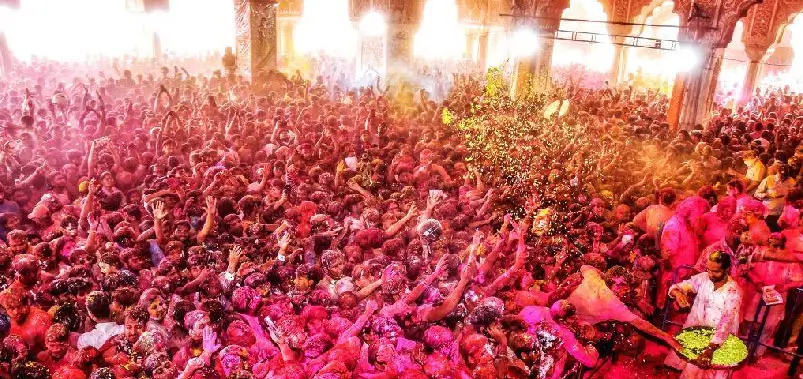
Janmashtami - August/September (The Biggest Event of the Year)
Janmashtami at Govind Dev Ji Temple is the single largest religious event in Jaipur. Crowds of 2–3 lakh (200,000–300,000) devotees gather over the two days of celebration. The night before Janmashtami, the temple stays open all night - the parda is lifted at midnight precisely to mark the moment of Krishna's birth, accompanied by an eruption of bells, conch shells, and the collective chanting of 'Govind Dev Ji ki Jai.' Streets around the City Palace are closed to traffic. Arrive before 9 PM to secure a position in the courtyard.
Holi - March (Festival of Colours)
At Govind Dev Ji Temple, Holi begins with a special puja and the deity is smeared with gulal (dry colour) by the priests. Then the celebration opens to devotees - the courtyard becomes a sea of colour and song. This is one of the most visually spectacular Holi celebrations in Rajasthan. Phoolon ki Holi (Holi with flowers) is also celebrated at the temple a day before the main festival - a more gentle and photogenic celebration.
Radha Ashtami - July/August
Radha's divine birthday is celebrated eight days after Janmashtami. The deity is dressed in pink and white garments with a special emphasis on the floral decoration of Radha's murti. Traditional Rajasthani devotional singing and kirtan performances continue through the night.
Diwali & Annakoot - October/November
The day after Diwali is celebrated as Annakoot - literally 'mountain of food.' Hundreds of food items are prepared and piled before the deity in an elaborate display symbolising the legendary Govardhan mountain that Krishna lifted. The Annakoot display at Govind Dev Ji is one of the most elaborate in Rajasthan. The food is later distributed as prasad.
NEARBY ATTRACTIONS
Combine Your Govind Dev Ji Visit with These Sites
|
Attraction
|
Distance
|
Time Needed
|
Why Visit
|
| City Palace Museum |
Adjacent |
2–3 hours |
Royal apartments, armoury, Peacock Gate. One of India's finest royal museums. |
| Jantar Mantar |
300 m |
1–1.5 hours |
UNESCO World Heritage Site – Sawai Jai Singh II's astronomical instruments. Context for the temple's founder. |
| Hawa Mahal |
800 m |
45 minutes |
Jaipur's iconic screen-windowed palace facade. Street view at sunrise is superb. |
| Johari Bazaar & Bapu Bazaar |
500 m |
As long as you wish |
Gemstones, block-printed textiles, lac bangles, blue pottery. Best browsed in the morning. |
| Amber Fort |
12 km |
2.5–3 hours |
Magnificent Rajput-Mughal fort. Combine with Govind Dev Ji for a full day itinerary. |
| Galtaji Temple |
11 km |
1–1.5 hours |
Ancient pilgrimage complex with natural springs built into the Aravalli Hills. |
PRACTICAL INFORMATION
Everything You Need to Plan Your Visit
|
Category
|
Details
|
| Address |
Govind Dev Ji Temple, Jalebi Chowk, City Palace Complex, Jaipur, Rajasthan 302002 |
| Opening Hours |
4:30 AM to 9:00 PM with 7 darshan windows and gaps between. Temple closes between aartis. |
| Entry Fee |
Free for all visitors. No ticket, no prior booking required for general darshan. |
| Photography |
Strictly prohibited inside temple premises. Mobile phones must be put away during darshan. |
| Footwear |
Must be removed at shoe counter (token system, free). Do not attempt to enter with shoes. |
| Best Season |
October to March. Avoid May–June (extreme heat up to 42°C). Monsoon (July–Sep) is atmospheric. |
| Time Needed |
45 minutes to 1.5 hours for a single darshan. Allow extra time on weekends and festival days. |
| Accessibility |
Main courtyard and approach on flat ground. Manageable for visitors with mobility limitations. Wheelchair users should contact temple administration in advance. |
| Prasad |
Prasad (sweet offerings) distributed after each aarti. Numerous mithai shops in Jalebi Chowk nearby. |
| Contact |
Top Indian Holidays: +91-8955000999 | info@topindianholidays.net | www.topindianholidays.com |
TOP INDIAN HOLIDAYS - TOUR PACKAGES
Jaipur & Rajasthan Tour Packages for International Visitors
All packages designed exclusively for international visitors. Includes private AC transfers, certified local guides from Jaipur, and over 25 years of India travel expertise.
| Pink City Heritage & Temples |
Golden Triangle Tour |
Royal Rajasthan Tour |
| 1 Full Day from Jaipur |
5 Nights / 6 Days |
7 Nights / 8 Days |
| Govind Dev Ji Sandhya Aarti |
Delhi - 1 night (Old Delhi) |
Jaipur - 2 nights |
| City Palace Museum |
Agra - 1 night (Taj Mahal) |
Govind Dev Ji Temple |
| Hawa Mahal & bazaar walk |
Jaipur - 3 nights |
Pushkar - 1 night |
| Jantar Mantar UNESCO site |
Govind Dev Ji morning + evening aarti |
Jodhpur - 2 nights |
| Amber Fort with guide |
All 4-star accommodation |
Udaipur - 2 nights |
| All entry fees included |
Private vehicle + guide throughout |
Heritage hotel accommodation |
| Enquire: +91-9828085426 |
www.topindianholidays.com |
info@topindianholidays.net |
Related Guides



 info@topindianholidays.net
 +91-8955000999