Accessible Travel in India with Private Vehicle and Mobility Assistance
Traveling through India with limited mobility requires more than simply booking a car. It requires thoughtful planning, realistic expectations, additional time, appropriate vehicle selection, and people who understand that every traveler may need a different level of assistance. Our accessible travel services in India are designed for international visitors who may use a folding wheelchair, walking stick, walker, or other mobility aid, as well as seniors and travelers who find long walks, stairs, uneven surfaces, or repeated vehicle entry and exit difficult.
Our approach is practical rather than making unrealistic promises about specialized vehicles. Dedicated wheelchair-accessible vans with permanent ramps, hydraulic lifts, lowered floors, and wheelchair restraint systems are not widely or consistently available across every Indian city and touring route. Therefore, we do not automatically describe an ordinary vehicle as a wheelchair-accessible vehicle or promise specialized equipment that may not be available.
Instead, suitable trips can be planned using a private standard vehicle selected according to the traveler's mobility needs, with additional care and assistance incorporated wherever practical. Depending on the confirmed arrangement, this can include an attendant or support person, assistance while getting into and out of the vehicle, a folding wheelchair where arranged, additional time at stops, careful hotel selection, reduced walking, convenient drop-off planning, and an itinerary designed around the traveler's realistic comfort level.
For visitors from the United States, Canada, the United Kingdom, Australia, Europe, and other countries searching for accessible travel in India, wheelchair assistance tours India, mobility assistance travel India, senior-friendly India tours, private India tour for limited mobility, assisted travel India, or India tour with wheelchair support, our objective is to create a practical private travel plan without suggesting that accessibility conditions in India are identical to those in North America or Western Europe.
A Practical Approach to Accessible Travel in India
Accessibility in India varies considerably between airports, hotels, monuments, restaurants, historic sites, streets, railway stations, and cities. A modern international hotel may offer elevators and step-free areas, while a centuries-old fort or palace may involve steep ramps, stone steps, uneven pathways, narrow entrances, or long walking distances. For this reason, a successful accessible India tour cannot be planned around the vehicle alone.
We look at the complete journey: how the traveler gets into the vehicle, how far they are comfortable walking, whether they can manage a few steps with assistance, whether they use a wheelchair continuously or only for longer distances, what kind of hotel room is required, which attractions may present difficulties, and how much rest time should be built into each day.
This practical approach is particularly important for international travelers who may be accustomed to highly standardized accessibility infrastructure at home. India can be rewarding for travelers with mobility limitations, but the itinerary needs to acknowledge local conditions rather than assuming every destination will provide the same level of step-free access.
Private Vehicle for Travelers with Limited Mobility in India
A private vehicle for travelers with limited mobility in India offers significant advantages over shared group transportation. The vehicle can be selected according to the number of passengers, ease of entry and exit, luggage, mobility equipment, and overall itinerary rather than requiring the traveler to adapt to a fixed group coach.
Depending on the travel party and mobility requirements, a sedan, MPV, minivan-style vehicle, SUV, or larger passenger vehicle may be considered. A vehicle with comfortable door access and suitable seating may be more useful for one traveler, while another may benefit from additional cabin and luggage space for a folding wheelchair or walker.
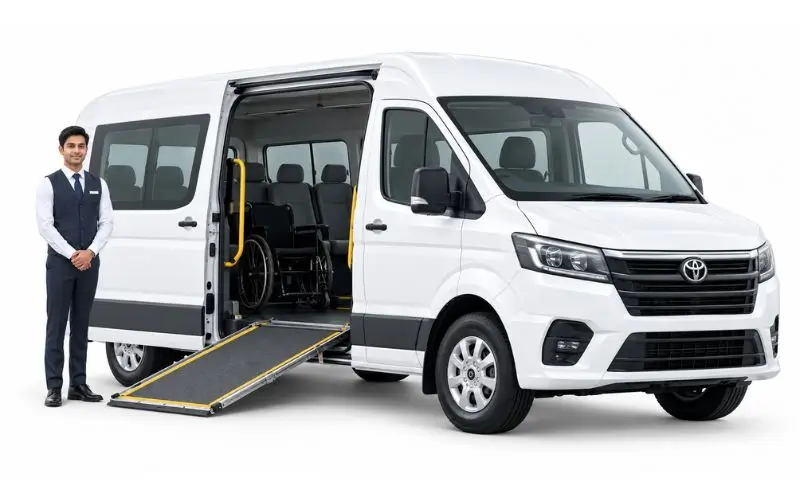
The vehicle itself will generally be a standard passenger vehicle rather than a permanently modified wheelchair van unless a specialized arrangement has been specifically confirmed. The important difference is the level of planning and assistance around the traveler.
Standard Private Vehicles with Special Mobility Assistance
Our assisted travel model generally uses normal private touring vehicles with additional mobility support rather than claiming that every vehicle has been structurally adapted for wheelchair users. This distinction is important for both safety and transparency.
Where appropriate, the selected vehicle can be chosen with attention to door opening, seat height, cabin space, luggage capacity, and room for a folding mobility aid. A traveler who can transfer from a wheelchair into a regular passenger seat may have considerably more vehicle options than someone who must remain seated in a wheelchair while the vehicle is moving.
We therefore ask detailed questions before suggesting transportation. The objective is not to label an ordinary vehicle “accessible,” but to determine whether a standard vehicle combined with appropriate human assistance and itinerary planning can realistically meet the traveler's needs.
Attendant Support for Accessible Tours in India
For some travelers, having an additional attendant or travel support person can make a significant difference. Where arranged as part of the confirmed service, an attendant can provide practical assistance during travel rather than leaving every mobility-related task to the traveler or accompanying family members.
The exact role of an attendant should be agreed before the trip because different travelers require different types of support. Assistance may include helping with a folding wheelchair, providing a steady hand during appropriate vehicle entry and exit, accompanying the traveler through suitable sightseeing areas, helping coordinate with the driver and guide, and allowing additional time for movement between locations.
An attendant should not automatically be considered a nurse, licensed medical professional, professional caregiver, or trained personal-care specialist unless such qualifications and services have been specifically arranged and confirmed separately. Travelers requiring medical or clinical assistance should explain those requirements clearly before booking.
Folding Wheelchair Assistance in India
A folding wheelchair for an India tour can be practical for travelers who are able to transfer into a regular vehicle seat but need mobility assistance at airports, hotels, sightseeing locations, or places involving longer walking distances. Where a folding wheelchair is required as part of the travel arrangement, this requirement should be discussed and confirmed in advance.
The advantage of a folding wheelchair is that it may be carried in the luggage area of an appropriate vehicle, subject to available space. This allows the traveler to use the wheelchair where needed while sitting in a regular passenger seat during transportation.
Vehicle capacity must still be considered carefully. A folding wheelchair occupies luggage space, so passenger numbers, full-size suitcases, carry-on bags, walkers, and other equipment need to be considered together. International visitors should provide complete luggage and mobility-equipment details before the vehicle is selected.
Bringing Your Own Wheelchair or Mobility Aid to India
Travelers who already use a familiar wheelchair, walker, cane, or other mobility aid may prefer to bring it with them. In many cases, familiarity with personal equipment can be beneficial because the traveler already understands its dimensions, weight, folding mechanism, and daily use.
Before the trip, provide the dimensions and approximate folded size of any equipment that needs to travel in the vehicle. Powered wheelchairs and mobility scooters require considerably more planning than lightweight folding wheelchairs because of their size, weight, battery requirements, and loading considerations.
Never assume that a standard touring vehicle can accommodate a large powered mobility device. Equipment details should be reviewed before transportation arrangements are finalized.
Wheelchair Assistance Tours in India
A wheelchair assistance tour in India should be designed according to the individual rather than sold as a generic package. Two wheelchair users can have completely different requirements. One traveler may walk short distances and use a folding wheelchair only at larger monuments, while another may rely on a wheelchair for most movement.
These differences affect vehicle choice, sightseeing duration, hotel selection, restaurant access, and the number of attractions that can realistically be visited in one day. They also affect whether particular historical sites are appropriate.
For this reason, we focus on personalized private itineraries rather than promising universal accessibility. Where an attraction presents substantial barriers, the itinerary may need additional planning, a modified visit, or an alternative experience.
Private India Tours for Travelers with Mobility Challenges
A private India tour for travelers with mobility challenges provides flexibility that large group tours generally cannot offer. Shared tours often operate according to fixed departure times and predetermined sightseeing schedules, which may leave limited time for slower walking, rest periods, or additional boarding assistance.
With private transportation, the day can be planned at a more comfortable pace. Morning departure can be adjusted according to the itinerary, sightseeing can focus on the most meaningful experiences, and unnecessary rushing can be reduced.
This does not remove physical barriers at historical sites, but it gives the itinerary greater flexibility to work around the traveler's needs wherever practical.
Accessible India Tours for Foreign Travelers
International visitors searching for an accessible India tour often need more information than a conventional traveler. Questions about steps, walking distance, vehicle access, hotel elevators, bathrooms, monument surfaces, and mobility equipment may be essential to deciding whether a destination is realistic.
Our approach is to encourage travelers to explain their mobility needs in detail before the itinerary is finalized. This includes not only whether they use a wheelchair, but how independently they can transfer, how many steps they can manage, whether they can walk short distances with support, and how long they can comfortably remain outside the hotel.
These details allow the journey to be designed around the person rather than around a generic accessibility label.
Senior-Friendly India Tours with Private Vehicle
Many travelers looking for senior-friendly tours in India do not identify as disabled and may not use a wheelchair regularly. They may simply prefer shorter walking distances, easier vehicle access, additional rest periods, slower sightseeing, and private transportation.
A carefully planned private journey can work particularly well for older travelers because the itinerary does not need to follow the pace of a large group. Fewer hotel changes, later morning departures where appropriate, strategically selected sightseeing, and additional rest time can make the vacation considerably more comfortable.
A folding wheelchair may also be useful for some senior travelers who can walk independently but become tired during large sightseeing complexes or long days.
India Tours for Elderly Travelers
An India tour for elderly travelers should focus on comfort and pacing rather than attempting to visit the maximum number of attractions each day. India is a large and stimulating destination, and an itinerary that looks manageable on paper can become exhausting when traffic, weather, walking, and repeated hotel changes are added.
Private transportation allows the itinerary to prioritize the traveler's energy. Important attractions can be retained while lower-priority stops are reduced, and longer stays can replace constant movement between cities.
The objective is to create a satisfying journey rather than a rushed checklist. Travelers should disclose relevant mobility requirements before travel so practical arrangements can be considered.
Accessible Airport Transfers in India
An accessible airport transfer in India requires planning around the passenger, luggage, mobility aid, and vehicle rather than simply assigning a standard sedan. International travelers may arrive with large checked bags in addition to a folding wheelchair or walker, so vehicle space needs to be considered carefully.
Where a traveler can transfer into a standard passenger seat, a suitable private vehicle may be arranged with room for the folding mobility equipment, subject to capacity. Assistance at the airport terminal itself may be provided separately by the airline or airport according to their procedures and should normally be requested through the airline in advance.
For the road transfer, the driver and any confirmed support person can follow the planned pickup arrangement and take the traveler to the hotel in the selected private vehicle.
Delhi Airport Transfer with Mobility Assistance
Delhi is a major gateway for international visitors and a common starting point for Golden Triangle and North India tours. A Delhi airport transfer for travelers with limited mobility should consider the entire arrival process, particularly after a long international flight.
A suitable private vehicle can be selected according to the traveler's transfer ability, passenger count, luggage, and mobility equipment. Where additional attendant assistance has been confirmed, this can provide another level of practical support during the transfer.
Travelers requiring airport wheelchair assistance inside the terminal should also coordinate with their airline according to the carrier's procedures rather than assuming that a road transportation provider controls airport accessibility services.
Accessible Hotel Selection in India
Hotel selection is one of the most important parts of accessible travel planning in India. A beautiful heritage hotel may be culturally fascinating but could involve stairs, long corridors, uneven courtyards, or rooms located far from elevators. A modern hotel may sometimes provide easier access, but individual room layouts and facilities still need to be checked.
Travelers should explain whether they require step-free access, elevator proximity, a walk-in shower, grab rails, additional bathroom space, or other specific features. These requirements should be verified with the hotel rather than assumed from the property's category or star rating.
When accessibility is a priority, choosing the right room can be more important than simply choosing the most famous hotel.
Five-Star Hotels for Travelers with Limited Mobility
Many international visitors with mobility limitations prefer established five-star hotels because modern properties may provide elevators, larger common areas, and more structured guest services. However, luxury does not automatically mean fully accessible, particularly in historic or converted properties.
The exact requirements should therefore be communicated to the hotel before confirmation. If a traveler needs a particular bathroom configuration, elevator access, or minimal walking distance from reception to the room, these details matter.
For private tours, hotel selection can be incorporated into the wider mobility plan so transportation, room access, and sightseeing are considered together.
Heritage Hotels and Accessibility in India
India's palace and heritage hotels can be among the most memorable places to stay, but historic architecture can create accessibility challenges. Original staircases, courtyards, raised thresholds, narrow passages, and long walking routes may be part of the property's character.
This does not mean every heritage hotel is unsuitable for travelers with limited mobility. It means that heritage hotel accessibility in India needs to be considered property by property and, sometimes, room by room.
International travelers who strongly want a palace or heritage experience should explain their mobility level so practical options can be explored without assuming complete step-free access.
Accessible Sightseeing in India
Accessible sightseeing in India varies significantly according to the attraction. Modern museums and newer visitor facilities may be easier to navigate, while forts, palaces, temples, old cities, and archaeological sites can present substantial physical barriers.
Private transportation can help by bringing the traveler as close as permitted to the attraction entrance, but vehicle access cannot eliminate steps or uneven pathways inside a monument. A folding wheelchair may help at suitable locations, while at others the terrain may limit its usefulness.
A realistic itinerary should therefore evaluate each major attraction rather than simply labeling an entire city accessible or inaccessible.
Reduced-Walking India Tours
Some travelers do not need wheelchair-based travel but specifically want a reduced-walking India tour. This can be appropriate for seniors, people recovering from an injury, travelers with limited stamina, or anyone who finds extended sightseeing on foot difficult.
The itinerary can prioritize major experiences while reducing unnecessary walking wherever practical. Private vehicle drop-offs can be planned near permitted entrances, sightseeing days can include more breaks, and fewer attractions can be scheduled so the traveler has more time at each location.
This approach can make India significantly more manageable without requiring the traveler to identify as a wheelchair user.
Slow-Paced Private Tours of India
A slow-paced private India tour can be an excellent option for travelers who value comfort over covering the maximum number of destinations. Instead of changing hotels every night or attempting several monuments in a single day, the itinerary can include longer stays and more flexible sightseeing.
This style is especially suitable for older travelers and people with limited mobility because it reduces repeated packing, vehicle transfers, hotel check-ins, and physically demanding days.
The journey can still include India's major highlights, but they are experienced at a pace designed around the traveler rather than a rigid group-tour schedule.
Accessible Travel in Delhi
Delhi can be both rewarding and demanding for travelers with limited mobility. The city includes broad modern avenues, major monuments, museums, markets, historic districts, and large sightseeing complexes, but accessibility conditions vary significantly from one attraction to another.
A private Delhi tour with mobility assistance can be planned around selected attractions, comfortable vehicle transportation, reduced unnecessary walking, and additional time for entry and exit. A folding wheelchair may be useful at suitable locations, while some historic areas may still involve uneven surfaces or restricted vehicle access.
Rather than trying to cover every famous attraction in one day, travelers with limited mobility may benefit from a more selective itinerary that prioritizes the experiences most important to them.
Accessible Travel in Agra
For many international visitors, seeing the TajMahal is one of the most important reasons for traveling to India. An Agra tour for travelers with limited mobility therefore requires thoughtful planning around transportation, entrance procedures, walking distances, surfaces, and the traveler's individual ability.
Conditions and visitor arrangements can change, and access may differ across various sections of major monuments. Travelers should not assume that every area will be step-free simply because a wheelchair can be used in some portions.
A private vehicle and carefully paced schedule can reduce unnecessary fatigue, while a folding wheelchair may provide additional assistance where conditions permit. The exact sightseeing plan should be based on the traveler's mobility level and current site conditions.
Accessible Travel in Jaipur
Jaipur is a highlight of many North India itineraries and combines palaces, forts, museums, markets, and historic neighborhoods. An accessible Jaipur tour needs to recognize that many of these attractions were built centuries before modern accessibility standards.
Some locations may be easier to experience than others, while forts and heritage complexes can involve ramps, steps, cobbled or uneven surfaces, and considerable distances. A private vehicle can help reduce unnecessary walking between attractions, and a slower itinerary can allow more time for each visit.
Travelers should prioritize the Jaipur experiences most meaningful to them rather than attempting to cover every attraction in a single day.
Accessible Golden Triangle Tour India
The Delhi–Agra–Jaipur route is India's best-known first-time visitor itinerary, making an accessible Golden Triangle tour India one of the most important options for international travelers with limited mobility.
The journey can be arranged using a private standard vehicle selected according to passenger and mobility requirements, with a folding wheelchair and attendant support considered where specifically arranged. Each city can then be planned according to the traveler's mobility level rather than following a generic sightseeing schedule.
The Golden Triangle works particularly well as a private tour because Delhi, Agra, and Jaipur can be connected by road without requiring travelers to repeatedly manage public transportation. However, individual monuments still present different accessibility conditions, so sightseeing should remain flexible and realistic.
Wheelchair Assistance Golden Triangle Tour
A Golden Triangle tour with wheelchair assistance can be suitable for a traveler who uses a folding wheelchair and can transfer into a regular vehicle seat, depending on their individual needs. The wheelchair can potentially be carried in an appropriately sized vehicle and used at suitable sightseeing locations.
An attendant or support person may be incorporated where arranged, providing additional practical assistance during the journey. The itinerary can also include longer sightseeing times, fewer daily stops, and hotels selected with mobility requirements in mind.
Travelers who cannot transfer from a wheelchair into a standard passenger seat need to explain this clearly before booking because this significantly changes the transportation requirement and may require specialized equipment that is not routinely available.
Accessible Rajasthan Tours
Rajasthan is one of India's most rewarding destinations, but an accessible Rajasthan tour requires particularly careful planning because many of its major attractions are forts, palaces, old cities, and historic properties.
Jaipur, Jodhpur, Udaipur, Pushkar, Jaisalmer, and other destinations each present different conditions. Long road journeys between cities also need to be considered for travelers who find extended sitting uncomfortable.
A private vehicle makes it possible to plan rest stops, adjust daily departure times, and reduce unnecessary walking. Hotel selection is equally important, especially when travelers want to stay in heritage properties where historic architecture may affect accessibility.
Accessible Jaipur, Jodhpur and Udaipur Tour
An accessible Rajasthan itinerary covering Jaipur, Jodhpur, and Udaipur can be designed with longer stays and fewer rushed travel days. Instead of attempting to visit every fort and palace, the itinerary can prioritize the most suitable experiences for the traveler's mobility level.
Private transportation can reduce the physical demands of moving between cities, while strategically selected hotels can provide more comfortable bases for sightseeing. Where a particular monument involves significant barriers, alternatives or modified visits may need to be considered.
The objective is not to claim that Rajasthan's historic sites are universally accessible, but to create the most practical and rewarding journey possible around the traveler's abilities.
Accessible Private Tours Beyond the Golden Triangle
Travelers with mobility limitations are not restricted to Delhi, Agra, and Jaipur. Depending on individual needs and local conditions, private journeys may also include destinations such as Udaipur, Jodhpur, Mumbai, Goa, Kerala, Varanasi, or other parts of India.
Each additional destination should be evaluated separately. A modern resort stay may be relatively straightforward, while an old-city walking area or historic temple complex can require much more planning.
Longer itineraries should also include sufficient rest days. Trying to combine too many cities can create unnecessary fatigue even for travelers without mobility challenges.
Accessible Travel in Varanasi – Important Practical Considerations
Varanasi is culturally extraordinary but can be particularly challenging for travelers with significant mobility limitations. Narrow lanes, steps, crowded areas, uneven surfaces, and access to the riverfront can make certain experiences physically demanding.
A Varanasi tour for travelers with limited mobility therefore needs especially realistic planning. Some experiences may be adapted or approached differently, while others may not be practical depending on the traveler's mobility level.
Travelers should explain exactly what they hope to experience in Varanasi so suitable possibilities can be explored without promising access that local conditions may not support.
Accessible Kerala Tours
Kerala can offer a slower travel pace than some intensive North India itineraries, with resorts, scenic drives, coastal areas, and relaxed stays forming an important part of the experience. An accessible Kerala tour can potentially be designed around suitable hotels, private transportation, and carefully selected activities.
However, accessibility still varies among houseboats, heritage properties, beaches, sightseeing locations, and other experiences. Houseboats in particular may have boarding arrangements that need careful evaluation for travelers with mobility limitations.
The itinerary should therefore be based on the exact traveler's capabilities rather than assumptions about the destination as a whole.
Accessible Goa Holidays
A Goa holiday for travelers with limited mobility can focus on comfortable resort stays, private transportation, selected sightseeing, and relaxed pacing. Modern hotels and resorts may provide useful facilities, but beach access, sand, steps, and older heritage areas can create challenges.
Travelers should specify whether their priority is relaxation at a resort, sightseeing, beach access, dining, or a combination of activities. The hotel can then become a particularly important part of the overall accessibility plan.
Private transportation can reduce the need to depend on unfamiliar local transport for movements between the hotel and suitable attractions.
Accessible Luxury Tours in India
A luxury accessible India tour can combine private transportation, carefully selected hotels, private guides, slower sightseeing, and additional mobility support where arranged. Luxury in this context is not simply about expensive hotels; it is about using resources to reduce unnecessary physical difficulty and improve the traveler's comfort.
For example, longer stays can replace rushed one-night stops, private vehicles can reduce waiting and transfers, and hotel rooms can be selected with specific mobility requirements in mind.
This personalized format is particularly suitable for international travelers who want to experience India while avoiding the rigid pace of conventional group tours.
Private Guide for Travelers with Limited Mobility
A private guide can be valuable on an India tour for travelers with limited mobility because sightseeing can be adjusted to the individual's pace. Instead of following a large group through every section of a monument, the guide can focus on the most meaningful and realistically accessible areas.
The guide can also help explain the historical and cultural significance of areas the traveler may not physically enter, allowing the experience to remain informative even when architectural barriers exist.
Guide services and physical mobility assistance are different roles, however, and a guide should not automatically be assumed to provide personal-care or lifting assistance.
Extra Time for Boarding and Sightseeing
One of the simplest but most important parts of assisted travel is allowing enough time. Travelers with mobility limitations should not be rushed while entering or leaving the vehicle, moving through a hotel, or approaching a sightseeing location.
A slow-paced accessible India itinerary can include realistic transition times rather than scheduling attractions back-to-back. This makes the day less stressful for the traveler, accompanying family members, driver, guide, and attendant.
The goal is to create a vacation rather than a timetable that constantly pressures the traveler to move faster than is comfortable.
Accessible Travel for Couples
A couple traveling together may have different mobility levels. One partner may use a wheelchair or walker while the other is fully mobile. A private India tour for a couple with mobility assistance can be designed so both travelers still enjoy the journey.
The itinerary should avoid making every day exclusively about limitations. Where practical, sightseeing can include experiences both travelers enjoy together while allowing flexibility when one person needs additional rest.
Private transportation is particularly valuable in this situation because the couple does not have to match the pace of a larger group.
Accessible Family Tours in India
Families traveling with a parent, grandparent, or other member who has limited mobility can benefit from a private family tour of India with mobility assistance. The itinerary can account for different ages and energy levels while keeping the family together.
A larger private vehicle may be appropriate when several family members, luggage, and a folding wheelchair need to travel together. Exact capacity should be evaluated before booking.
Where an attendant is arranged, that additional support can also reduce the physical demands placed entirely on accompanying family members, depending on the confirmed scope of assistance.
Accessible Solo Travel in India
Solo travelers with limited mobility require particularly careful planning because they may not have a family member or companion available to provide everyday assistance. An assisted solo tour of India may be possible depending on the traveler's level of independence and support requirements.
An attendant can be considered where arranged, but travelers need to explain clearly what assistance they require. A person who needs occasional help with a folding wheelchair has very different requirements from someone who requires continuous personal or medical care.
Being precise about these needs is essential to determine whether a proposed trip is realistically suitable.
What Our Mobility Assistance Does Not Automatically Mean
It is important to distinguish mobility-assisted private travel from fully specialized medical or wheelchair transportation. Unless specifically confirmed otherwise, the vehicle should not be assumed to have a hydraulic wheelchair lift, permanent ramp, lowered floor, wheelchair restraint system, or space for a passenger to remain seated in a wheelchair while traveling.
Likewise, an attendant should not automatically be assumed to provide nursing, medical monitoring, lifting, toileting, bathing, medication administration, or other professional personal-care services.
Being transparent about these distinctions allows travelers to make informed decisions and prevents unrealistic expectations after arrival.
Travelers Who Cannot Transfer into a Standard Vehicle Seat
A traveler who must remain seated in their wheelchair during road transportation has substantially different requirements from a traveler who can transfer into a normal passenger seat. Standard sedans, SUVs, and MPVs are generally not designed for occupied-wheelchair transportation.
If a traveler cannot transfer, this should be stated at the very beginning of the inquiry. Specialized wheelchair-accessible transportation may need to be investigated separately, and availability can be limited depending on the city and route.
No specialized vehicle should be assumed to be available until the exact requirement has been reviewed and confirmed.
Travelers Requiring Medical or Nursing Support
Mobility assistance and medical care are not the same service. Travelers who require a nurse, trained caregiver, oxygen management, medication administration, medical lifting, or other clinical support should explain these requirements separately.
A normal driver, guide, or travel attendant should not be treated as a substitute for a qualified medical professional.
International travelers with significant medical requirements should also discuss travel suitability with their own healthcare professionals before departure and ensure they have appropriate insurance and contingency plans.
Planning an Accessible India Tour Before Arrival
The most successful accessible tours of India begin with detailed information. Before designing the itinerary, tell us whether the traveler walks independently, uses a cane or walker, uses a wheelchair occasionally or continuously, can manage steps, can transfer into a regular car seat, and requires assistance with vehicle entry or exit.
Also provide the dimensions of mobility equipment, number of passengers, luggage quantity, preferred destinations, hotel expectations, and ideal travel pace.
These details allow a realistic itinerary to be developed instead of attempting to fit every traveler into one generic accessible-tour package.
Why Private Travel Works Better for Many Mobility-Assisted Tours
Private travel cannot remove every accessibility barrier, but it provides flexibility. A private car and driver for accessible India travel allows the itinerary to be adjusted around the traveler's pace, planned rest stops, hotel locations, and selected sightseeing.
There is no requirement to keep up with a large coach group or wait for unrelated passengers. If a traveler becomes tired, the day's schedule may have more flexibility than a fixed group tour.
For many seniors and travelers with moderate mobility limitations, this combination of private transportation, thoughtful pacing, and practical human assistance can be more valuable than simply searching for a vehicle labeled “accessible.”
Cost of Accessible and Mobility-Assisted Travel in India
The cost of an accessible India tour with private vehicle and mobility assistance depends on the itinerary, number of travelers, vehicle category, trip duration, destinations, hotel selection, guide requirements, and any additional attendant or mobility-support arrangements confirmed for the journey.
Because every traveler has different needs, it is difficult to provide one universal accessibility supplement or vehicle price. A traveler needing only slower sightseeing and space for a folding wheelchair will have very different arrangements from someone requiring an additional attendant throughout a multi-week journey.
Providing detailed requirements allows the transportation and tour arrangements to be quoted more accurately.
Book a Private India Tour with Mobility Assistance
To plan a private India tour with mobility assistance, share your travel dates, destinations, number of passengers, approximate luggage, and the traveler's specific mobility requirements. Tell us whether the traveler can walk independently, walk short distances with assistance, manage a few steps, transfer into a standard vehicle seat, and use a folding wheelchair, walker, or other mobility aid.
If an attendant is required, explain what type of practical assistance is expected. If a folding wheelchair needs to be arranged, mention this as part of the inquiry rather than assuming it is automatically included. Travelers bringing their own equipment should provide approximate dimensions and weight where relevant.
Most importantly, tell us what you want to experience in India. The objective of mobility-assisted travel in India is not simply to transport a traveler from hotel to hotel. It is to build a private journey around the experiences that matter while recognizing that India's accessibility conditions vary and that practical planning, realistic pacing, suitable vehicles, and attentive human support can make a meaningful difference.



 info@topindianholidays.net
 +91-8955000999