11 Nights / 12 Days Fully Guided Tours Private Car
Delhi - Jaipur - Ranthambore - Udaipur - Jaisalmer - Jodhpur - Agra - Delhi - Kathmandu - Pashupatinath - Kathmandu
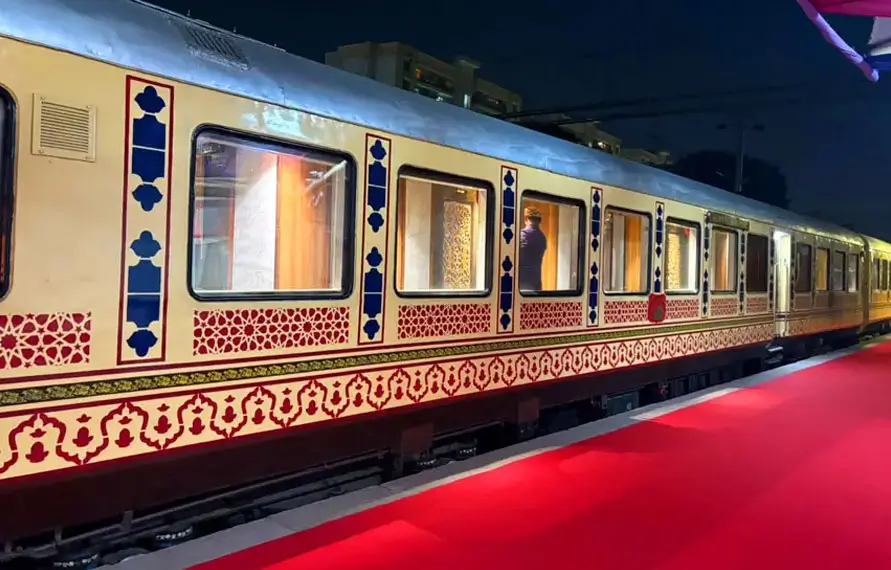
Two kingdoms of very different character share this itinerary. Rajasthan was ruled for centuries by warrior clans who built forts on every ridge and palaces beside every lake, while the Kathmandu Valley grew rich on Himalayan trade and filled its squares with pagoda temples, carved wooden windows and golden roofs. The Palace on Wheels with Nepal joins the two in twelve days, starting with a full week on India's first luxury train and finishing with three nights in the Nepali capital, within sight of the highest mountains on earth.
Rajasthan Tourism and Indian Railways have jointly run the Palace on Wheels for over four decades, and every saloon still carries the name of a vanished Rajput state. In a week on board you call at the Pink City of Jaipur, the tiger forest of Ranthambore, the fortress of Chittorgarh, lakeside Udaipur, desert Jaisalmer, blue Jodhpur, the Bharatpur wetlands and finally Agra, with guided visits at every stop and the train covering most of the distance at night. The season runs from September to April, and October to early December and late February to April are also the clearest months for mountain views in Kathmandu.
After the train returns to Delhi, a short flight of about ninety minutes takes you to Kathmandu. Here you visit the three royal Durbar Squares of the valley, the great white dome of Boudhanath and the riverside temple of Pashupatinath, with the option of an early morning flight along the Everest range. Most nationalities can obtain a Nepal tourist visa on arrival at Kathmandu airport. Our company, Top Indian Holidays, has been organizing private journeys out of Jaipur for over twenty-five years with Ministry of Tourism approval, and we take care of the train, the flights, hotels in both capitals, private guides and every transfer, so the change of country feels easy rather than complicated.
Your Palace on Wheels with Nepal holiday begins when you land at Indira Gandhi International Airport. Look for our representative and your name on a placard just past customs; from there it is a short walk to a cool private car and on to your hotel, which takes roughly 40 minutes at night and longer in daytime traffic. Most flights from the West land late, so we request early check-in where possible and keep the first day completely free, giving you time to rest properly before the week on the rails.
If you arrive early and feel restless, a short drive to the Gurudwara Bangla Sahib, the principal Sikh shrine of central Delhi, makes a peaceful first outing. Visitors cover their heads, leave shoes at the entrance and can watch the community kitchen at work. Alternatively, spend the afternoon at the hotel spa or by the pool. The weather in Delhi varies widely across the season, from warm October days to cool, foggy mornings in January, so our team tailors advice to your dates. Both options take only a couple of hours.
After dark, a member of our Delhi staff comes by with your trip folder and runs through the days ahead. Because this journey crosses an international border, we check passport validity, which should be at least six months from arrival in Nepal, and remind you to carry two spare passport photographs and some US dollars in cash for the Nepal visa. We also confirm that your Indian e-Visa allows the exit and onward travel, since rules differ by nationality and visa type. Our team keeps copies of your documents on file as a backup.
The morning is unhurried, so take a late breakfast and enjoy the hotel. Check-out is usually at noon, but we can arrange a late room or a lounge where you can wait comfortably. Your car leaves around 15:30 for Safdarjung in south Delhi, the boarding point for the Palace on Wheels, where guests are asked to arrive by four. This small station is used for heritage and luxury trains, so the platform is calm, uncrowded and decorated for the occasion. Pack a small overnight bag for easy access in the cabin.
You are greeted by staff in turbans and traditional dress, with a garland, a welcome drink and the sound of drums and folk instruments. Your attendant then escorts you to your carriage, each named after an old princely state such as Alwar, Bharatpur or Jhalawar. The cabins have private bathrooms, wardrobes and wide windows, and the corridor leads to a lounge bar and two restaurant cars. Take a few minutes to learn the layout of your carriage before dark, since the lights are softer at night.
The train leaves at about 18:30 and heads into the night toward Jaipur. Dinner is a relaxed first meeting with fellow travelers from many countries, and the menu combines Rajasthani specialties with familiar continental choices. Our tip for this first evening is to ask the restaurant manager about the next day's timings, since the morning in Jaipur is busy. Lay out comfortable walking shoes, a hat and sunscreen tonight, and keep a light shawl for temples where shoulders must be covered. Breakfast is served early tomorrow, before the coach leaves.
The train reaches Jaipur early, and today begins with Amber Fort, the old capital of the Kachwaha rulers above Maota Lake. Our recommendation is to spend real time in the Sheesh Mahal, the Mirror Palace, where the walls and ceilings are covered in tiny pieces of glass set into plaster in floral patterns. Ask your guide to point out the marble panel known as the magic flower, carved with a butterfly, a fish, a scorpion and a lotus that appear in turn as you cover different parts of it with your hands.
Back in the city, you visit the City Palace, Jantar Mantar and the Albert Hall Museum, and pause for pictures in front of the latticed pink face of the Hawa Mahal. Jaipur was laid out in the early eighteenth century on a grid of wide streets, and the whole old city was painted pink to welcome a royal visitor from Britain in the nineteenth century. The color has been kept ever since by local law, which explains why every shop front on the main avenues shares the same soft terracotta shade.
The late afternoon is free for shopping in the old city markets, where you can watch gem cutters polishing stones and printers stamping cotton with carved wooden blocks. The jewelry quarter is particularly interesting even if you are only browsing. Dinner is generally served off the train at a palace hotel, and the train departs Jaipur at about 20:00. Ask your attendant for a very early wake-up call, as tomorrow begins at Sawai Madhopur well before dawn. Carry small notes, since card machines are not universal.
The train halts at Sawai Madhopur at around 04:45, and after a hot drink you climb into an open jeep or canter for a morning in Ranthambore National Park. Gates open close to 07:00 in the coldest months and roughly half an hour sooner in October, February and March. The first hour is often the most rewarding, when tigers are still on the move along the forest roads and around the water holes. Dress in muted colors, avoid bright reds and whites, and bring a warm hat for the cold air.
The park is a mix of dry forest, grassland and lakes framed by rocky ridges, with the ruined walls of a tenth-century fort on the skyline. Watch for the rufous treepie, a bird that sometimes lands on the safari vehicles, and for crocodiles sunning themselves on the lake shores. Your naturalist explains how the guides identify individual tigers by the stripe patterns on their faces. Remember that no sighting can be guaranteed, but the scenery alone justifies the early start. Keep voices low so the animals stay relaxed near the vehicle.
After breakfast on the train, the journey continues to Chittorgarh, arriving mid-afternoon. No fort in India covers more ground than Chittorgarh Fort, whose walls run for kilometers around the rim of a lofty plateau. Today our suggestion is the Meera Temple, linked to the sixteenth-century princess-poet Meera Bai, whose devotional songs are still sung across India. After dark, the sound and light show tells the dramatic history of Chittorgarh's three great sieges, with colored lights playing on the ancient walls as the evening air cools. Carry a light jacket, as the plateau is breezy after sunset.
Udaipur greets you at about 07:00, and the morning opens at Saheliyon Ki Bari, a garden of fountains, marble pavilions and lotus pools built for the ladies of the royal household. Today, ask your guide to show you the rain fountain pavilion, where water falls from the roof like a summer shower, a clever piece of engineering from the eighteenth century. Early morning is the most peaceful time here, and the garden is a lovely introduction to a city famous for its water and greenery.
Next comes the City Palace, a ridge-top sprawl of courtyards that grew over many generations and outsizes every other royal residence in the state. The courtyards are decorated with colored glass, painted walls and inlaid mirrors, and the Crystal Gallery holds a collection of glittering crystal furniture ordered from England. The upper terraces give wonderful views over the rooftops of the old city and across Lake Pichola to the island palaces and the distant Aravalli Hills, which ring the city on every side. Allow about two hours, as the stairways are narrow and steep.
A boat ride on the lake follows, circling past Jag Mandir island and the white Taj Lake Palace hotel. After lunch in town, you return to the train for its departure at about 16:00 toward Jaisalmer. The afternoon on board is a perfect time to rest, read or watch the landscape gradually turn from green hills to dry desert scrub. Before dinner, the lounge bar is lively with guests swapping photographs and stories from the first half of the journey. Ask the bar staff about their nonalcoholic cocktails as well.
The train arrives in Jaisalmer at around 08:30, deep in the Thar Desert. After a stop at Gadisar Lake, you climb into Jaisalmer Fort, a living citadel of golden sandstone where families still live, run shops and pray in temples. Our tip today is to visit the fort's royal palace museum and climb to its rooftop, where the view stretches across the flat roofs of the fort to the town below and the desert beyond. In the clear desert air, you can see for many kilometers in every direction.
Next you visit Patwon Ki Haveli, a cluster of five merchant mansions famous for their carved stone facades, and the nearby Nathmal Ji Ki Haveli. A town hotel hosts lunch, after which you can browse the lanes beneath the ramparts, where stalls sell embroidered cushion covers, woolen blankets, leather goods and silver jewelry. Bargaining is expected in the small shops, and your guide can suggest reliable places for textiles and antiques if you are looking for something special. Most shops will also arrange shipping for larger items.
In the late afternoon, you drive to the sand dunes outside town for a camel ride as the sun sets. The changing colors of the sand are beautiful, and the silence of the desert is a welcome contrast to the busy cities. Dinner tonight is served at a five-star hotel with folk musicians and dancers from the desert communities. The train departs at about 23:00 for Jodhpur, and the gentle rocking quickly sends tired travelers to sleep. Keep your camera in a dust-proof bag on the dunes, as fine sand gets everywhere.
Your carriage wakes at Mandore, just outside Jodhpur, near 07:00, and the first stop is Mehrangarh Fort, perched on a cliff above the city. Inside, our recommendation today is the Moti Mahal, the Pearl Palace, a hall of public audience where the ceiling is decorated with mirrors and gold leaf and the windows are fitted with colored glass. The museum's collection of turbans, shields and royal cradles is also excellent. From the walls, the old city below glows in shades of blue. Allow at least two and a half hours to see the fort properly.
You then visit Jaswant Thada, the white marble memorial of the Jodhpur rulers, surrounded by small lakes and gardens. The marble is so thin in places that light passes through it. This is a quiet spot to sit and look back toward the fort. The day's last call is the museum wing of Umaid Bhawan Palace, a vast residence in sandstone that is part royal home, part luxury hotel, with displays of vintage cars, clocks and family photographs from the early twentieth century. Photography is allowed in most of the museum's rooms.
You return to the train for lunch and depart at about 16:30. The afternoon offers a chance to rest and to visit the lounge as the train crosses the farmland of eastern Rajasthan. This is also a good time to begin thinking about Nepal: our team can talk you through clothing for Kathmandu, which is cool in the evenings for much of the season, and confirm your flight details. An early night is wise, as the train reaches Bharatpur before five. Pack a fleece for Nepal in your hand luggage.
The train reaches Bharatpur at about 05:00, and after tea you head into Keoladeo National Park, a UNESCO-listed bird sanctuary. In winter, the wetlands hold thousands of ducks, geese, herons and storks, and today we suggest looking out for the darter, a long-necked water bird that swims with only its head above water and then perches with wings spread to dry. Your naturalist helps you identify species, and a pair of binoculars makes the visit far more rewarding. Morning mist often hangs over the water, so wear a warm layer and enjoy the soft light it gives to photographs.
The train continues to Agra, arriving around 11:00. You visit Agra Fort, the red sandstone fortress where the Mughal emperors ruled, with its white marble palaces, mosques and audience halls overlooking the Yamuna River. Lunch follows at a hotel in Agra. The Mughal cooking of Agra is famous for its rich, creamy sauces and slow-cooked meats, and the chefs are happy to make milder versions for those who prefer them. There is time to rest before the afternoon visit. Sunglasses help in the glare of the red sandstone courtyards.
Afternoon brings you to the Taj Mahal, and our suggestion is to study the inlay work on the cenotaphs inside the main chamber, where carnelian, lapis lazuli and jade are set into the marble in delicate floral designs. Your guide can show you how light passes through some of the stones. The monument is closed on Fridays, and food, tripods and large bags are not permitted. A farewell dinner is served on board before the train leaves Agra at roughly 20:45. Shoe covers are provided for the marble platform.
The Palace on Wheels arrives at Delhi Safdarjung at about 02:30 and waits at the platform while guests sleep. Breakfast is served in the dining car, cabins are vacated by 07:30, and a driver collects you beside the train for the run to the airport. The flight from Delhi to Kathmandu takes about an hour and a half. On a clear day, the left side of the aircraft is the best place to be for views of the Himalaya as you approach the Kathmandu Valley. Keep your passport and visa papers in your hand luggage.
On arrival at Tribhuvan International Airport, you follow the signs for visa on arrival. Most nationalities, including citizens of the US, UK, European Union countries and Australia, can obtain a tourist visa here, valid for 15, 30 or 90 days. We recommend completing the online arrival form within fifteen days before travel, carrying a printed confirmation, a passport photograph and US dollars in cash for the visa fee. The process usually takes thirty minutes to an hour, depending on the queues. Our Nepal team can help with forms if you have questions.
Our representative in Nepal meets you outside the terminal for the drive to your hotel. Kathmandu sits at about 1,400 meters, and the air is noticeably cooler and fresher than in the Indian plains. After checking in, take the afternoon to rest or walk through the gardens of your hotel. In the evening, enjoy a dinner of Nepali dishes such as steamed dumplings and lentil soup with rice and spiced vegetable stews, which make a gentle introduction to the cooking of the mountains. Drink plenty of water to adjust to the higher altitude.
After breakfast, your guide takes you to Kathmandu Durbar Square, the old royal center of the city, where pagoda temples, carved wooden windows and the former royal palace of Hanuman Dhoka surround a busy square. You may see the Kumari, a young girl worshipped as a living goddess, who sometimes appears at a window of her house in the square. Parts of the square were damaged in a major earthquake and are still being restored, and watching traditional woodcarvers at work on the repairs adds an interesting dimension to the visit.
Next, a short drive across the Bagmati River brings you to Patan Durbar Square, which many travelers consider the most beautiful of the three. The stone temple of Krishna Mandir, the golden gate of the royal palace and the bronze statues on tall pillars create a remarkable scene. The Patan Museum, housed in part of the old palace, is one of the finest in Asia, with a superb collection of bronze and stone sculptures. Allow at least two hours here. Look up at the carved roof struts, which show deities and animals in vivid detail.
In the late afternoon, you visit Boudhanath, one of the largest domed Buddhist monuments in the world, its great white dome topped by a golden spire painted with the watchful eyes of the Buddha. Pilgrims, monks and local families walk clockwise around the monument, spinning prayer wheels and murmuring prayers. Dusk is the most atmospheric time, when butter lamps are lit and the light softens. Join the walk around the great dome, then enjoy a coffee on a rooftop terrace overlooking the scene. Spinning the prayer wheels as you walk is welcomed.
For those who choose the optional Everest mountain flight, the day begins very early. Flights leave Kathmandu's domestic terminal from about 06:30 and last about an hour, flying east along the main Himalayan range past about twenty of the highest peaks, including Everest itself. Every passenger has a window seat, and the aircraft turns so that both sides get a view. Flights depend on clear weather and are sometimes delayed or cancelled, so your guide keeps the rest of the day flexible in case of a delay. Our team confirms the morning schedule the evening before.
After breakfast, your guide takes you to Bhaktapur, about 14 kilometers east of Kathmandu, a remarkably preserved medieval town where cars are largely kept out of the historic center. The Durbar Square holds the 55-Window Palace, famous for its finely carved wooden windows, while the nearby Taumadhi Square is dominated by the five-tiered Nyatapola Temple. In Pottery Square, craftsmen shape clay on spinning wheels in the open air. Try the local sweet curd, served in small clay pots, which is a Bhaktapur specialty. Comfortable shoes are needed on the brick lanes.
In the late afternoon, you visit Pashupatinath, the most sacred Hindu temple in Nepal, on the banks of the Bagmati River. Only Hindus may enter the main temple, but visitors can watch the open-air cremations on the riverbank from the opposite side and see the holy men who live around the temple. Please be respectful and avoid photographing grieving families. As darkness falls, an evening ceremony with lamps, bells and chanting is held on the riverbank, a moving end to your time in Nepal. Wear modest clothing that covers shoulders and knees.
Your last morning in Nepal is free until the airport transfer. If your flight leaves in the afternoon, an early visit to Swayambhunath, the hilltop Buddhist shrine west of the city sometimes called the Monkey Temple, gives a wonderful final view over the Kathmandu Valley. The eastern stairway has 365 steps, but a road leads up to the back of the hill for those who prefer not to climb. Keep food and sunglasses out of sight, as the monkeys here are quick and curious. A visit takes about ninety minutes in all.
We time your pick-up so that you reach Tribhuvan International Airport three hours or more before an international flight. Many travelers fly home via Delhi or a Gulf hub, and our team can help match connections. Remember that Nepal and India have different currencies; Nepali money cannot easily be changed abroad, so spend or exchange any remaining notes before departure. Keep your passport and boarding passes in your hand luggage, and allow time for security checks. Our Nepal team stays in touch until you have checked in.
All of us at Top Indian Holidays, the independent Jaipur operator behind this journey, are grateful you traveled with us. We booked your Palace on Wheels cabin, your flights, hotels, guides and every transfer across two countries so that the whole journey felt easy. May the forts of Rajasthan and the pagodas of the Kathmandu Valley stay with you for years, and we would be delighted to arrange your next adventure in India or the Himalaya, perhaps Bhutan, Sikkim or the Kerala backwaters. For now, travel home safely, with the snow peaks of the Himalaya still fresh in your mind.
Fill out this form with all the required information. Within 12 hours, we will provide you with a tailor-made itinerary at the best price.
Read the reviews of our esteemed client's, go through the experiences they had with Top Indian Holidays.

Whether you're planning your first India trip or returning to explore deeper — get honest, expert advice from someone who knows every corner of this country. No pressure, no cost.



 info@topindianholidays.net
 +91-8955000999