12 Nights / 13 Days Fully Guided Tours Private Car
Delhi - Jaipur - Ranthambore - Chittorgarh - Udaipur - Jaisalmer - Jodhpur - Bharatpur - Agra - Delhi - Goa
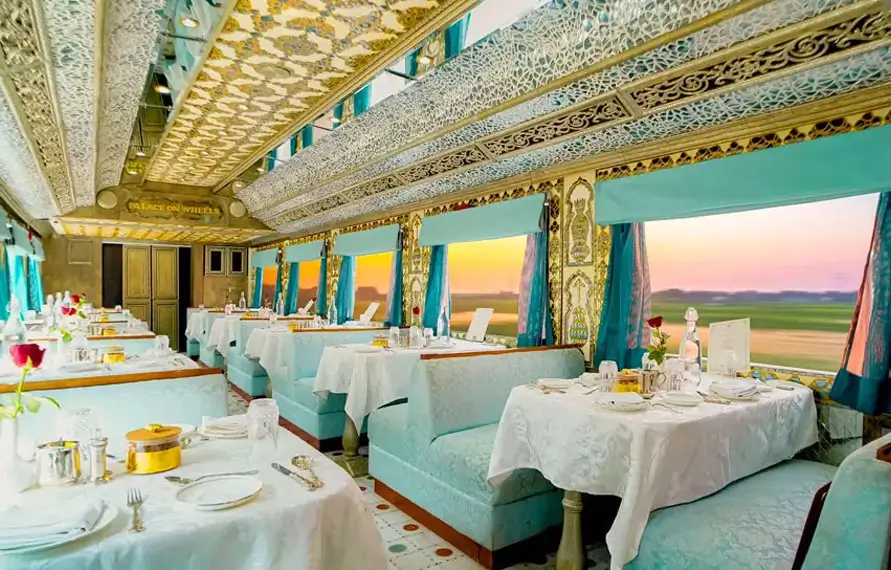
Rajasthan by royal train and Goa by the sea make one of the most satisfying pairings in Indian travel: a busy week of forts, palaces and desert towns, followed by four easy days on the coast with nothing more demanding than a swim before lunch. The Palace on Wheels with Goa Beach Holiday is designed exactly that way, with a gentle arrival night in Delhi, seven nights on board India's first luxury train and a beach hotel waiting at the end to let everything you have seen settle in.
The Palace on Wheels is operated by Rajasthan Tourism with Indian Railways and has carried travelers around the state for more than forty years. Every carriage is named after a former princely state, and the route covers Jaipur, Ranthambore, Chittorgarh, Udaipur, Jaisalmer, Jodhpur, Bharatpur and Agra, with a guide and transport ready at each stop. Most of the traveling happens at night, which means mornings are spent sightseeing rather than sitting in traffic. The train season runs from September to April, the same months when Goa enjoys dry skies and calm seas.
On the coast, you stay at a luxury beach resort and choose your own pace. One day is reserved for a private tour of the Portuguese churches of Old Goa and the painted lanes of Fontainhas in Panaji, and another for the quieter beaches of the south. Your train seat, Delhi hotel, domestic flight, Goa resort and each transfer are booked by Top Indian Holidays, an independent Jaipur travel house holding Ministry of Tourism approval, with a private car and driver whenever you leave the hotel. The result is a trip that balances sightseeing with genuine rest, ideal for couples and for anyone who finds a full fortnight of touring too much.
On arrival at Indira Gandhi International Airport, our representative meets you outside the customs hall and walks you to a private air-conditioned car. The drive to your hotel takes about 40 minutes at night and can stretch to an hour in daytime traffic. Your Palace on Wheels with Goa Beach Holiday begins with a full night of rest in a luxury hotel, chosen for comfort and a quiet room, since most flights from Europe and the Americas land late and the train boards tomorrow afternoon.
If you land early in the day and want to stretch your legs, we suggest a short private visit to Humayun's Tomb, the Mughal garden tomb that inspired the Taj Mahal, set among fountains and avenues of trees. It takes about ninety minutes and is the most restful monument in Delhi. Alternatively, simply spend the afternoon at the hotel pool. October and March are warm and pleasant, while December and January evenings in Delhi are cool enough to need a sweater and sometimes bring morning fog.
In the evening, our team briefs you on the week ahead, from the dress code for dinners on the train to the clothing you will need for a cold dawn safari and a hot afternoon in the desert. Pack light layers, a warm jacket, a sun hat and comfortable walking shoes, and keep your swimwear in the main suitcase for Goa. Indian SIM cards can be arranged at the hotel if you prefer local data, which is helpful for keeping in touch while the train is moving.
A slow morning in Delhi gives you time to adjust to the time difference before the train. After breakfast, you might visit a nearby craft emporium for gifts or take a spa treatment at the hotel. Check-out is usually at noon, and we keep a room or a lounge available for the afternoon if you prefer. Around 15:30 a car takes you to Safdarjung, a calm station in south Delhi reserved for special services, since guests for the Palace on Wheels must check in by 16:00.
The welcome is colorful and warm. Musicians play on the platform, staff place garlands around your neck and a cold drink is offered while your documents are checked. Porters carry your bags to the carriage, and the attendant assigned to your coach shows you in. Cabins are compact but well designed, with an attached bathroom, a wardrobe and wide windows. Take a moment to note the location of the restaurant cars and the lounge bar, since you will walk between them often over the coming week.
At about 18:30 the train eases away from the platform and heads out of the city lights into the darkness of Haryana and Rajasthan. The first dinner on board sets an easygoing tone, as travelers from a dozen countries swap names and stories over the meal. The rocking motion of the train takes a night or two to get used to, so earplugs and an eye mask are worth packing. Breakfast tomorrow is early, as the train arrives in Jaipur at dawn. Ask the attendant for an extra blanket if you feel the cold.
The train rolls into Jaipur in the early morning, and your first stop is the Albert Hall Museum, an elegant Indo-Saracenic building in the Ram Niwas Garden that is the oldest museum in Rajasthan. Inside are carpets, arms, pottery and miniature paintings, but most visitors linger by its Egyptian mummy, an unexpected find in the middle of India. The building itself is the real star: domes, arcades and carved balconies that look particularly fine in the soft morning light before the city traffic builds. The museum opens at 09:00, so the timing works well for train guests.
Next the coach stops at the Hawa Mahal, the Palace of Winds, a five-story wall of screened windows that let the ladies of the court look down on festivals in the street while staying hidden from view. From the street it looks like a giant honeycomb, but it is worth stepping inside and climbing the narrow ramps to the top, where you look straight down onto the old city. Morning is the best time for photographs, since the facade faces east and catches the early sun directly. Allow about forty minutes, as the ramps are narrow and busy.
The day continues with Jantar Mantar, the City Palace and the hilltop Amber Fort before a free period in the markets. Jaipur is famous for block-printed cotton, hand-knotted rugs, semi-precious stones and blue pottery, and the old city streets are grouped by craft, which makes browsing easy. Keep an eye on the time, as the train departs at about 20:00. Dinner is usually served off the train in Jaipur, and you return on board tired and happy after a long first day. Carry small notes, as many market stalls do not accept cards.
The train halts at Sawai Madhopur at about 04:45, in darkness and often in cold. After a hot drink you step into an open safari vehicle and drive the short distance into Ranthambore National Park, with the morning slot starting at about 07:00 in winter and about 06:30 in October and from February. Your naturalist checks the tracks along the forest roads for fresh prints and listens for warning calls from monkeys in the trees, which can mean a tiger or leopard is close by.
The park is beautiful even without a big cat. Lakes reflect the old hunting pavilions of the Jaipur rulers, banyan trees spread their aerial roots over the trails, and large brown deer wade into the water to feed on plants. Look for the sloth bear, the striped hyena and the marsh crocodile, along with more than three hundred bird species. A thermos of coffee, gloves and a camera with a long lens make the drive more comfortable and rewarding. You are back on the train for a late breakfast.
The train continues to Chittorgarh, arriving in the middle of the afternoon. Chittorgarh Fort covers a vast hilltop and was the capital of the Mewar rulers for centuries before they moved to Udaipur. Today, ask your guide about the Kirti Stambh, the Tower of Fame, an older and smaller tower dedicated to a Jain saint that most groups pass quickly. The sound and light show inside the fort after dark retells the stories of sieges and sacrifice that made Chittorgarh a symbol of courage across Rajasthan.
The train reaches Udaipur at around 07:00, and the first visit is to Saheliyon Ki Bari, the Garden of the Maidens, laid out in the eighteenth century for the queen and her companions. Its fountains are fed by water from the nearby Fateh Sagar Lake and still work by gravity, without pumps. Stone elephants spray water into lotus pools, and the marble pavilions are cool and shaded. Visit early, before the school groups arrive, when birdsong fills the trees and the garden is almost empty.
Next you head to the City Palace of Udaipur, a sprawling complex built over several centuries by successive Mewar rulers on a ridge above the lake. Highlights include the Mor Chowk, a courtyard famous for its peacock mosaics in colored glass, and a series of rooms decorated with mirrors, painted tiles and inlaid glass. Corridors are narrow and stairways steep, which was deliberate, to slow down any invading army. Comfortable shoes are essential, and the climb is rewarded with wide views over Lake Pichola. Allow about two hours to walk the whole complex at a gentle pace.
Your guide then leads you through the Crystal Gallery before a boat ride on Lake Pichola, gliding past the Taj Lake Palace and the island pavilion of Jag Mandir. The lake is calm and the light is gentle in the morning, making this a lovely time for photographs. Lunch is served in town, and you return to the train for its 16:00 departure toward Jaisalmer. This long overnight run takes you deep into the desert, so the afternoon is perfect for rest. Keep a hat handy, since the deck of the boat has little shade.
The train arrives in Jaisalmer at about 08:30, a city almost entirely built of yellow sandstone that glows gold in morning and evening light. The program begins at Gadisar Lake, the old reservoir of the town, ringed by small shrines and pavilions where catfish crowd the steps hoping for bread. From there you walk up into Jaisalmer Fort, a living fortress where around a quarter of the old city's residents still have homes, guesthouses and shops inside the walls. The walk up through four great gates takes about fifteen minutes.
Inside the fort, ask your guide to point out the Jain temples carved from the same golden stone, with every pillar, ceiling and doorway decorated in intricate detail. Shoes must be removed and leather items left outside. Afterwards you visit Patwon Ki Haveli and Nathmal Ji Ki Haveli, two of the merchant mansions that made Jaisalmer famous for stone carving. Lunch is served at a hotel in town, and there is free time for shopping: mirrorwork textiles, puppets and camel leather are local specialties. Shopkeepers inside the fort are friendly and rarely pushy.
In the late afternoon, a drive of about forty minutes brings you to the dunes, where a short camel ride carries you to a crest for sunset. The light changes quickly, from orange to pink to deep blue, and the temperature drops just as fast in winter. Keep your camera in a dust-proof bag and carry a warm layer. Dinner is at a five-star hotel with folk music and dance, and the train leaves for Jodhpur at about 23:00. Most guests say this evening is the most atmospheric of the week.
The train stops at Mandore station near Jodhpur at around 07:00. Your morning starts at Mehrangarh Fort, a colossal citadel whose walls grow out of a cliff that towers some 120 meters over Jodhpur. Its museum has an excellent collection of royal palanquins, elephant seats, textiles and weapons, and the rooms are decorated with gold leaf and stained glass. From the ramparts, the old city spreads below in shades of blue, the traditional color of homes in this part of Jodhpur. Audio guides in several languages are available at the entrance.
After the fort, a short drive brings you to Jaswant Thada, a white marble memorial surrounded by gardens. Today we suggest giving more time to the museum at Umaid Bhawan Palace, a domed sandstone giant finished in the early twentieth century and still counted among the biggest private homes anywhere. Descendants of the royal line occupy one wing and hotel guests another, while the museum displays clocks, crockery and photographs from the royal past, along with a row of vintage cars. Photography is allowed in most rooms, though not of the family quarters.
Departure from Jodhpur comes at roughly 16:30, leaving the rest of the day for unwinding, read or chat with fellow guests in the lounge as the scenery changes from desert scrub to greener farmland. Ask your attendant about the dinner menu, since the chefs are happy to adjust spice levels and prepare simple dishes for anyone who needs a break from rich sauces. An early night is wise, as the next stop comes just after five in the morning. Ask the train staff whether spa treatments are offered on your departure.
The train reaches Bharatpur at around 05:00, and after tea and biscuits you head into Keoladeo National Park, a wetland reserve and UNESCO World Heritage Site that is home to hundreds of species of birds. In winter, migratory ducks, geese and waders arrive from Central Asia, and resident species such as painted storks, herons and kingfishers are visible all year. Pedal cycle carts ridden by trained local guides are a feature here, though many guests now prefer the quiet electric carts. Binoculars are useful, and a light jacket helps against the morning mist.
The train then continues to Agra, arriving at about 11:00. The morning visit is to Agra Fort, the red sandstone stronghold of the Mughal emperors, where palaces of white marble were added inside the walls in the seventeenth century. From its terraces you can see the Taj Mahal along a bend of the Yamuna River. Lunch is served at a hotel in Agra, and there is a brief rest before the most famous visit of the trip. Wear sunglasses, since the red stone reflects strong light at midday.
Later comes the Taj Mahal, raised in white marble by a grieving Shah Jahan as the resting place of Mumtaz Mahal. Your guide explains the design, from the symmetrical gardens to the inlay of semi-precious stones in the marble, and how the minarets lean slightly outward. Remember that the monument is closed on Fridays and that food, tripods and large bags are not allowed. The train departs Agra at about 20:45 after a farewell dinner, heading back to Delhi through the night. Late afternoon light on the marble is soft, warm and ideal for photographs.
Your train is back at Safdarjung by around 02:30, though the staff let you sleep through until daylight. After breakfast in the restaurant car, you leave the cabin by 07:30 and find our driver beside the carriage, ready to take you to the domestic terminal for your flight to Goa, which takes about two and a half hours. If your flight departs later in the morning, we arrange a hotel lounge or a day room so that you can freshen up after the week on the train.
On landing at Goa, either at Dabolim in the south or at the newer Mopa airport in the north, our driver meets you for the drive to your beach resort. Goa has a completely different feel from Rajasthan: the air is warm and humid, palm trees line the roads, whitewashed churches appear in every village and the pace slows instantly. Drive times vary from thirty minutes to over an hour depending on the airport and your resort's location on the coast. Light cotton clothes and sunscreen are now far more useful than woolens.
After checking in, spend the rest of the day doing nothing at all. Walk to the beach, take a swim and watch the sun go down over the Arabian Sea with a cold drink. Goa is a mix of Indian and Portuguese influences, and dinner is a good chance to try local seafood, such as fish cooked in a tangy coconut sauce or prawns grilled with garlic and spices. From November to February the weather is at its best, with warm days and clear skies.
After breakfast, your private guide takes you to Old Goa, once the capital of Portuguese India and now a UNESCO World Heritage Site. The highlight is the Basilica of Bom Jesus, a Baroque church of dark laterite stone that holds the remains of Saint Francis Xavier in a silver casket. Nearby is the Se Cathedral, one of the largest churches in Asia, and the Church of Saint Francis of Assisi, both reminders of the time when Old Goa was compared to Lisbon in size and wealth.
In the afternoon you drive to Panaji, Goa's small capital on the Mandovi River, and walk through Fontainhas, the old Latin Quarter. The narrow lanes are lined with houses painted in yellow, blue and green, with tiled roofs, wooden balconies and blue-and-white tile name plates beside the doors. There are small galleries, bakeries and cafes where you can stop for a coffee. Late afternoon is best for photographs, when the light warms the colored walls and the streets are quieter. Respect residents' privacy and avoid photographing people at their doorways.
Before returning to the resort, you can visit the whitewashed Church of Our Lady of the Immaculate Conception, whose zigzag staircase is one of the most photographed sights in Panaji. Your guide can also suggest a restaurant serving traditional Goan dishes, such as pork cooked with vinegar and spices or fish fried in a semolina crust. You return to the resort in the evening, with the rest of the night free to stroll the beach or enjoy dinner by the pool. Tomorrow begins a little earlier, so an early night is sensible.
Today is reserved for the southern coast, where the beaches are cleaner, wider and calmer than the busy stretches of the north. Our driver takes you south toward Palolem, a crescent-shaped bay framed by coconut palms, and Agonda, a long, quiet beach where olive ridley turtles nest in the winter months. Along the way you pass rice fields, red laterite hills and village churches, and the drive itself is a gentle introduction to rural Goa that few beach visitors ever see. The drive from central Goa takes about ninety minutes each way.
At Palolem you can hire a small boat for a trip along the coast to Butterfly Beach or Honeymoon Beach, which are reachable only from the water or by forest trails. Dolphins are sometimes seen early in the morning. For lunch, a beachfront shack serving grilled fish and cold drinks is the classic choice. The sea is calm from November to March, and swimming is safe in most bays, though always watch for red flags on the beach. Carry cash for the boatmen, since card machines are rare on the sand.
In the late afternoon, return to your resort for a quiet evening. If you prefer some energy, the north of Goa has lively beaches and night markets, especially at Arpora on Saturday evenings, with stalls selling clothes, jewelry and handicrafts alongside food and live music. Your driver can take you there and back. For most guests, though, a slow dinner at the resort with the sound of the waves is the best way to end the day. Pack a light shawl, as sea breezes can feel cool after dark.
Your last full day in Goa is completely free, and our advice is to use it simply. Sleep late, have breakfast by the pool and spend the morning on the beach. Many resorts offer yoga at sunrise, Ayurvedic massages and cooking classes where you can learn to make a Goan spiced stew from scratch. The sea is warm enough for swimming throughout the season, and the water temperature stays around 27 to 29 degrees Celsius. Morning and late afternoon are the gentlest hours for sunbathing, since the midday sun is intense even in winter.
If you would like a short outing, a spice plantation in the hills near Ponda makes a pleasant half-day trip. Guides walk you through gardens of pepper, cardamom, vanilla, nutmeg and cinnamon, explaining how each is grown and used, and a simple lunch is often served on banana leaves. Alternatively, a sunset cruise on the Mandovi River from Panaji offers music and views of the city lights. Our team can book either option the day before. Both outings return to the resort in good time for a late swim before dinner.
Your final evening calls for a celebratory meal. Goa has excellent restaurants, from Portuguese-style taverns in old mansions to modern kitchens using local fish and spices. Our team can reserve a table at a restaurant with sea views or in a restored colonial house. Pack your bags tonight so that tomorrow's departure is stress-free, and keep your passport and any medicines in your hand luggage. Your driver can also arrange a final morning visit to a local market for cashews and spices if you have a later flight.
After a final breakfast, there may be time for a last swim before check-out, depending on your flight. Our driver collects you at the agreed hour for the drive to the airport, allowing about three hours before an international departure or two hours for a domestic connection. For late departures, ask us to hold the room longer or book a day room, giving you a place to shower and change before the long flight. Check that you have collected anything left in the room safe before you leave the resort, especially passports and jewelry.
Many international travelers connect through Mumbai, Delhi or a Gulf hub, and our team will help you match flight timings so that connections are comfortable. Remember to keep any cashew nuts, spices or local spirits bought in Goa in your checked luggage, since liquids over the limit are confiscated at security. A light jacket is useful on the plane, as air conditioning on Indian domestic flights can be quite cold after the warm Goa sun. Our team checks your flight status on the morning of departure and will call you if there is any change to the schedule.
It has been a pleasure for Top Indian Holidays, a privately run operator with no ties to the railway beyond booking it, to organize your seat on the Palace on Wheels, your hotels, flights, guides and every private transfer so that the trip ran smoothly from the first evening in Delhi to the last swim in Goa. We hope you take home memories of desert sunsets, marble palaces and warm Goan evenings, and we would be delighted to arrange your next journey to India. Until then, we wish you a safe and comfortable journey home and warm memories of every stop along the way.
Fill out this form with all the required information. Within 12 hours, we will provide you with a tailor-made itinerary at the best price.
Read the reviews of our esteemed client's, go through the experiences they had with Top Indian Holidays.

Whether you're planning your first India trip or returning to explore deeper — get honest, expert advice from someone who knows every corner of this country. No pressure, no cost.



 info@topindianholidays.net
 +91-8955000999