14 Nights / 15 Days Fully Guided Tours Private Car
Delhi - Jaipur - Ranthambore - Chittorgarh - Udaipur - Jaisalmer - Jodhpur - Bharatpur - Agra - Delhi - Bengaluru - Kanchipuram - Thanjavur - Kochi - Bengaluru
Rajasthan's desert forts and Kerala's palm-lined canals sit roughly 2,500 kilometers apart, and on most holidays you would have to choose one or the other. North & South India by Luxury Train: Palace on Wheels & Golden Chariot links them with two classic rail journeys and a single flight, giving you fifteen days that cover the royal north, the Mughal heartland and the temple country of the deep south. You sleep thirteen of those nights aboard a train or in a carefully chosen hotel, and you never have to drive long distances on the road.
The first half is the Palace on Wheels, India's original luxury train, launched in the early 1980s and run by Rajasthan Tourism with Indian Railways. Its carriages are named after former princely states of Rajasthan and decorated in their style. Over seven nights it visits Jaipur, Ranthambore, Chittorgarh, Udaipur, Jaisalmer, Jodhpur, Bharatpur and Agra. The second half is the Golden Chariot Jewels of South, an IRCTC train freshly refitted for 2026-27 with redesigned cabins, smart televisions, Wi-Fi and the Arogya wellness spa. Its five-night circuit out of Bengaluru calls at Mysuru, the temple towns of Kanchipuram and Mahabalipuram, Thanjavur, the mansions of Chettinad, Kochi and the lagoons outside Alleppey.
The two trains operate on separate calendars, so their dates must align for this trip to work: the Palace on Wheels must reach Delhi on the morning the flight to Bengaluru leaves, with the Golden Chariot departing the following day. Top Indian Holidays, a Jaipur firm founded in the late nineties that works independently of both trains and holds Ministry of Tourism approval, lines up the two timetables, picks a pair of departures that dovetail, and reserves the cabins, hotels, the connecting flight and each transfer. If the dates do not fit in your preferred month, we suggest the nearest pairing or add a few private days in between to bridge the gap. It is a long trip, but the pace is gentle and every day has a clear purpose.
Once you are through customs at Indira Gandhi International Airport, our representative takes you by private car to your luxury hotel in central or south Delhi, normally a ride of 40 to 60 minutes. Long-haul flights tend to land late at night or early in the morning, so this day is left open for rest. The Palace on Wheels does not leave until tomorrow evening, which gives you a comfortable cushion against flight delays and plenty of time to adjust to the time difference before two weeks of travel.
If you arrive in the morning, you may want a short outing in the afternoon. Your driver can take you to Lodhi Garden, a peaceful park dotted with tombs of the fifteenth and sixteenth century rulers, and on to Khan Market for coffee and a bookshop browse. Both are close to the main hotel district and easy to enjoy without a guide. Delhi in winter has mild, sunny days around 20 to 23 degrees Celsius, though mornings are often hazy and evenings cool quickly after dark.
In the evening, our representative goes through the full program with you, including the boarding details for both trains, the flight to Bengaluru and the contact numbers you will need. The trains have limited storage, so it helps to bring a medium soft suitcase and a day bag; extra luggage can be stored at the hotel and forwarded or kept for your return. Pack layers for Rajasthan's cold mornings and lighter cotton clothing for the warmth of Tamil Nadu and Kerala later in the trip. Our team can also arrange a local SIM card for you.
The morning is free. After a late breakfast, you might visit Humayun's Tomb, the sixteenth century garden tomb that inspired the Taj Mahal, which takes about two hours with a guide and is near most hotels. Alternatively, rest by the pool and keep your energy for the week ahead. Hotel checkout is usually around noon, and a late checkout or a day room can be arranged so you can shower and change before boarding in the afternoon. A light lunch at the hotel or a nearby cafe is the last chance for a quiet meal before the train's routine begins.
At about 16:00 your driver brings you to Delhi Safdarjung station, where the Palace on Wheels waits at the platform. A welcome ceremony with flower garlands and music greets you, and staff in traditional turbans show you to your cabin, while your luggage follows. Each saloon is named after a former princely state such as Jaipur, Udaipur, Bikaner or Jodhpur, and the decor echoes its style with painted panels, fabrics and miniature art. Every cabin has an attached bathroom with a shower. The corridors are narrow, so the attendants carry heavier bags for you.
The train departs at about 18:30, heading south-west out of the city. The evening meal is laid in the Maharaja or Maharani dining car, where the menu moves between Rajasthani specialties, other Indian regional dishes and continental plates. The lounge bar is a good place to meet fellow travelers over a drink before bed. Your cabin attendant explains the next morning's timing and asks about breakfast preferences. Tonight's run is short, and the train reaches Jaipur in the early hours while you sleep. Light sleepers may want earplugs for the station stops during the night.
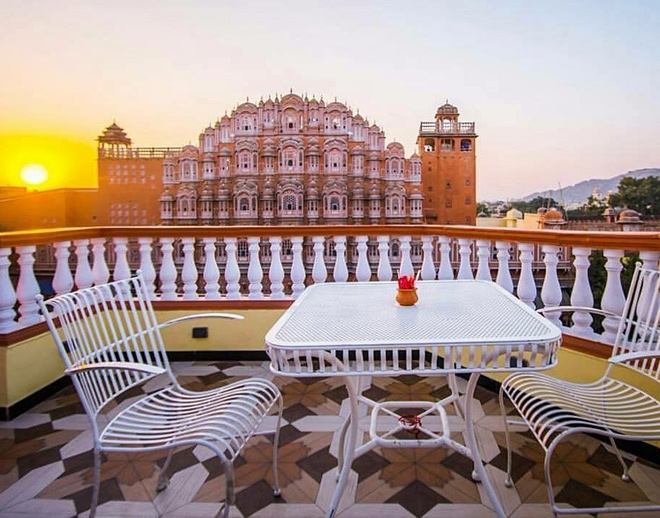
By daybreak the train has pulled into Jaipur, Rajasthan's capital, and following breakfast the onboard guides lead a full day of sightseeing around the Pink City. First comes the Albert Hall Museum, a grand Indo-Saracenic building in Ram Niwas Garden that houses carpets, armor, miniature paintings and an Egyptian mummy. A photo stop outside the Hawa Mahal, the five-story Palace of the Winds with its honeycomb of small windows, follows, and then a visit to Jantar Mantar, the open-air observatory of giant masonry instruments. Each instrument was designed to measure time or track the stars with the naked eye.
The City Palace comes next, a complex of courtyards and gateways still partly home to the former royal family. The Peacock Gate in the Pritam Niwas Chowk courtyard, with its glossy blue and green plaster, is one of the most photographed doorways in India. The museum galleries display royal costumes, arms and armor, and the guide explains the history of the Kachwaha rulers who founded the city in the early eighteenth century and laid it out in a precise grid. Photography is allowed in the courtyards but not inside some galleries.
In the afternoon you drive north to Amber Fort, the honey-colored fortress-palace overlooking Maota Lake. Jeeps take you to the main courtyard, from where you walk through halls of public and private audience to the Mirror Palace. Afterwards there is time for the markets, where block-printed textiles, silver jewelry and gemstones are the classic buys. You return to the train for dinner, and it leaves Jaipur at about 20:00, heading south through the night toward Sawai Madhopur. Dinner on board is unhurried, with the train staff serving Rajasthani dishes alongside lighter continental choices.
Sawai Madhopur comes into view at around 04:45; a knock on the door brings tea and biscuits, and soon you are climbing into an open jeep for a dawn game drive through Ranthambore National Park. Drives set off near 07:00 and return about 10:30 in the November to January period, while in October and after February the start moves forward to roughly 06:30. Temperatures at that hour in winter can sit at 6 to 9 degrees Celsius, so bring a warm jacket, gloves and a hat. Blankets are provided in most vehicles. A thermos of hot tea in the vehicle helps too.
Ranthambore's landscape of rocky ridges, lakes and dry forest is one of the most beautiful of any Indian park, and the ancient fort on the hill gives it a timeless quality. Tigers here are relatively used to vehicles, and sightings are good by Indian standards, though never guaranteed. You will almost certainly see large brown deer wading in the lakes, spotted deer, wild boar, crocodiles and a wide range of birds, from treepies and parakeets to crested serpent eagles. Return to the train for a late breakfast as it continues south-west.
By mid-afternoon you reach Chittorgarh, home to one of the largest forts in India, spread along a high plateau about 180 meters above the plain. Its walls enclose palaces, temples, water tanks and two towers of victory and fame. The fort is famed for its stories of courage and sacrifice, especially the legend of Queen Padmini. The guide walks you through the ruins in the softening light. In the evening, a sound and light show recounts the fort's history before you return to the train.
Udaipur station is reached at roughly 07:00, and once breakfast is done the first visit is Saheliyon Ki Bari, the Garden of the Maidens, created as a retreat for women of the court with fountains, marble elephants and lotus pools. The garden is cool and green in the morning, with peacocks wandering among the flower beds. Next comes the City Palace of Udaipur, which stretches along the eastern bank of Lake Pichola and grew, wing by wing, under many generations of Mewar kings into the state's biggest royal complex. It is best seen before the day crowds arrive.
Inside the palace, a maze of courtyards, balconies and narrow staircases leads past rooms decorated with mirror work, colored glass and painted walls. The Crystal Gallery, part of the palace complex, holds a remarkable collection of crystal furniture and objects ordered from England in the late nineteenth century, including beds, seating and a fountain. From the upper terraces you look over the lake to the white Lake Palace and the island of Jag Mandir, with the Aravalli hills beyond. The guide also explains the Mewar rulers' long resistance to the Mughals.
Late morning brings a boat ride on Lake Pichola, the best way to see the city's palaces, temples and lakeside mansions from the water. Mornings are calm and the light is clear, ideal for photographs. After lunch the train leaves Udaipur at about 16:00 for the long run to the Thar Desert, and the rest of the day is for relaxing on board. Dinner is served as the landscape grows drier and the villages more scattered, with distant lights on the horizon. Settle into the lounge car with a drink to see the countryside give way to scrub and sand.
You reach Jaisalmer at about 08:30, deep in the Thar Desert near the border with Pakistan. You begin at Gadisar Lake, a fourteenth century water tank ringed with little temples and shrines, which shimmers in the morning light. Then the coach climbs to Jaisalmer Fort, a living fort of yellow sandstone where several thousand people still live within the walls, in houses, shops and small hotels. From the ramparts the whole city glows gold below you. Some of its inner lanes are too narrow for vehicles, so you go on foot.
Inside the town, your guide takes you through narrow lanes to the merchant mansions, including Patwon Ki Haveli, a row of five connected homes commissioned by a prosperous merchant clan, and Nathmal Ji Ki Haveli, carved by two brothers who each worked on one side, producing slightly different designs. The stone carving is so fine it looks like lace, with balconies, screens and brackets covered in floral patterns. Walk slowly to take in the details, and wear sturdy shoes for the uneven paving. Shops nearby sell embroidered textiles and puppets.
In the late afternoon, the coach takes you out to the sand dunes for a camel ride at sunset, one of the highlights of any trip to Rajasthan. The light turns the dunes orange and pink, and the desert silence is broken only by the bells of the camels. Once night falls, you dine at a five-star Jaisalmer hotel, usually to the accompaniment of desert musicians and dancers. You return to the train, which departs at about 23:00 for Jodhpur. Nights in the desert are cold in winter, so carry a warm layer. The train staff keep hot drinks ready for your return.
Around 07:00 the train halts at Mandore, just outside Jodhpur, and after breakfast you ride up to Mehrangarh Fort, a colossal stronghold perched on a rock outcrop some 120 meters over the town. Its massive walls still carry marks from cannon fire, and inside are elegant palaces with fine latticework, painted ceilings and a superb museum of palanquins, elephant seats, arms, textiles and miniature paintings. The audio guide here is excellent, and the views over the blue houses of the old city stay with you long after the trip.
A few minutes away by road is Jaswant Thada, the cenotaph of Maharaja Jaswant Singh II, raised in pale marble toward the end of the nineteenth century. Some of its panels are cut so fine that sunlight passes through them with a soft glow, and the terraced garden and small lake beside it are peaceful. Next is the Umaid Bhawan Palace museum, part of one of the world's largest private residences, completed in the mid-twentieth century and still home to the former royal family in one wing. Photography is allowed throughout the grounds.
The museum displays vintage clocks, royal photographs and art deco furniture, and gives a glimpse into the life of a modern ruling prince. The rest of the palace is a luxury hotel. After the visit you return to the train, which leaves Jodhpur at about 16:30 for the long run east across Rajasthan. The afternoon is free to relax, use the lounge or read in your cabin. Dinner is served on board, and the train travels through the night toward Bharatpur. It is a quiet afternoon after an early and busy morning.
Bharatpur is reached at about 05:00, and with tea in hand you set out for Keoladeo National Park, a World Heritage wetland that began as the duck-hunting preserve of Bharatpur's ruler. Today it is one of the finest bird sanctuaries in Asia. In winter, thousands of migratory birds arrive from Central Asia and Siberia, and you may see painted storks, tall gray cranes, pelicans, spoonbills and many species of ducks and geese. Cycle carriages are the usual way to move along the raised tracks. The best viewing is usually in the first two hours after dawn.
Bring binoculars and dress in warm layers, as early mornings are cold and misty. The naturalist guides know the park well and can point out owls roosting in tree hollows and pythons sunning themselves near their burrows. After the visit you return to the train, which reaches Agra at about 11:00. The first stop is Agra Fort, the red sandstone citadel of the Mughal emperors, with palaces of white marble and views along the Yamuna River. The Taj Mahal is visible across the river from several of its terraces, which makes a fine preview of the afternoon visit.
In the afternoon you visit the Taj Mahal, the marble mausoleum built by Shah Jahan in the seventeenth century for his wife Mumtaz Mahal. The afternoon light gives the marble a warm glow, and the guide explains its symmetry, its gardens and the fine inlay work. Remember that the Taj is closed every Friday. A farewell dinner awaits back on board before the Palace on Wheels pulls out near 20:45 for its brief final run to Delhi. The staff often prepare a special menu for this last evening on board.
Although the train reaches Delhi Safdarjung around 02:30, guests sleep on in their cabins until daylight. Checkout follows breakfast by roughly 07:30, when a driver from our team waits beside the carriage to take the bags. A short drive takes you to Delhi airport for a direct flight to Bengaluru, which takes about two hours and forty minutes. We choose a late morning or early afternoon flight to give you a comfortable margin after leaving the train. Breakfast on board is unhurried before checkout, so there is no need to rush.
Domestic flights usually allow about 15 kilograms of checked baggage in economy, so let us know in advance if you need extra allowance. At Kempegowda International Airport a team member is waiting to drive you the hour or so to your luxury hotel in Bengaluru. The change in climate is immediate: Bengaluru sits on the Deccan plateau at about 900 meters, with mild, sunny days and cool evenings in winter, and a greener, more relaxed atmosphere than the north. The drive into the city passes new office parks and long avenues of flowering trees.
Spend the evening resting and preparing for the second train. Wash or send out any laundry from Rajasthan, as the hotel can return it the same evening, and repack lighter clothing for the warmth of Tamil Nadu and Kerala. Temple visits in the south require removing shoes and covering shoulders and knees, so keep sandals and a light scarf in your day bag. Dine simply at the hotel and turn in early, since boarding begins promptly in the morning. Our team calls to confirm tomorrow's pickup time.
Your driver takes you to Yeshwantpur station by about 08:30, where the Golden Chariot Jewels of South welcomes you with music and a garland. Registration is quick, and your bags are delivered to the cabin while you settle into the lounge. The train departs at about 09:45, and the cabin feels noticeably more modern than the Palace on Wheels, with a smart TV, Wi-Fi and contemporary furnishings inspired by Karnataka's temple art. Lunch is served in Ruchi or Nalpaka as the train runs south-west. Your attendant explains the cabin's controls and storage.
In the afternoon the Golden Chariot arrives in Mysuru, and a coach carries you to Mysuru Palace, home of the Wadiyar princes. After a week of Rajput forts, the contrast is striking: this palace, rebuilt in the early twentieth century, combines Indo-Saracenic domes with Gothic stained glass, Scottish cast iron and English tiles. The royal court hall opens onto a vast balcony, and the octagonal Kalyana Mantapa is lit by a peacock-patterned glass ceiling. The paintings of the Dasara procession are a highlight. Photography is restricted inside the main halls.
Back on the train in the evening, you can try the Arogya spa for an Ayurvedic massage with warm herbal oils, a welcome treat after a week of early starts. Dinner features dishes from Karnataka, with continental options always available. The train then travels overnight east toward Chengalpattu in Tamil Nadu. It is a long journey, so the motion is gentle and steady, and most guests sleep soundly. Ask your attendant about the timing of tomorrow's optional excursion when you return to your cabin. Breakfast is served early tomorrow.
Breakfast is served as the train reaches Chengalpattu, and around midday an optional excursion visits Kanchipuram, the ancient Pallava capital and one of the holiest cities in South India. The town has more than a hundred temples, and the sandstone Kailasanathar Temple, dating to the early eighth century, is one of the oldest and most beautiful. Kanchipuram is also famous for its heavy silk, and a visit to a weaver's home shows the slow work of hand looms threaded with gold wire. Silk bought here comes with a certificate of purity.
After lunch on board, the afternoon is spent at Mahabalipuram, the old Pallava seaport on the Bay of Bengal. The Shore Temple stands right at the edge of the sea, its granite towers softened by salt and wind. Nearby, the great relief known as Arjuna's Penance covers two giant boulders with gods, animals and sages, and the Five Rathas are carved from single rocks. The site is open and sunny, so wear a hat, carry water and use plenty of sunscreen. Allow at least two hours to see the main monuments.
In the evening, dinner is served at a beachfront hotel in Mahabalipuram, with fresh seafood and the sound of the waves. The setting feels a world away from the desert dinner in Jaisalmer only five days earlier. After dinner you return to the train, which travels overnight south toward Thanjavur in the fertile Kaveri delta. Rice paddies and coconut groves surround the line, but you will see them in the morning light rather than tonight. Tamil dishes, often flavored with tamarind and fragrant leaves, sit alongside grilled fish and lighter continental choices on the menu.
At about 09:00 you leave the train in Thanjavur for the Brihadeeswarar Temple, built by the Chola emperor Rajaraja I in the early eleventh century and listed by UNESCO. Its tower, about 66 meters high, was among the tallest structures in the world when built. The guide explains the engineering behind the massive capstone at the top and shows you the great stone bull, carved from a single block. Inside the corridors, faded Chola frescoes survive behind later paintings. Morning light on the granite is warm and golden.
Lunch is on board as the train continues south to Chettinad, the home of the Chettiar merchants, who made fortunes in banking and trade across Burma, Malaya and Ceylon in the nineteenth century. Their mansions, some with dozens of rooms, are built around sunlit courtyards with Burmese teak pillars, Italian marble floors and colored glass from Belgium. A guided visit inside one of these homes shows how families of several generations lived and celebrated together under one roof. The scale of these homes is hard to imagine until you stand inside one.
The afternoon also includes a visit to an Athangudi tile workshop, where artisans create bright cement tiles by hand, pouring colored pigments into molds on glass. The tiles, with their bold geometric and floral patterns, are still used in many heritage homes. Chettinad cuisine, known for its peppery, aromatic spice blends, often appears on the dinner menu. After dinner, the train continues west overnight toward Kerala, crossing the southern hills that divide Tamil Nadu from the Malabar coast. Tiles can be bought and shipped home by arrangement with the workshop.
You wake at the port city of Kochi, where Chinese, Arab, Portuguese, Dutch and British traders all left traces. Following breakfast you go by coach to Mattancherry Palace, a sixteenth century residence popularly known as the Dutch Palace, whose wall paintings of the Ramayana rank with the best in Kerala. Next you wander Fort Kochi, a small district of colonial bungalows, shady rain trees and galleries. A cultural performance of traditional Kerala dance is often included in the morning program. Cameras must stay switched off inside the palace mural rooms.
Lunch is served on board. In the afternoon, the optional excursion visits St. Francis Church, one of the oldest European churches in India, and the Chinese fishing nets along the waterfront, which are raised and lowered by teams of fishermen using a system of stone counterweights. The best time to see them is in the late afternoon, when the light turns golden over the harbor and fishermen sell their catch at small stalls nearby. Kochi is warm and humid, so cotton clothing is best. Wear a hat for the walk.
In the evening, browse the antique shops and spice warehouses in Mattancherry, where the air smells of pepper, cardamom and ginger. The old Jewish quarter has a small synagogue with blue and white hand-painted Chinese tiles on the floor, though it is closed on Fridays and Saturdays. You dine on board as the Golden Chariot creeps a little further south to Chertala, close to the backwaters near Alleppey, ready for the final excursion of the journey. Shops in this quarter close early on some days, so the evening hours are the best time to browse before returning to the train.
After breakfast you leave the train at Chertala and transfer a short distance to a waiting houseboat for a cruise on the Kerala backwaters. These traditional boats, once used to carry rice and spices, are built of jackwood planks bound with coconut fiber rope and topped with curved thatched roofs. The boat drifts slowly along canals and lagoons lined with coconut palms, past villages, churches, small temples and paddy fields that lie below the level of the water. The boat crew includes a cook, so lunch is prepared fresh in the small galley.
Life along the backwaters unfolds at a gentle pace. Women wash clothes on stone steps, children paddle small canoes to school, and ducks are herded along the canals by farmers in narrow boats. Kingfishers, herons, egrets and cormorants are common sights. A Kerala lunch is served on board, often with fish cooked in coconut, vegetable stews, red rice and fresh fruit. The pace is slow, and the best approach is simply to sit back and watch the scenery go by. Keep insect repellent and sunscreen at hand.
Toward dusk you rejoin the Golden Chariot for its final evening on the rails. The farewell dinner is a cheerful occasion, with guests sharing stories from two weeks of travel and the crew joining in the celebrations. After two trains, twelve nights on the rails and more than a dozen destinations, this is a good moment to look back on how much ground you have covered. The train then begins its long overnight journey back to Bengaluru. The crew often surprise guests with a small farewell cake.
A last breakfast is served while the train closes in on Bengaluru, reaching Yeshwantpur station later that day. Clear any spa or bar charges beforehand and take a moment to thank the staff who have cared for you over five nights. A driver waits beside the carriage, loads the bags and heads either to Kempegowda International Airport, which takes 45 minutes to an hour, or to a hotel day room if your flight leaves late at night. Our team confirms the exact arrival time with you on the final evening on board.
If you have free hours before your flight, we can arrange a short city tour, including Lalbagh Botanical Garden with its glass house and Tipu Sultan's teak summer palace, or a visit to a contemporary art gallery. Many international flights from Bengaluru leave around midnight, so a day room allows you to shower, rest and repack before the long journey home. Allow about three hours at the airport for international departures, especially during the busy winter months. Our driver waits outside throughout the tour, so luggage can stay safely in the car.
Until you have checked in, our Jaipur-based team at Top Indian Holidays, an independent and government-approved operator, can be reached at any hour of the day or night. Over fifteen days you have traveled from the deserts and forts of Rajasthan and the marble of Agra to the temples of Tamil Nadu and the quiet canals of Kerala, on two of India's great luxury trains. If you would like to return, the Maharajas' Express or the Deccan Odyssey would show you yet another side of India by rail.
Fill out this form with all the required information. Within 12 hours, we will provide you with a tailor-made itinerary at the best price.
Read the reviews of our esteemed client's, go through the experiences they had with Top Indian Holidays.

Whether you're planning your first India trip or returning to explore deeper — get honest, expert advice from someone who knows every corner of this country. No pressure, no cost.



 info@topindianholidays.net
 +91-8955000999