10 Nights / 11 Days Fully Guided Tours Private Car
Mumbai - Udaipur - Jodhpur - Bikaner - Jaipur - Ranthambore - Agra - Delhi - Varanasi - Delhi
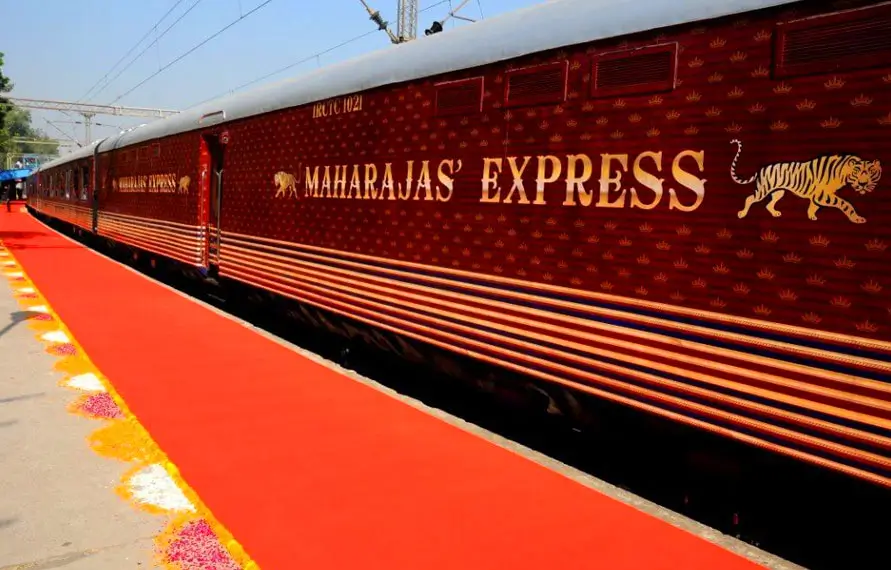
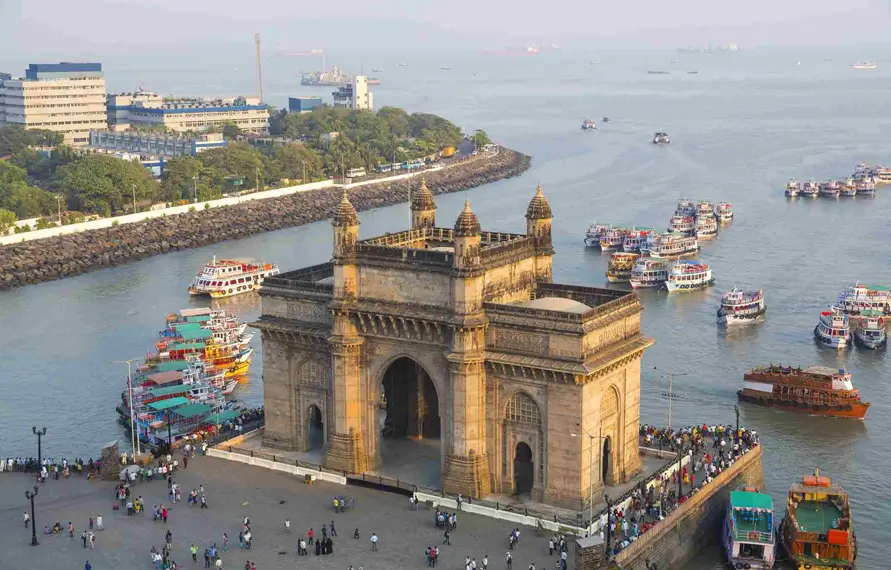
Mumbai's Gateway of India faces the sea, and on a Sunday morning a short drive from it a small group of travelers gathers to begin one of the great rail journeys of Asia. The Maharajas Express Heritage of India with Varanasi follows the train north from the Arabian Sea through Udaipur, Jodhpur, Bikaner, Jaipur, Ranthambore and Agra, arriving in Delhi after six nights. Rather than ending there, the trip continues by air to Varanasi, the sacred city on the Ganges, for two nights that add a spiritual, deeply human counterpoint to a week of royal palaces and forts.
The direction of travel matters. Starting in Mumbai means the journey builds steadily toward its most famous sight, the Taj Mahal at sunrise, saved for the final morning on board. Along the way you cruise Lake Pichola in Udaipur, climb the ramparts of Mehrangarh in Jodhpur, ride camel carts to a desert sundowner near Bikaner, lunch at Rambagh Palace in Jaipur and search for tigers in Ranthambore. Varanasi then gives you something the train cannot: time to sit on a boat at dawn and watch an ancient city wake up along its river.
The Maharajas' Express, operated by IRCTC, carries guests in Deluxe Cabins, Junior Suites, Suites and a carriage-sized Presidential Suite, each with a private bathroom and butler service, and its shelf of World Travel Awards includes several wins as the globe's top luxury train. Separately from the railway, Top Indian Holidays, a Jaipur-born company with Ministry of Tourism approval and more than two decades in private travel, looks after your Mumbai arrival, the flights onward from Delhi, a riverside hotel in Varanasi and private guides for every off-train day. Departures run on selected Sundays from October to April, when northern and western India enjoy their driest and most comfortable weather.
Your flight lands at Mumbai's Chhatrapati Shivaji Maharaj International Airport, and a member of our team meets you just outside the arrivals hall with a name board. Allow 45 to 90 minutes for the run into South Mumbai and your luxury hotel, depending on the hour, and crosses the Bandra Worli Sea Link, a cable-stayed bridge that sweeps over the bay with views of the city skyline. Early check-in is arranged for overnight arrivals so that you can sleep before the train departs the following morning.
Mumbai is India's financial capital and its film capital, and the southern tip of the city has the best of its colonial architecture. If you have energy in the afternoon, take a gentle walk around the Gateway of India, the basalt arch built to welcome a British royal visit in the early twentieth century, and look across the harbor at the fishing boats and ferries bound for Elephanta Island. The Colaba Causeway behind it is lined with small shops selling books, silver and handicrafts. Mumbai is humid all year, with winter temperatures around 30 degrees Celsius in the afternoon.
As the sun sets, stroll along Marine Drive, the curved seafront promenade where families gather to watch the light fade over the Arabian Sea. Mumbai's restaurants are excellent, and the city is famous for coastal seafood, especially butter garlic crab and crisp fried pomfret. Our team calls in the evening to confirm the arrangements for the next morning: train registration takes place at a central Mumbai hotel, and our driver will take you there with your luggage at the agreed time. Pack a small day bag with medication, a charger and a jacket for the cooler north.
The morning starts with registration for the Maharajas Express Heritage of India at a grand hotel in Colaba, where the train's guest relations team checks your passport and tickets and collects your luggage. Guests are then taken by coach to Chhatrapati Shivaji Maharaj Terminus. This railway station, a UNESCO World Heritage Site, is a masterpiece of Victorian Gothic design with stone gargoyles, domes and stained glass, and it deserves a few minutes of admiration before you step onto the platform, where music and a welcome drink await.
The train leaves Mumbai in the late morning and works north through the suburbs and into the green countryside of Maharashtra and southern Gujarat. Lunch is served as rice paddies, banana groves and small market towns slide past the windows, with the Sahyadri hills visible in the distance on clear days. Your butler helps you unpack and explains the daily routine, including the morning tea service and the system for booking spa treatments on board. The cabin's large windows make this a lovely day for watching rural India.
In the afternoon the train manager briefs guests in the lounge car on each stop: the timing of excursions, what to wear at religious sites and which afternoons are free for optional activities. This is the right moment to request extras such as a private guide in Jaipur or a spa session. Dinner is served in one of the two restaurants, where the menu alternates between regional Indian dishes and continental cooking. The train passes through Ahmedabad in the evening and continues overnight toward the hills of southern Rajasthan.
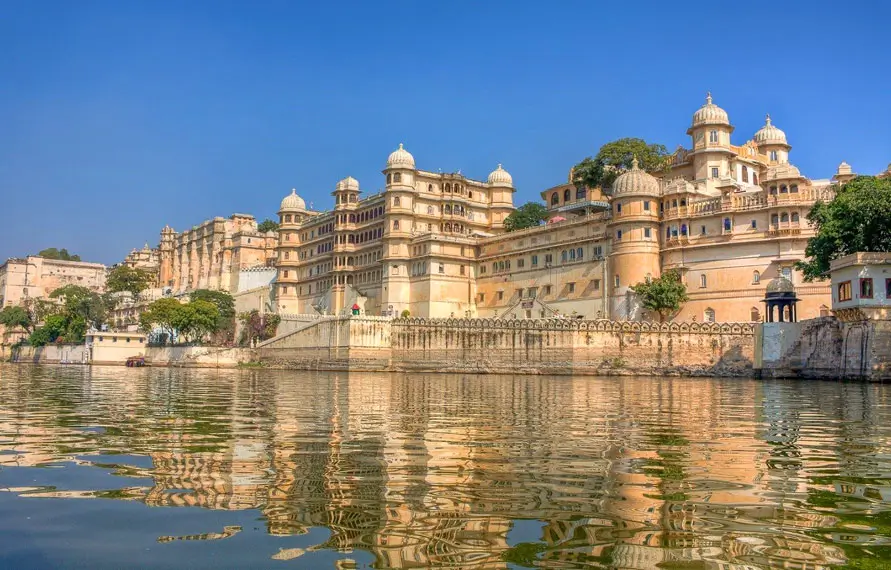
You wake among the green Aravalli hills, and after breakfast on board the train arrives in Udaipur, often described as the most romantic city in India. A coach brings you down to the jetty on Lake Pichola, where launches wait for a cruise. Gliding across the water, you pass the white Lake Palace on its island, the bathing steps of the old town and the island palace of Jag Mandir with its row of stone elephants. Gentle morning light suits pictures of the City Palace, whose long front climbs above the lake's eastern edge.
Back on land, your guide takes you inside the City Palace of Udaipur, a royal compound bigger than any other in the state that successive Mewar rulers enlarged across three centuries. It is a maze of narrow staircases, courtyards and halls decorated with mirrors, colored glass and mosaics. The Peacock Courtyard is particularly famous for its glass birds in deep blue and green. You also visit the Crystal Gallery and the Durbar Hall, where an audio guide explains the collection of crystal furniture ordered from England by a nineteenth-century ruler.
Your midday meal is laid in Satkar Hall at the Fateh Prakash Palace, its windows framing the water. The afternoon is free to relax on the train or choose an optional activity, such as a visit to the gardens of Saheliyon Ki Bari, a shopping trip for miniature paintings, or a spa treatment. Udaipur's old town is known for its painters, who still produce fine works with brushes made from squirrel hair. The train departs in the evening, and dinner is served on board as you travel north-west through the night toward Jodhpur.
Breakfast is unhurried this morning, and the train arrives in Jodhpur in the middle of the morning. Lunch is served on board before the afternoon tour. Jodhpur sits on the edge of the Thar Desert, and its old city is famous for the indigo-blue walls of its houses, which glow in the sunlight below the fort. Wear comfortable shoes and sunglasses, as the light is bright and the lanes are steep, and carry a scarf for the afternoon breeze on the ramparts. A light jacket helps too.
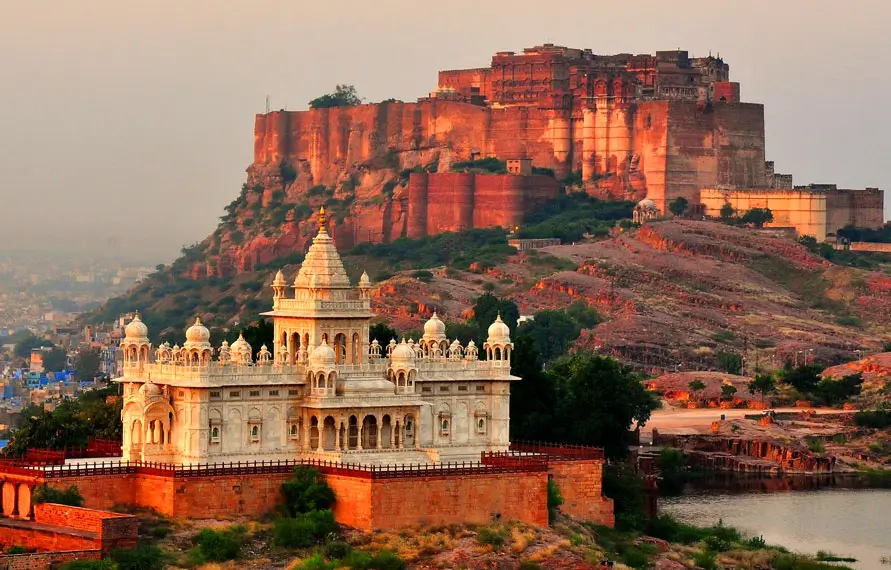
Your guide takes you up to Mehrangarh Fort, one of the largest forts in India, rising from a cliff high above the city. A lift carries you to the upper palace, and from there you walk down through the royal apartments and the museum. Highlights include the Pearl Palace, the Flower Palace with its gilded ceilings, and a remarkable collection of royal cradles, elephant saddles, paintings and weapons. Musicians often play at the gates. The views across the blue roofs toward the distant desert are spectacular, especially in the late afternoon.
You then descend to the old Clock Tower market, where your guide leads you through the lanes past stalls selling spices, textiles, silver jewelry and colorful turbans. A few guests like to cover a stretch of the route in one of the city's small motorized three-wheel taxis. Come evening, an invitation awaits to cocktails and dinner at a Rajput palace venue, such as Khaas Bagh or Hanwant Mahal, with views toward Umaid Bhawan Palace. The night is lit by lanterns and torches, with folk music and Marwari cooking. You return to the train for the night.
The train arrives in Bikaner after breakfast, and the morning is yours to rest on board or join an optional activity. Bikaner was founded in the late fifteenth century by a Rathore prince and grew rich on the camel caravan trade that crossed the Thar. It has kept much of its traditional character, with fewer visitors than the other cities on the route. Lunch is served on board before your afternoon visits, and it is a good idea to apply sunscreen, since the desert sun is strong at midday.
After lunch you visit Junagarh Fort, a massive fortress built on the plain, with a moat and walls more than 980 meters long. It was never captured, and its interiors are remarkably well preserved. Highlights include the Anup Mahal, with its gold leaf and red lacquer decoration, and the Badal Mahal, painted with blue clouds and falling rain. Your guide also leads you through the old city to see the merchants' mansions, whose red sandstone facades are carved with flowers, birds and elaborate balconies, and decorated with painted walls inside.
In the late afternoon, a convoy of camel carts carries you into the dunes, accompanied by drummers and musicians. A sunset drink is served on the sand as the sky turns gold and violet over the desert. After dark, an open-air barbecue is laid out under the stars, with folk singers and dancers performing around a fire. Temperatures drop quickly in winter after sunset, so bring a warm jacket and a scarf. You return to the train by about 21:00 for the overnight journey to Jaipur.
The train arrives in Jaipur at breakfast time, and guests are welcomed on the platform with music and garlands. Jaipur, the capital of Rajasthan, was founded in the early eighteenth century and laid out on a grid, with its old city painted in a distinctive shade of terracotta pink. The coach drives you out to Amber Fort, the former royal capital, about 30 minutes north of the city center along a road lined with old walls and watchtowers, passing the lake palace of Jal Mahal on the way. Morning is the coolest and quietest time to arrive.
Jeeps handle the steep climb at Amber, dropping you in the great main courtyard. From there your guide moves through the public audience hall, the victory hall and finally the Mirror Palace, its walls and ceiling set with tiny pieces of convex glass. When candles are lit, the whole room sparkles like a starry night. Look out for the carved marble panels of flowers and the screened windows from which royal women watched life in the courtyards. Optional visits include an ancient stepwell nearby or the Anokhi Museum of Hand Printing.
Lunch is served at Rambagh Palace, a former royal residence surrounded by manicured gardens, peacocks and colonnaded verandas. In the afternoon you can relax at the hotel or continue sightseeing in the city with an optional tour of the City Palace, Hawa Mahal and Jantar Mantar. Shopping is excellent in Jaipur, especially for gemstones, block-printed textiles, blue pottery and hand-knotted carpets. You return to the train for dinner in the evening as it leaves for Sawai Madhopur, the station for Ranthambore National Park, about two hours to the south-east.
Your butler wakes you early with tea and toast, and you head out on a morning game drive in Ranthambore National Park. The drive lasts about three and a half hours, starting at around 06:30 in October and from February, and around 07:00 between November and January. Mornings in winter can be cold, so wear warm layers, gloves and a hat. You travel in an open vehicle with a naturalist who knows the park well and tracks animals by their calls and paw prints in the sandy tracks.
Ranthambore is one of the best places in India to see Bengal tigers in the wild, though sightings are never guaranteed. The park is a beautiful mix of dry forest, grassy meadows, lakes and rocky ridges, and the ruins of a medieval fort crown the hills. Even when the tigers hide, there is plenty to see: large brown deer, spotted deer, wild boar, gray monkeys, crocodiles, and hundreds of bird species, including eagles, owls and kingfishers. Return to the train for a hearty breakfast after the drive.
The train then heads east toward Fatehpur Sikri, which Akbar raised in red sandstone toward the end of the sixteenth century as his capital, only for the court to leave it within a few decades. After lunch on board, your guide leads you through the palaces, audience halls and courtyards, and into the great mosque with its towering gateway. The marble tomb of the Sufi saint Salim Chishti is a place of pilgrimage, where visitors tie threads to the screens while making a wish. The train pulls into Agra around dinnertime, and the evening meal is enjoyed on board.
The final morning on the train begins very early, with a coach waiting to take you to the Taj Mahal in time for the first entry at sunrise. As the sky lightens, the white marble shifts through shades of gray, pink and gold, and the reflecting pools catch the dome in perfect symmetry. Your guide tells how a grieving Shah Jahan raised the tomb for his wife Mumtaz Mahal and shows you the inlaid semiprecious stones and the calligraphy. After the visit, a celebratory breakfast is served with a view of the monument.
You return to the train for the journey of around four hours to Delhi, with lunch served on board. On arrival at Delhi Safdarjung station in the afternoon, a driver from our office is standing by the carriage to load your bags, and the car heads directly to Indira Gandhi International Airport, typically a 30 to 45 minute run, for an evening flight to Varanasi. The flight takes about an hour and a half, and the domestic terminal has good lounges if you have time to wait. Our team checks your flight status during the train journey.
On arrival at Varanasi airport, our driver meets you for the transfer to your hotel, which takes about an hour. We recommend a heritage hotel on the riverfront or a luxury property in the quieter cantonment area, depending on your preference for atmosphere or space. Check in, have a light dinner and get an early night, since the next morning begins before sunrise. Varanasi winter nights are cool, about 8 to 10 degrees Celsius, so keep a warm layer ready for the early boat ride.
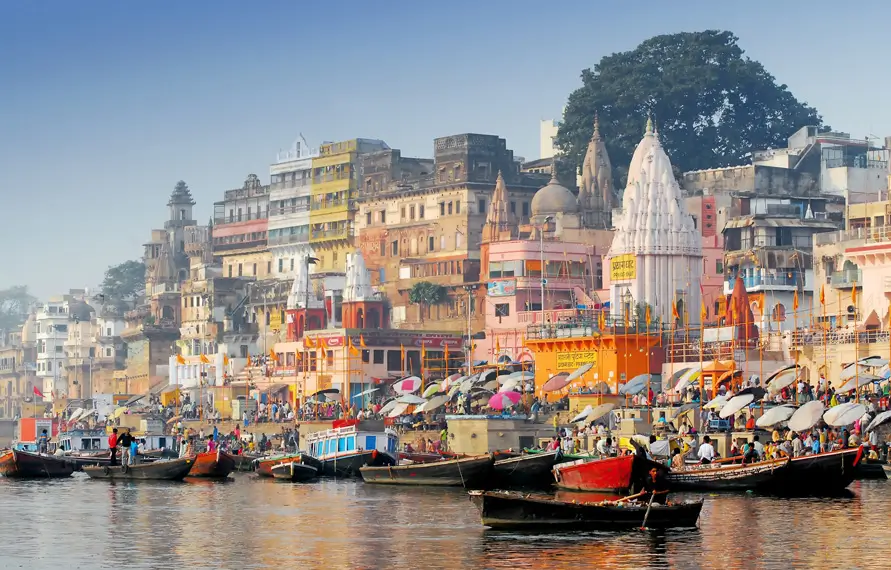
Your private guide meets you at about 05:30 for a short walk to the riverfront, where a rowing boat waits. As the sun rises over the far bank of the Ganges in Varanasi, the city comes to life: pilgrims bathe and pray on the stone steps, priests sit under umbrellas, laundry workers beat clothes on flat stones and yoga groups stretch in the morning air. The boat drifts past palaces, temples and the cremation grounds, where fires burn day and night. Photography of the cremations is not allowed out of respect.
After the boat ride, your guide leads you on foot through the old city's maze of narrow lanes, past small shrines, sweet shops and houses that have stood for centuries. You stop near the Kashi Vishwanath Temple, one of the holiest in India, though non-Hindus may face restrictions on entering. The walk ends with a cup of hot tea and the famous local sweets before you return to the hotel for breakfast and a rest. Wear comfortable closed shoes, as the lanes can be crowded and uneven.
In the afternoon you drive to Sarnath, about 10 kilometers from the city, where the Buddha gave his first sermon after his enlightenment. The site includes the large Dhamek Stupa, the ruins of ancient monasteries and a museum that holds the lion capital of Ashoka, the emblem of modern India. In the early evening, you return to the riverfront to watch the evening fire ceremony, which begins at about 18:00 in winter, from a reserved spot on the steps or from a boat on the water.
After a leisurely breakfast, there is time for a last walk along the river or a visit to a silk weaving workshop, where you can see artisans creating the famous Varanasi brocades on traditional looms. Many visitors buy silk scarves or stoles as gifts, and larger pieces can be shipped home with full tracking. Our driver then collects you for the transfer to Varanasi airport and your flight to Delhi, which takes about an hour and a half. Our Delhi driver meets you on arrival at the domestic terminal.
Depending on your flight time, the afternoon can include a private tour of New Delhi with our guide. Visit Humayun's Tomb, the garden tomb that inspired the Taj Mahal, set in formal gardens with fountains and channels. Then drive past India Gate and the government buildings designed by the British in the early twentieth century, and stop at Gurudwara Bangla Sahib, the Sikh temple where volunteers serve free meals to thousands of visitors every day. Cover your head and remove your shoes before entering; scarves are provided.
Check in to your luxury hotel in Delhi for the night. Enjoy a farewell dinner at one of the city's excellent restaurants, many of which specialize in the rich, slow-cooked Mughal dishes of northern India, from grilled skewers to creamy black lentils. Delhi is also a good place for last-minute shopping, especially at Khan Market or Dilli Haat. Our team will confirm your airport transfer time for the following day. Pack your bags, keeping your passport and documents handy for the departure, along with any shipping receipts for purchases.
Enjoy a relaxed breakfast at the hotel. If your flight leaves later in the day, the morning is free for a final walk, a swim or a little more shopping. Hotels usually ask guests to check out by around 12:00, and late check-out can be requested, depending on availability. If you have a late-night flight, we can arrange a day room so that you can rest and freshen up before heading to the airport. Our team can also suggest a final lunch spot near your hotel, so the last hours of the trip remain relaxed rather than rushed.
At the time fixed the day before, your car arrives for the run to Indira Gandhi International Airport, a drive of 30 to 60 minutes depending on traffic. For international departures, we recommend arriving at least three hours before your flight, as security checks and immigration queues can be long during the busy winter season. Remember that you need a printed or digital copy of your ticket to enter the terminal building, as guards check documents at the door. Keep your passport and e-Visa printout together for immigration.
Over eleven days you will have crossed India from the Arabian Sea to the sacred Ganges, by luxury train, car and plane. Top Indian Holidays, the Ministry of Tourism approved team in Jaipur that put this trip together, is on hand for anything you need until you board your flight home, and we welcome your feedback afterward. Many guests return to see Kerala's backwaters, the mountains of Ladakh or the temples of South India, and we would be delighted to help with a second journey around your interests and the best season for each region.
Fill out this form with all the required information. Within 12 hours, we will provide you with a tailor-made itinerary at the best price.
Read the reviews of our esteemed client's, go through the experiences they had with Top Indian Holidays.

Whether you're planning your first India trip or returning to explore deeper — get honest, expert advice from someone who knows every corner of this country. No pressure, no cost.



 info@topindianholidays.net
 +91-8955000999