07 Nights / 08 Days Fully Guided Tours Private Car
Bengaluru - Bandipur - Mysuru - Hampi - Bengaluru - Goa
Karnataka holds some of the most varied country in southern India within a single day's train ride: elephant forest in the south, a palace city on the Mysore plateau and a field of granite boulders in the north where an empire once stood. The Golden Chariot Glimpses of Karnataka with Goa combines that short rail loop with three unhurried nights on the coast, so the trip ends with sea air and long lunches rather than another early start. It suits couples and friends who want a taste of luxury rail travel without committing to a full week on board.
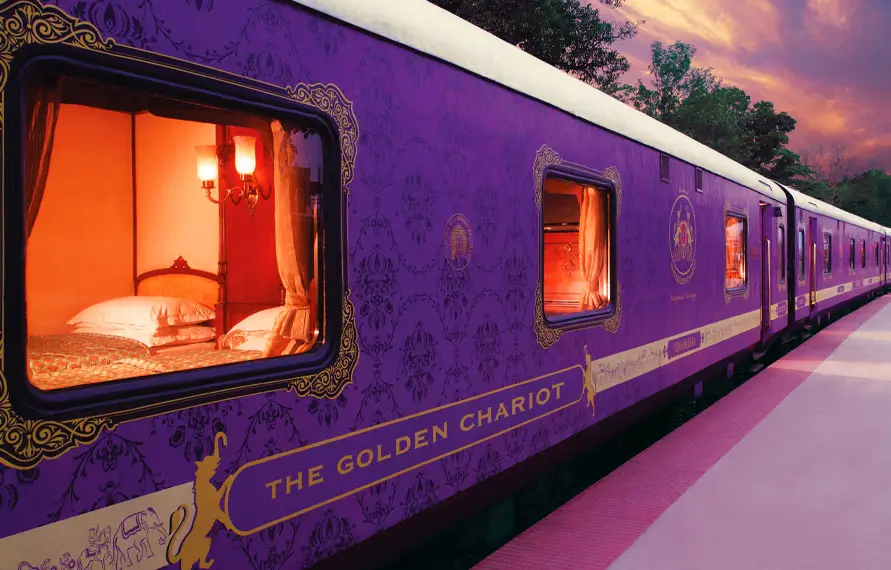
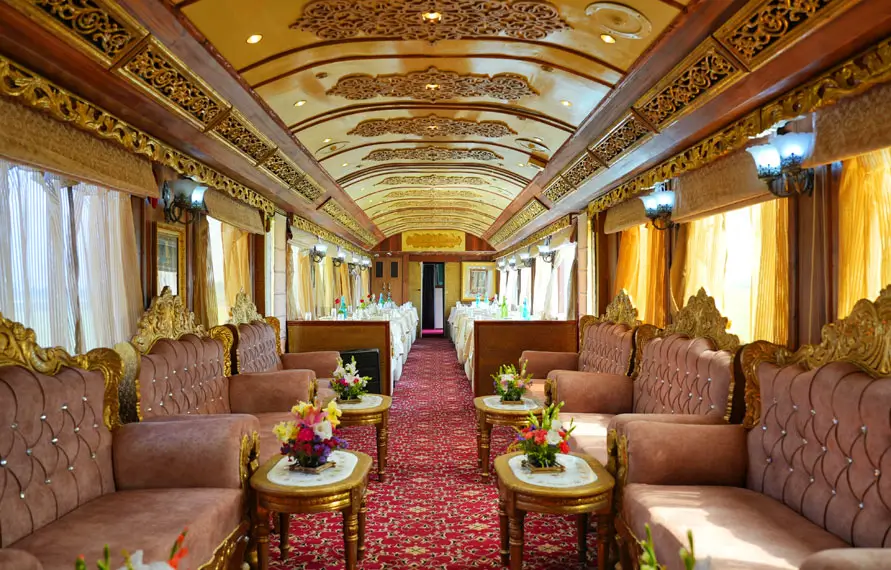
The trip opens with a night in Bengaluru, giving you time to recover from a long-haul flight and see a little of the garden city before boarding. The Golden Chariot, operated by IRCTC, then carries you for three nights to Bandipur National Park, Mysuru and Hampi, a UNESCO World Heritage Site. For 2026-27 the train has new interiors, smart TVs, Wi-Fi, CCTV and an Arogya spa for Ayurvedic treatments, while its 40 cabins keep the guest list to 80 at most. Meals rotate between two restaurants, Ruchi and Nalpaka, with Karnataka specialties alongside continental dishes, and a lounge bar for evenings.
On the afternoon the train returns to Bengaluru, you take a short flight west to Goa, the former Portuguese territory on the Arabian Sea. Three nights at a luxury beach resort leave room for the baroque churches of Old Goa, the painted lanes of Panaji, a shaded spice farm and as much time by the water as you like. Your cabin, hotels, flight and all road transfers are put together by Top Indian Holidays, a Jaipur-based independent operator recognized by India's Ministry of Tourism, which also adjusts the Bengaluru and Goa days to match the train's published schedule once you choose a departure.
Kempegowda International Airport sits roughly 35 kilometers north of central Bengaluru, and a member of our team is waiting for you as you walk out of the terminal. International arrivals often land in the early morning, so an early check-in can be booked in advance if you want to sleep straight away. The drive into town takes about an hour, along a fast raised highway and then through busy avenues lined with rain trees. Your luxury hotel is chosen for its quiet garden and its easy reach to Yeshwantpur station, where the train departs tomorrow.
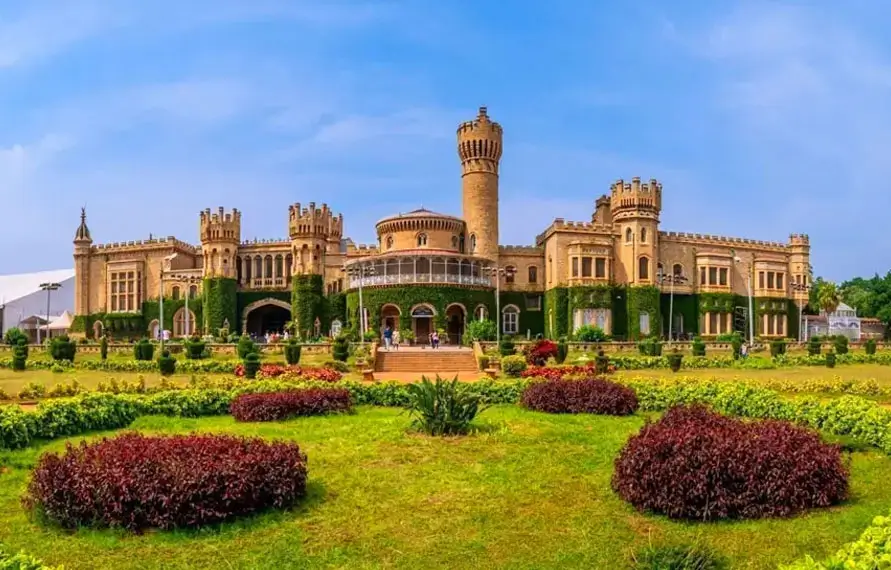
Once rested, a private car and English-speaking guide are available for a gentle afternoon in the city. Start in Cubbon Park, a 300 acre green space in the center, then pass the Vidhana Soudha, the grand granite seat of the state legislature, built after independence in a neo-Dravidian style. Bangalore Palace, a Tudor-style residence with turrets and battlements modeled loosely on Windsor Castle, has an audio tour and a fine collection of royal photographs. It makes a curious contrast with the palace you will see in Mysuru.
Bengaluru is the technology capital of India and one of its liveliest dining cities, with craft breweries, South Indian breakfast houses and contemporary restaurants. Ask your guide for a table at a place serving crisp rice and lentil crepes with coconut relish if you want to try the local classic. At around 900 meters above sea level, the city is pleasantly mild, with winter days near 27 degrees Celsius and cool nights. Pack your day bag tonight for the train: walking shoes, sunscreen, a cap and a warm layer for the open safari vehicle.
The driver drops you at Yeshwantpur station by about 08:30. A traditional welcome on the platform, with music and flower garlands, marks the start of the Golden Chariot Glimpses of Karnataka. While staff collect your passports for registration and take bags to the cabins, you are offered a welcome drink in the lounge. Departure is at about 09:45. The cabin is compact but well thought out, with wardrobe space, a safe, an en-suite shower and a large window for the morning scenery of coconut groves and red earth.
After lunch on board, the train stops at Nanjangud at about 13:30. A coach then takes you roughly 50 kilometers south to Bandipur National Park, the drive taking around an hour and a half. Bandipur forms part of the Nilgiri Biosphere Reserve together with Mudumalai, Wayanad and Nagarhole, a continuous belt of forest that supports one of the largest wild Asian elephant populations in the world. That connection is what makes this park special, because animals move freely across state borders, and elephants are the animal most guests remember long after the trip.
The evening game drive runs from about 16:30 to 18:30. Teak and bamboo dominate the forest, and the naturalist listens for the alarm barks of spotted deer that can signal a leopard or tiger nearby. Even without a big cat, you are likely to see Indian bison, large brown deer, peacocks and perhaps a crested serpent eagle on a dead branch. Bring a long lens if you have one, since vehicles must stay on the tracks. You return to the train at about 20:15, dinner is served in Nalpaka, and the train runs on to Mysuru.
Breakfast on board, then a short coach ride from Mysuru station to the palace. Mysuru Palace was rebuilt for the ruling princes of the Wadiyar dynasty in the early twentieth century, after the earlier timber palace burned, and is one of the most visited buildings in India. Your guide explains how the design blends domes from Islamic architecture, Hindu temple motifs and Gothic stained glass. Look for the carved rosewood doors inlaid with ivory, the cast iron pillars made in Scotland and the colorful mosaic floors, then step back outside to see the whole facade framed by its broad lawns.
The Kalyana Mantapa, or wedding hall, is the most photographed room, though photography indoors is restricted. Its octagonal skylight and peacock-patterned glass create a soft, colored light by mid-morning. Long galleries hold paintings of the Dasara procession, the great autumn festival that still fills Mysuru with decorated elephants every year. Shoes are left at a counter by the entrance, and the floors can be cool, so socks are a good idea. Allow plenty of time to look at the oil portraits of the royal family on the upper floor.
Lunch is back on the train. In the afternoon, an optional coach trip goes to Srirangapatna, the island stronghold in the Kaveri River where Tipu Sultan fought the British. His summer palace, Daria Daulat Bagh, is built of teak and covered with painted murals of battles and court life. Guests who stay in Mysuru can shop for pure silk, sandalwood soap and rosewood inlay at the government emporium, where quality is reliable. Return to the train by 20:00 for dinner as it sets off north for the long overnight run to Hospet.
You arrive in Hospet after breakfast, and the coach covers the short distance to Hampi in about half an hour. The site was Vijayanagara, a name meaning city of victory, and in its peak in the fifteenth and sixteenth centuries it was among the largest cities in the world, visited by Persian and Portuguese traders who described its markets of precious stones. Today the ruins lie scattered across a surreal landscape of granite boulders balanced on one another, with the Tungabhadra River curling through and coracles, round woven boats, still ferrying villagers across.
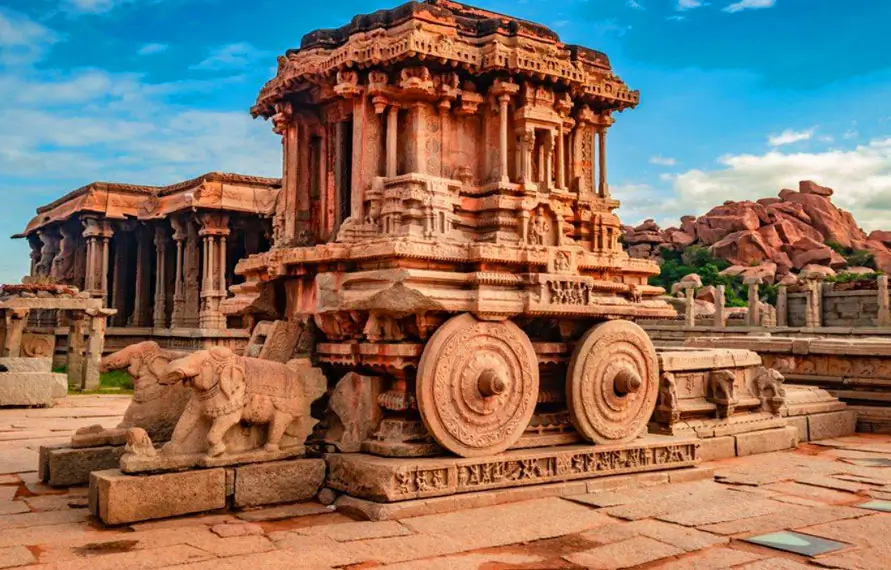
Your guide begins at Virupaksha Temple, still in active worship, with a tall white gateway tower visible from far away. Inside, a small opening in a wall projects an inverted image of the tower onto the stone, a natural pinhole camera that delights children and photographers alike. From Hemakuta Hill nearby you get a wide view over the old market street and the boulder hills. The program continues to the Vittala Temple, where the famous stone chariot stands in the courtyard, and to the royal quarter with its Lotus Mahal and Elephant Stables.
Midday in Hampi is warm, even in December, so lunch and a rest back on the train are welcome. The optional afternoon outing crosses the river toward Anegundi, an older village with stone houses and a small craft cooperative making banana fiber bags and baskets. As the light softens, the group gathers on the riverbank to watch the sunset turn the boulders pink and orange. Dinner is the last of the train journey, and you may want to thank the cabin staff tonight. The Golden Chariot leaves overnight for Bengaluru.
Breakfast is served on board while the train runs south, and it pulls into Yeshwantpur station at about 11:00. Settle any spa or bar bills before arrival. Our driver waits on the platform, loads your luggage and drives you straight to the airport, about 45 minutes away. The afternoon flight to Goa takes around an hour and a quarter, short enough that you are on the coast for a late lunch or an early sunset depending on the schedule we confirm. Domestic checked luggage is usually limited to about 15 kilograms, so tell us in advance if you need more.
Goa has two airports, Dabolim in the south and Manohar International at Mopa in the north, and we book the one closest to your resort. The landscape changes the moment you land: red laterite soil, coconut palms, whitewashed churches and old Portuguese-style houses painted ocher, blue and green. Goa was ruled by Portugal for around four and a half centuries, until the early 1960s, and that history shows in its architecture, its food and the easy pace of daily life, where shops still close for a long siesta after lunch.
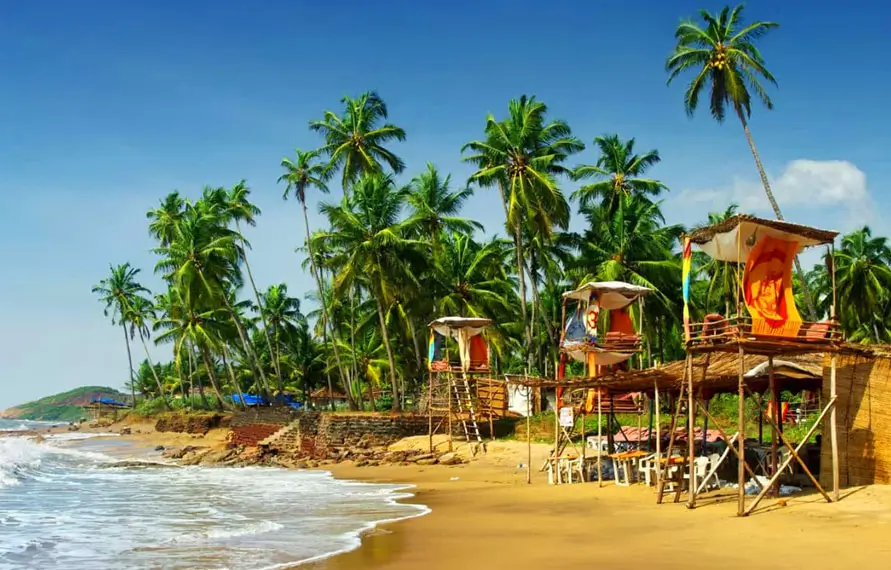
Your resort for three nights is a luxury beachfront property with a pool and direct access to the sand. Spend the rest of the day settling in and walking along the shore at dusk, when fishermen haul in their nets and the sky turns red over the Arabian Sea. Winter in Goa is dry and warm, about 32 degrees Celsius by day and 20 degrees at night, with calm seas. For dinner, try fish in a spiced coconut sauce with rice or a spicy prawn dish at the resort, where kitchens keep the heat to your taste.
Around 09:00 your guide and driver head upriver to Old Goa, the seat of Portuguese rule in Asia for centuries and, by some accounts, a city that once matched Lisbon for population. Little of that city survives apart from its grand churches, which stand on open lawns near the Mandovi River and form a UNESCO World Heritage Site. Saint Francis Xavier's remains rest in a silver reliquary inside the Basilica of Bom Jesus, while the vast Se Cathedral nearby, among Asia's biggest churches, is known for its Golden Bell. Dress modestly, with covered shoulders and knees.
Late morning, drive to Panaji, the small capital city, to stroll around Fontainhas, the historic Latin district, where slender streets are flanked by homes washed in ocher, cobalt and oxblood, with tiled roofs, wooden balconies and blue and white tiles naming each street. A small bakery or two still sells Portuguese-style bread rolls, and art galleries occupy several old homes. Above the central square rises the bright white facade of the Church of Our Lady of the Immaculate Conception, reached by a criss-crossing flight of steps and lovely in the late morning sun.
Lunch can be at a Goan restaurant serving a tangy pork stew slow-cooked with vinegar and garlic, green-herb chicken or fish in a coconut-rich spiced sauce, followed by a rich layered coconut cake. Afterwards your driver takes you back to the resort, roughly 45 minutes to an hour depending on its location. The evening is free. Many guests take a sunset river cruise on the Mandovi from Panaji, with live music and folk dancing on deck, which can be added to this day. Others prefer a cocktail by the pool, the sound of the waves and an early night.
After breakfast, a short drive inland to Ponda brings you to a spice plantation in the hills, where the shade of tall betel-nut palms covers pepper vines climbing their trunks, cardamom, nutmeg, cinnamon and vanilla. A guide walks you through the farm, crushing leaves for you to smell and explaining how each spice is grown and dried. The visit usually ends with a simple buffet lunch served on banana leaves. The temples of Ponda, including Shri Mangueshi with its tall lamp tower, can be added on the way.
If you prefer the coast, the morning can be spent instead at Fort Aguada, a seventeenth century Portuguese fort with a lighthouse at the mouth of the Mandovi River, or at Chapora Fort, whose ruined walls look down on Vagator beach. Both offer sweeping views across the sea. Weekday mornings are quiet, and the light is clearer before the afternoon haze. Your driver stays with you throughout and can stop at small cashew shops, as Goa is famous for its cashew nuts, sold plain, salted, roasted with pepper or coated in chili.
The afternoon is completely free. Book a massage at the resort spa, swim in the pool or walk the beach as the tide goes out. Dolphin trips leave from several beaches in the late afternoon, and our team can reserve a private boat if you would like one. Tonight is your last evening in India, so consider dinner at a beach shack with your feet in the sand and grilled fish on the table, or a quieter candlelit meal at one of the resort's restaurants.
Take your last breakfast with the ocean in view, and fit in one more swim if the clock allows. Checkout at most resorts is around 11:00 or 12:00, and a late checkout can be requested if your flight is in the evening. Our driver collects you at the agreed time and takes you to Dabolim or Mopa airport for your onward connection, which for most international travelers runs through Mumbai, Delhi or a Gulf hub such as Dubai or Doha. The drive can take anywhere from 30 minutes to an hour and a half, depending on where your resort sits along the coast and which airport your flight uses, so we time the pickup with a comfortable margin.
Allow about three hours before an international departure and two hours for a domestic one. Goa's airports are small and easy to handle, but security lines can build up in the afternoon during the winter high season. Make sure any liquids bought locally, such as cashew liqueur or bottled spices, are packed in your checked luggage. The driver helps with your bags to the terminal entrance, where only passengers with tickets may enter. Keep a printed or digital copy of your e-Visa and onward ticket handy, as the guards at the door check both before letting you in.
Over eight days you have moved from the green avenues of Bengaluru to the elephant forest of Bandipur, the royal city of Mysuru, the boulder fields of Hampi and the palm-fringed coast of Goa. Top Indian Holidays, whose Jaipur office has been in business since the late nineties, stays on call 24 hours a day until you board your flight, and we are always happy to hear how the trip went. If you would like to return to India, the Maharajas' Express in the north or a Kerala backwater cruise would be a natural next chapter.
Fill out this form with all the required information. Within 12 hours, we will provide you with a tailor-made itinerary at the best price.
Read the reviews of our esteemed client's, go through the experiences they had with Top Indian Holidays.

Whether you're planning your first India trip or returning to explore deeper — get honest, expert advice from someone who knows every corner of this country. No pressure, no cost.



 info@topindianholidays.net
 +91-8955000999