12 Nights / 13 Days Fully Guided Tours Private Car
Delhi - Agra - Ranthambore - Udaipur - Jodhpur - Jaisalmer - Jaipur - Delhi - Kochi - Kumarakom - Kochi
Sand-colored ramparts in the Thar Desert and green coconut palms leaning over still water are about as far apart as two Indian landscapes can be, and the Deccan Odyssey Heritage Odyssey with Kerala brings them together in under two weeks. The first part is a seven-night luxury train loop from Delhi through Agra, Ranthambore, Udaipur, Jodhpur, Jaisalmer and Jaipur. The second is a flight south to the tropical coast of Kerala for two nights in historic Fort Kochi and two more on the shores of Vembanad Lake at Kumarakom.
The Heritage Odyssey is the most Rajasthan-focused of the Deccan Odyssey routes, and it is one of the few luxury trains to reach the golden city of Jaisalmer, deep in the desert near the Pakistan border. Along the way you see the Taj Mahal, look for tigers, cruise past the palaces of Udaipur and climb to Mehrangarh Fort above the blue houses of Jodhpur. By the time the train returns to Delhi, many travelers are ready for a gentler pace, and Kerala supplies it with backwater boat rides, Ayurvedic massage, spice markets and seafood cooked with coconut.
Maharashtra Tourism runs the Deccan Odyssey jointly with Indian Railways; on board you find en-suite cabins, two restaurant cars, a bar, a spa and a fitness room. Heritage Odyssey trains leave Delhi in 2026-27 on October 10, October 31, November 21, December 5, January 2, February 27 and April 17, and you arrive in the capital the evening before. Reservations for the cabin, the Delhi, Kochi and Kumarakom hotels, the southbound flight and every private driver and guide are made by Top Indian Holidays, a family-run independent operator in Jaipur with Ministry of Tourism approval and more than twenty-five years in the trade.
As you leave customs at Indira Gandhi International Airport, someone from our team holding a placard with your name steps forward, takes over the luggage and guides you to a chauffeured, air-conditioned car. Depending on the hour, the ride into central Delhi and your luxury hotel lasts 40 to 60 minutes. Long-haul flights often land late at night or very early, so we ask the hotel to hold your room for immediate check-in whenever we can. Your driver carries bottled water and can stop at an airport cash machine or a mobile phone counter on the way.
The rest of the day is unscheduled, which is deliberate after a long flight. If you feel like a short outing, Lodhi Garden is close to most central hotels and offers a peaceful hour among fifteenth-century tombs, flowering trees and local walkers. The Gandhi Smriti, the house where Mahatma Gandhi spent his last days, is nearby and gives a moving insight into modern India's story. From November to January, Delhi mornings can be foggy and evenings cool, so a jacket or shawl is useful after sunset.
Eat at the hotel tonight, or let us book you into one of Delhi's celebrated dining rooms for a first taste of North Indian cooking, from slow-cooked black lentils to clay-oven breads and smoky grilled skewers. Before you sleep, sort your luggage for the week ahead. The Deccan Odyssey cabins have good wardrobe space, but it helps to keep a small day bag ready for excursions, with sunscreen, a hat, a scarf, a refillable water bottle and comfortable shoes that slip on and off easily at temples.
With the train leaving in the afternoon or evening, the morning is set aside for a private guided tour of Delhi. Start at Humayun's Tomb, a sixteenth-century garden mausoleum of red sandstone and white marble that served as a model for the Taj Mahal, and then drive to Qutub Minar, a tall tower of fluted stone begun in the late twelfth century. Its courtyard holds an iron pillar that has stood for about sixteen centuries without rusting, a puzzle that still fascinates metallurgists today. Allow about an hour at each site.
After lunch, return to your hotel to rest and freshen up; a late check-out can be arranged. Our driver then takes you to the station for check-in, allowing generous time for Delhi's traffic, which can be slow in the late afternoon. At the platform the train staff welcome you with a drink, complete the registration and passport check, and carry your bags to your cabin. The Deccan Odyssey Heritage Odyssey then pulls out of the capital and heads south toward Agra, a run of only a few hours.
Your cabin attendant explains the controls for the lights and air conditioning, shows you the safe and wardrobe, and asks how you take your morning tea. Dinner is served in one of the restaurant cars, where the menu mixes Indian regional dishes with continental choices, and the kitchen is happy to cater for vegetarian or other dietary needs if you mention them early. After dinner, the bar car is a friendly place to meet fellow guests, though an early night is wise before the Taj Mahal visit.
The train reaches Agra overnight, and after breakfast on board your guide meets you on the platform for the visit to the Taj Mahal. The great white tomb stands at the end of a long garden of water channels and cypress trees, beside the Yamuna River. Morning visits are cooler and the light is softer on the marble. Keep to a small bag, since guards at the gate turn away snacks, tripods and bulky backpacks. The monument closes every Friday, so the train timetable brings you here on another day.
Your guide explains how about twenty thousand workers spent roughly twenty years building the tomb and its gardens, and points out the precious stone inlay, the four minarets, tilted a fraction away from the dome so that an earthquake would topple them clear of it, and the matching mosque and guesthouse on either side. Take time to walk the full length of the garden for different views. Shoe covers are provided on the marble platform, and photography is not allowed inside the tomb chamber itself. The guide also explains the calligraphy around the main arch, which grows larger toward the top so it reads evenly from below.
Afterward comes Agra Fort, the vast red sandstone stronghold where the Yamuna curves. Begun by the emperor Akbar and refined by his grandson Shah Jahan, it contains audience halls, mosques and marble royal apartments with views back toward the Taj Mahal. Back aboard for lunch, you have a free afternoon to rest, use the spa car or visit a marble inlay workshop where artisans still cut stones by hand. Dinner is served on board as the train heads west into Rajasthan toward Sawai Madhopur and the dry deciduous forests of Ranthambore.
Breakfast comes early as the train arrives at Sawai Madhopur, and soon you are in an open vehicle heading into Ranthambore National Park. Morning drives start at about 06:30 in October and from February onward, and at about 07:00 from November to January. Early starts in winter can be cold, around 6 to 9 degrees Celsius, so wear a warm hat, gloves and layers in neutral colors. Your naturalist knows the park intimately and reads tracks, scratch marks and alarm calls to decide where to go.
Formerly the shooting preserve of Jaipur's ruling princes, Ranthambore now offers some of the country's best odds of a tiger sighting in the wild. Lakes surrounded by banyan trees and ruined pavilions give the park a rare, almost romantic beauty, and the walls of Ranthambore Fort crown a ridge in the middle. Besides tigers, you may see leopards, sloth bears, spotted and large brown deer, crocodiles and many birds. Sightings can never be guaranteed, but every drive offers something worth watching, from kingfishers to wild boar.
Lunch is served on board, and in the afternoon a village safari takes you out among the farms and hamlets that surround the reserve. Families here grow wheat, mustard and millet, keep cattle and goats, and live in homes of mud and stone often painted with simple designs. You learn how villagers and the park coexist, and why tourism matters to the local economy. Remember to ask before photographing people. Dinner is served as the train travels south-west overnight toward Udaipur and the Aravalli hills.
The train pulls into Udaipur in the morning, and you head first to the City Palace, a vast complex of white and cream terraces built by the Mewar rulers over about four centuries. Climb through its narrow stairways and courtyards to the upper floors, where balconies look over Lake Pichola to the Lake Palace and Jagmandir islands. The Crystal Gallery displays a nineteenth century order of English cut glass that never left its crates for decades: sofas, chandeliers, dinner services and more, including a remarkable crystal bed, which is rare even by royal standards.
Lunch today is served off the train at a lakeside venue, with the palaces and hills reflected in the water as a backdrop. Udaipur's setting is the reason it is often called the most romantic city in Rajasthan, and lingering over a long meal with this view is part of the experience. In the warm middle of the day, sunglasses and a hat are useful, as the glare off the water can be strong even in the cooler months. Ask your guide which other hotels and palaces surround the lake.
In the afternoon, your guide leads a walk through the old city of Udaipur, where steep lanes wind past small temples, workshops and family-run shops. The Jagdish Temple, with its carved elephants and steep stone stairs, sits just above the palace. Udaipur is famous for miniature painting, and you may watch an artist working with very fine brushes and colors made from minerals and plants. Comfortable shoes are essential on the uneven streets. Dinner is served on board as the train heads west across the hills toward Jodhpur.
The train reaches Jodhpur in the morning, and the first sight of Mehrangarh Fort rising from a rock cliff about 120 meters above the city stays with you for years. The fort was founded in the fifteenth century by Rao Jodha, and its walls hold a series of palaces with delicate stone latticework, mirrored rooms and painted ceilings. The museum displays elephant seats, royal palanquins, weapons, textiles and miniature paintings, and the audio guide is one of the best in India. Give the fort roughly two and a half hours so that you can linger at the lookouts on the higher terraces.
From the ramparts, look down over the old city, where many houses are painted in shades of blue. Locals say the color keeps homes cool and deters insects, and it was once linked to the Brahmin priestly community. Walking the battlements on a clear winter morning is a pleasure, though the stone gets warm by midday, so start early. Your guide can point out the bullet and cannonball marks on the gateways, left from sieges by rival armies centuries ago. Small handprints carved beside one gate recall royal widows of the past, and your guide will explain their story with care.
Just beneath the ramparts is Jaswant Thada, a pale marble cenotaph raised toward the close of the nineteenth century to honor Maharaja Jaswant Singh II. Its thin marble walls glow when the sun shines through them, and the small garden and lake behind it offer a calm place to rest, with a fine view of the fort. Afterward, return to the train for lunch, and use the afternoon to rest or visit the spa car. Dinner is served on board as the train heads further west into the heart of the Thar Desert.
Breakfast is served on board as the train crosses a landscape of sand, scrub and wind-shaped dunes, with herds of camels and goats grazing near desert villages. By mid-morning you reach Jaisalmer, the golden sandstone city that Rawal Jaisal, a chief of the Bhati Rajputs, established in the twelfth century. Its fort sits on a long hill above the plain, and its walls glow golden in the sun. Remarkably, it is still a living fort, with several thousand people living inside its walls. Nearly a quarter of the old city's people still live and work within its ramparts.
Your guide leads you through the fort's narrow lanes to the main square and the Maharawal's palace, then to a cluster of Jain temples whose stone carving is as fine as lace. Below the fort, in the old town, the carved merchant mansions show the wealth of traders who once controlled caravan routes across the desert. Patwon Ki Haveli, actually a group of five connected mansions, has balconies and screens carved with extraordinary detail, and Nathmal Ji Ki Haveli was decorated by two brothers working on opposite sides.
The desert sun is strong even in winter, so a wide-brimmed hat, sunscreen and plenty of water are essential, while nights can be cold. If the program on your departure allows, ask your guide about the sunset over the dunes outside the city, when the sand turns orange and then purple. Jaisalmer is also a good place to buy embroidered textiles, mirror-work cushions and silver jewelry. Dinner is served on board as the train begins the long overnight run east across Rajasthan to Jaipur. Keep a warm layer for the evening.
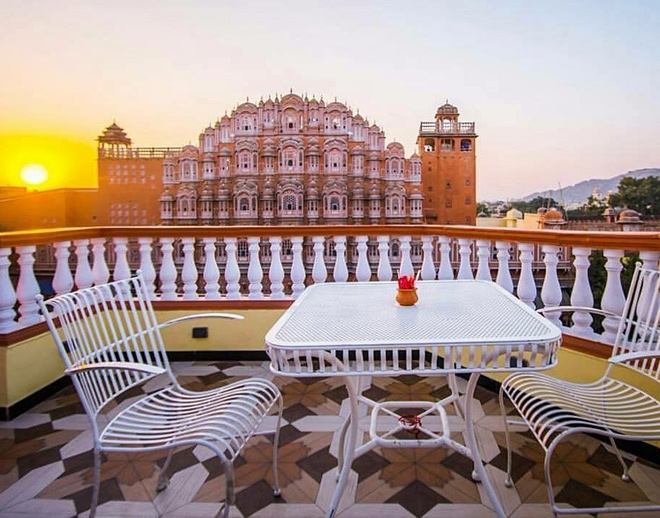
After breakfast on board, the coach takes you into the walled heart of Jaipur, laid out by Maharaja Sawai Jai Singh II early in the eighteenth century and only later washed in its famous pink. The Hawa Mahal, a five-story screen of small windows, was built so royal women could watch street processions unseen. Its finest view is from the rooftop cafes across the road, which open early. Your guide explains how the city's grid was laid out according to ancient Indian principles of architecture. Morning light is best for photographs here.
Next you visit the City Palace, where courtyards, gateways and halls hold the royal collection of costumes, weapons, carpets and miniature paintings. Look for the four colorful gateways in the inner courtyard, each representing a season, and the two giant silver urns once used to carry Ganges water on a royal journey to England. Part of the palace remains the home of the former ruling family, whose flag flies above it when the head of the family is in residence. The museum's textile gallery is especially fine, with royal robes in heavy silk and gold thread.
The afternoon is free for the old city markets, which are arranged by trade, with whole streets selling bangles, textiles, brass or spices. Jaipur is famous for gemstones, block-printed cotton, blue pottery and silver jewelry, and our team can suggest trusted workshops with international shipping. Alternatively, rest on board or book a massage. The farewell dinner on the Deccan Odyssey is a warm occasion, with thanks to the crew and stories shared between guests. Pack most of your luggage tonight, as tomorrow begins with an early arrival.
Breakfast is served on board as the train runs into Delhi in the morning, ending the rail part of your trip. A driver is waiting at your carriage door to run you directly to the domestic terminal at Indira Gandhi International Airport for your flight to Kochi, which takes around three hours. Our team chooses a flight with a comfortable margin in case the train runs late, and we can arrange a hotel day room if there is a long wait. Keep a light layer handy, as aircraft cabins are cool.
The change on landing is striking: Kochi is warm and humid, with temperatures around 30 to 32 degrees Celsius in the day and green palm trees everywhere. Your driver meets you at the airport and drives you about an hour to Fort Kochi, the historic peninsula at the mouth of the harbor, where your hotel is a heritage property or boutique luxury hotel in the old quarter. Light cotton or linen clothing is ideal from here on, with a long-sleeved layer for temples and evenings.
After checking in, take a gentle stroll along the waterfront at sunset to see the Chinese fishing nets, giant cantilevered frames of teak and bamboo that fishermen raise and lower into the sea using counterweights of stone. Most historians credit their arrival to merchants sent by Kublai Khan, centuries before the Portuguese came. Fish stalls nearby will cook the catch you choose at small restaurants, or you can dine at your hotel, where Kerala seafood cooked with coconut, fragrant leaves and tamarind is the specialty. It is a gentle first evening by the sea.
After breakfast, your guide leads a walking tour of Fort Kochi, where Portuguese, Dutch and British traders left their marks over five centuries. Stop at St Francis Church, India's earliest European-built church, whose floor briefly held the grave of Vasco da Gama, and the Santa Cruz Basilica with its painted interior. Shaded streets lined with old warehouses, cafes and art galleries make Fort Kochi pleasant to walk, especially in the morning before the midday heat. The Dutch Cemetery and old colonial bungalows are worth noting along the way.
Next, a short drive takes you to Mattancherry, where the Mattancherry Palace, a Portuguese gift to the local raja that the Dutch later refurbished, holds some of the finest mural paintings in Kerala, showing scenes from Hindu epics. Nearby is the Paradesi Synagogue, built in the sixteenth century, with Chinese porcelain floor tiles and Belgian glass lamps; it is closed on Fridays, Saturdays and Jewish holidays. The surrounding streets still smell of ginger, pepper and cardamom from spice warehouses that have traded here for generations. Antique shops line the lane outside.
In the late afternoon, attend a performance of Kerala's classical dance drama. Arrive about an hour early to watch the performers apply their elaborate makeup, using natural pigments to create green faces, red lips and white paper frames around the jaw. The performance combines dramatic eye movements, hand gestures and drumming to tell stories from the great Indian epics, and a short introduction explains what each gesture means. Afterward, dinner is at your hotel or at a waterfront restaurant serving fresh grilled fish and Kerala-style prawns.
After a final breakfast in Fort Kochi, your driver takes you south-east to Kumarakom, a drive of about two hours through small towns, paddy fields and canals. Kumarakom lies on the eastern shore of Vembanad Lake, the longest lake in India, and is known for its quiet backwaters, birdlife and lakeside resorts. Your resort is a luxury property with cottages or villas set among coconut groves, many with private pools or decks over the water. Check-in is usually from about 14:00. The drive takes you through the edges of the rice-growing Kuttanad region, which lies partly below sea level.
After lunch, settle into the resort's rhythm. Many guests head straight for the spa, as Kerala is the home of Ayurveda, the traditional Indian system of medicine, and resort therapists offer warm oil massages, herbal steam baths and longer treatment programs. Alternatively, swim in the pool or sit on your veranda watching kingfishers, egrets and cormorants fishing in the shallow water. Kerala's winter is warm and mostly dry, with short showers possible in October and November. A short consultation with the resort doctor helps you choose treatments, and some resorts recommend a simple diet during longer programs.
In the late afternoon, enjoy a sunset cruise on Vembanad Lake in a traditional wooden boat. As the sun drops, the sky and water turn orange and pink, and the silhouettes of fishermen in small canoes stand out against the light. Many resorts offer cooking demonstrations in the evening, showing how Kerala dishes such as fish simmered in a tamarind sauce or vegetable stew with coconut milk are prepared. Dinner tonight is at the resort, where you can ask for spice levels to be adjusted to your taste.
Today is devoted to the Kerala backwaters, a maze of lakes, canals and rivers lined with coconut palms, rice fields and small villages. After breakfast, board a private boat from the resort jetty for a morning cruise along the narrower channels, where life still revolves around the water. You see women washing clothes on stone steps, children paddling canoes to school, ducks being herded along the canals and small ferries crossing between villages. The best light for photographs is in the early morning. Your boatman knows the quiet channels well.
Bird lovers can visit the Kumarakom Bird Sanctuary, a patch of mangroves and wetland near the lake, where herons, egrets, darters and kingfishers are common, and migratory birds arrive from northern regions in winter. Early morning is the best time, and a local guide helps with identification. Alternatively, your guide can lead a walk through a nearby village to see coconut fiber rope being made from husks, palm wine tappers climbing the trees and fishermen mending nets on the riverbank. These village crafts and trades have changed very little over generations, and families are usually happy to show visitors how the work is done.
The afternoon is free to relax at the resort. Book a final Ayurvedic massage, take a cooking class, or simply read in the shade by the water. In the evening, many resorts host a cultural performance of local music or dance. Pack your bags for tomorrow's departure, keeping souvenirs such as spices, tea, banana chips and hand-woven cotton carefully wrapped. Your Top Indian Holidays team will confirm the pickup time for the drive to Kochi airport, allowing for traffic on the narrow roads through the backwater villages.
After breakfast, check out and enjoy a last look at the lake before your driver takes you to Cochin International Airport, a drive of about two to two and a half hours from Kumarakom. Cochin earned fame as the earliest airport anywhere powered fully by the sun, and it offers direct flights to the Gulf and connections through Delhi, Mumbai and Bengaluru. For international departures, aim to arrive at least three hours before your flight, as security and immigration queues can be slow. Your driver will help with luggage at the terminal.
With an evening departure, ask us to hold your resort room past checkout time or to book a stop at a hotel near the airport so that you can rest and freshen up. Some guests like to break the drive at a spice shop or tea store to buy last gifts. Kerala's black pepper, cardamom and vanilla are some of the best in the world and travel well in sealed packs, while banana chips and coconut sweets make simple presents for friends. Our team will suggest the best shops on the route.
From the first night in Delhi to this final drive, Top Indian Holidays, working as an independent tour operator, has arranged every link of the Deccan Odyssey Heritage Odyssey with Kerala, and someone from the Jaipur office will answer your call at any hour until your plane leaves. If you would like to return, the Golden Chariot through Karnataka or a tea country stay in Munnar make lovely next chapters in South India, and we would be glad to help you shape that journey when the time comes. Simply let us know your preferred month and we will suggest the best route.
Fill out this form with all the required information. Within 12 hours, we will provide you with a tailor-made itinerary at the best price.
Read the reviews of our esteemed client's, go through the experiences they had with Top Indian Holidays.

Whether you're planning your first India trip or returning to explore deeper — get honest, expert advice from someone who knows every corner of this country. No pressure, no cost.



 info@topindianholidays.net
 +91-8955000999