11 Nights / 12 Days Fully Guided Tours Private Car
Delhi - Ranthambore - Agra - Jaipur - Udaipur - Vadodara - Mumbai - Goa
Between the snowmelt rivers of the north and the warm surf of the Arabian Sea lie seven nights of railway, and the Deccan Odyssey Indian Odyssey with Goa uses every one of them well. You begin with a night in Delhi, board the train the next evening, and wake each morning somewhere new: the tiger forest of Ranthambore, the Mughal city of Agra, pink Jaipur, lakeside Udaipur, princely Vadodara and the rock-cut temples of Ellora. On the final morning the train rolls into Mumbai, and a short flight carries you south to three unhurried nights on the coast of Goa.
The appeal of this combination is balance. A luxury train week is rich but busy, with early safaris, monument tours and evenings at the dinner table, and many travelers find that a few days of sea air afterward lets the memories settle. Goa offers Portuguese-era churches, spice farms, river sunsets and long sandy beaches, but it also rewards doing very little. You can swim before breakfast, read under a palm tree and eat grilled fish with your feet in the sand, all without a single alarm clock.
The Deccan Odyssey is run by Maharashtra Tourism with Indian Railways and offers cabins with private bathrooms, two dining cars, a bar, a spa and a gym. Seven Delhi departures are scheduled across the 2026-27 season, on October 17, November 7, December 12, January 9, January 30, March 13 and April 24, and your arrival day falls one day ahead of whichever date you pick. Your cabin, the Delhi hotel, the onward flight to Goa, the beach resort and each private car are all organized by Top Indian Holidays, a Ministry of Tourism approved operator that has worked independently out of Jaipur since the late nineties.
Once you clear customs at Indira Gandhi International Airport, look for a member of our team with your name on a placard, who escorts you to a chauffeured, air-conditioned car. Because transatlantic and European flights tend to arrive around dawn or near midnight, we ask the hotel to have your room ready the moment you check in whenever possible. The drive to a central luxury hotel takes about 40 to 60 minutes, and your driver can stop for a local SIM card or cash from an airport machine if needed.
The rest of the day is yours to recover. If you feel fresh, a short afternoon visit to Lodhi Garden is a gentle introduction to the city: shaded lawns, joggers, families picnicking and fifteenth-century tombs standing among the trees. Alternatively, an hour at the National Museum gives useful background for the week ahead, from Harappan seals to Mughal miniatures. Delhi's air can be hazy between November and January, and a light scarf is handy in the evenings when the temperature drops sharply after sunset. Ask your driver to point out India Gate and the government buildings of New Delhi on the way.
Dinner tonight is at your hotel or one of Delhi's well-known restaurants, which our team can reserve. Before bed, check that your passport is in your hand luggage and pack a small overnight bag with essentials, since your main luggage goes to the cabin on boarding. Our team will confirm tomorrow's pickup time, which is set around the evening check-in for the Deccan Odyssey. The departure station and exact reporting time are printed on your train documents, and we time the transfer accordingly. A good night's sleep tonight sets you up well for the days ahead.
With the train leaving in the evening, you have most of the day for a private guided tour of Delhi. Start in the old city with the Jama Masjid, the largest mosque built by the Mughals, then walk the crowded lanes of Chandni Chowk with your guide, where spice merchants, silver sellers and wedding card printers have worked for generations. Later, the calm gardens of Humayun's Tomb show the Persian-style design that inspired the Taj Mahal, which you will see in two days. Wear covered shoulders and knees for the mosque, where shoes are left at the gate.
After lunch, return to the hotel to rest and freshen up. A late check-out or day room can be arranged so you are not living out of a suitcase in the lobby. Our driver collects you in the early evening, and check-in for the Deccan Odyssey Indian Odyssey opens at about 20:15. At the station, staff greet you with a welcome drink and a traditional welcome, complete the registration formalities and carry your bags to the cabin while you settle in. Keep a sweater handy, as the station platforms can be chilly at night in winter.
Cabins have a double or twin beds, an en-suite bathroom with shower, a wardrobe and a wide picture window. Your attendant explains the lights, the air conditioning and how to order morning tea. Dinner is served as the train leaves the capital and heads toward Sawai Madhopur, the station for Ranthambore. This first night is a good chance to visit the bar car and meet fellow passengers, but turn in at a sensible hour: tomorrow begins with a forest drive and the morning air can be cold.
Breakfast is served as the train pulls into Sawai Madhopur, and soon after you set out on an open-top safari through Ranthambore National Park, guided by a resident naturalist. The reserve was once the hunting ground of the princes of Jaipur and is now one of the best places in India to see wild tigers. In October the drive starts at around 06:30; from November to January it shifts to about 07:00. Dress in layers of neutral colors, as winter mornings can begin at 6 to 9 degrees Celsius.
The park is a mix of dry forest, grassland, rocky ridges and lakes, crowned by the walls of Ranthambore Fort. Beyond tigers, look for leopards, sloth bears, large brown deer, spotted deer, antelope and the crocodiles that sun themselves near the water. Bird lovers can tick off kingfishers, treepies, owls and storks. Sightings are never certain, so it helps to treat the drive as a whole forest experience rather than a single search. Bring binoculars, and pack a long lens if you have one, because animals often keep their distance.
Lunch is on board, and in the afternoon you take a village safari through the surrounding farmland, where wheat and mustard fields, grazing goats and painted village homes show a quieter side of Rajasthan. The day ends with high tea at the Sawai Madhopur Lodge, a former royal hunting retreat now run as a heritage hotel, where you can relax on the lawns among old trees. Dinner is served back on the train as it turns north-east toward Agra for an overnight run. The run takes only a few hours, so you arrive rested.
A guide meets you at the platform in Agra for the morning visit to the Taj Mahal. Raised by Shah Jahan in memory of Mumtaz Mahal during the seventeenth century, the mausoleum used white marble from Makrana in Rajasthan and gemstones carried from across Asia. Morning brings the coolest air and gentle light, and the guide will show you the angles where the reflection in the long water channel is at its best. Keep your bag small, as security does not allow food, tripods or large backpacks.
Lunch is served at a city hotel, after which you visit the tomb of Itmad-ud-Daulah on the opposite bank of the Yamuna River. Often called the Baby Taj, it was built for a Persian nobleman by his daughter, the empress Nur Jahan, and it was the first Mughal building faced entirely in white marble with fine stone inlay. It sees far fewer visitors than the Taj Mahal, and its small gardens are peaceful in the early afternoon. Look closely at the delicate wine cup and cypress patterns.
The last visit is to Agra Fort, a red sandstone citadel with a ring of walls more than two kilometers long. Inside, the Hall of Public Audience and the royal pavilions show how Mughal architecture moved from sandstone to marble over three generations. If you have energy left, an optional visit to the market or a hotel spa is available. Agra is famous for marble inlay work, and a reputable workshop can show you how artisans still cut tiny pieces of stone by hand. Dinner is on board as the train leaves for Jaipur.
After breakfast on board you drive out to Amber Fort, whose honey-colored walls climb the hillside above Maota Lake about 11 kilometers from Jaipur. Kachwaha kings ruled from this hilltop until the early eighteenth century, when they shifted their capital down to the new walled city laid out on the plain. The highlight is the Hall of Mirrors, where tiny pieces of convex glass cover walls and ceilings; even a little light makes the room shimmer. Go early to beat the heat and the tour groups climbing the main ramp.
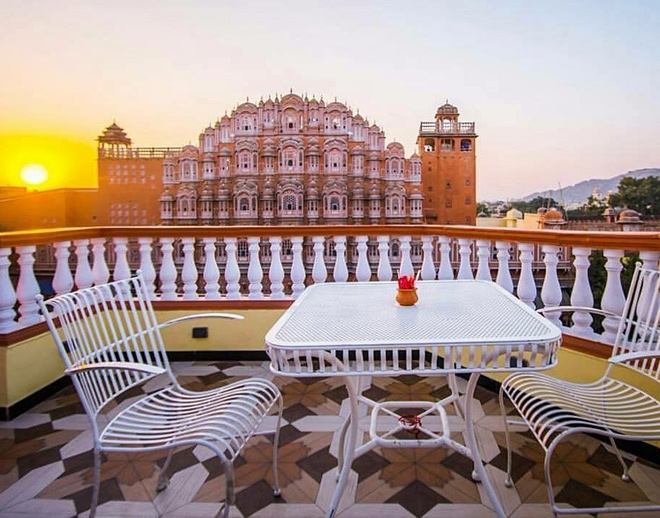
Back in the city, you stop in front of the Hawa Mahal and then visit the City Palace, where courtyards, gateways and museum halls hold royal costumes, weapons, carpets and manuscripts. Next door, Jantar Mantar is an eighteenth-century observatory of oversized masonry instruments built to track stars and measure time. Its largest sundial can tell the local time to within a few seconds, and its shadow moves visibly as you watch. Hats and sunscreen are useful, as there is little shade. Your guide can also explain how the observatory was used to set the calendar for festivals and royal ceremonies.
Lunch is served at a city hotel, and the afternoon offers a choice between a spa visit at a palace hotel and a shopping walk in the old markets. Gem cutting is a major Jaipur trade with a worldwide reputation, alongside block-printed textiles, blue pottery and silver jewelry. If you intend to buy carpets or jewelry, ask our team for workshops with clear certificates and international shipping. Dinner is served on board as the train leaves for Udaipur, a longer overnight run across the Aravalli hills.
Udaipur rises from the shores of Lake Pichola, and today is one of the most scenic of the week. In the morning you tour the City Palace, a sprawling lakeside complex, the biggest of its kind in Rajasthan, that generation after generation of Mewar rulers expanded over several hundred years. Its upper terraces overlook the lake and the white Lake Palace hotel floating in the middle. Inside, the Crystal Gallery displays a remarkable collection of cut-glass furniture, chandeliers and even a crystal bed that was ordered from England by a nineteenth-century ruler. Allow around two and a half hours for the full tour, as the palace is a maze of narrow stairs, courtyards and small rooms.
From the palace jetty a boat carries you across the water to Jagmandir, an island palace where lunch is served with live music. The island's stone elephants, marble pavilions and gardens make a lovely setting, and the views back toward the city walls and palace are among the best in Rajasthan. Late morning and early afternoon are pleasantly warm on the lake in winter, but a hat and sunglasses are useful, as the glare from the water can be strong. Ask the boat crew to slow down near the Lake Palace for photographs; the white walls look superb against the blue water.
After a rest on the train, you join a walking tour of the old city, where narrow lanes are lined with small temples, painting studios and craft shops. Udaipur is known for miniature painting on paper and silk, and some artists still use brushes made from a single squirrel hair. Look out for hand-printed textiles, puppets and silver jewelry. Comfortable shoes are essential, as the streets are steep and uneven. Dinner is on board as the train sets off south-west into Gujarat. Small rooftop cafes along the way offer good views of the lake if you need a break and a cold drink before returning to the train.
Morning brings the train to Vadodara in Gujarat, a city shaped by the Gaekwad rulers who governed it until India's independence. Following breakfast, a drive of roughly sixty minutes north-east brings you to the UNESCO-protected ruins of Champaner-Pavagadh Archaeological Park, spread beneath the slopes of Pavagadh hill. Its walls, palaces, step wells and mosques belong to a fifteenth and sixteenth century city that was abandoned and gradually reclaimed by the forest, and few foreign travelers ever see it. The drive passes through cotton fields and small market towns, and the low hill of Pavagadh rises sharply from the flat plain ahead, topped by a hilltop shrine that draws pilgrims year-round.
The centerpiece is the Jami Masjid, built in the early sixteenth century, which blends Islamic layouts with Hindu and Jain carving traditions. Its slender minarets, carved balconies and pillared prayer hall are among the finest in western India. After lunch back on the train, you visit the Maharaja Fateh Singh Museum, which holds paintings by Raja Ravi Varma, one of India's most celebrated artists, together with works by European masters and a collection of marble and bronze sculpture. The museum building was originally a school for the royal children, and its quiet galleries are rarely busy, so you can look at the paintings at your own pace without crowds.
The afternoon ends with high tea at Laxmi Vilas Palace, a vast royal residence completed in the late nineteenth century and still home to the Gaekwad family. Its royal court hall, the Durbar Hall, has a Venetian mosaic floor, Belgian stained glass and an armory with weapons from several centuries. A regional folk performance and local snacks follow, giving you a taste of Gujarat that most India itineraries miss entirely. Dinner is served on board as the train heads south toward Maharashtra and the caves of Ellora. The palace is said to be several times the size of Buckingham Palace.
This morning starts slowly, with a late breakfast and time to enjoy the train itself: a spa treatment, a session in the gym or simply a book in the lounge car. The train arrives in Aurangabad, now officially renamed Chhatrapati Sambhajinagar, around lunchtime. After a meal on board you drive about 30 kilometers to the Ellora Caves, a UNESCO World Heritage Site where 34 Buddhist, Hindu and Jain shrines were cut into a long basalt cliff between roughly the sixth and tenth centuries. The rest of the morning passes gently as the Deccan plateau rolls by outside the window.
The astonishing sight is the Kailasa temple, Cave 16, a full temple with courtyards, pillars, life-size elephants and towers carved downward out of a single mass of rock. Workers removed many thousands of tons of stone to free it, and there was no room for error. Allow time to walk around the upper ledges for a view down into the courtyard. The site is closed on Tuesdays, which the train program takes into account, and the rock floors can be warm in the afternoon sun.
The Buddhist caves at the southern end, with their prayer halls and carved ribbed ceilings, and the Jain caves to the north, with their fine detail, are just as rewarding if time allows. Wear shoes that slip on and off easily, as some shrines ask visitors to remove footwear. Back on board, guests gather for a sundowner and the farewell dinner as the train runs west through the night toward Mumbai. Pack most of your luggage before bed to make the morning easier. Your attendant can help arrange luggage tags for the morning.
Your last breakfast on board is cleared away as the Deccan Odyssey rolls into Mumbai's Chhatrapati Shivaji Maharaj Terminus, a UNESCO-listed Victorian Gothic station with spires, gargoyles and stained glass. Take a minute on the concourse to look back at the building before you leave. A driver waiting beside your carriage takes care of the bags and heads for the domestic terminal, a ride which can take 60 to 90 minutes in Mumbai's notorious traffic, so the flight is booked with a comfortable margin. If time allows, the driver can loop past the Gateway of India and the sea front of Marine Drive on the way to the airport.
The flight from Mumbai to Goa takes about one hour and ten minutes. Flights into Goa use either Dabolim, roughly in the middle of the state, or the newer Mopa airport in the far north, and we book whichever lies nearer your resort. Your driver in Goa meets you on arrival. The change in air is immediate: warm, humid and gently scented with the sea, and the palm-lined roads feel very different from the dry plains of Rajasthan. The drive from the airport to a beach resort usually takes between 30 and 90 minutes, depending on the airport and your hotel's location along the coast.
Your resort sits on or near the beach, with gardens, pools and restaurants serving Goan seafood, and the rest of the day is free. Most guests head straight for a swim or a long walk along the sand at sunset. Goan cooking reflects four centuries of Portuguese rule, so look for dishes such as prawns in a coconut sauce soured with tart fruit, fish cooked with red spice paste and the layered coconut cake served at celebrations. Sea temperatures stay around 27 to 29 degrees Celsius through the winter.
An unhurried breakfast is followed by a guided outing to Old Goa, which in the sixteenth century governed Portugal's Asian possessions and was reputedly as populous as Lisbon. Today only its great churches remain, set on wide lawns. Inside the Basilica of Bom Jesus a silver reliquary contains the body of Saint Francis Xavier, and facing it across the road stands the Se Cathedral, among the biggest churches anywhere in Asia. Together they form a UNESCO World Heritage Site and are about 30 to 50 minutes from most resorts.
Next, your guide leads a walk through Fontainhas, the Latin quarter of the capital Panaji, where narrow streets are lined with houses painted ochre, blue and green, with tiled roofs and oyster-shell windows. Bakeries, small galleries and family-run cafes make it a pleasant place to linger, and a criss-cross stairway climbs to the gleaming facade of the Church of Our Lady of the Immaculate Conception above the town. Dress modestly for the churches, with shoulders covered, and bring water. The quarter is best seen on foot in the morning before the day warms up, and your guide will point out the old Portuguese street names on blue and white tiles at corners.
Lunch can be at a Goan restaurant in Panaji, then the afternoon is free. Alternatively, ask your driver to stop at a spice farm in the Ponda area, about 40 minutes inland, where guides show you pepper vines, cardamom, nutmeg and vanilla growing under the forest canopy, followed by a simple buffet lunch on banana leaves. Back at the resort, the evening is free for a swim, a spa ritual or a sunset drink. A cruise on the Mandovi River at dusk is another easy option.
Today has no fixed program, which after a busy train week can feel like the greatest luxury of all. Begin with an early walk along the sand while the beach is quiet and fishermen are hauling in their nets, then take a long breakfast by the pool. Goa's winter weather is ideal, with blue skies, temperatures around 30 degrees Celsius in the day and very little rain from November to March, though the midday sun is strong and shade is wise. Pool loungers and beach beds fill quickly around mid-morning, so ask the resort team to reserve one for you.
If you want gentle activity, our team can arrange a morning boat trip to look for dolphins off the coast, a kayak through mangrove creeks, a cooking class with a Goan family or a yoga session on the beach. In North Goa, Fort Aguada, a seventeenth-century Portuguese fort with a lighthouse, offers wide sea views. Further south, quieter beaches such as Cola and Palolem have softer sand and calmer water. Your driver is available for any outings you choose. Simply ask the concierge or our team the day before, and timings will be set around the tides and your energy.
For the evening, consider dinner at a beach shack with tables set on the sand and fish chosen from the morning catch, or a more refined Goan meal at one of the restaurants in a restored Portuguese mansion. Try a cashew-based local spirit if you are curious, but keep it to a small glass. Settle any resort bills tonight and pack your bags so the morning is easy. Our team will confirm the time for tomorrow's airport transfer. A last walk along the shore under the stars is a lovely way to close the holiday.
Savor one more breakfast and a parting swim before you check out. Our driver takes you to the airport with plenty of time for your flight, whether you are connecting through Mumbai or Delhi or flying direct to a Gulf hub for the long journey home. Several Middle Eastern airlines fly to Goa, which can make the return more convenient than going back through a large Indian city. Allow at least three hours before an international departure, as security queues can be long. Our team will confirm the pickup time the evening before, allowing for traffic on the coastal roads.
For a late-evening departure, ask us to extend your checkout time with the resort, so the room stays yours and enjoy the beach for most of the day. It is worth taking a moment to sort souvenirs: spices, cashews and local sweets travel well, while some liquids must go in checked luggage. Keep your passport, e-Visa printout and onward flight details close at hand when you reach the airport. Cashew nuts from Goa are especially good, and the local spice farms sell sealed packs of pepper, cardamom and cinnamon that are easy to carry home in hand luggage or checked bags.
As an independent Jaipur-based operator, Top Indian Holidays looks after every link in this trip, from the first night in Delhi through the Deccan Odyssey Indian Odyssey with Goa to this final transfer, and our team remains available around the clock until you are home. If this journey has given you a taste for Indian rail travel, the Golden Chariot through Karnataka or the Palace on Wheels through Rajasthan make natural next chapters, and we would be glad to help with either on a future visit. Simply tell us your preferred dates and we will take care of the rest.
Fill out this form with all the required information. Within 12 hours, we will provide you with a tailor-made itinerary at the best price.
Read the reviews of our esteemed client's, go through the experiences they had with Top Indian Holidays.

Whether you're planning your first India trip or returning to explore deeper — get honest, expert advice from someone who knows every corner of this country. No pressure, no cost.



 info@topindianholidays.net
 +91-8955000999