07 Nights / 08 Days Fully Guided Tours Private Car
Delhi - Sawai Madhopur - Agra - Jaipur - Udaipur - Vadodara - Ellora - Mumbai
Between Delhi and Mumbai lie roughly fourteen hundred kilometers of plains, desert hills, lakes and volcanic plateau, and the Deccan Odyssey Indian Odyssey Tour crosses all of it in seven nights. The train leaves the capital on a Saturday evening and reaches Mumbai the following Saturday morning, stopping along the way at a tiger reserve, the Taj Mahal, two great Rajput cities, a little-visited royal state in Gujarat and the caves of Ellora. It is a one-way journey, which makes it an elegant bridge between the north and the west of India.
What gives this route its own character is the stretch after Rajasthan. Most luxury trains turn back toward Delhi once they leave Udaipur, but this one continues south into Gujarat, to the UNESCO-listed ruins of Champaner-Pavagadh and the vast Laxmi Vilas Palace in Vadodara, and then down onto the Deccan plateau for the rock-cut temples of Ellora. Earlier in the week you have Ranthambore National Park, the Taj Mahal and the forts of Jaipur, so the trip gives a rounded picture of the country without a single flight. The 2026-27 departures are 17 October, 7 November, 12 December, 9 January, 30 January, 13 March and 24 April.
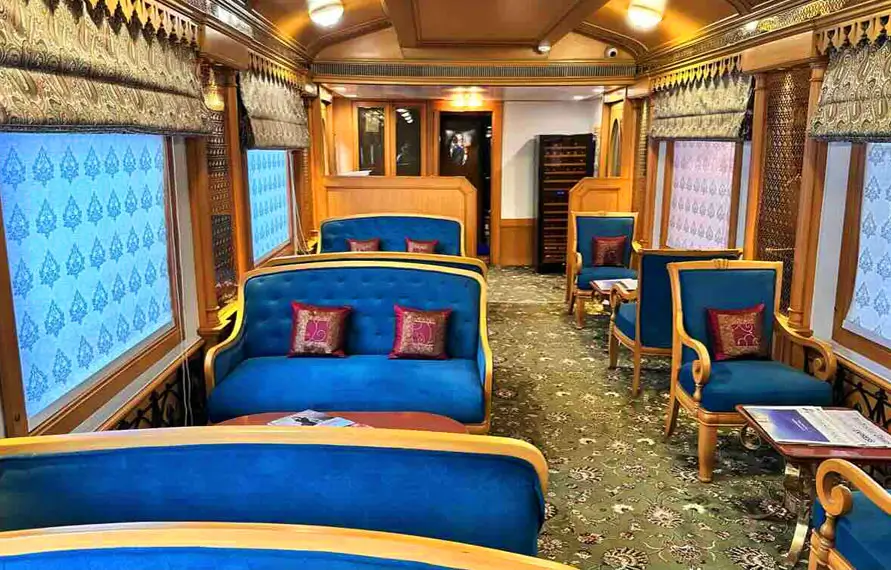
The Deccan Odyssey is operated by Maharashtra Tourism in association with Indian Railways. Every Deluxe Cabin and Presidential Suite comes with its own bathroom, while guests mingle in the dining carriages, the bar, a fitness corner, a meeting carriage and a spa offering Ayurvedic therapies. Behind the scenes, Top Indian Holidays, a private travel company that opened its Jaipur doors in the late nineties and carries national tourism accreditation, secures your berth, books hotels in Delhi and Mumbai and drives you to and from each station.
Most guests arrive in Delhi a day or two early to rest after the long flight, and we recommend at least one night at a hotel in the city before boarding. On the day of departure the morning and afternoon are free. If you have energy, a few hours with a private guide in Old Delhi or at Humayun's Tomb is an excellent warm-up for the week. Otherwise enjoy the hotel pool and a late lunch, because the first dinner on board is served fairly late in the evening.
In the evening our driver takes you to the station named in your joining instructions, where the train's staff welcome you with a drink and garlands of flowers. Registration is brief, and porters take your luggage to your cabin. The Indian Odyssey is a long one-way journey, so it is worth unpacking properly on the first night. Cabins have hanging space and drawers, and the attendant will take away any empty suitcases if you ask, which frees up valuable floor space for the week. Keep a small day bag ready for excursions.
The train pulls away from Delhi after dark and runs south-west toward Rajasthan. Dinner is served in the restaurant car, where the menu changes daily and draws on the cooking of the regions you pass through. Evenings on board are smart casual, so a collared shirt or a light dress is appropriate. After dinner, most guests take an early night, since tomorrow begins at the edge of a tiger reserve. Ask your attendant for a wake-up call and tea at the time that suits you.
You wake at Sawai Madhopur, the small railway town at the gateway to Ranthambore National Park. Ranthambore was once the private hunting ground of the ruling princes of Jaipur, and it is now one of the best-known tiger reserves in Asia. The timing of the safari depends on the departure and the forest department's allotment, so the train team confirms on the first evening whether you head out in the morning or the afternoon slot. Either way, you travel in an open vehicle with a naturalist and driver.
The park is a landscape of dry forest, rocky hills, grassy meadows and lakes, with the walls of a medieval fort rising above it all. Tigers here are famously relaxed around vehicles, and sightings in the dry months can be excellent, though nothing in the wild is guaranteed. Spotted deer, large brown deer, blue bull antelope, wild boar and crocodiles are almost certain, and the bird list is long. Dress in layers: November to January mornings can start at 6 to 9 degrees Celsius before warming up quickly.
Outside safari hours, the program includes a short visit to a village near the park, where you meet farming families and see how people live alongside the forest. Tea is often served at the Sawai Madhopur Lodge, a former hunting lodge of the Jaipur royal family set in large gardens. It is a pleasant place to sit on the lawn and look at the architecture of the old shooting retreat. You return to the train in the evening for dinner as it heads east toward Agra.
The train stops at Tundla, a junction outside Agra, and after breakfast you drive about forty minutes into the city. Your first stop is the Taj Mahal, built by the emperor Shah Jahan as a tomb for his wife Mumtaz Mahal in the seventeenth century. The approach through the great red sandstone gateway, with the white dome slowly appearing in the arch, is one of the most famous moments in world travel. Your guide shows you the details, from the calligraphy to the flowers inlaid in semi-precious stone.
Lunch is served at a city hotel, and in the afternoon you visit Agra Fort, a red sandstone citadel on the bend of the Yamuna River. Inside its walls are audience halls, mosques and white marble pavilions added by Shah Jahan, who spent his final years here as a prisoner of his own son. From the Musamman Burj, a marble tower on the riverside wall, you can see the Taj Mahal across the water. Some departures also include Itmad-ud-Daulah, the delicate tomb nicknamed the Baby Taj.
Late in the afternoon you visit a workshop where craftsmen still practice the same stone inlay technique used on the Taj Mahal. Thin slivers of lapis, malachite, carnelian and mother of pearl are cut by hand and set into marble to form flowers and vines. It is slow, precise work, and pieces range from small coasters to large table tops that the workshop can ship abroad. You are back on board for dinner at around 19:00, and the train leaves for Jaipur at about 20:00.
The train arrives in Jaipur early, and you are welcomed at the station at about 08:30. Sawai Jai Singh II, an eighteenth-century king fascinated by the stars and by town layout, created Rajasthan's capital, and its old city is laid out on a grid of broad, straight streets painted a soft terracotta pink, with markets set out in neat blocks. This morning you head out to Amber Fort, about eleven kilometers north, which overlooks Maota Lake from a ridge of the Aravalli hills. The drive takes about thirty minutes.
Amber was the seat of the Kachwaha clan before they moved down to the plains. The fort's courtyards rise in stages, and each one grows more refined: the pillared Hall of Public Audience, the Ganesh Gate covered in painted floral patterns, and the Sheesh Mahal, a hall whose walls are set with thousands of small mirrors. Morning is the right time to come, as the sun is still gentle on the ramparts. Wear flat shoes, since the stone floors are worn smooth and some ramps are steep.
After lunch at a city hotel, you visit the City Palace of Jaipur, where part of the complex is still home to the former royal family, and drive past the honeycomb facade of Hawa Mahal, built so royal women could watch street processions unseen. Depending on the day's timing, you may also see the Jantar Mantar, a UNESCO-listed collection of giant stone astronomical instruments. Late afternoon is free for shopping for gemstones, textiles or blue pottery, before you return to the train for dinner and the overnight run to Udaipur.
Breakfast is served as the train climbs through the Aravalli hills, and by mid-morning you are in Udaipur, the capital of the Mewar kingdom. Founded in the sixteenth century around a series of man-made lakes, Udaipur is the most romantic city in Rajasthan, all white marble palaces, temple spires and green hills reflected in still water. The City Palace is the first stop, a vast complex of eleven palaces built by successive rulers over about four centuries along the eastern shore of Lake Pichola, still partly home to the former royal family.
Inside the palace your guide leads you through courtyards decorated with peacock mosaics and colored glass, and into the Crystal Gallery, which holds a remarkable collection of cut crystal furniture ordered from England in the nineteenth century and never used by the ruler who commissioned it. Afterward a boat takes you out onto Lake Pichola, past the Lake Palace hotel and toward Jag Mandir, an island palace where a young Mughal prince once took refuge. The late morning light on the water is lovely for photographs.
Lunch is served at a venue in the city, and in the afternoon you walk through the Old City with a guide. The lanes around the Jagdish Temple are full of small workshops selling miniature paintings on silk and paper, puppets, silver jewelry and hand-dyed textiles. Udaipur is known for its miniature painting schools, and some artists still use squirrel-hair brushes and stone pigments. Wear comfortable shoes and keep small notes handy. The train leaves Udaipur at about 20:00, bound for Gujarat, with dinner on board.
The train halts at Vishwamitri station in Vadodara, and after breakfast you drive about an hour north-east to Champaner-Pavagadh Archaeological Park, a UNESCO World Heritage Site that most international travelers have never heard of. Champaner was the capital of the Sultans of Gujarat in the late fifteenth and early sixteenth centuries, and the site combines ruined city walls, step wells and a series of mosques that blend Islamic and Hindu architecture. Above it rises Pavagadh hill, crowned by a temple to the goddess Kali and reached by a cable car.
The highlight is the Jami Masjid, completed in the early sixteenth century, with two slender minarets, carved stone windows and a prayer hall of more than one hundred and seventy pillars. The level of detail is remarkable, and because visitor numbers are low, you often have the courtyard largely to yourself. After the visit you return to the train for lunch on board. Gujarat can be warm even in winter, so a hat, sunscreen and water are useful today. Shoes must be removed inside the mosque, so wear socks if the stone is hot.
In the afternoon you visit the Maharaja Fateh Singh Museum, which holds a fine collection of paintings by Raja Ravi Varma, one of the great Indian artists of the nineteenth century, commissioned by the Gaekwad rulers of Baroda. Then comes tea at the Laxmi Vilas Palace, a royal residence said to be about four times the size of Buckingham Palace and still owned by the former royal family. Its Durbar Hall has Venetian mosaic floors and stained glass. Some departures add a folk performance before you return to the train for dinner.
The morning is a gift after six busy days. Breakfast is late and unhurried, and you have time for a spa treatment, a session in the small gym or simply a morning in your cabin as the train crosses into Maharashtra. Lunch is served on board at about 12:30, as the train pulls into Aurangabad, now officially Chhatrapati Sambhajinagar. In the afternoon a coach takes you about 30 kilometers to the Ellora Caves, arriving as the heat of the day begins to ease and the light grows warmer.
Ellora is a UNESCO World Heritage Site where Buddhist, Hindu and Jain communities carved temples and monasteries into the same basalt ridge between about the sixth and tenth centuries. Spend time in Cave 10, a Buddhist prayer hall whose ceiling is carved to look like wooden rafters, and where a softly spoken word echoes beautifully. Then move to the Kailasa temple, an entire multi-story temple cut downward from the cliff, and finally to the Jain caves at the northern end, where the carving is almost lace-like.
Afternoon visits mean the western-facing cliff takes on a golden color, and the large groups of day visitors start to thin out. Ellora is closed on Tuesdays, which is why this journey reaches it on a Friday. You return to the station at about 18:00, and the train departs an hour later. The farewell dinner follows, often with a sundowner first in the bar. Use the evening to settle your account with the guest relations team, since arrival in Mumbai is early tomorrow and the morning moves quickly.
The Deccan Odyssey descends from the Deccan plateau through the Sahyadri hills overnight, and breakfast is served early as the train enters Mumbai's suburbs. You arrive at Chhatrapati Shivaji Maharaj Terminus, a UNESCO World Heritage Site in its own right, with stone carvings of animals and leaves, stained glass and a soaring central dome. Our driver is waiting on the platform to help with your luggage, and it is worth looking back at the building from the street as you leave. Thank your attendant before you go.
Anyone catching an international flight that same day is best served by a late departure from Mumbai's main airport, since the road from the terminus can take close to an hour or longer in heavy traffic. A daytime hotel room for a shower and some rest is simple for our team to arrange. With a free afternoon, a short guided drive takes in Marine Drive, the Gateway of India and the art deco buildings around the Oval Maidan, which form part of another UNESCO World Heritage Site. Lunch in the Kala Ghoda district rounds off the day nicely.
Many guests continue their journey from Mumbai. Goa's beaches are just over an hour away by air, and Kerala's backwaters make a gentle, green contrast to a week of forts and palaces. Each add-on is organized directly by our staff, pairing chauffeured cars with local guides and hotels we have visited ourselves, and our team remains on call around the clock until you board your flight home. If you would rather do the route in reverse, from Mumbai to Delhi, ask us about the Indian Sojourn, which follows a similar route northbound.
Fill out this form with all the required information. Within 12 hours, we will provide you with a tailor-made itinerary at the best price.
Read the reviews of our esteemed client's, go through the experiences they had with Top Indian Holidays.

Whether you're planning your first India trip or returning to explore deeper — get honest, expert advice from someone who knows every corner of this country. No pressure, no cost.



 info@topindianholidays.net
 +91-8955000999